Refine search
Actions for selected content:
26076 results in Abstract analysis
A Problem in Partitions: Enumeration of Elements of a given Degree in the free commutative entropic cyclic Groupoid
-
- Journal:
- Proceedings of the Edinburgh Mathematical Society / Volume 11 / Issue 4 / November 1959
- Published online by Cambridge University Press:
- 20 January 2009, pp. 223-224
-
- Article
-
- You have access
- Export citation
-
A groupoid is a set closed with respect to a binary operation. It is commutative and entropic if xy = yx and xy.zw = xz.yw hold for all its elements. It is cyclic if it is generated by one element. Let x be the generator of the free commutative entropic cyclic groupoid
 . Then any element of can be written in the form xP where x1 = x and xQ+R = xQxR. Two indices P, Q are equal (called “concordant” in (3)) if and only if xP = xQ. The groupoid of these indices, the free additive commutative entropic logarithmetic (cf. (3)), is clearly isomorphic to .
 . Then any element of
 Local spectrum and subharmonicity
-
- Journal:
- Proceedings of the Edinburgh Mathematical Society / Volume 39 / Issue 3 / October 1996
- Published online by Cambridge University Press:
- 20 January 2009, pp. 571-579
-
- Article
-
- You have access
- Export citation
Irreducible locally nilpotent finitary skew linear groups
-
- Journal:
- Proceedings of the Edinburgh Mathematical Society / Volume 38 / Issue 1 / February 1995
- Published online by Cambridge University Press:
- 20 January 2009, pp. 63-76
-
- Article
-
- You have access
- Export citation
Integrals involving Bessel and Legendre functions
-
- Journal:
- Proceedings of the Edinburgh Mathematical Society / Volume 14 / Issue 4 / December 1965
- Published online by Cambridge University Press:
- 20 January 2009, pp. 269-272
-
- Article
-
- You have access
- Export citation
-
Felsen (1) has shown that when a plane wave is incident along the axis of a rigid cone of narrow apex angle an approximate expression for the scattered wave involves an integral of the form

where
 is a Bessel function of the third kind, k a constant and
  , is the Legendre (conical) function of the first kind.
 is a Bessel function of the third kind, k a constant and
  , is the Legendre (conical) function of the first kind.
An application of the Kontorovich-Lebedev Transform
-
- Journal:
- Proceedings of the Edinburgh Mathematical Society / Volume 11 / Issue 3 / May 1959
- Published online by Cambridge University Press:
- 20 January 2009, pp. 135-137
-
- Article
-
- You have access
- Export citation
Positive solutions and eigenvalues of conjugate boundary value problems
-
- Journal:
- Proceedings of the Edinburgh Mathematical Society / Volume 42 / Issue 2 / June 1999
- Published online by Cambridge University Press:
- 20 January 2009, pp. 349-374
-
- Article
-
- You have access
- Export citation
-
We consider the following boundary value problem

where λ > 0 and 1 ≤ p ≤ n – 1 is fixed. The values of λ are characterized so that the boundary value problem has a positive solution. Further, for the case λ = 1 we offer criteria for the existence of two positive solutions of the boundary value problem. Upper and lower bounds for these positive solutions are also established for special cases. Several examples are included to dwell upon the importance of the results obtained.
PEM volume 28 issue 3 Cover and Front matter
-
- Journal:
- Proceedings of the Edinburgh Mathematical Society / Volume 28 / Issue 3 / October 1985
- Published online by Cambridge University Press:
- 20 January 2009, pp. f1-f2
-
- Article
-
- You have access
- Export citation
A Theorem on General Regular Transformations of Series
-
- Journal:
- Proceedings of the Edinburgh Mathematical Society / Volume 9 / Issue 3 / July 1956
- Published online by Cambridge University Press:
- 20 January 2009, pp. 105-108
-
- Article
-
- You have access
- Export citation
-
Many papers have been written on transformations of sequences which can be written as
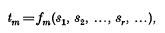
where
 is a function of a finite or infinite number of variables for fixed m. If the number of variables is finite it becomes large with m.
Almost all these papers are on linear transformations of the sr, e.g. Cesàro and Abel means, but there are obvious transformations of non-linear form which are regular, and it is a theorem on these which is considered here.
 is a function of a finite or infinite number of variables for fixed m. If the number of variables is finite it becomes large with m.
PEM volume 9 Cover and Front matter
-
- Journal:
- Proceedings of the Edinburgh Mathematical Society / Volume 9 / February 1890
- Published online by Cambridge University Press:
- 20 January 2009, pp. f1-f5
-
- Article
-
- You have access
- Export citation
Calculations of cylindrical p-homotopy groups
-
- Journal:
- Proceedings of the Edinburgh Mathematical Society / Volume 32 / Issue 3 / October 1989
- Published online by Cambridge University Press:
- 20 January 2009, pp. 401-413
-
- Article
-
- You have access
- Export citation
The Numerical Evaluation of Double Integrals
-
- Journal:
- Proceedings of the Edinburgh Mathematical Society / Volume 42 / February 1923
- Published online by Cambridge University Press:
- 20 January 2009, pp. 2-13
-
- Article
-
- You have access
- Export citation
An inverse scattering problem for acoustic waves in a spherically stratified medium*
-
- Journal:
- Proceedings of the Edinburgh Mathematical Society / Volume 20 / Issue 3 / March 1977
- Published online by Cambridge University Press:
- 20 January 2009, pp. 257-263
-
- Article
-
- You have access
- Export citation
A Note on Logarithmic Summability (L)
-
- Journal:
- Proceedings of the Edinburgh Mathematical Society / Volume 15 / Issue 1 / June 1966
- Published online by Cambridge University Press:
- 20 January 2009, pp. 47-55
-
- Article
-
- You have access
- Export citation
A simple proof of Arazy's theorem
-
- Journal:
- Proceedings of the Edinburgh Mathematical Society / Volume 37 / Issue 2 / June 1994
- Published online by Cambridge University Press:
- 20 January 2009, pp. 239-242
-
- Article
-
- You have access
- Export citation
-
Arazy has characterized the isometries of
 p, (0 < p ≦ ∞, p ≠ 2) onto itself as all maps of the form X↦UXV where U and V are either both unitary or both anti-unitary. A simple proof of this result is given.

Constructions connected with Euclid VI., 3 and A, and the Circle of Apollonius
-
- Journal:
- Proceedings of the Edinburgh Mathematical Society / Volume 20 / February 1901
- Published online by Cambridge University Press:
- 20 January 2009, pp. 67-69
-
- Article
-
- You have access
- Export citation
-
Let ABC be a triangle and AD the bisector of the angle A meeting BC in D. (Fig. 8.)
For simplicity let us suppose AB > AC.
From AB cut off AE = AC, and join DE. Then by Euclid I. 4 it follows that the triangles AED, ACD are equal.

This proof of VI. 3 has the merit of depending only on I. 4 and VI. 1. A similar proof for VI. A can be got by cutting off AE′ = AC from BA produced.
Hilbert spaces of tempered distributions, Hermite expansions and sequence spaces
-
- Journal:
- Proceedings of the Edinburgh Mathematical Society / Volume 34 / Issue 2 / June 1991
- Published online by Cambridge University Press:
- 20 January 2009, pp. 271-293
-
- Article
-
- You have access
- Export citation
-
Although it is well-known that tempered distributions on ℝn can be expanded into series of Herrnite functions, it does not seem to be known, however, that expansions of this type are accessible through the elementary concept of orthonorma! expansions in Hilbert space. This approach is developed here complementing previous work on a Hilbert space approach to distributions. The basis of the development is the observation that the Hermite functions are a complete orthogonal set in each space of a certain scale of Sobolev type Hilbert spaces associated with the family of differential operators defined by

Here Ф denotes a smooth function with compact support. The setting is first developed in the one-dimensional case. By use of the usual multi-index notation this can be extended to the higher-dimensional case. As applications various imbedding results are derived. The paper concludes with a characterization of tempered distributions by convergent Hermite expansions.
On the other pαqβ theorem of Burnside
-
- Journal:
- Proceedings of the Edinburgh Mathematical Society / Volume 30 / Issue 1 / February 1987
- Published online by Cambridge University Press:
- 20 January 2009, pp. 41-49
-
- Article
-
- You have access
- Export citation
Local spectral properties of convolution operators on non-abelian groups
-
- Journal:
- Proceedings of the Edinburgh Mathematical Society / Volume 39 / Issue 1 / February 1996
- Published online by Cambridge University Press:
- 20 January 2009, pp. 143-149
-
- Article
-
- You have access
- Export citation
Yuri V. Linnik, Decomposition of Probability Distributions (Edinburgh and London, Oliver and Boyd, 1964), xii + 242 pp., 84s.
-
- Journal:
- Proceedings of the Edinburgh Mathematical Society / Volume 14 / Issue 4 / December 1965
- Published online by Cambridge University Press:
- 20 January 2009, pp. 341-342
-
- Article
-
- You have access
- Export citation
J. Milnor and D. Husemoller Symmetric Bilinear forms (Ergebnisse der Mathematik und ihrer Grenzgebiete Bd. 73, Springer-Verlag, 1973), ii+146 pp., $13.40.
-
- Journal:
- Proceedings of the Edinburgh Mathematical Society / Volume 19 / Issue 2 / September 1974
- Published online by Cambridge University Press:
- 20 January 2009, p. 214
-
- Article
-
- You have access
- Export citation
