Refine search
Actions for selected content:
26079 results in Abstract analysis
Some Integral Equations Involving Hypergeometric Functions
-
- Journal:
- Proceedings of the Edinburgh Mathematical Society / Volume 15 / Issue 3 / June 1967
- Published online by Cambridge University Press:
- 20 January 2009, pp. 169-198
-
- Article
-
- You have access
- Export citation
On a Diophantine Equation
-
- Journal:
- Proceedings of the Edinburgh Mathematical Society / Volume 13 / February 1894
- Published online by Cambridge University Press:
- 20 January 2009, pp. 179-180
-
- Article
-
- You have access
- Export citation
-
In the consideration of Question 12612 appearing in the Educational Times for January of this year, proposed by the Rev. Dr. Haughton, F.R.S., of Trinity College, Dublin, the following Diophantine Equation suggests itself:

Lie algebras all of whose maximal subalgebras have codimension one
-
- Journal:
- Proceedings of the Edinburgh Mathematical Society / Volume 24 / Issue 3 / October 1981
- Published online by Cambridge University Press:
- 20 January 2009, pp. 217-219
-
- Article
-
- You have access
- Export citation
-
Let
 denote the class of finite-dimensional Lie algebras L (over a fixed, but arbitrary, field F) all of whose maximal subalgebras have codimension 1 in L. In (2) Barnes proved that the solvable algebras in are precisely the supersolvable ones. The purpose of this paper is to extend this result and to give a characterisation of all of the algebras in . Throughout we shall place no restrictions on the underlying field of the Lie algebra.
 denote the class of finite-dimensional Lie algebras L (over a fixed, but arbitrary, field F) all of whose maximal subalgebras have codimension 1 in L. In (
Abstract of one of Euler's papers
-
- Journal:
- Proceedings of the Edinburgh Mathematical Society / Volume 4 / February 1885
- Published online by Cambridge University Press:
- 20 January 2009, pp. 51-55
-
- Article
-
- You have access
- Export citation
A Proof of the Addition Theorem for the Legendre Functions
-
- Journal:
- Proceedings of the Edinburgh Mathematical Society / Volume 42 / February 1923
- Published online by Cambridge University Press:
- 20 January 2009, pp. 93-94
-
- Article
-
- You have access
- Export citation
-
A Theorem of Dougall's. In Vol. XVIII. (p. 78) of these Proceedings Dr Dougall has established the theorem that, if m is a positive integer,

Oscillation results on y″ + Ay = 0 in the complex domain with transcendental entire coefficients which have extremal deficiencies
-
- Journal:
- Proceedings of the Edinburgh Mathematical Society / Volume 38 / Issue 1 / February 1995
- Published online by Cambridge University Press:
- 20 January 2009, pp. 13-34
-
- Article
-
- You have access
- Export citation
-
Let A(z) be a transcendental entire function and f1, f2 be linearly independent solutions of

We prove that if A(z) has Nevanlinna deficiency δ(0, A) = 1, then the exponent of convergence of E: = flf2 is infinite. The theorems that we prove here are similar to those in Bank, Laine and Langley [3].

H. Boerner, Representations of Groups with Special Consideration for the Needs of Modern Physics, translated by P. G. Murphy in co-operation with J. Mayerkalkschmidt and P. Carr (North Holland Publishing Co., Amsterdam, 1962), xii + 325 pp., 80s.
-
- Journal:
- Proceedings of the Edinburgh Mathematical Society / Volume 13 / Issue 3 / June 1963
- Published online by Cambridge University Press:
- 20 January 2009, p. 261
-
- Article
-
- You have access
- Export citation
Office Bearers
-
- Journal:
- Proceedings of the Edinburgh Mathematical Society / Volume 19 / February 1900
- Published online by Cambridge University Press:
- 20 January 2009, p. 1
-
- Article
-
- You have access
- Export citation
PEM volume 29 issue 3 Cover and Front matter
-
- Journal:
- Proceedings of the Edinburgh Mathematical Society / Volume 29 / Issue 3 / October 1986
- Published online by Cambridge University Press:
- 20 January 2009, pp. f1-f3
-
- Article
-
- You have access
- Export citation
Office Bearers
-
- Journal:
- Proceedings of the Edinburgh Mathematical Society / Volume 39 / February 1920
- Published online by Cambridge University Press:
- 20 January 2009, p. 1
-
- Article
-
- You have access
- Export citation
Two Theorems on the factors of 2p−1
-
- Journal:
- Proceedings of the Edinburgh Mathematical Society / Volume 23 / February 1904
- Published online by Cambridge University Press:
- 20 January 2009, p. 54
-
- Article
-
- You have access
- Export citation
Index According to Subjects
-
- Journal:
- Proceedings of the Edinburgh Mathematical Society / Volume 6 / Issue 4 / October 1941
- Published online by Cambridge University Press:
- 20 January 2009, p. 266
-
- Article
-
- You have access
- Export citation
Note on Gauss' Proof of the Reciprocity of Parallelism
-
- Journal:
- Proceedings of the Edinburgh Mathematical Society / Volume 32 / February 1913
- Published online by Cambridge University Press:
- 20 January 2009, pp. 15-18
-
- Article
-
- You have access
- Export citation
Test words of a free product of two finite cyclic groups
-
- Journal:
- Proceedings of the Edinburgh Mathematical Society / Volume 40 / Issue 3 / October 1997
- Published online by Cambridge University Press:
- 20 January 2009, pp. 551-562
-
- Article
-
- You have access
- Export citation
On radial variation of holomorphic functions with lp Taylor coefficients
-
- Journal:
- Proceedings of the Edinburgh Mathematical Society / Volume 33 / Issue 3 / October 1990
- Published online by Cambridge University Press:
- 20 January 2009, pp. 475-481
-
- Article
-
- You have access
- Export citation
-
Suppose
 is holomorphic in Δ = {z:|z|<l} and (an)∈lp where 1≦p≦2. We prove that
  for k=1,2,…, and almost every θ. This result is sharp in the following sense: Let p∈[1,2] and ε(r) be a positive function defined on [0,1] such that limr→1-ε(r)=0. Then there exists a function holomorphic in Δ with (an)∈lp such that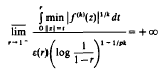
for each k>1/p.
 is holomorphic in Δ = {z:|z|<l} and (a
 for k=1,2,…, and almost every θ. This result is sharp in the following sense: Let p∈[1,2] and ε(r) be a positive function defined on [0,1] such that lim
P. Glendinning Stability, instability and chaos (Cambridge University Press, Cambridge 1994), xiii + 388 pp., hardcover: 0 521 41553 5, £45, paperback: 0 521 42566 2, £17.95.
-
- Journal:
- Proceedings of the Edinburgh Mathematical Society / Volume 39 / Issue 1 / February 1996
- Published online by Cambridge University Press:
- 20 January 2009, pp. 190-191
-
- Article
-
- You have access
- Export citation
The Modified Bessel Function Kn(z)
-
- Journal:
- Proceedings of the Edinburgh Mathematical Society / Volume 38 / February 1919
- Published online by Cambridge University Press:
- 20 January 2009, pp. 10-19
-
- Article
-
- You have access
- Export citation
-
Gray and Mathews, in their treatise on Bessel Functions, define the function Kn(z) to be

We shall denote this function by Vn(z). This definition only holds when z is real, and R(n)≧0. The asymptotic expansion of the function is also given; but the proof, which is said to be troublesome and not very satisfactory, is omitted. Basset (Proc. Camb. Phil. Soc., Vol. 6) gives a similar definition of the function.
The closure of convergence sets for continued fractions are convergence sets
-
- Journal:
- Proceedings of the Edinburgh Mathematical Society / Volume 37 / Issue 1 / February 1994
- Published online by Cambridge University Press:
- 20 January 2009, pp. 39-46
-
- Article
-
- You have access
- Export citation
-
We prove that if Ω is a simple convergence set for continued fractions K(an/bn), then the closure
 of Ω is also such a convergence set. Actually, we prove more: every continued fraction K(an/bn) has a “neighbourhood”
  where rn>0 and sn>0, with the following property: Every continued fraction from {
 n} converges if and only if K(an/bn) converges.
 of Ω is also such a convergence set. Actually, we prove more: every continued fraction K(a
 where r
A Problem in Combinations
-
- Journal:
- Proceedings of the Edinburgh Mathematical Society / Volume 4 / February 1885
- Published online by Cambridge University Press:
- 20 January 2009, pp. 78-87
-
- Article
-
- You have access
- Export citation
-
Given sets of balls of different colours, in how many ways may they be arranged in line so that no two balls of the same colour shall come together.
If we have two colours only, and the same number ‘m of each colour, there are evidently two arrangements possible; if we have m, m – 1 respectively, only one arrangement is possible; if we have m, m – 2 ; in, m – 3, &c., no arrangement is possible. We may write these results

On Methods of Election
-
- Journal:
- Proceedings of the Edinburgh Mathematical Society / Volume 14 / February 1895
- Published online by Cambridge University Press:
- 20 January 2009, p. 113
-
- Article
-
- You have access
- Export citation
