Refine search
Actions for selected content:
26079 results in Abstract analysis
On the inner automorphisms of finite transformation semigroups
-
- Journal:
- Proceedings of the Edinburgh Mathematical Society / Volume 39 / Issue 1 / February 1996
- Published online by Cambridge University Press:
- 20 January 2009, pp. 27-30
-
- Article
-
- You have access
- Export citation
PEM volume 12 issue 1 Cover and Front matter
-
- Journal:
- Proceedings of the Edinburgh Mathematical Society / Volume 12 / Issue 1 / June 1960
- Published online by Cambridge University Press:
- 20 January 2009, pp. f1-f2
-
- Article
-
- You have access
- Export citation
R. Harte, Invertibility and singularity for bounded linear operators (Marcel Dekker Inc., New York and Basel, 1987) xii + 590 pp. 0 8247 7754 9, $119.50.
-
- Journal:
- Proceedings of the Edinburgh Mathematical Society / Volume 32 / Issue 2 / June 1989
- Published online by Cambridge University Press:
- 20 January 2009, pp. 334-335
-
- Article
-
- You have access
- Export citation
Vorlesungen über Geschichte der Mathematik, von Moritz Cantor: Dritter Band
-
- Journal:
- Proceedings of the Edinburgh Mathematical Society / Volume 14 / February 1895
- Published online by Cambridge University Press:
- 20 January 2009, pp. 148-174
-
- Article
-
- You have access
- Export citation
J. C. McConnell and J. C. Robson, Noncommutative Noetherian ringsJohn Wiley & Sons, Chichester and New York1987, xvi + 596 pp. 0 471 91550 5, £65.
-
- Journal:
- Proceedings of the Edinburgh Mathematical Society / Volume 32 / Issue 2 / June 1989
- Published online by Cambridge University Press:
- 20 January 2009, pp. 329-331
-
- Article
-
- You have access
- Export citation
Asymptotic Formulæ for the Number of Partitions of a Multi-Partite Number
-
- Journal:
- Proceedings of the Edinburgh Mathematical Society / Volume 12 / Issue 1 / June 1960
- Published online by Cambridge University Press:
- 20 January 2009, pp. 31-40
-
- Article
-
- You have access
- Export citation
-
A multi-partite number of orders j is a j dimensional vector, the components of which are non-negative rational integers. A partition of (n1, n2, …, nj) is a solution of the vector equation

in multi-partite numbers other than (0, 0, …, 0). Two partitions, which differ only in the order of the multi-partite numbers on the left-hand side of (1), are regarded as identical. We denote by P1(n1, …, nj) the number of different partitions of (n1 …, nj) and by p2(n1, …, nj) the number of those partitions in which no part has a zero component. Also, we write P3(n1, …, nj) for the number of partitions of (n1; …, nj) into different parts and p4(n1, …, nj) for the number of partitions into different parts none of which has a zero component.
Transformations of Axes for Whittaker's Solution of Laplace's Equation
-
- Journal:
- Proceedings of the Edinburgh Mathematical Society / Volume 35 / February 1916
- Published online by Cambridge University Press:
- 20 January 2009, pp. 32-37
-
- Article
-
- You have access
- Export citation
-
Whittaker has shown that a general solution of Laplace's equation, ∇2V = 0, may be expressed in the form

Since the harmonic property of a function is in no way dependent upon any particular set of axes it follows that the same solution must be capable of being expressed in the form

where X, Y, Z are any second set of rectangular coordinates.
The approximation of bivariate functions by sums of univariate ones using the L1-metric
-
- Journal:
- Proceedings of the Edinburgh Mathematical Society / Volume 25 / Issue 2 / June 1982
- Published online by Cambridge University Press:
- 20 January 2009, pp. 173-181
-
- Article
-
- You have access
- Export citation
-
We shall study a special case of the following abstract approximation problem: givena normed linear space E and two subspaces, M1 and M2, of E, we seek to approximate f ∈ E by elements in the sum of M1 and M2. In particular, we might ask whether closest points to f from M = M1 + M2 exist, and if so, how they are characterised. If we can define proximity maps p1 and p2 for M1 and M2, respectively, then an algorithm analogous to the one given by Diliberto and Straus [4] can be defined by the formulae

The locus of points at which two sides of a given triangle subtend equal or supplementary angles
-
- Journal:
- Proceedings of the Edinburgh Mathematical Society / Volume 28 / February 1909
- Published online by Cambridge University Press:
- 20 January 2009, pp. 73-80
-
- Article
-
- You have access
- Export citation
-
1. Let the sides AB, AC subtend equal angles λ at P.
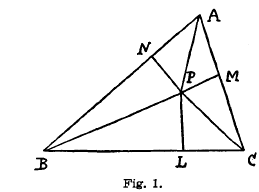
Take ABC as the triangle of reference and denote AP, BP, CP by x, y, z. Then we have, using trilinears,

Finite presentability of arithmetic groups over global function fields
-
- Journal:
- Proceedings of the Edinburgh Mathematical Society / Volume 30 / Issue 1 / February 1987
- Published online by Cambridge University Press:
- 20 January 2009, pp. 23-39
-
- Article
-
- You have access
- Export citation
Theorem regarding Orthogonal Conics
-
- Journal:
- Proceedings of the Edinburgh Mathematical Society / Volume 26 / February 1907
- Published online by Cambridge University Press:
- 20 January 2009, pp. 18-20
-
- Article
-
- You have access
- Export citation
V. Hutson and J. S. Pym Applications of Functional Analysis and Operator Theory (Mathematics in Science and Engineering, Volume 146, Academic Press, London, 1980), xii + 390 pp.
-
- Journal:
- Proceedings of the Edinburgh Mathematical Society / Volume 25 / Issue 3 / October 1982
- Published online by Cambridge University Press:
- 20 January 2009, pp. 280-281
-
- Article
-
- You have access
- Export citation
Stability of barrelledness and related concepts in topological vector spaces
-
- Journal:
- Proceedings of the Edinburgh Mathematical Society / Volume 27 / Issue 3 / October 1984
- Published online by Cambridge University Press:
- 20 January 2009, pp. 321-325
-
- Article
-
- You have access
- Export citation
-
Let E be a separated locally convex barrelled space with continuous dual E′ and algebraic dual E* and let M be a subspace of E* with
 and dim
  Robertson, Tweddle and Yeomans have recently considered the question of barrelledness under the Mackey topology τ(E,E' + M) when E is given to be barrelled under its original topology τ(E,E') [5], [6], [7].
 and dim
  Robertson, Tweddle and Yeomans have recently considered the question of barrelledness under the Mackey topology τ(E,E' + M) when E is given to be barrelled under its original topology τ(E,E') [
A geometrical note on the Binary Cubic Form
-
- Journal:
- Proceedings of the Edinburgh Mathematical Society / Volume 8 / Issue 2 / October 1948
- Published online by Cambridge University Press:
- 20 January 2009, pp. 87-88
-
- Article
-
- You have access
- Export citation
On periodic groups having almost regular 2-elements*
-
- Journal:
- Proceedings of the Edinburgh Mathematical Society / Volume 41 / Issue 2 / June 1998
- Published online by Cambridge University Press:
- 20 January 2009, pp. 385-391
-
- Article
-
- You have access
- Export citation
Integral Functions with Gap Power Series
-
- Journal:
- Proceedings of the Edinburgh Mathematical Society / Volume 10 / Issue 2 / December 1954
- Published online by Cambridge University Press:
- 20 January 2009, pp. 62-70
-
- Article
-
- You have access
- Export citation
-
1. Let

be an integral function, λn being a strictly increasing sequence of nonnegative integers. We shall use the notations
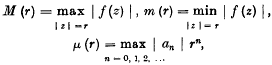
describing M (r) as the maximum modulus, m (r) as the minimum modulus and μ(r) as the maximum term of f (z).
S. K. Donaldson and P. B. Kronheimer The geometry of four-manifolds (Oxford Mathematical Monographs, Clarendon Press, Oxford1990), x + 440 pp. 0 19 853553 8, £35.
-
- Journal:
- Proceedings of the Edinburgh Mathematical Society / Volume 35 / Issue 3 / October 1992
- Published online by Cambridge University Press:
- 20 January 2009, pp. 520-521
-
- Article
-
- You have access
- Export citation
The p-Huppert-subgroup and the set of p-quasi-superfluous elements in a finite group
-
- Journal:
- Proceedings of the Edinburgh Mathematical Society / Volume 36 / Issue 2 / June 1993
- Published online by Cambridge University Press:
- 20 January 2009, pp. 289-297
-
- Article
-
- You have access
- Export citation
Corrigenda: Inverse multi-parameter eigenvalue problems for matrices II
-
- Journal:
- Proceedings of the Edinburgh Mathematical Society / Volume 30 / Issue 2 / June 1987
- Published online by Cambridge University Press:
- 20 January 2009, p. 323
-
- Article
-
- You have access
- Export citation
-
In the paper referred to above (see [1]), the following corrections should be made.
(1) Hypothesis 2.2 should read:

(2) The set E⊂ℝn should be defined as
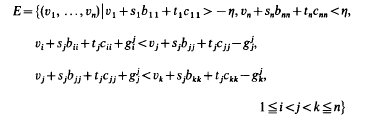
(3) F0(υ)=υ+x should read F(υ)=υ–x.
(4) The unique solution of F0(υ)=0 is υ=x (not υ= –x as printed).
(5) Page 345, line 14:

C. G. C. Pitts, Introduction to Metric Spaces (Oliver & Boyd, 1972), £1.50.
-
- Journal:
- Proceedings of the Edinburgh Mathematical Society / Volume 18 / Issue 2 / December 1972
- Published online by Cambridge University Press:
- 20 January 2009, p. 165
-
- Article
-
- You have access
- Export citation
