Refine search
Actions for selected content:
26079 results in Abstract analysis
Some triple series equations involving Jacobi polynomials
-
- Journal:
- Proceedings of the Edinburgh Mathematical Society / Volume 16 / Issue 2 / December 1968
- Published online by Cambridge University Press:
- 20 January 2009, pp. 101-108
-
- Article
-
- You have access
- Export citation
-
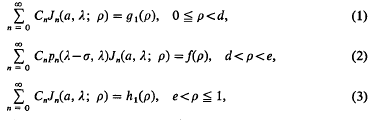
Equations which may be regarded as extensions of the dual series equations discussed by Noble (1) and the present author (2) are the triple series equations of the first kind
and the triple series equations of the second kind
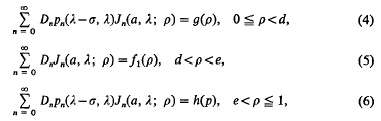
where f, f1, g, g1h and h1 are all known functions,

is the Jacobi polynomial (3).
A. Bellini-Morante and A. C. McBride Applied nonlinear semigroups: an introduction (Wiley Series in Mathematical Methods in Practice, vol.3, John Wiley & Sons, 1998), ix + 273 pp., 0 471 97867 1, £50.
-
- Journal:
- Proceedings of the Edinburgh Mathematical Society / Volume 43 / Issue 1 / February 2000
- Published online by Cambridge University Press:
- 20 January 2009, pp. 222-223
-
- Article
-
- You have access
- Export citation
On products of all elements of a finite semigroup
-
- Journal:
- Proceedings of the Edinburgh Mathematical Society / Volume 42 / Issue 3 / October 1999
- Published online by Cambridge University Press:
- 20 January 2009, pp. 551-557
-
- Article
-
- You have access
- Export citation
On the Numerical Solution of Integral Equations
-
- Journal:
- Proceedings of the Edinburgh Mathematical Society / Volume 42 / February 1923
- Published online by Cambridge University Press:
- 20 January 2009, pp. 46-59
-
- Article
-
- You have access
- Export citation
On the Discrimination of Conics enveloped by the rays joining the corresponding points of two projective ranges
-
- Journal:
- Proceedings of the Edinburgh Mathematical Society / Volume 2 / February 1883
- Published online by Cambridge University Press:
- 20 January 2009, pp. 47-49
-
- Article
-
- You have access
- Export citation
A De Rham Theorem for Generalised Manifolds
-
- Journal:
- Proceedings of the Edinburgh Mathematical Society / Volume 22 / Issue 2 / June 1979
- Published online by Cambridge University Press:
- 20 January 2009, pp. 127-135
-
- Article
-
- You have access
- Export citation
On the generalized heat-equation
-
- Journal:
- Proceedings of the Edinburgh Mathematical Society / Volume 27 / Issue 3 / October 1984
- Published online by Cambridge University Press:
- 20 January 2009, pp. 261-273
-
- Article
-
- You have access
- Export citation
-
The general heat equation is defined as

where v is a fixed positive number and α is a fixed number. If v = α = 0, then (1.1) reduces to the ordinary heat equation

where u(x,t) is regarded as the temperature at a point x at time t, in an infinite insulated rod extended along the x-axis in the xt-plane. If we set
 , then (1.1) becomes

 , then (1.1) becomes
EXACTNESS OF CUNTZ–PIMSNER C*-ALGEBRAS
-
- Journal:
- Proceedings of the Edinburgh Mathematical Society / Volume 44 / Issue 2 / June 2001
- Published online by Cambridge University Press:
- 20 January 2009, pp. 425-444
-
- Article
-
- You have access
- Export citation
PEM volume 29 Cover and Front matter
-
- Journal:
- Proceedings of the Edinburgh Mathematical Society / Volume 29 / February 1910
- Published online by Cambridge University Press:
- 20 January 2009, pp. f1-f5
-
- Article
-
- You have access
- Export citation
PEM volume 15 issue 1 Cover and Back matter
-
- Journal:
- Proceedings of the Edinburgh Mathematical Society / Volume 15 / Issue 1 / June 1966
- Published online by Cambridge University Press:
- 20 January 2009, pp. b1-b2
-
- Article
-
- You have access
- Export citation
On the closure of the prime radical of a Banach algebra
-
- Journal:
- Proceedings of the Edinburgh Mathematical Society / Volume 36 / Issue 3 / October 1993
- Published online by Cambridge University Press:
- 20 January 2009, pp. 421-425
-
- Article
-
- You have access
- Export citation
On the automorphism group of a connected locally compact topological group
-
- Journal:
- Proceedings of the Edinburgh Mathematical Society / Volume 35 / Issue 2 / June 1992
- Published online by Cambridge University Press:
- 20 January 2009, pp. 285-294
-
- Article
-
- You have access
- Export citation
Polynomial algebras over the Steenrod algebra variations on a theorem of Adams and Wilkerson
-
- Journal:
- Proceedings of the Edinburgh Mathematical Society / Volume 27 / Issue 1 / February 1984
- Published online by Cambridge University Press:
- 20 January 2009, pp. 11-19
-
- Article
-
- You have access
- Export citation
-
The problem of deciding which graded polynomial algebras over the field
 of p elements can occur as the -cohomology of a space has played a central rôle in the development of algebraic topology beginning as early as 1950. In the case where the polynomial generators do not occur in dimensions divisible by p, Adams and Wilkerson [1] have given a complete solution by showing that the spaces constructed by Clark and Ewing [3] suffice to realize all such algebras as -cohomology rings. The main result of Adams and Wilkerson for odd primes can be stated as follows.
 of p elements can occur as the
 GLOBALS OF PSEUDOVARIETIES OF COMMUTATIVE SEMIGROUPS: THE FINITE BASIS PROBLEM, DECIDABILITY AND GAPS
-
- Journal:
- Proceedings of the Edinburgh Mathematical Society / Volume 44 / Issue 1 / February 2001
- Published online by Cambridge University Press:
- 20 January 2009, pp. 27-47
-
- Article
-
- You have access
- Export citation
A note on an inequality with non-conjugate parameters
-
- Journal:
- Proceedings of the Edinburgh Mathematical Society / Volume 18 / Issue 4 / December 1973
- Published online by Cambridge University Press:
- 20 January 2009, pp. 293-294
-
- Article
-
- You have access
- Export citation
-
The inequality

which is valid for positive, non-null f, g in the spaces Lp(0, ∞), Lq(0, ∞), where p > 1, (1/p)+(1/q) = 1, is a well-known generalisation of the classical inequality of Hilbert (see for instance Chapter 9 of Hardy, Littlewood, and Polya (1)).
The Complete Irreducible System of Invariants of Three Quadrics
-
- Journal:
- Proceedings of the Edinburgh Mathematical Society / Volume 12 / Issue 4 / December 1961
- Published online by Cambridge University Press:
- 20 January 2009, pp. 197-204
-
- Article
-
- You have access
- Export citation
Congruence permutability for algebras with pseudocomplementation
-
- Journal:
- Proceedings of the Edinburgh Mathematical Society / Volume 24 / Issue 1 / February 1981
- Published online by Cambridge University Press:
- 20 January 2009, pp. 55-58
-
- Article
-
- You have access
- Export citation
Note on the derivation and distribution of Pearson's x2
-
- Journal:
- Proceedings of the Edinburgh Mathematical Society / Volume 6 / Issue 1 / May 1939
- Published online by Cambridge University Press:
- 20 January 2009, pp. 57-60
-
- Article
-
- You have access
- Export citation
On a recurrence relation
-
- Journal:
- Proceedings of the Edinburgh Mathematical Society / Volume 5 / Issue 3 / February 1938
- Published online by Cambridge University Press:
- 20 January 2009, pp. 151-154
-
- Article
-
- You have access
- Export citation
-
It is proposed here to consider the sequence un determined by the relation

where, in particular,

and initially u1 = θ1. The following is the main result to be proved.

E. P. Wigner, Group Theory and its Application to the Quantum Mechanics of Atomic Spectra, (Academic Press Inc., New York, 1959), J. J. griffin, ix + 372 pp.,80s.
-
- Journal:
- Proceedings of the Edinburgh Mathematical Society / Volume 12 / Issue 1 / June 1960
- Published online by Cambridge University Press:
- 20 January 2009, p. 67
-
- Article
-
- You have access
- Export citation
