Refine search
Actions for selected content:
26079 results in Abstract analysis
PEM volume 40 issue 3 Cover and Back matter
-
- Journal:
- Proceedings of the Edinburgh Mathematical Society / Volume 40 / Issue 3 / October 1997
- Published online by Cambridge University Press:
- 20 January 2009, pp. b1-b8
-
- Article
-
- You have access
- Export citation
The Hypothesis of Le Bel and Van't Hoff
-
- Journal:
- Proceedings of the Edinburgh Mathematical Society / Volume 2 / February 1883
- Published online by Cambridge University Press:
- 20 January 2009, pp. 28-32
-
- Article
-
- You have access
- Export citation
On the integral representation of the endomorphisms of Mikuśinski's operator field
-
- Journal:
- Proceedings of the Edinburgh Mathematical Society / Volume 17 / Issue 4 / December 1971
- Published online by Cambridge University Press:
- 20 January 2009, pp. 351-367
-
- Article
-
- You have access
- Export citation
Isomorphisms between spaces of vector-valued continuous functions
-
- Journal:
- Proceedings of the Edinburgh Mathematical Society / Volume 26 / Issue 1 / February 1983
- Published online by Cambridge University Press:
- 20 January 2009, pp. 29-48
-
- Article
-
- You have access
- Export citation
B. Zacharov, Digital Systems Logic and Circuits (George Allen and Unwin Ltd., 1968) xviii+160 pp., 20s. (paper), 30s. (cloth).
-
- Journal:
- Proceedings of the Edinburgh Mathematical Society / Volume 16 / Issue 4 / December 1969
- Published online by Cambridge University Press:
- 20 January 2009, p. 376
-
- Article
-
- You have access
- Export citation
Note on two intrinsically related plane curves
-
- Journal:
- Proceedings of the Edinburgh Mathematical Society / Volume 21 / February 1902
- Published online by Cambridge University Press:
- 20 January 2009, pp. 84-87
-
- Article
-
- You have access
- Export citation
A Summary of the Theory of the Refraction of Thin Approximately Axial Pencils through a series of Media bounded by Coaxial Spherical Surfaces, with application to a Photographic Triplet, etc
-
- Journal:
- Proceedings of the Edinburgh Mathematical Society / Volume 14 / February 1895
- Published online by Cambridge University Press:
- 20 January 2009, pp. 2-25
-
- Article
-
- You have access
- Export citation
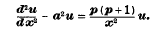
Recurrence Formulae for the Functions which represent Solutions of the Differential Equation:
-
- Journal:
- Proceedings of the Edinburgh Mathematical Society / Volume 33 / February 1914
- Published online by Cambridge University Press:
- 20 January 2009, pp. 107-117
-
- Article
-
- You have access
- Export citation
-
The contents of this paper were suggested by a discussion of the equation:

in a paper by Glaisher which appears in the Philosophical Transactions, 1881, Part III.
The solutions in series of (1) are:

and in the paper referred to it is shewn that the coefficients of hp+1 in the expansions of
 and of
  satisfy equation (1) when p is a positive integer.
 and of
  satisfy equation (1) when p is a positive integer.
Classification of Geometries with Projective Metric
-
- Journal:
- Proceedings of the Edinburgh Mathematical Society / Volume 28 / February 1909
- Published online by Cambridge University Press:
- 20 January 2009, pp. 25-41
-
- Article
-
- You have access
- Export citation
PEM volume 15 issue 2 Cover and Back matter
-
- Journal:
- Proceedings of the Edinburgh Mathematical Society / Volume 15 / Issue 2 / December 1966
- Published online by Cambridge University Press:
- 20 January 2009, pp. b1-b2
-
- Article
-
- You have access
- Export citation
Determination of the Arbitrary Constants which appear in the Asymptotic Expansions for the Functions of the Elliptic Cylinder
-
- Journal:
- Proceedings of the Edinburgh Mathematical Society / Volume 40 / February 1921
- Published online by Cambridge University Press:
- 20 January 2009, pp. 2-8
-
- Article
-
- You have access
- Export citation
-
In an article, published some time since, the author of the present paper deduced an asymptotic expression for the functions of the elliptic cylinder, which expression took the following form:

Here P and Q are certain asymptotic series, and C and a arbitrary constants. General expressions for these constants were not determined in the aforementioned article on account of the difficulties there set forth, though it was pointed out that their numerical calculation for any particular problem was simply a matter of arithmetic computation. It is the object of the present paper to deduce general expressions for these constants C and a in terms of the two parameters which appear in the defining equation for U.
Interpolation by means of Given Differences (Central-Difference Notation)
-
- Journal:
- Proceedings of the Edinburgh Mathematical Society / Volume 3 / Issue 1 / March 1932
- Published online by Cambridge University Press:
- 20 January 2009, pp. 1-5
-
- Article
-
- You have access
- Export citation
The action of a maximal parabolic subgroup on the transpositions of the Baby Monster
-
- Journal:
- Proceedings of the Edinburgh Mathematical Society / Volume 37 / Issue 1 / February 1994
- Published online by Cambridge University Press:
- 20 January 2009, pp. 185-189
-
- Article
-
- You have access
- Export citation
Naturally ordered regular semigroups with maximum inverses
-
- Journal:
- Proceedings of the Edinburgh Mathematical Society / Volume 32 / Issue 1 / February 1989
- Published online by Cambridge University Press:
- 20 January 2009, pp. 33-39
-
- Article
-
- You have access
- Export citation
N. I. Akhiezer, The Classical Moment Problem (Oliver and Boyd, 1965), x+252 pp.,70s.
-
- Journal:
- Proceedings of the Edinburgh Mathematical Society / Volume 15 / Issue 2 / December 1966
- Published online by Cambridge University Press:
- 20 January 2009, pp. 155-156
-
- Article
-
- You have access
- Export citation
On the envelope of the Simson line of a polygon
-
- Journal:
- Proceedings of the Edinburgh Mathematical Society / Volume 14 / February 1895
- Published online by Cambridge University Press:
- 20 January 2009, pp. 122-126
-
- Article
-
- You have access
- Export citation
THE NON-LOCAL CAUCHY PROBLEM FOR SEMILINEAR INTEGRODIFFERENTIAL EQUATIONS WITH DEVIATING ARGUMENT
-
- Journal:
- Proceedings of the Edinburgh Mathematical Society / Volume 44 / Issue 1 / February 2001
- Published online by Cambridge University Press:
- 20 January 2009, pp. 63-70
-
- Article
-
- You have access
- Export citation
PEM volume 2 issue 1 Cover and Front matter
-
- Journal:
- Proceedings of the Edinburgh Mathematical Society / Volume 2 / Issue 1 / January 1930
- Published online by Cambridge University Press:
- 20 January 2009, pp. f1-f2
-
- Article
-
- You have access
- Export citation
The integral formula for the reduced algebraic multiplicity of meromorphic operator functions
-
- Journal:
- Proceedings of the Edinburgh Mathematical Society / Volume 21 / Issue 1 / March 1978
- Published online by Cambridge University Press:
- 20 January 2009, pp. 65-71
-
- Article
-
- You have access
- Export citation
Charles A. HayesJR., Concepts of Real Analysis (John Wiley and Sons Ltd., 1964), vii+190 pp., 49s.
-
- Journal:
- Proceedings of the Edinburgh Mathematical Society / Volume 15 / Issue 2 / December 1966
- Published online by Cambridge University Press:
- 20 January 2009, pp. 161-162
-
- Article
-
- You have access
- Export citation
