Refine search
Actions for selected content:
26079 results in Abstract analysis
PEM volume 21 issue 2 Cover and Back matter
-
- Journal:
- Proceedings of the Edinburgh Mathematical Society / Volume 21 / Issue 2 / September 1978
- Published online by Cambridge University Press:
- 20 January 2009, pp. b1-b7
-
- Article
-
- You have access
- Export citation
A Trigonometrical Note
-
- Journal:
- Proceedings of the Edinburgh Mathematical Society / Volume 5 / February 1886
- Published online by Cambridge University Press:
- 20 January 2009, p. 61
-
- Article
-
- You have access
- Export citation
On Straneo's Unified Theory of Gravitation and Electricity
-
- Journal:
- Proceedings of the Edinburgh Mathematical Society / Volume 3 / Issue 4 / August 1933
- Published online by Cambridge University Press:
- 20 January 2009, pp. 269-275
-
- Article
-
- You have access
- Export citation
Functorial radicals and non-abelian torsion
-
- Journal:
- Proceedings of the Edinburgh Mathematical Society / Volume 23 / Issue 3 / October 1980
- Published online by Cambridge University Press:
- 20 January 2009, pp. 317-329
-
- Article
-
- You have access
- Export citation
Erratum
-
- Journal:
- Proceedings of the Edinburgh Mathematical Society / Volume 1 / Issue 4 / July 1929
- Published online by Cambridge University Press:
- 20 January 2009, p. 246
-
- Article
-
- You have access
- Export citation
-
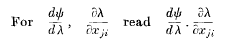
Turnbull : On differentiating a matrix, p. 126, line 12-
Free resolutions for certain classes of groups
-
- Journal:
- Proceedings of the Edinburgh Mathematical Society / Volume 26 / Issue 2 / June 1983
- Published online by Cambridge University Press:
- 20 January 2009, pp. 173-179
-
- Article
-
- You have access
- Export citation
Some Elementary Theorems regarding Surds
-
- Journal:
- Proceedings of the Edinburgh Mathematical Society / Volume 19 / February 1900
- Published online by Cambridge University Press:
- 20 January 2009, pp. 46-49
-
- Article
-
- You have access
- Export citation
-
1. If p and q be both commensurable, and if
 , then, if n be prime to r, both the roots must be commensurable.
For, since n is prime to r, we can find two integers λ and μ such that λn + μr = 1.
 , then, if n be prime to r, both the roots must be commensurable.
A. C. Aitken To catch the spirit (with a biographical introduction by P. C. Fenton) (University of Otago Press 1995), 123 pp., 0 908569 99 8, NZ$29.95.
-
- Journal:
- Proceedings of the Edinburgh Mathematical Society / Volume 39 / Issue 2 / June 1996
- Published online by Cambridge University Press:
- 20 January 2009, pp. 407-408
-
- Article
-
- You have access
- Export citation
PEM volume 10 issue 4 Cover and Front matter
-
- Journal:
- Proceedings of the Edinburgh Mathematical Society / Volume 10 / Issue 4 / June 1957
- Published online by Cambridge University Press:
- 20 January 2009, pp. f1-f2
-
- Article
-
- You have access
- Export citation
On a Boolean algebra of projections constructed by Dieudonné
-
- Journal:
- Proceedings of the Edinburgh Mathematical Society / Volume 16 / Issue 3 / June 1969
- Published online by Cambridge University Press:
- 20 January 2009, pp. 259-262
-
- Article
-
- You have access
- Export citation
-
Dieudonné (4) has constructed an example of a Banach space X and a complete Boolean algebra


A note on left bipotent near-rings
-
- Journal:
- Proceedings of the Edinburgh Mathematical Society / Volume 27 / Issue 2 / June 1984
- Published online by Cambridge University Press:
- 20 January 2009, p. 151
-
- Article
-
- You have access
- Export citation
Maximum idempotents in naturally ordered regular semigroups
-
- Journal:
- Proceedings of the Edinburgh Mathematical Society / Volume 26 / Issue 2 / June 1983
- Published online by Cambridge University Press:
- 20 January 2009, pp. 213-220
-
- Article
-
- You have access
- Export citation
-
We shall denote by ω the natural partial order on the idempotents E = E(S) of a regular semigroup S, so that in E,

A partially ordered semigroup S(≦) is called naturally partially ordered [9] if the imposed partial order ≦ extends ω in the sense that

No assumption is made about the reverse implication.
R. L. Goodstein, Boolean Algebra (The Commonwealth and International Library of Science, Technology, Engineering and Liberal Studies, Vol. 6, Pergamon Press, Oxford, 1963), 140 pp., 12s. 6d.
-
- Journal:
- Proceedings of the Edinburgh Mathematical Society / Volume 13 / Issue 4 / December 1963
- Published online by Cambridge University Press:
- 20 January 2009, p. 343
-
- Article
-
- You have access
- Export citation
Matrices with prescribed characteristic polynomial and principal blocks
-
- Journal:
- Proceedings of the Edinburgh Mathematical Society / Volume 24 / Issue 3 / October 1981
- Published online by Cambridge University Press:
- 20 January 2009, pp. 203-208
-
- Article
-
- You have access
- Export citation
-
Let A be a matrix over a field Φ partitioned as follows

where A11 is n×n and A22 is m×m. The objective of the present paper is to give further results on the problems mentioned in Section 1 of (3). Concretely we shall consider the following question: “we prescribe the characteristic polynomial f(λ) = λn+m−c1λn+m−1 + … of A and the principal blocks A11, A22. Find a necessary and sufficient condition for the existence of A satisfying these prescribed conditions”.

On the Latent Roots of Certain Matrices
-
- Journal:
- Proceedings of the Edinburgh Mathematical Society / Volume 1 / Issue 2 / March 1928
- Published online by Cambridge University Press:
- 20 January 2009, pp. 135-138
-
- Article
-
- You have access
- Export citation
On the nine-point conic
-
- Journal:
- Proceedings of the Edinburgh Mathematical Society / Volume 19 / February 1900
- Published online by Cambridge University Press:
- 20 January 2009, pp. 23-32
-
- Article
-
- You have access
- Export citation
To transform a rectangle into a square
-
- Journal:
- Proceedings of the Edinburgh Mathematical Society / Volume 4 / February 1885
- Published online by Cambridge University Press:
- 20 January 2009, p. 24
-
- Article
-
- You have access
- Export citation
A Transformation of Which The Equation of Telegraphy is a Differential Invariant
-
- Journal:
- Proceedings of the Edinburgh Mathematical Society / Volume 15 / Issue 1 / June 1966
- Published online by Cambridge University Press:
- 20 January 2009, pp. 87-88
-
- Article
-
- You have access
- Export citation
Sums of Laurent and bilateral Hankel operators
-
- Journal:
- Proceedings of the Edinburgh Mathematical Society / Volume 31 / Issue 3 / October 1988
- Published online by Cambridge University Press:
- 20 January 2009, pp. 369-373
-
- Article
-
- You have access
- Export citation
-
One can define “Laurent” and “Hankel” operators relative to groups more general than the circle group
 . We do that here, derive some of their properties, and compute their spectra, using a concrete realization of a crossed product C*-algebra by the two-element group ℤ2.
 . We do that here, derive some of their properties, and compute their spectra, using a concrete realization of a crossed product C*-algebra by the two-element group ℤ
Maximal subsemigroups of Lie groups that are total
-
- Journal:
- Proceedings of the Edinburgh Mathematical Society / Volume 30 / Issue 3 / October 1987
- Published online by Cambridge University Press:
- 20 January 2009, pp. 479-501
-
- Article
-
- You have access
- Export citation
