Refine search
Actions for selected content:
26079 results in Abstract analysis
Note on the expression for the area of a triangle in Cartesian Coordinates, and a general proof of the Addition Theorem in Trigonometry connected therewith
-
- Journal:
- Proceedings of the Edinburgh Mathematical Society / Volume 19 / February 1900
- Published online by Cambridge University Press:
- 20 January 2009, pp. 2-4
-
- Article
-
- You have access
- Export citation
On a function which is self-reciprocal in the Hankel transform
-
- Journal:
- Proceedings of the Edinburgh Mathematical Society / Volume 5 / Issue 1 / October 1936
- Published online by Cambridge University Press:
- 20 January 2009, pp. 35-36
-
- Article
-
- You have access
- Export citation
-
It is well-known that if v≧–½ and

then ø (x) is said to be self-reciprocal in the Hankel transform and may be described as Rv. If v = ±½(1) reduces to the Fourier sine or cosine transform. Functions of these two classes may be described as Rg and Re.
In a list of pairs of reciprocal functions, G. A. Campbell gives the example that

is Rc, but there does not seem to be any explicit reference to this function in the literature. It suggests that there is a corresponding function which is Rv.
C. A. Rogers, Hausdorff Measures (Cambridge University Press, 1970), viii+179 pp., £3·80.
-
- Journal:
- Proceedings of the Edinburgh Mathematical Society / Volume 17 / Issue 4 / December 1971
- Published online by Cambridge University Press:
- 20 January 2009, pp. 371-372
-
- Article
-
- You have access
- Export citation
§1. Centroid
-
- Journal:
- Proceedings of the Edinburgh Mathematical Society / Volume 1 / February 1883
- Published online by Cambridge University Press:
- 20 January 2009, pp. 12-31
-
- Article
-
- You have access
- Export citation
Ideals and filters of pseudo-complemented semilattices
-
- Journal:
- Proceedings of the Edinburgh Mathematical Society / Volume 23 / Issue 3 / October 1980
- Published online by Cambridge University Press:
- 20 January 2009, pp. 301-316
-
- Article
-
- You have access
- Export citation
PEM volume 3 issue 2 Cover and Front matter
-
- Journal:
- Proceedings of the Edinburgh Mathematical Society / Volume 3 / Issue 2 / July 1932
- Published online by Cambridge University Press:
- 20 January 2009, pp. f1-f2
-
- Article
-
- You have access
- Export citation
The Elements of Quaternions Second Paper): Discussion of the Proofs of the Laws of the Quaternionic Algebra
-
- Journal:
- Proceedings of the Edinburgh Mathematical Society / Volume 11 / February 1892
- Published online by Cambridge University Press:
- 20 January 2009, pp. 130-136
-
- Article
-
- You have access
- Export citation
Theorems connecting different classes of Self-Reciprocal Functions
-
- Journal:
- Proceedings of the Edinburgh Mathematical Society / Volume 4 / Issue 1 / March 1934
- Published online by Cambridge University Press:
- 20 January 2009, pp. 53-56
-
- Article
-
- You have access
- Export citation
PEM volume 3 issue 1 Cover and Front matter
-
- Journal:
- Proceedings of the Edinburgh Mathematical Society / Volume 3 / Issue 1 / March 1932
- Published online by Cambridge University Press:
- 20 January 2009, pp. f1-f2
-
- Article
-
- You have access
- Export citation
The subnormal subgroup structure of the infinite symplectic group
-
- Journal:
- Proceedings of the Edinburgh Mathematical Society / Volume 25 / Issue 3 / October 1982
- Published online by Cambridge University Press:
- 20 January 2009, pp. 209-216
-
- Article
-
- You have access
- Export citation
-
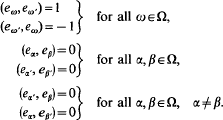
Let R be a ring with identity and let Ω be a totally ordered set. Let Ω′ be a totally ordered set which is disjoint from and equipotent to Ω′ with ′:Ω→Ω′ an order preserving bijection. Define Ω1=Ω∪Ω′ and let Ω1, be totally ordered by inheriting the order from Ω and Ω′ and with ω<λ for all ω∈Ω and λ′∈Ω′. Let M be the free R-module R(Ω1).(We define the alternate bilinear form (*, *) on M by
PEM volume 32 issue 1 Cover and Back matter
-
- Journal:
- Proceedings of the Edinburgh Mathematical Society / Volume 32 / Issue 1 / February 1989
- Published online by Cambridge University Press:
- 20 January 2009, p. b1
-
- Article
-
- You have access
- Export citation
A General Method of Solving the Equations of Elasticity
-
- Journal:
- Proceedings of the Edinburgh Mathematical Society / Volume 16 / February 1897
- Published online by Cambridge University Press:
- 20 January 2009, pp. 82-98
-
- Article
-
- You have access
- Export citation
Special Train Algebras Arising in Genetics
-
- Journal:
- Proceedings of the Edinburgh Mathematical Society / Volume 12 / Issue 1 / June 1960
- Published online by Cambridge University Press:
- 20 January 2009, pp. 41-53
-
- Article
-
- You have access
- Export citation
On Appell's Function P (θ, φ)
-
- Journal:
- Proceedings of the Edinburgh Mathematical Society / Volume 3 / Issue 1 / March 1932
- Published online by Cambridge University Press:
- 20 January 2009, pp. 53-55
-
- Article
-
- You have access
- Export citation
-
§1. Appell's functions, P (θ, φ), Q (θ, φ) and R (θ, φ) are defined by the expansion

where j3 = 1, affording, both for the third order and the field of two variables, a very direct generalization of the circular functions, as

“La Perspective d'une Conique est une Conique.” Démonstration Élémentaire
-
- Journal:
- Proceedings of the Edinburgh Mathematical Society / Volume 17 / February 1898
- Published online by Cambridge University Press:
- 20 January 2009, p. 112
-
- Article
-
- You have access
- Export citation
The following Presents to the Library have been received, for which the Society tenders its grateful thanks
-
- Journal:
- Proceedings of the Edinburgh Mathematical Society / Volume 34 / February 1915
- Published online by Cambridge University Press:
- 20 January 2009, p. vii
-
- Article
-
- You have access
- Export citation
A procedure for summing asymptotic series
-
- Journal:
- Proceedings of the Edinburgh Mathematical Society / Volume 16 / Issue 4 / December 1969
- Published online by Cambridge University Press:
- 20 January 2009, pp. 317-324
-
- Article
-
- You have access
- Export citation
-
When a function ƒ(x) possesses an asymptotic series

this series provides a useful means of evaluating ƒ(x) for large values of x. The usual procedure is to sum all the terms in S(x) up to, but excluding, the term of smallest magnitude. The degree of accuracy obtained by this method cannot normally be improved by direct summation of S(x), but sometimes better accuracy can be obtained by using one of the familiar devices for accelerating the convergence of series. Simple δ2-extrapolation may be successful, and Rosser (1) and others have used the Euler transformation to some effect. The method given here provides, in suitable cases, a more effective means of evaluating ƒ(x) from the series for a wide range of values of x.
Notation
-
- Journal:
- Proceedings of the Edinburgh Mathematical Society / Volume 1 / February 1883
- Published online by Cambridge University Press:
- 20 January 2009, pp. 6-11
-
- Article
-
- You have access
- Export citation
On a Nine-Point Conic, etc.
-
- Journal:
- Proceedings of the Edinburgh Mathematical Society / Volume 24 / February 1905
- Published online by Cambridge University Press:
- 20 January 2009, pp. 31-33
-
- Article
-
- You have access
- Export citation
Peaucellier's Cell and other linkages in non-euclidean Geometry
-
- Journal:
- Proceedings of the Edinburgh Mathematical Society / Volume 44 / February 1925
- Published online by Cambridge University Press:
- 20 January 2009, pp. 26-31
-
- Article
-
- You have access
- Export citation
