Refine search
Actions for selected content:
26079 results in Abstract analysis
On the centre and residual finiteness of the automorphism group of a group ring
-
- Journal:
- Proceedings of the Edinburgh Mathematical Society / Volume 30 / Issue 2 / June 1987
- Published online by Cambridge University Press:
- 20 January 2009, pp. 207-213
-
- Article
-
- You have access
- Export citation
Reflection of a Wave by a Cylindrical Mirror
-
- Journal:
- Proceedings of the Edinburgh Mathematical Society / Volume 9 / Issue 3 / July 1956
- Published online by Cambridge University Press:
- 20 January 2009, pp. 145-150
-
- Article
-
- You have access
- Export citation
Hausdorff-Young inequalities for functions in Bergman spaces on tube domains
-
- Journal:
- Proceedings of the Edinburgh Mathematical Society / Volume 41 / Issue 3 / October 1998
- Published online by Cambridge University Press:
- 20 January 2009, pp. 553-566
-
- Article
-
- You have access
- Export citation
Office Bearers
-
- Journal:
- Proceedings of the Edinburgh Mathematical Society / Volume 24 / February 1905
- Published online by Cambridge University Press:
- 20 January 2009, p. 1
-
- Article
-
- You have access
- Export citation
Morley's Trisection Theorem: an Extension and its Relation to the Circles of Apollonius
-
- Journal:
- Proceedings of the Edinburgh Mathematical Society / Volume 32 / February 1913
- Published online by Cambridge University Press:
- 20 January 2009, pp. 136-150
-
- Article
-
- You have access
- Export citation
-
In Morley's trisection theorem there are three triads of parallel lines which by their intersection with each other form equilateral triangles. The three lines EF, E11F11, E22F22 (v. Taylor and Marr) form one of these triads, and the equations are:—



where

and β γ β1, γ1, etc., are similarly defined.
A method of finding (i) the double points of a unicursal curve, (ii) unicursal quartics with three given double points
-
- Journal:
- Proceedings of the Edinburgh Mathematical Society / Volume 31 / February 1912
- Published online by Cambridge University Press:
- 20 January 2009, pp. 35-46
-
- Article
-
- You have access
- Export citation
-
The equations
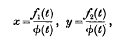
where f1(t), f2(t)φ(t) are polynomials in t, determine a unicursal curve. If α and β can be found so that

then the point (α, β) is on the curve and is given by two values of t, t1 and t2, which are the roots of the equation at2 + 2bt + c =0.
Invariant subspace theorems for amenable groups
-
- Journal:
- Proceedings of the Edinburgh Mathematical Society / Volume 32 / Issue 3 / October 1989
- Published online by Cambridge University Press:
- 20 January 2009, pp. 415-430
-
- Article
-
- You have access
- Export citation
On the Use of the term Power in Geometry, and on the treatment of the “doubtful sign.”
-
- Journal:
- Proceedings of the Edinburgh Mathematical Society / Volume 22 / February 1903
- Published online by Cambridge University Press:
- 20 January 2009, pp. 68-73
-
- Article
-
- You have access
- Export citation
K. F. Riley, Mathematical Methods for the Physical Sciences (Cambridge University Press, 1974), xvi + 533 pp., £8·75 (cloth), £3·95 (soft cover).
-
- Journal:
- Proceedings of the Edinburgh Mathematical Society / Volume 19 / Issue 3 / March 1975
- Published online by Cambridge University Press:
- 20 January 2009, pp. 317-318
-
- Article
-
- You have access
- Export citation
D. M. Bressoud, Factorization and primality testing (Undergraduate Texts in Mathematics, Springer-Verlag, Berlin-Heidelberg-New York1989), pp. xiii + 237, 3 540 97040 1, DM 98.
-
- Journal:
- Proceedings of the Edinburgh Mathematical Society / Volume 34 / Issue 1 / February 1991
- Published online by Cambridge University Press:
- 20 January 2009, p. 168
-
- Article
-
- You have access
- Export citation
On metacyclic Fibonacci groups
-
- Journal:
- Proceedings of the Edinburgh Mathematical Society / Volume 19 / Issue 3 / March 1975
- Published online by Cambridge University Press:
- 20 January 2009, pp. 253-256
-
- Article
-
- You have access
- Export citation
-
Let Fn be the free group on {ai: i ∈ Zn}, where the set of congruence classes mod n is used as an index set for the generators. Let φ be the permutation (1, 2, 3, …, n) of Zn and denote by θ the automorphism of Fn induced by φ, namely


The Equation of Telegraphy
-
- Journal:
- Proceedings of the Edinburgh Mathematical Society / Volume 42 / February 1923
- Published online by Cambridge University Press:
- 20 January 2009, pp. 14-28
-
- Article
-
- You have access
- Export citation
-
The equation of the propagation of electric signals along cables, generally known as the equation of telegraphy, may be written

Particular solutions of this equation, adapted to various purposes have been found by Heaviside, Poincaré, A. G. Webster, T. W. Chaundy, § and others. The object of the present paper is to unify the theory of the equation by exhibiting the relations which these solutions bear to each other, and by obtaining them as particular cases of a general solution. The derivation of new particular solutions by the solution of integral equations is also discussed.
Forty-Second Session, 1923–4
-
- Journal:
- Proceedings of the Edinburgh Mathematical Society / Volume 42 / February 1923
- Published online by Cambridge University Press:
- 20 January 2009, pp. v-vi
-
- Article
-
- You have access
- Export citation
Application of Wynn's epsilon algorithm to periodic continued fractions
-
- Journal:
- Proceedings of the Edinburgh Mathematical Society / Volume 30 / Issue 2 / June 1987
- Published online by Cambridge University Press:
- 20 January 2009, pp. 295-299
-
- Article
-
- You have access
- Export citation
-
The infinite continued fraction

in which

is periodic with period l and is equal to a quadratic surd if and only if the partial quotients, ak, are integers or rational numbers [1]. We shall also assume that they are positive. The transformation discussed below applies only to pure periodic fractions where n is zero.
PEM volume 16 issue 2 Cover and Front matter
-
- Journal:
- Proceedings of the Edinburgh Mathematical Society / Volume 16 / Issue 2 / December 1968
- Published online by Cambridge University Press:
- 20 January 2009, pp. f1-f2
-
- Article
-
- You have access
- Export citation
Some dual series and triple integral equations
-
- Journal:
- Proceedings of the Edinburgh Mathematical Society / Volume 16 / Issue 4 / December 1969
- Published online by Cambridge University Press:
- 20 January 2009, pp. 273-280
-
- Article
-
- You have access
- Export citation
-
In this paper we first of all solve the dual series equations
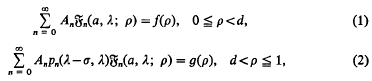
where ƒ(ρ) and g(ρ) are prescribed functions,

is the Jacobi polynomial (2).
Matrices with Prescribed Characteristic Polynomials
-
- Journal:
- Proceedings of the Edinburgh Mathematical Society / Volume 11 / Issue 3 / May 1959
- Published online by Cambridge University Press:
- 20 January 2009, pp. 143-146
-
- Article
-
- You have access
- Export citation
F. M. Arscott Periodic Differential Equations (Pergamon Press, 1964), vii + 275 pp., 602.
-
- Journal:
- Proceedings of the Edinburgh Mathematical Society / Volume 15 / Issue 1 / June 1966
- Published online by Cambridge University Press:
- 20 January 2009, p. 81
-
- Article
-
- You have access
- Export citation
T. S. Blyth, Module Theory: An approach to Linear Algebra (Oxford University Press, 1977), £9·50.
-
- Journal:
- Proceedings of the Edinburgh Mathematical Society / Volume 24 / Issue 2 / June 1981
- Published online by Cambridge University Press:
- 20 January 2009, pp. 151-152
-
- Article
-
- You have access
- Export citation
Jacobians of singular spectral curves and completely integrable systems
-
- Journal:
- Proceedings of the Edinburgh Mathematical Society / Volume 43 / Issue 3 / October 2000
- Published online by Cambridge University Press:
- 20 January 2009, pp. 605-623
-
- Article
-
- You have access
- Export citation
