Refine search
Actions for selected content:
26079 results in Abstract analysis
Explicit evaluation of Euler sums
-
- Journal:
- Proceedings of the Edinburgh Mathematical Society / Volume 38 / Issue 2 / June 1995
- Published online by Cambridge University Press:
- 20 January 2009, pp. 277-294
-
- Article
-
- You have access
- Export citation
-
In response to a letter from Goldbach, Euler considered sums of the form

where s and t are positive integers.
As Euler discovered by a process of extrapolation (from s + t ≦ 13), σh(s, t) can be evaluated in terms of Riemann ζ-functions when s + t is odd. We provide a rigorous proof of Euler's discovery and then give analogous evaluations with proofs for corresponding alternating sums. Relatedly we give a formula for the series
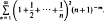
This evaluation involves ζ-functions and σh(2, m).
On compact action in JB-algebras
-
- Journal:
- Proceedings of the Edinburgh Mathematical Society / Volume 26 / Issue 3 / October 1983
- Published online by Cambridge University Press:
- 20 January 2009, pp. 353-360
-
- Article
-
- You have access
- Export citation
-
A real Jordan algebra which is also a Banach space with a norm which satisfies

for each pair a, b of elements, is said to be a JB-algebra. A JB-algebra which is also a Banach dual space is said to be a JBW-algebra.
Office-Bearers
-
- Journal:
- Proceedings of the Edinburgh Mathematical Society / Volume 21 / February 1902
- Published online by Cambridge University Press:
- 20 January 2009, p. 1
-
- Article
-
- You have access
- Export citation
Note on the Fundamental Theorem on Irreducible Non-Negative Matrices
-
- Journal:
- Proceedings of the Edinburgh Mathematical Society / Volume 11 / Issue 2 / November 1958
- Published online by Cambridge University Press:
- 20 January 2009, pp. 127-130
-
- Article
-
- You have access
- Export citation
Infinite Coxeter groups are virtually indicarle
-
- Journal:
- Proceedings of the Edinburgh Mathematical Society / Volume 41 / Issue 2 / June 1998
- Published online by Cambridge University Press:
- 20 January 2009, pp. 303-313
-
- Article
-
- You have access
- Export citation
Thirty-Second Session, 1913–1914
-
- Journal:
- Proceedings of the Edinburgh Mathematical Society / Volume 32 / February 1913
- Published online by Cambridge University Press:
- 20 January 2009, pp. v-vi
-
- Article
-
- You have access
- Export citation
On the Theory of Contours, and its Applications in Physical Science
-
- Journal:
- Proceedings of the Edinburgh Mathematical Society / Volume 4 / February 1885
- Published online by Cambridge University Press:
- 20 January 2009, pp. 61-64
-
- Article
-
- You have access
- Export citation
A note on some peculiar nonlinear extremal phenomena of the Chebyshev polynomials
-
- Journal:
- Proceedings of the Edinburgh Mathematical Society / Volume 38 / Issue 2 / June 1995
- Published online by Cambridge University Press:
- 20 January 2009, pp. 343-355
-
- Article
-
- You have access
- Export citation
-
We consider the problem of maximizing the sum of squares of the leading coefficients of polynomials
 (where Pj(x) is a polynomial of degree j) under the restriction that the sup-norm of
  is bounded on the interval [ −b, b] (b>0). A complete solution of the problem is presented using duality theory of convex analysis and the theory of canonical moments. It turns out, that contrary to many other extremal problems the structure of the solution will depend heavily on the size of the interval [ −b, b].
 (where P
 is bounded on the interval [ −b, b] (b>0). A complete solution of the problem is presented using duality theory of convex analysis and the theory of canonical moments. It turns out, that contrary to many other extremal problems the structure of the solution will depend heavily on the size of the interval [ −b, b].
Sequences in genetic algebras for overlapping generations
-
- Journal:
- Proceedings of the Edinburgh Mathematical Society / Volume 18 / Issue 1 / June 1972
- Published online by Cambridge University Press:
- 20 January 2009, pp. 19-29
-
- Article
-
- You have access
- Export citation
G. Pisier, Similarity problems and completely bounded maps (Lecture Notes in Mathematics Vol. 1618, Springer-Verlag, Berlin–Heidelberg–New York–London–Paris–Tokyo–Hong Kong, 1996), vii + 156 pp., 3 540 60322 0, (softcover) £20.50.
-
- Journal:
- Proceedings of the Edinburgh Mathematical Society / Volume 40 / Issue 2 / June 1997
- Published online by Cambridge University Press:
- 20 January 2009, pp. 405-406
-
- Article
-
- You have access
- Export citation
R. M. Dudley Real analysis and probability (Wadsworth and Brooks/Cole Mathematics Series, Pacific Grove, California, 1989), xii + 436 pp. 0 534 10050 3, $52.95.
-
- Journal:
- Proceedings of the Edinburgh Mathematical Society / Volume 33 / Issue 2 / June 1990
- Published online by Cambridge University Press:
- 20 January 2009, pp. 333-334
-
- Article
-
- You have access
- Export citation
Unstable invariant distributions for a class of stochastic delay equations
-
- Journal:
- Proceedings of the Edinburgh Mathematical Society / Volume 31 / Issue 1 / February 1988
- Published online by Cambridge University Press:
- 20 January 2009, pp. 1-23
-
- Article
-
- You have access
- Export citation
List of members – September 1938
-
- Journal:
- Proceedings of the Edinburgh Mathematical Society / Volume 5 / Issue 4 / September 1938
- Published online by Cambridge University Press:
- 20 January 2009, pp. 225-232
-
- Article
-
- You have access
- Export citation
PEM volume 39 issue 3 Cover and Back matter
-
- Journal:
- Proceedings of the Edinburgh Mathematical Society / Volume 39 / Issue 3 / October 1996
- Published online by Cambridge University Press:
- 20 January 2009, pp. b1-b7
-
- Article
-
- You have access
- Export citation
Note on the Polynomials which satisfy the Differential Equation

-
- Journal:
- Proceedings of the Edinburgh Mathematical Society / Volume 38 / February 1919
- Published online by Cambridge University Press:
- 20 January 2009, pp. 27-33
-
- Article
-
- You have access
- Export citation
-
Laguerre has shown that if
 be expanded in ascending powers of t,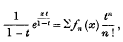
where fn(x) is a polynomial of degree n, satisfying the differential equation


 be expanded in ascending powers of t,
PEM volume 18 issue 1 Cover and Front matter
-
- Journal:
- Proceedings of the Edinburgh Mathematical Society / Volume 18 / Issue 1 / June 1972
- Published online by Cambridge University Press:
- 20 January 2009, pp. f1-f2
-
- Article
-
- You have access
- Export citation
PEM volume 41 issue 3 Cover and Front matter
-
- Journal:
- Proceedings of the Edinburgh Mathematical Society / Volume 41 / Issue 3 / October 1998
- Published online by Cambridge University Press:
- 20 January 2009, pp. f1-f8
-
- Article
-
- You have access
- Export citation
Solutions of Laplace's equation in an n-dimensional space of constant curvature
-
- Journal:
- Proceedings of the Edinburgh Mathematical Society / Volume 6 / Issue 1 / May 1939
- Published online by Cambridge University Press:
- 20 January 2009, pp. 24-45
-
- Article
-
- You have access
- Export citation
-
This paper is a sequel to an earlier one containing a tensor formulation and generalisation of well-known solutions of Laplace's equation and of the classical wave-equation. The partial differential equation considered was
where
is the Christoffel symbol of the second kind, and the work was restricted to the case in which the associated line-element
was that of an n-dimensional flat space. It is shown below that similar solutions exist for any n-dimensional space of constant positive or negative curvature K.
PEM volume 6 issue 4 Cover and Back matter
-
- Journal:
- Proceedings of the Edinburgh Mathematical Society / Volume 6 / Issue 4 / October 1941
- Published online by Cambridge University Press:
- 20 January 2009, pp. b1-b5
-
- Article
-
- You have access
- Export citation
Note on the determination of the axes of a conic
-
- Journal:
- Proceedings of the Edinburgh Mathematical Society / Volume 23 / February 1904
- Published online by Cambridge University Press:
- 20 January 2009, pp. 94-95
-
- Article
-
- You have access
- Export citation
