Refine search
Actions for selected content:
26078 results in Abstract analysis
ON MULTIPLICATION TABLES OF GROUPS THAT AGREE ON HALF OF THE COLUMNS AND HALF OF THE ROWS
-
- Journal:
- Glasgow Mathematical Journal / Volume 45 / Issue 2 / May 2003
- Published online by Cambridge University Press:
- 01 August 2003, pp. 293-308
-
- Article
-
- You have access
- Export citation
A Hölder continuous ODE related to traffic flow
-
- Journal:
- Proceedings of the Royal Society of Edinburgh. Section A: Mathematics / Volume 133 / Issue 4 / August 2003
- Published online by Cambridge University Press:
- 12 July 2007, pp. 759-772
- Print publication:
- August 2003
-
- Article
- Export citation
Homogenization of a Hamilton–Jacobi equation associated with the geometric motion of an interface
-
- Journal:
- Proceedings of the Royal Society of Edinburgh. Section A: Mathematics / Volume 133 / Issue 4 / August 2003
- Published online by Cambridge University Press:
- 12 July 2007, pp. 773-805
- Print publication:
- August 2003
-
- Article
- Export citation
Stability of scalar delay differential equations with dominant delayed terms
-
- Journal:
- Proceedings of the Royal Society of Edinburgh. Section A: Mathematics / Volume 133 / Issue 4 / August 2003
- Published online by Cambridge University Press:
- 12 July 2007, pp. 951-968
- Print publication:
- August 2003
-
- Article
- Export citation
Pencils of differential operators containing the eigenvalue parameter in the boundary conditions
-
- Journal:
- Proceedings of the Royal Society of Edinburgh. Section A: Mathematics / Volume 133 / Issue 4 / August 2003
- Published online by Cambridge University Press:
- 12 July 2007, pp. 893-917
- Print publication:
- August 2003
-
- Article
- Export citation
Uniform asymptotic expansions for associated Legendre functions of large order
-
- Journal:
- Proceedings of the Royal Society of Edinburgh. Section A: Mathematics / Volume 133 / Issue 4 / August 2003
- Published online by Cambridge University Press:
- 12 July 2007, pp. 807-827
- Print publication:
- August 2003
-
- Article
- Export citation
-
Uniform asymptotic expansions are obtained for the associated Legendre functions
and
Estimates of averages of Fourier transforms with respect to general measures
-
- Journal:
- Proceedings of the Royal Society of Edinburgh. Section A: Mathematics / Volume 133 / Issue 4 / August 2003
- Published online by Cambridge University Press:
- 12 July 2007, pp. 943-950
- Print publication:
- August 2003
-
- Article
- Export citation
Some beta-function inequalities
-
- Journal:
- Proceedings of the Royal Society of Edinburgh. Section A: Mathematics / Volume 133 / Issue 4 / August 2003
- Published online by Cambridge University Press:
- 12 July 2007, pp. 731-745
- Print publication:
- August 2003
-
- Article
- Export citation
-
We present several new inequalities for Euler's beta function, B(x, y). One of our results states that the beta function can be approximated on (0, 1] × (0, 1] by rational functions as follows,
 with the best possible constants α = 1 and β = ⅔π2 − 4 = 2.579 73 ….
On Povzner–Wienholtz-type self-adjointness results for matrix-valued Sturm–Liouville operators
-
- Journal:
- Proceedings of the Royal Society of Edinburgh. Section A: Mathematics / Volume 133 / Issue 4 / August 2003
- Published online by Cambridge University Press:
- 12 July 2007, pp. 747-758
- Print publication:
- August 2003
-
- Article
- Export citation
-
We derive Povzner–Wienholtz-type self-adjointness results for m × m matrix-valued Sturm–Liouville operators
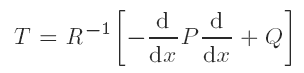 in L2((a, b);R dx)m, m ∈ N, for (a, b) a half-line or R.
Some limiting properties of randomly forced two-dimensional Navier–Stokes equations
-
- Journal:
- Proceedings of the Royal Society of Edinburgh. Section A: Mathematics / Volume 133 / Issue 4 / August 2003
- Published online by Cambridge University Press:
- 12 July 2007, pp. 875-891
- Print publication:
- August 2003
-
- Article
- Export citation
On certain Glasner sets
-
- Journal:
- Proceedings of the Royal Society of Edinburgh. Section A: Mathematics / Volume 133 / Issue 4 / August 2003
- Published online by Cambridge University Press:
- 12 July 2007, pp. 849-853
- Print publication:
- August 2003
-
- Article
- Export citation
Rough isometry and energy-finite solutions for the Schrödinger operator on Riemannian manifolds
-
- Journal:
- Proceedings of the Royal Society of Edinburgh. Section A: Mathematics / Volume 133 / Issue 4 / August 2003
- Published online by Cambridge University Press:
- 12 July 2007, pp. 855-873
- Print publication:
- August 2003
-
- Article
- Export citation
A decomposition of the (1 + β)-superprocess conditioned on survival
-
- Journal:
- Proceedings of the Royal Society of Edinburgh. Section A: Mathematics / Volume 133 / Issue 4 / August 2003
- Published online by Cambridge University Press:
- 12 July 2007, pp. 829-847
- Print publication:
- August 2003
-
- Article
- Export citation
THE SPECTRAL SCALE AND THE $k$–NUMERICAL RANGE
-
- Journal:
- Glasgow Mathematical Journal / Volume 45 / Issue 2 / May 2003
- Published online by Cambridge University Press:
- 31 July 2003, pp. 225-238
-
- Article
-
- You have access
- Export citation
THE CONSERVATION OF NUMBER PRINCIPLE IN REAL ALGEBRAIC GEOMETRY
-
- Journal:
- Glasgow Mathematical Journal / Volume 45 / Issue 2 / May 2003
- Published online by Cambridge University Press:
- 31 July 2003, pp. 217-224
-
- Article
-
- You have access
- Export citation
NON-AMENABLE TYPE K EQUATIONS OVER GROUPS
-
- Journal:
- Glasgow Mathematical Journal / Volume 45 / Issue 2 / May 2003
- Published online by Cambridge University Press:
- 31 July 2003, pp. 389-400
-
- Article
-
- You have access
- Export citation
SIMPLE $(-1,-1)$ BALANCED FREUDENTHAL KANTOR TRIPLE SYSTEMS
-
- Journal:
- Glasgow Mathematical Journal / Volume 45 / Issue 2 / May 2003
- Published online by Cambridge University Press:
- 31 July 2003, pp. 353-372
-
- Article
-
- You have access
- Export citation
ON SUBGROUPS RELATED TO THE TENSOR CENTER
-
- Journal:
- Glasgow Mathematical Journal / Volume 45 / Issue 2 / May 2003
- Published online by Cambridge University Press:
- 31 July 2003, pp. 323-332
-
- Article
-
- You have access
- Export citation
HOLOMORPHIC AUTOMORPHISMS OF THE UNIT BALLS OF HILBERT C$^*$-MODULES
-
- Journal:
- Glasgow Mathematical Journal / Volume 45 / Issue 2 / May 2003
- Published online by Cambridge University Press:
- 31 July 2003, pp. 249-262
-
- Article
-
- You have access
- Export citation
ANOSOV DIFFEOMORPHISMS ON A CLASS OF 2-STEP NILMANIFOLDS
-
- Journal:
- Glasgow Mathematical Journal / Volume 45 / Issue 2 / May 2003
- Published online by Cambridge University Press:
- 31 July 2003, pp. 269-280
-
- Article
-
- You have access
- Export citation
