Refine search
Actions for selected content:
26078 results in Abstract analysis
ON FACTORIZATION IN BLOCK MONOIDS FORMED BY $\{\bar{1},\bar{a}\}$ IN $\mathbb{Z}_{n}$
-
- Journal:
- Proceedings of the Edinburgh Mathematical Society / Volume 46 / Issue 2 / June 2003
- Published online by Cambridge University Press:
- 04 July 2003, pp. 257-267
-
- Article
-
- You have access
- Export citation
FINITE AND LOCAL LAPLACE TRANSFORMS IN BANACH SPACES
-
- Journal:
- Proceedings of the Edinburgh Mathematical Society / Volume 46 / Issue 2 / June 2003
- Published online by Cambridge University Press:
- 04 July 2003, pp. 357-372
-
- Article
-
- You have access
- Export citation
MINORATION DE LA HAUTEUR NORMALISÉE DANS UN TORE
-
- Journal:
- Journal of the Institute of Mathematics of Jussieu / Volume 2 / Issue 3 / July 2003
- Published online by Cambridge University Press:
- 21 July 2003, pp. 335-381
- Print publication:
- July 2003
-
- Article
- Export citation
A model for speed adaptation of individuals and existence of weak solutions
-
- Journal:
- European Journal of Applied Mathematics / Volume 14 / Issue 3 / June 2003
- Published online by Cambridge University Press:
- 01 July 2003, pp. 291-311
-
- Article
- Export citation
Travelling wave solutions of the degenerate Kolmogorov–Petrovski–Piskunov equation
-
- Journal:
- European Journal of Applied Mathematics / Volume 14 / Issue 3 / June 2003
- Published online by Cambridge University Press:
- 01 July 2003, pp. 343-367
-
- Article
- Export citation
TWISTED HILBERT SPACES AND UNCONDITIONAL STRUCTURE
-
- Journal:
- Journal of the Institute of Mathematics of Jussieu / Volume 2 / Issue 3 / July 2003
- Published online by Cambridge University Press:
- 21 July 2003, pp. 401-408
- Print publication:
- July 2003
-
- Article
- Export citation
NON-INJECTIVITY OF THE MAP FROM THE WITT GROUP OF A VARIETY TO THE WITT GROUP OF ITS FUNCTION FIELD
-
- Journal:
- Journal of the Institute of Mathematics of Jussieu / Volume 2 / Issue 3 / July 2003
- Published online by Cambridge University Press:
- 21 July 2003, pp. 483-493
- Print publication:
- July 2003
-
- Article
- Export citation
THE SEMIGROUP OF A QUASI-ORDINARY HYPERSURFACE
-
- Journal:
- Journal of the Institute of Mathematics of Jussieu / Volume 2 / Issue 3 / July 2003
- Published online by Cambridge University Press:
- 21 July 2003, pp. 383-399
- Print publication:
- July 2003
-
- Article
- Export citation
Existence of a solution to the line contact problem of elastohydrodynamic lubrication
-
- Journal:
- European Journal of Applied Mathematics / Volume 14 / Issue 3 / June 2003
- Published online by Cambridge University Press:
- 01 July 2003, pp. 279-290
-
- Article
- Export citation
Estimates for the low eigenfrequencies of a multi-structure including an elastic shell
-
- Journal:
- European Journal of Applied Mathematics / Volume 14 / Issue 3 / June 2003
- Published online by Cambridge University Press:
- 01 July 2003, pp. 313-342
-
- Article
- Export citation
The onset of superconductivity in long rectangles
-
- Journal:
- European Journal of Applied Mathematics / Volume 14 / Issue 3 / June 2003
- Published online by Cambridge University Press:
- 01 July 2003, pp. 257-277
-
- Article
- Export citation
GERMS OF CHARACTERS OF ADMISSIBLE REPRESENTATIONS OF p-ADIC GENERAL LINEAR GROUPS
-
- Journal:
- Journal of the Institute of Mathematics of Jussieu / Volume 2 / Issue 3 / July 2003
- Published online by Cambridge University Press:
- 21 July 2003, pp. 409-481
- Print publication:
- July 2003
-
- Article
- Export citation
Extinction and wavefront propagation in a reaction-diffusion model of a structured population with distributed maturation delay
-
- Journal:
- Proceedings of the Royal Society of Edinburgh. Section A: Mathematics / Volume 133 / Issue 3 / June 2003
- Published online by Cambridge University Press:
- 12 July 2007, pp. 527-548
- Print publication:
- June 2003
-
- Article
- Export citation
Relaxation in an L∞-optimization problem
-
- Journal:
- Proceedings of the Royal Society of Edinburgh. Section A: Mathematics / Volume 133 / Issue 3 / June 2003
- Published online by Cambridge University Press:
- 12 July 2007, pp. 599-615
- Print publication:
- June 2003
-
- Article
- Export citation
-
Let Ω be an open bounded subset of Rn and f a continuous function on Ω̄ satisfying f(x) > 0 for all x ∈ Ω̄. We consider the maximization problem for the integral ∫Ωf(x)u(x)dx over all Lipschitz continuous functions u subject to the Dirichlet boundary condition u = 0 on ∂Ω and to the gradient constraint of the form H(Du(x)) ≤ 1, and prove that the supremum is ‘achieved’ by the viscosity solution of Ĥ(Du(x)) = 1 in Ω and u = 0 on ∂Ω, where Ĥ denotes the convex envelope of H. This result is applied to an asymptotic problem, as p → ∞, for quasi-minimizers of the integral
 An asymptotic problem as k → ∞ for inf
 is also considered, where the infimum is taken all over
 and the set K is given by {ξ | H(ξ) ≤ 1}.
Constructing an operator from a complete and minimal set
-
- Journal:
- Proceedings of the Royal Society of Edinburgh. Section A: Mathematics / Volume 133 / Issue 3 / June 2003
- Published online by Cambridge University Press:
- 12 July 2007, pp. 653-663
- Print publication:
- June 2003
-
- Article
- Export citation
-
Let
Relative normal modes for nonlinear Hamiltonian systems*
-
- Journal:
- Proceedings of the Royal Society of Edinburgh. Section A: Mathematics / Volume 133 / Issue 3 / June 2003
- Published online by Cambridge University Press:
- 12 July 2007, pp. 665-704
- Print publication:
- June 2003
-
- Article
- Export citation
On the parallelizability of generalized complex projective Stiefel manifolds
-
- Journal:
- Proceedings of the Royal Society of Edinburgh. Section A: Mathematics / Volume 133 / Issue 3 / June 2003
- Published online by Cambridge University Press:
- 12 July 2007, pp. 497-504
- Print publication:
- June 2003
-
- Article
- Export citation
Interior Hölder estimates for non-parametric surfaces of prescribed mean curvature
-
- Journal:
- Proceedings of the Royal Society of Edinburgh. Section A: Mathematics / Volume 133 / Issue 3 / June 2003
- Published online by Cambridge University Press:
- 12 July 2007, pp. 625-638
- Print publication:
- June 2003
-
- Article
- Export citation
On two functionals connected to the Laplacian in a class of doubly connected domains
-
- Journal:
- Proceedings of the Royal Society of Edinburgh. Section A: Mathematics / Volume 133 / Issue 3 / June 2003
- Published online by Cambridge University Press:
- 12 July 2007, pp. 617-624
- Print publication:
- June 2003
-
- Article
- Export citation
-
Let B1 be a ball of radius R1 in RN with centre at the origin and let B0 be a smaller ball of radius R0 contained inside it. Let u be the solution of the problem −Δu = 1 in B1\B0 vanishing on the boundary. It is shown that
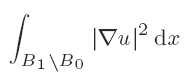 is minimal if and only if the balls are concentric. It is also shown that the first (Dirichlet) eigenvalue of the Laplacian in B1\B0 is maximal if and only if the balls are concentric. Generalizations are indicated.
Constructing the symplectic Evans matrix using maximally analytic individual vectors
-
- Journal:
- Proceedings of the Royal Society of Edinburgh. Section A: Mathematics / Volume 133 / Issue 3 / June 2003
- Published online by Cambridge University Press:
- 12 July 2007, pp. 505-526
- Print publication:
- June 2003
-
- Article
- Export citation
