Refine search
Actions for selected content:
26079 results in Abstract analysis
Constructing the symplectic Evans matrix using maximally analytic individual vectors
-
- Journal:
- Proceedings of the Royal Society of Edinburgh. Section A: Mathematics / Volume 133 / Issue 3 / June 2003
- Published online by Cambridge University Press:
- 12 July 2007, pp. 505-526
- Print publication:
- June 2003
-
- Article
- Export citation
Extensions of multilinear operators and Banach space properties
-
- Journal:
- Proceedings of the Royal Society of Edinburgh. Section A: Mathematics / Volume 133 / Issue 3 / June 2003
- Published online by Cambridge University Press:
- 12 July 2007, pp. 549-566
- Print publication:
- June 2003
-
- Article
- Export citation
Exact multiplicity for semilinear elliptic Dirichlet problems involving concave and convex nonlinearities
-
- Journal:
- Proceedings of the Royal Society of Edinburgh. Section A: Mathematics / Volume 133 / Issue 3 / June 2003
- Published online by Cambridge University Press:
- 12 July 2007, pp. 705-717
- Print publication:
- June 2003
-
- Article
- Export citation
-
Let B be the unit ball in Rn, n ≥ 3. Let 0 < p < 1 < q ≤ (n + 2)/(n − 2). In 1994, Ambrosetti et al. found that the semilinear elliptic Dirichlet problem
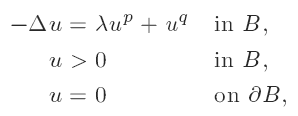 admits at least two solutions for small λ > 0 and no solution for large λ. In this paper, we prove that there is a critical number Λ > 0 such that this problem has exactly two solutions for λ ∈ (0, Λ), exactly one solution for λ = Λ and no solution for λ > Λ.
Non-existence of global smooth solutions to symmetrizable nonlinear hyperbolic systems
-
- Journal:
- Proceedings of the Royal Society of Edinburgh. Section A: Mathematics / Volume 133 / Issue 3 / June 2003
- Published online by Cambridge University Press:
- 12 July 2007, pp. 719-728
- Print publication:
- June 2003
-
- Article
- Export citation
Indefinite Sturm–Liouville problems
-
- Journal:
- Proceedings of the Royal Society of Edinburgh. Section A: Mathematics / Volume 133 / Issue 3 / June 2003
- Published online by Cambridge University Press:
- 12 July 2007, pp. 639-652
- Print publication:
- June 2003
-
- Article
- Export citation
Homogenized model for a laminar ferromagnetic medium
-
- Journal:
- Proceedings of the Royal Society of Edinburgh. Section A: Mathematics / Volume 133 / Issue 3 / June 2003
- Published online by Cambridge University Press:
- 12 July 2007, pp. 567-598
- Print publication:
- June 2003
-
- Article
- Export citation
Existence of renormalized solutions of degenerate elliptic-parabolic problems
-
- Journal:
- Proceedings of the Royal Society of Edinburgh. Section A: Mathematics / Volume 133 / Issue 3 / June 2003
- Published online by Cambridge University Press:
- 12 July 2007, pp. 477-496
- Print publication:
- June 2003
-
- Article
- Export citation
Corrigendum
-
- Journal:
- Proceedings of the Royal Society of Edinburgh. Section A: Mathematics / Volume 133 / Issue 3 / June 2003
- Published online by Cambridge University Press:
- 12 July 2007, pp. 729-730
- Print publication:
- June 2003
-
- Article
-
- You have access
- Export citation
The Oberwolfach Meeting on Combinatorics, Probability and Computing
-
- Journal:
- Combinatorics, Probability and Computing / Volume 12 / Issue 3 / May 2003
- Published online by Cambridge University Press:
- 20 May 2003, p. 223
-
- Article
- Export citation
Randomized Pursuit-Evasion in Graphs
-
- Journal:
- Combinatorics, Probability and Computing / Volume 12 / Issue 3 / May 2003
- Published online by Cambridge University Press:
- 20 May 2003, pp. 225-244
-
- Article
- Export citation
Connectedness of the Degree Bounded Star Process
-
- Journal:
- Combinatorics, Probability and Computing / Volume 12 / Issue 3 / May 2003
- Published online by Cambridge University Press:
- 20 May 2003, pp. 269-283
-
- Article
- Export citation
Hereditary Extended Properties, Quasi-Random Graphs and Induced Subgraphs
-
- Journal:
- Combinatorics, Probability and Computing / Volume 12 / Issue 3 / May 2003
- Published online by Cambridge University Press:
- 20 May 2003, pp. 319-344
-
- Article
- Export citation
Tail Bounds and Expectations for Random Arc Allocation and Applications
-
- Journal:
- Combinatorics, Probability and Computing / Volume 12 / Issue 3 / May 2003
- Published online by Cambridge University Press:
- 20 May 2003, pp. 301-318
-
- Article
- Export citation
Determining the Optimal Contrast for Secret Sharing Schemes in Visual Cryptography
-
- Journal:
- Combinatorics, Probability and Computing / Volume 12 / Issue 3 / May 2003
- Published online by Cambridge University Press:
- 20 May 2003, pp. 285-299
-
- Article
- Export citation
Branching Random Walks on Quasi-Transitive Graphs
-
- Journal:
- Combinatorics, Probability and Computing / Volume 12 / Issue 3 / May 2003
- Published online by Cambridge University Press:
- 20 May 2003, pp. 345-358
-
- Article
- Export citation
Some Results on Random Unsatisfiable k-Sat Instances and Approximation Algorithms Applied to Random Structures
-
- Journal:
- Combinatorics, Probability and Computing / Volume 12 / Issue 3 / May 2003
- Published online by Cambridge University Press:
- 20 May 2003, pp. 245-267
-
- Article
- Export citation
A residual-based error formula for a class of transport equations
-
- Journal:
- European Journal of Applied Mathematics / Volume 14 / Issue 2 / April 2003
- Published online by Cambridge University Press:
- 09 May 2003, pp. 181-200
-
- Article
- Export citation
An Abel ordinary differential equation class generalizing known integrable classes
-
- Journal:
- European Journal of Applied Mathematics / Volume 14 / Issue 2 / April 2003
- Published online by Cambridge University Press:
- 09 May 2003, pp. 217-229
-
- Article
- Export citation
Existence of a solution for a free boundary problem in the thermoelectrical modelling of an aluminium electrolytic cell
-
- Journal:
- European Journal of Applied Mathematics / Volume 14 / Issue 2 / April 2003
- Published online by Cambridge University Press:
- 09 May 2003, pp. 201-216
-
- Article
- Export citation
On the solution of the modified Ginzburg–Landau type equation for a one-dimensional superconductor in the presence of a normal layer
-
- Journal:
- European Journal of Applied Mathematics / Volume 14 / Issue 2 / April 2003
- Published online by Cambridge University Press:
- 09 May 2003, pp. 247-256
-
- Article
- Export citation
