Refine search
Actions for selected content:
26078 results in Abstract analysis
Contents
-
- Book:
- Complex Variables
- Published online:
- 05 September 2012
- Print publication:
- 28 April 2003, pp vii-x
-
- Chapter
- Export citation
LA FORMULE DE PLANCHEREL POUR LES GROUPES p-ADIQUES. D’APRÈS HARISH-CHANDRA
-
- Journal:
- Journal of the Institute of Mathematics of Jussieu / Volume 2 / Issue 2 / April 2003
- Published online by Cambridge University Press:
- 13 May 2003, pp. 235-333
- Print publication:
- April 2003
-
- Article
-
- You have access
- Export citation
On Cahn—Hilliard systems with elasticity
-
- Journal:
- Proceedings of the Royal Society of Edinburgh. Section A: Mathematics / Volume 133 / Issue 2 / April 2003
- Published online by Cambridge University Press:
- 12 July 2007, pp. 307-331
- Print publication:
- April 2003
-
- Article
- Export citation
Gradient theory of phase transitions in composite media
-
- Journal:
- Proceedings of the Royal Society of Edinburgh. Section A: Mathematics / Volume 133 / Issue 2 / April 2003
- Published online by Cambridge University Press:
- 12 July 2007, pp. 265-296
- Print publication:
- April 2003
-
- Article
- Export citation
Bendixson's criterion for systems with non-C1 vector fields
-
- Journal:
- Proceedings of the Royal Society of Edinburgh. Section A: Mathematics / Volume 133 / Issue 2 / April 2003
- Published online by Cambridge University Press:
- 12 July 2007, pp. 393-407
- Print publication:
- April 2003
-
- Article
- Export citation
The structure of the bounded trajectories set of a scalar convex differential equation
-
- Journal:
- Proceedings of the Royal Society of Edinburgh. Section A: Mathematics / Volume 133 / Issue 2 / April 2003
- Published online by Cambridge University Press:
- 12 July 2007, pp. 237-263
- Print publication:
- April 2003
-
- Article
- Export citation
Heat asymptotics with spectral boundary conditions. II
-
- Journal:
- Proceedings of the Royal Society of Edinburgh. Section A: Mathematics / Volume 133 / Issue 2 / April 2003
- Published online by Cambridge University Press:
- 12 July 2007, pp. 333-361
- Print publication:
- April 2003
-
- Article
- Export citation
REAL HYPERELLIPTIC SURFACES AND THE ORBIFOLD FUNDAMENTAL GROUP
-
- Journal:
- Journal of the Institute of Mathematics of Jussieu / Volume 2 / Issue 2 / April 2003
- Published online by Cambridge University Press:
- 13 May 2003, pp. 169-233
- Print publication:
- April 2003
-
- Article
- Export citation
Hypersurfaces of extremal slope
-
- Journal:
- Proceedings of the Royal Society of Edinburgh. Section A: Mathematics / Volume 133 / Issue 2 / April 2003
- Published online by Cambridge University Press:
- 12 July 2007, pp. 449-465
- Print publication:
- April 2003
-
- Article
- Export citation
New characterizations of Lorentz spaces
-
- Journal:
- Proceedings of the Royal Society of Edinburgh. Section A: Mathematics / Volume 133 / Issue 2 / April 2003
- Published online by Cambridge University Press:
- 12 July 2007, pp. 439-448
- Print publication:
- April 2003
-
- Article
- Export citation
Structure of non-trivial non-negative solutions to singularly perturbed semilinear Dirichlet problems
-
- Journal:
- Proceedings of the Royal Society of Edinburgh. Section A: Mathematics / Volume 133 / Issue 2 / April 2003
- Published online by Cambridge University Press:
- 12 July 2007, pp. 363-392
- Print publication:
- April 2003
-
- Article
- Export citation
-
The structure of non-trivial non-negative solutions to singularly perturbed semilinear Dirichlet problems of the form −ε2Δu = f(u) in Ω, u = 0 on ∂Ω, Ω ⊂ RN a bounded smooth domain, is studied as ε → 0+, for a class of nonlinearities f(u) satisfying f(0) = f(z1) = f(z2) = 0 with 0 < z1 < z2, f < 0 in (0, z1), f > 0 in (z1, z2) and
. It is shown that there are many non-trivial non-negative solutions and they are spike-layer solutions. Moreover, the measure of each spike layer is estimated as ε → 0+. These results are applied to the study of the structure of positive solutions of the same problems with f changing sign many times in (0, ∞). Uniqueness of a large positive solution and many positive intermediate spike-layer solutions are obtained for ε sufficiently small.
Positive solutions for non-homogeneous semilinear elliptic equations with data that changes sign
-
- Journal:
- Proceedings of the Royal Society of Edinburgh. Section A: Mathematics / Volume 133 / Issue 2 / April 2003
- Published online by Cambridge University Press:
- 12 July 2007, pp. 297-306
- Print publication:
- April 2003
-
- Article
- Export citation
-
Let Ω ⊂ RN be a bounded domain. We consider the nonlinear problem
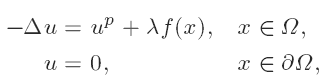 and prove that the existence of positive solutions of the above nonlinear problem is closely related to the existence of non-negative solutions of the following linear problem:
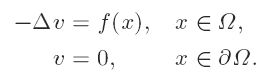 .
.In particular, if p > (N + 2)/(N − 2), then the existence of positive solutions of nonlinear problem is equivalent to the existence of non-negative solutions of the linear problem (for more details, we refer to theorems 1.2 and 1.3 in § 1 of this paper).
Stationary solutions to a nonlinear Schrödinger equation with potential in one dimension
-
- Journal:
- Proceedings of the Royal Society of Edinburgh. Section A: Mathematics / Volume 133 / Issue 2 / April 2003
- Published online by Cambridge University Press:
- 12 July 2007, pp. 409-437
- Print publication:
- April 2003
-
- Article
- Export citation
Multiple boundary blow-up solutions for nonlinear elliptic equations
-
- Journal:
- Proceedings of the Royal Society of Edinburgh. Section A: Mathematics / Volume 133 / Issue 2 / April 2003
- Published online by Cambridge University Press:
- 12 July 2007, pp. 225-235
- Print publication:
- April 2003
-
- Article
- Export citation
A remark on concentration of the error between a function and its best polynomial approximants
-
- Journal:
- Proceedings of the Royal Society of Edinburgh. Section A: Mathematics / Volume 133 / Issue 2 / April 2003
- Published online by Cambridge University Press:
- 12 July 2007, pp. 467-476
- Print publication:
- April 2003
-
- Article
- Export citation
Nucleation of vortices with a temperature and time-dependent Ginzburg–Landau model of superconductivity
-
- Journal:
- European Journal of Applied Mathematics / Volume 14 / Issue 1 / February 2003
- Published online by Cambridge University Press:
- 19 March 2003, pp. 111-127
-
- Article
- Export citation
The Average Displacement of the Simple Random Walk on the Sierpiński Graph
-
- Journal:
- Combinatorics, Probability and Computing / Volume 12 / Issue 2 / March 2003
- Published online by Cambridge University Press:
- 17 March 2003, pp. 203-222
-
- Article
- Export citation
Propagation of hexagonal patterns near onset
-
- Journal:
- European Journal of Applied Mathematics / Volume 14 / Issue 1 / February 2003
- Published online by Cambridge University Press:
- 17 March 2003, pp. 85-110
-
- Article
- Export citation
Local Density in Graphs with Forbidden Subgraphs
-
- Journal:
- Combinatorics, Probability and Computing / Volume 12 / Issue 2 / March 2003
- Published online by Cambridge University Press:
- 17 March 2003, pp. 139-153
-
- Article
- Export citation
Expulsion of disclinations in nematic liquid crystals
-
- Journal:
- European Journal of Applied Mathematics / Volume 14 / Issue 1 / February 2003
- Published online by Cambridge University Press:
- 17 March 2003, pp. 39-59
-
- Article
- Export citation
