Refine search
Actions for selected content:
26077 results in Abstract analysis
Normal modes for a stratified viscous fluid layer
-
- Journal:
- Proceedings of the Royal Society of Edinburgh. Section A: Mathematics / Volume 132 / Issue 3 / June 2002
- Published online by Cambridge University Press:
- 12 July 2007, pp. 611-625
- Print publication:
- June 2002
-
- Article
- Export citation
Multiplicities of eigenvalues of a vector-valued Sturm-Liouville problem
- Part of
-
- Journal:
- Mathematika / Volume 49 / Issue 1-2 / June 2002
- Published online by Cambridge University Press:
- 26 February 2010, pp. 119-127
- Print publication:
- June 2002
-
- Article
- Export citation
Subexponential solutions of linear integro-differential equations and transient renewal equations
-
- Journal:
- Proceedings of the Royal Society of Edinburgh. Section A: Mathematics / Volume 132 / Issue 3 / June 2002
- Published online by Cambridge University Press:
- 12 July 2007, pp. 521-543
- Print publication:
- June 2002
-
- Article
- Export citation
-
This paper studies the asymptotic behaviour of the solutions of the scalar integro-differential equation
 The kernel k is assumed to be positive, continuous and integrable.If
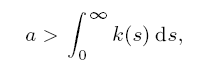 it is known that all solutions x are integrable and x(t) → 0 as t → ∞, but also that x = 0 cannot be exponentially asymptotically stable unless there is some γ > 0 such that
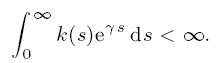 Here, we restrict the kernel to be in a class of subexponential functions in which k(t) → 0 as t → ∞ so slowly that the above condition is violated. It is proved here that the rate of convergence of x(t) → 0 as t → ∞ is given by
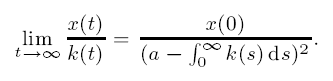 The result is proved by determining the asymptotic behaviour of the solution of the transient renewal equation
 If the kernel h is subexponential, then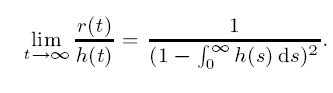
Hilbert function and fractional powers
- Part of
-
- Journal:
- Mathematika / Volume 49 / Issue 1-2 / June 2002
- Published online by Cambridge University Press:
- 26 February 2010, pp. 71-75
- Print publication:
- June 2002
-
- Article
- Export citation
On the representation of an integer as the sum of a large and a small square
- Part of
-
- Journal:
- Mathematika / Volume 49 / Issue 1-2 / June 2002
- Published online by Cambridge University Press:
- 26 February 2010, pp. 245-251
- Print publication:
- June 2002
-
- Article
- Export citation
-
We continue our study of the different representations of an integer n as a sum of two squares initiated in our final paper written with Paul Erdős [1]. We let r(n) denote the number of representations n = a2 + b2 counted in the usual way, that is, with regard to both the order and sign of a and b. We have

where x is the non-principal Dirichlet character (mod 4); moreover, r(n)≥0 if and only if n has no prime factor p ≡ 3 (mod 4) with odd exponent. We define the function b(n) on the sequence of representable numbers as the least possible value of |b|—for example, we have b(13) = 2,b(25) = 0, b(65) = 1—and we write

here and throughout the paper the star denotes that the sum is restricted to the representable integers. The problem considered here is to find an asymptotic formula for this sum, or, less ambitiously, to determine the order of magnitude of the function B(x).
Index to Volume 49
-
- Journal:
- Mathematika / Volume 49 / Issue 1-2 / June 2002
- Published online by Cambridge University Press:
- 26 February 2010, p. 263
- Print publication:
- June 2002
-
- Article
- Export citation
Adjacency preserving maps on matrices and operators
-
- Journal:
- Proceedings of the Royal Society of Edinburgh. Section A: Mathematics / Volume 132 / Issue 3 / June 2002
- Published online by Cambridge University Press:
- 12 July 2007, pp. 661-684
- Print publication:
- June 2002
-
- Article
- Export citation
Rational homology of spaces of complex monic polynomials with multiple roots
- Part of
-
- Journal:
- Mathematika / Volume 49 / Issue 1-2 / June 2002
- Published online by Cambridge University Press:
- 26 February 2010, pp. 77-91
- Print publication:
- June 2002
-
- Article
- Export citation
An analogue of Van der Corput's A5-process for exponential sums
- Part of
-
- Journal:
- Mathematika / Volume 49 / Issue 1-2 / June 2002
- Published online by Cambridge University Press:
- 26 February 2010, pp. 167-183
- Print publication:
- June 2002
-
- Article
- Export citation
-
A diophantine system is studied from which is deduced an analogue of van der Corput's A5-process in order to bound analytic exponential sums of the form
 . The saving has now to be taken to the exponent 1/20 instead of 1/32. Our main application is a “ninth derivative test” for exponential sums which is essential for giving new exponent pairs in [3].
 . The saving has now to be taken to the exponent 1/20 instead of 1/32. Our main application is a “ninth derivative test” for exponential sums which is essential for giving new exponent pairs in [3].
An application of the theory of monotone systems to an electrical circuit
-
- Journal:
- Proceedings of the Royal Society of Edinburgh. Section A: Mathematics / Volume 132 / Issue 3 / June 2002
- Published online by Cambridge University Press:
- 12 July 2007, pp. 711-728
- Print publication:
- June 2002
-
- Article
- Export citation
Small positive values of indefinite ternary forms
- Part of
-
- Journal:
- Mathematika / Volume 49 / Issue 1-2 / June 2002
- Published online by Cambridge University Press:
- 26 February 2010, pp. 185-196
- Print publication:
- June 2002
-
- Article
- Export citation
-
For an indefinite quadratic form f(x1,…,xn) of discriminant d. let P(f) denote the greatest lower bound of the positive values assumed by f for integers x1, …, xn. This paper investigates the values of P3/|d| for nonzero ternary forms of signature −1, and finds the only remaining class of forms with
 .
.
 .
.The Hooley–Huxley contour method, for problems in number fields II: factorization and divisibility
- Part of
-
- Journal:
- Mathematika / Volume 49 / Issue 1-2 / June 2002
- Published online by Cambridge University Press:
- 26 February 2010, pp. 201-225
- Print publication:
- June 2002
-
- Article
- Export citation
-
Let L be a Galois extension of the number field K. Set n = nK = deg K/ℚ, nL = deg L/ℚ and nL/K = deg L/K. Let I = IL/K denote the group of fractional ideals of K whose prime decomposition contains no prime ideals that ramify in L, and let P = {(α)ΣI: αΣK*, α>0}. Following Hecke [9}, let (λ1, λ2, …, λn − 1) be a basis for the torsion-free characters on P that satisfy λi(α) = 1 (1≤i≤n − 1) for all units α>0 in
 , the ring of integers of K. Fixing an extension of each λi to a character on I, then λi,(α) (1 ≤i≤n − 1) are defined for all ideals α of K that do not ramify in L. So, for such ideals, we can define
  . Then the small region of K referred to above is
for 0<l<½ and
with the notation that, for any α ∈ ℝ, we set  β. where β is the unique real satisyfing
  .
.
 , the ring of integers of K. Fixing an extension of each λ
 . Then the small region of K referred to above is
 β. where β is the unique real satisyfing
  .
.On the spectral theory of a tapered rod
-
- Journal:
- Proceedings of the Royal Society of Edinburgh. Section A: Mathematics / Volume 132 / Issue 3 / June 2002
- Published online by Cambridge University Press:
- 12 July 2007, pp. 729-764
- Print publication:
- June 2002
-
- Article
- Export citation
-
This paper establishes the main features of the spectral theory for the singular two-point boundary-value problem

 and
and which models the buckling of a rod whose cross-sectional area decays to zero at one end. The degree of tapering is related to the rate at which the coefficient A tends to zero as s approaches 0. We say that there is tapering of order p ≥ 0 when A ∈ C([0, 1]) with A(s) > 0 for s ∈ (0, 1] and there is a constant L ∈ (0, ∞) such that lims→0A(s)/sp = L. A rigorous spectral theory involves relating (1)−(3) to the spectrum of a linear operator in a function space and then investigating the spectrum of that operator. We do this in two different (but, as we show, equivalent) settings, each of which is natural from a certain point of view. The main conclusion is that the spectral properties of the problem for tapering of order p = 2 are very different from what occurs for p < 2. For p = 2, there is a non-trivial essential spectrum and possibly no eigenvalues, whereas for p < 2, the whole spectrum consists of a sequence of simple eigenvalues. Establishing the details of this spectral theory is an important step in the study of the corresponding nonlinear model. The first function space that we choose is the one best suited to the mechanical interpretation of the problem and the one that is used for treating the nonlinear problem. However, we relate this formulation in a precise way to the usual L2 setting that is most common when dealing with boundary-value problems.
Infinitely many arbitrarily small positive solutions for the Dirichlet problem involving the p-Laplacian
-
- Journal:
- Proceedings of the Royal Society of Edinburgh. Section A: Mathematics / Volume 132 / Issue 3 / June 2002
- Published online by Cambridge University Press:
- 12 July 2007, pp. 511-519
- Print publication:
- June 2002
-
- Article
- Export citation
-
In this paper we present a result of existence of infinitely many arbitrarily small positive solutions to the following Dirichlet problem involving the p-Laplacian,
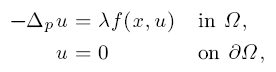 where Ω ∈ RN is a bounded open set with sufficiently smooth boundary ∂Ω, p > 1, λ > 0, and f: Ω × R → R is a Carathéodory function satisfying the following condition: there exists t̄ > 0 such that
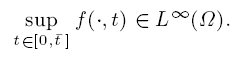 Precisely, our result ensures the existence of a sequence of a.e. positive weak solutions to the above problem, converging to zero in L∞(Ω).
Local inversion for differentiable functions and the Darboux property
- Part of
-
- Journal:
- Mathematika / Volume 49 / Issue 1-2 / June 2002
- Published online by Cambridge University Press:
- 26 February 2010, pp. 141-158
- Print publication:
- June 2002
-
- Article
- Export citation
-
The main goal of this paper is to prove that the classical theorem of local inversion for
 functions extends in finite dimension to everywhere differentiable functions. As usual, a theorem of implicit functions can be deduced from this “Local Inversion Theorem”. The deepest part of the local inversion theorem consists of showing that a differentiable function with non-vanishing Jacobian determinant is locally one-to-one. In turn, this fact allows one to extend the Darboux property of derivative functions on ℝ (the range of the derivative is an interval) to the Jacobian function Df of a differentiable function, under the condition that this Jacobian function does not vanish. It is also proved that these results are no longer true in infinite dimension. These results should be known in whole or part, but references to a complete proof could not be found.
 functions extends in finite dimension to everywhere differentiable functions. As usual, a theorem of implicit functions can be deduced from this “Local Inversion Theorem”. The deepest part of the local inversion theorem consists of showing that a differentiable function with non-vanishing Jacobian determinant is locally one-to-one. In turn, this fact allows one to extend the Darboux property of derivative functions on ℝ (the range of the derivative is an interval) to the Jacobian function D
Positive solutions for the p-Laplacian in annuli
-
- Journal:
- Proceedings of the Royal Society of Edinburgh. Section A: Mathematics / Volume 132 / Issue 3 / June 2002
- Published online by Cambridge University Press:
- 12 July 2007, pp. 595-610
- Print publication:
- June 2002
-
- Article
- Export citation
Lipschitz quotient mappings with good ratio of constants
- Part of
-
- Journal:
- Mathematika / Volume 49 / Issue 1-2 / June 2002
- Published online by Cambridge University Press:
- 26 February 2010, pp. 159-165
- Print publication:
- June 2002
-
- Article
- Export citation
MTK volume 49 issue 1-2 Cover and Front matter
-
- Journal:
- Mathematika / Volume 49 / Issue 1-2 / June 2002
- Published online by Cambridge University Press:
- 26 February 2010, pp. f1-f4
- Print publication:
- June 2002
-
- Article
-
- You have access
- Export citation
On shifted products which are powers
- Part of
-
- Journal:
- Mathematika / Volume 49 / Issue 1-2 / June 2002
- Published online by Cambridge University Press:
- 26 February 2010, pp. 227-230
- Print publication:
- June 2002
-
- Article
- Export citation
Uniqueness theorems for convex bodies in non-Euclidean spaces
- Part of
-
- Journal:
- Mathematika / Volume 49 / Issue 1-2 / June 2002
- Published online by Cambridge University Press:
- 26 February 2010, pp. 13-31
- Print publication:
- June 2002
-
- Article
- Export citation
