Refine search
Actions for selected content:
26077 results in Abstract analysis
Admissible Lp norms for local existence and for continuation in semilinear parabolic systems are not the same
-
- Journal:
- Proceedings of the Royal Society of Edinburgh. Section A: Mathematics / Volume 131 / Issue 6 / December 2001
- Published online by Cambridge University Press:
- 12 July 2007, pp. 1435-1456
- Print publication:
- December 2001
-
- Article
- Export citation
Existence of positive solutions of some semilinear elliptic equations with singular coefficients
-
- Journal:
- Proceedings of the Royal Society of Edinburgh. Section A: Mathematics / Volume 131 / Issue 6 / December 2001
- Published online by Cambridge University Press:
- 12 July 2007, pp. 1275-1295
- Print publication:
- December 2001
-
- Article
- Export citation
-
In this paper we consider the semilinear elliptic problem in a bounded domain Ω ⊆ Rn,
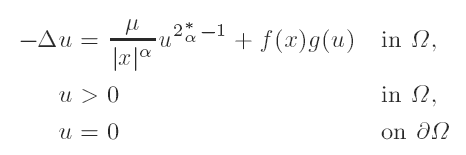 where μ ≥ 0, 0 ≤ α ≤ 2, 2α* := 2(n − α)/(n − 2), f : Ω → R+ is measurable, f > 0 a.e, having a lower-order singularity than |x|-2 at the origin, and g : R → R is either linear or superlinear. For 1 < p < n, we characterize a class of singular functions Ip for which the embedding
 is compact. When p = 2, α = 2, f ∈ I2 and 0 ≤ μ < (½(n − 2))2, we prove that the linear problem has
Blow-up for a parabolic system coupled in an equation and a boundary condition
-
- Journal:
- Proceedings of the Royal Society of Edinburgh. Section A: Mathematics / Volume 131 / Issue 6 / December 2001
- Published online by Cambridge University Press:
- 12 July 2007, pp. 1345-1355
- Print publication:
- December 2001
-
- Article
- Export citation
-
In this paper, we consider non-negative solutions of
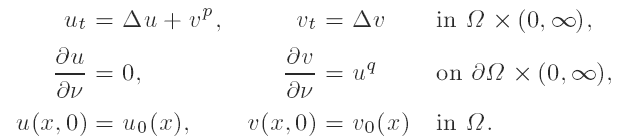 ,We prove that if pq ≤ 1, every solution is global while if pq > 1, all solutions blow up in finite time. We also show that if p, q ≥ 1, then blow-up can occur only on the boundary.
The values of ternary quadratic forms at prime arguments
-
- Journal:
- Mathematika / Volume 48 / Issue 1-2 / December 2001
- Published online by Cambridge University Press:
- 26 February 2010, pp. 137-149
- Print publication:
- December 2001
-
- Article
- Export citation
-
Montgomery and Vaughan [12] have shown that the exceptional set in Goldbach's problem

satisfies

for some Δ>0. Li [10,11] has shown that we may take Δ = 0·079 and Δ = 0·086. If the Riemann Hypothesis is true for all Dirichlet L-functions then (1) holds for any Δ<½. This is a classical result due to Hardy and Littlewood [7].
Minimal blow-up asymptotics of quasilinear heat equations
-
- Journal:
- Proceedings of the Royal Society of Edinburgh. Section A: Mathematics / Volume 131 / Issue 6 / December 2001
- Published online by Cambridge University Press:
- 12 July 2007, pp. 1297-1321
- Print publication:
- December 2001
-
- Article
- Export citation
-
We study the asymptotic properties of blow-up solutions u = u(x, t) ≥ 0 of the quasilinear heat equation
 ,where k(u) is a smooth non-negative function, with a given blowing up regime on the boundary u(0, t) = ψ(t) > 0 for t ∈ (0, 1), where ψ(t) → ∞ as t → 1−, and bounded initial data u(x, 0) ≥ 0. We classify the asymptotic properties of the solutions near the blow-up time, t → 1−, in terms of the heat conductivity coefficient k(u) and of boundary data ψ(t); both are assumed to be monotone. We describe a domain, denoted by
 We prove that for any problem in S11−, such a blow-up singularity is asymptotically structurally equivalent to a singularity of the heat equation ut = uxx described by its self-similar solution of the form u*(x, t) = −ln(1 − t) + g(ξ), ξ = x/(1 − t)1/2, where g solves a linear ordinary differential equation. This particular self-similar solution is structurally stable upon perturbations of the boundary function and also upon nonlinear perturbations of the heat equation with the basin of attraction
A new approach to analyticity of Dirichlet-Neumann operators
-
- Journal:
- Proceedings of the Royal Society of Edinburgh. Section A: Mathematics / Volume 131 / Issue 6 / December 2001
- Published online by Cambridge University Press:
- 12 July 2007, pp. 1411-1433
- Print publication:
- December 2001
-
- Article
- Export citation
How to realize a given number of tangents to four unit balls in ℝ3
- Part of
-
- Journal:
- Mathematika / Volume 48 / Issue 1-2 / December 2001
- Published online by Cambridge University Press:
- 26 February 2010, pp. 51-62
- Print publication:
- December 2001
-
- Article
- Export citation
Asymptotic problems for a kinetic model of two-phase flow
-
- Journal:
- Proceedings of the Royal Society of Edinburgh. Section A: Mathematics / Volume 131 / Issue 6 / December 2001
- Published online by Cambridge University Press:
- 12 July 2007, pp. 1371-1384
- Print publication:
- December 2001
-
- Article
- Export citation
Decay spectrum and decay subspace of normal operators
-
- Journal:
- Proceedings of the Royal Society of Edinburgh. Section A: Mathematics / Volume 131 / Issue 6 / December 2001
- Published online by Cambridge University Press:
- 12 July 2007, pp. 1245-1255
- Print publication:
- December 2001
-
- Article
- Export citation
-
Let A be a self-adjoint operator on a Hilbert space. It is well known that A admits a unique decomposition into a direct sum of three self-adjoint operators Ap, Aac and Asc such that there exists an orthonormal basis of eigenvectors for the operator Ap, the operator Aac has purely absolutely continuous spectrum and the operator Asc has purely singular continuous spectrum. We show the existence of a natural further decomposition of the singular continuous component Asc into a direct sum of two self-adjoint operators
A syntactic approach to covers for E-dense semigroups over group varieties
- Part of
-
- Journal:
- Mathematika / Volume 48 / Issue 1-2 / December 2001
- Published online by Cambridge University Press:
- 26 February 2010, pp. 231-245
- Print publication:
- December 2001
-
- Article
- Export citation
Index to Volume 47
-
- Journal:
- Mathematika / Volume 48 / Issue 1-2 / December 2001
- Published online by Cambridge University Press:
- 26 July 2012, p. 317
- Print publication:
- December 2001
-
- Article
- Export citation
Lattice points in lattice polytopes
- Part of
-
- Journal:
- Mathematika / Volume 48 / Issue 1-2 / December 2001
- Published online by Cambridge University Press:
- 26 February 2010, pp. 15-24
- Print publication:
- December 2001
-
- Article
- Export citation
Deterministic and randomized polynomial-time approximation of radii
- Part of
-
- Journal:
- Mathematika / Volume 48 / Issue 1-2 / December 2001
- Published online by Cambridge University Press:
- 26 February 2010, pp. 63-105
- Print publication:
- December 2001
-
- Article
-
- You have access
- Export citation
The arithmetic of partitions into distinct parts
- Part of
-
- Journal:
- Mathematika / Volume 48 / Issue 1-2 / December 2001
- Published online by Cambridge University Press:
- 26 February 2010, pp. 203-211
- Print publication:
- December 2001
-
- Article
- Export citation
-
A partition of the positive integer n into distinct parts is a decreasing sequence of positive integers whose sum is n, and the number of such partitions is denoted by Q(n). If we adopt the convention that Q(0) = 1, then we have the generating function

The inverse Goldbach problem
- Part of
-
- Journal:
- Mathematika / Volume 48 / Issue 1-2 / December 2001
- Published online by Cambridge University Press:
- 26 February 2010, pp. 151-158
- Print publication:
- December 2001
-
- Article
- Export citation
-
Improved upper and lower bounds of the counting functions of the conceivable additive decomposition sets of the set of primes are established. Suppose that
 where, ℝ′ differs from the set of primes in finitely many elements only and
  .
.It is shown that the counting functions A(x) of ℐ and B(x) of ℬ for sufficiently large x, satisfy

 where, ℝ′ differs from the set of primes in finitely many elements only and
  .
.
Book Reviews - M. Aigner and G. M. Ziegler. Proofs from The Book (2nd edition). Springer (Berlin), 2001; 215 pp. ISBN 3 540 67865 4 (hardback), £18.50. - R. P. Agarwal M. Meehan and D. O'reagan. Fixed Point Theory and Applications. Cambridge Tracts in Mathematics 141, Cambridge University Press, 2001; 170 pp. ISBN 0 521 80250 4 (hardback), £37.50. - S. Alpern and V. S. Prasad. Typical Dynamics of Volume-Preserving Homeomorphisms. Cambridge Tracts in Mathematics 139, Cambridge University Press, 2000; 216 pp. ISBN 0 521 58287 3 (hardback), £30. - I. Anderson. A First Course in Discrete Mathematics. Springer Undergraduate Mathematics Series, Springer (London), 2000; 200 pp. ISBN 1 85233 236 0 (paperback), £18.95. - M. Aschbacher. Finite Group Theory (2nd edition). Cambridge Studies in Advanced Mathematics 19, Cambridge University Press, 2000; 304 pp. ISBN 0 521 78145 0 (hardback), £52.50; 0 521 78675 4 (paperback), £19.95. - J. Bang-Jensen and G. Gutin. Digraphs: Theory, Algorithms and Applications. Springer Monographs in Mathematics, Springer (London), 2001; 754 pp. ISBN 1 85233 268 9 (hardback), £59. - D. Bao S.-S. Chern and Z. Shen. An Introduction to Riemann-Finsler Geometry. Graduate Texts in Mathematics 200, Springer (New York, Berlin), 2000; 431 pp. ISBN 0 387 98948 X (hardback), £34. - H. Bass and A. Lubotzky. Tree Lattices. Progress in Mathematics 176, Birkhäuser (Boston), 2000; 233 pp. ISBN 0 8176 4120 3 (hardback), £36 (approx.). - V. I. Bernik and M. M. Dobson. Metric Diophantine Aproximation on Manifolds. Cambridge University Press, 1999; 172 pp. ISBN 0 521 43275 8 (hardback), £27.50. - S. Billey and V. Lakshmibai. Singular Loci of Schubert Varieties. Progress in Mathematics 182, Birkhäuser (Boston), 2000; 251 pp. ISBN 0 8176 4092 4 (hardback), £40 (approx.). - F. Borceux and G. Janelidze. Galois Theories. Cambridge Studies in Advanced Mathematics, Cambridge University Press, 2001; 341 pp. ISBN 0 521 80309 8 (hardback), £50. - TH. Breuer. Characters and Automorphism Groups of Compact Riemann Surfaces. London Mathematical Society Lecture Notes Series 280, Cambridge University Press, 2000; 199 pp. ISBN 0 521 79809 4 (paperback), £24.95. - X. H. Cao S. X. Liu K. P. Shum and C. C. Yang. Rings, Groups and Algebras. Lecture Notes in Pure and Applied Mathematics 181, Marcel Dekker, Inc. (New York), 1996; 332 pp. ISBN 0 8247 9733 7 (paperback), £110 (approx.). - E. Casas-Alvero. Singularities of Plane Curves. London Mathematical Society Lecture Notes Series 276, Cambridge University Press, 2000; 345 pp. ISBN 0 521 78959 1 (paperback), £29.95. - J. L. Casti. Five More Golden Rules: Knots, Codes, Chaos and Other Great Theories of 20th Century Mathematics. John Wiley and Sons (New York), 2000; 268 pp. ISBN 0 471 39528 5 (paperback), £12.50. - J. W. Cholewa and T. Dlotko. Global Attractors in Abstract Parabolic Problems. London Mathematical Society Lecture Notes Series 278, Cambridge University Press, 2000; 235 pp. ISBN 0 521 79424 2 (paperback), £27.95. - S. Dăscălescu C. Năstăcescu and Ş Raianu. Hopf Algebras: An Introduction. Monographs and Textbooks in Pure and Applied Mathematics 235, Marcel Dekker, Inc. (New York), 2001; 401 pp. ISBN 0 8247 0481 9 (hardback), £97.40. - K. Deb. Multi-Objective Optimization Using Evolutionary Algorithms. Wiley-Interscience Series in Systems and Optimization, John Wiley and Sons (New York), 2001; 497 pp. ISBN 0 471 87339 X (hardback), £60. - R. A. De Vore A. Iserles and E. Süli. Foundations of Computational Mathematics. London Mathematical Society Lecture Notes Series 284, Cambridge University Press, 2001; 400 pp. ISBN 0 521 00349 0 (paperback), £34.95. - A. K. Dewdney. A Mathematical Mystery Tour. John Wiley and Sons (New York), 1999; 218 pp. ISBN 0 471 23847 3 (paperback), £11.50. - V. Drensky A. Giambruno and S. Sehgal (EDITORS). Methods in Ring Theory. Lecture Notes in Pure and Applied Mathematics 198, Marcel Dekker, Inc. (New York), 1998; 314 pp. ISBN 0 8247 0183 6 (paperback), £95 (approx.). - C. F. Dunkl and Y. Xu. Orthogonal Polynomials of Several Variables. Encyclopedia of Mathematics and its Applications 81, Cambridge University Press, 2001; 390 pp. ISBN 0 521 80043 9 (hardback), £55. - B. Engquist and W. Schmid (EDITORS). Mathematics Unlimited–2001 and Beyond. Springer (Berlin), 2001; 1297 pp. ISBN 3 540 66913 2 (hardback), £27. - D. R. Farenick. The Algebra of Linear Transformations. Springer Universitext, Springer (Berlin), 2001; 238 pp. ISBN 0 387 95062 1 (hardback), £34. - A. T. Filippov. The Versatile Soliton. Birkhäuser (Boston), 2000; 261 pp. ISBN 0 8176 3635 8 (hardback), £32 (approx.). - B. Fine and G. Rosenberger. Algebraic Generalizations of Discrete Groups. Monographs and Textbooks in Pure and Applied Mathematics 223, Marcel Dekker, Inc. (New York), 1999; 317 pp. ISBN 0 8247 0319 7 (hardback). - C. G. Gibson. Elementary Geometry of Differentiable Curves. Cambridge University Press, 2001; 216 pp. ISBN 0 521 80453 (hardback), £47.50; 0 521 01107 8 (paperback), £16.95. - J. J. Gray. Linear Differential Equations and Group Theory from Riemann to Poincaré (2nd edition). Birkhäuser (Basel), 2000; 338 pp. ISBN 0 8176 3837 7 (hardback), £50 (approx.). - E. Győri and V. T. Sős (EDITORS). Recent Trends in Combinatorics: The Legacy of Paul Erőds. Cambridge University Press, 2001; 192 pp. ISBN 0 521 80170 2 (hardback), £35. - D. R. Hankerson D. G. Hoffman D. A. Leonard C. C. Lindner K. T. Phelps C. A. Rodger and J. R. Wall. Coding Theory and Cryptography: The Essentials (2nd edition). Monoographs and Textbooks in Pure and Applied Mathematics 234, Marcel Dekker, Inc. (New York), 2000; 350 pp. ISBN 0 8247 0465 7 (hardback), £60 (approx.). - J. W. P. Hirschfeld (EDITOR). Surveys in Combinatorics 2001. London Mathematical Society Lecture Notes Series 288, Cambridge University Press, 2001; 301 pp. ISBN 0 521 00270 2 (paperback), £27.95. - R. J. IorioJr and V. De M. Iorio. Fourier Analysis and Partial Differential Equations. Cambridge Studies in Advanced Mathematics 70, Cambridge University Press, 2001; 411 pp. ISBN 0 521 62116 X (hardback), £45. - G. Kalai and G. M. Ziegler (EDITORS). Poly topes—Combinatorics and Computation. Birkhäuser (Basel), 2000; 225 pp. ISBN 3 7643 6351 7 (paperback), £20 (approx.). - J. Kigami. Analysis on Fractals. Cambridge Tracts in Mathematics 143, Cambridge University Press, 2001; 226 pp. ISBN 0 521 79321 1 (hardback), £35. - M. Kreuzer and L. Robbiano. Computational Commutative Algebra, I. Springer (Berlin-Heidelberg), 2000; 321 pp. ISBN 3 540 67733 X (hardback), £24. - S. Lang. Collected Papers. Springer (Berlin), 2000 (I-IV), 2001 (V). I: 525 pp. ISBN 0 387 98802 5 (hardback), £55; II: 590 pp. ISBN 0 387 98803 3 (hardback), £55; III: 393 pp. ISBN 0 387 98800 9 (hardback), £55; IV: 471 pp. ISBN 0 387 98804 1 (hardback), £55; V: 426 pp. ISBN 0 387 95030 3 (hardback), £61.50. - J. M. Lee. Introduction to Topological Manifolds. Graduate Texts in Mathematics 202, Springer (Berlin), 2000; 385 pp. ISBN 0 387 98759 2 (hardback), £48; 0 387 95026 5 (paperback), £24. - P. Mayberry. The Foundations of Mathematics in the Theory of Sets. Encyclopedia of Mathematics and its Applications 82, Cambridge University Press, 2000; 424 pp. ISBN 0 521 77034 3 (hardback), £55. - V. V. Mitin D. A. Romanov and M. P. Polis. Modern Advanced Mathematics for Engineers. John Wiley and Sons (New York), 2001; 308 pp. ISBN 0 471 41770 X (hardback), £64.50. - W. F. Pfeffer. Derivation and Integration. Cambridge Tracts in Mathematics 140, Cambridge University Press, 2001; 266 pp. ISBN 0 521 79268 1 (hardback), £45. - A. Pressley. Elementary Differential Geometry. Springer Undergraduate Mathematics Series, Springer (London), 2001; 332 pp. ISBN 1 85233 152 6 (paperback), £18.95. - H. Rademacher and O. Toeplitz. Von Zahlen und Figuren (reprint of the 2nd edition, 1933). Springer (Berlin), 2001; 173 pp. ISBN 3 540 63303 0 (hardback), £25.50. - A. M. Robert. A Course in p-adic Analysis. Springer Graduate Texts in Mathematics 198, Springer (New York, Berlin), 2000; 437 pp. ISBN 0 387 98669 3 (hardback), £37.50. - J. Robinson. Infinite-Dimensional Dynamical Systems. Cambridge Texts in Applied Mathematics, Cambridge University Press, 2001; 461 pp. ISBN 0 521 63204 8 (hardback), £70; 0 521 63564 0 (paperback), £24.95. - G. Sapiro. Geometric Partial Differential Equations and Image Analysis. Cambridge University Press, 2001; 385 pp. ISBN 0 521 79075 1 (hardback). £40. - R. Y. Sharp. Steps in Commutative Algebra (2nd edition). London Mathematical Society Student Texts 51, Cambridge University Press, 2000; 355 pp. ISBN 0 521 64623 5 (paperback), £17.95. - K. E. Smith L. Kahanpaa P. Kekalainen and W. Treves. An Invitation to Algebraic Geometry. Springer Universitext, Springer (New York, Berlin), 2000; 155 pp. ISBN 0 387 98980 3 (hardback), £22. - H. P. F. Swinnerton-Dyer. A Brief Guide to Algebraic Number Theory. London Mathematical Society Student Texts 50, Cambridge University Press, 2001; 146 pp. ISBN 0 521 80292 X (hardback), £45; 0 521 00423 3 (paperback), £15.95. - Y. Talpaert. Differential Geometry with Applications to Mechanics and Physics. Monographs and Textbooks in Pure and Applied Mathematics 237, Marcel Dekker, Inc. (New York), 2001; 454 pp. ISBN 0 8247 0385 5 (hardback), £120 (approx.). - W. T. Tutte. Graph Theory. Cambridge Mathematical Library, Cambridge University Press, 2001; 333 pp. ISBN 0 521 79489 7 (paperback), £19.95. - F. Van Oystaeyen and M. Saorin (EDITORS). Interactions between Ring Theory and Representations of Algebras. Lecture Notes in Pure and Applied Mathematics 210, Marcel Dekker, Inc. (New York), 2000; 449 pp. ISBN 0 8247 0367 7 (paperack), £125 (approx.). - R. H. Villarreal. Monomial Algebras. Monographs and Textbooks in Pure and Applied Mathematics 238, Marcel Dekker, Inc. (New York), 2001; 455 pp. ISBN 0 8247 0524 6 (hardback), £126.62. - R. Wilson and J. gray. Mathematical Conversations: Selections from The Mathematical Intelligencer. Springer (Berlin), 2001; 488 pp. ISBN 0 387 98686 3 (hardback), £41.
-
- Journal:
- Mathematika / Volume 48 / Issue 1-2 / December 2001
- Published online by Cambridge University Press:
- 26 February 2010, pp. 305-316
- Print publication:
- December 2001
-
- Article
- Export citation
About the centroid blody and the ellipsoid of inertia
-
- Journal:
- Mathematika / Volume 48 / Issue 1-2 / December 2001
- Published online by Cambridge University Press:
- 26 February 2010, pp. 1-13
- Print publication:
- December 2001
-
- Article
- Export citation
MTK volume 48 issue 1-2 Cover and Front matter
-
- Journal:
- Mathematika / Volume 48 / Issue 1-2 / December 2001
- Published online by Cambridge University Press:
- 26 February 2010, pp. f1-f4
- Print publication:
- December 2001
-
- Article
-
- You have access
- Export citation
Gaussian primes in narrow sectors
- Part of
-
- Journal:
- Mathematika / Volume 48 / Issue 1-2 / December 2001
- Published online by Cambridge University Press:
- 26 February 2010, pp. 119-135
- Print publication:
- December 2001
-
- Article
-
- You have access
- Export citation
Finite edge-to-edge tilings by convex polygons
- Part of
-
- Journal:
- Mathematika / Volume 48 / Issue 1-2 / December 2001
- Published online by Cambridge University Press:
- 26 February 2010, pp. 25-50
- Print publication:
- December 2001
-
- Article
- Export citation
