Refine search
Actions for selected content:
26077 results in Abstract analysis
Irrational dilations of Pascal's triangle
- Part of
-
- Journal:
- Mathematika / Volume 48 / Issue 1-2 / December 2001
- Published online by Cambridge University Press:
- 26 February 2010, pp. 159-168
- Print publication:
- December 2001
-
- Article
- Export citation
On an integral transform associated with the regular Dirac operator
-
- Journal:
- Proceedings of the Royal Society of Edinburgh. Section A: Mathematics / Volume 131 / Issue 6 / December 2001
- Published online by Cambridge University Press:
- 12 July 2007, pp. 1357-1370
- Print publication:
- December 2001
-
- Article
- Export citation
Orders in completely regular semigroups
- Part of
-
- Journal:
- Mathematika / Volume 48 / Issue 1-2 / December 2001
- Published online by Cambridge University Press:
- 26 February 2010, pp. 213-230
- Print publication:
- December 2001
-
- Article
- Export citation
Decay measures on locally compact abelian topological groups
-
- Journal:
- Proceedings of the Royal Society of Edinburgh. Section A: Mathematics / Volume 131 / Issue 6 / December 2001
- Published online by Cambridge University Press:
- 12 July 2007, pp. 1257-1273
- Print publication:
- December 2001
-
- Article
- Export citation
Total scalar curvature and rigidity of minimal hypersurfaces in Euclidean space
- Part of
-
- Journal:
- Mathematika / Volume 48 / Issue 1-2 / December 2001
- Published online by Cambridge University Press:
- 26 February 2010, pp. 247-251
- Print publication:
- December 2001
-
- Article
- Export citation
-
Let Mn, n ≥ 3, be a complete oriented minimal hypersurface in Euclidean space Rn+1. It is shown that, if the total scalar curvature on M is less than the n/2 power of 1/2Cs, where Cs is the Sobolev constant for M, and the square norm of the second fundamental form
 is a L2 function, then M is a hyperplane.
 is a L
Geometry of the gauss map and lattice points in convex domains
- Part of
-
- Journal:
- Mathematika / Volume 48 / Issue 1-2 / December 2001
- Published online by Cambridge University Press:
- 26 February 2010, pp. 107-117
- Print publication:
- December 2001
-
- Article
- Export citation
Asymptotic decay to relaxation shock fronts in two dimensions
-
- Journal:
- Proceedings of the Royal Society of Edinburgh. Section A: Mathematics / Volume 131 / Issue 6 / December 2001
- Published online by Cambridge University Press:
- 12 July 2007, pp. 1385-1410
- Print publication:
- December 2001
-
- Article
- Export citation
On sigma-phi numbers
-
- Journal:
- Mathematika / Volume 48 / Issue 1-2 / December 2001
- Published online by Cambridge University Press:
- 26 February 2010, pp. 169-189
- Print publication:
- December 2001
-
- Article
- Export citation
-
Let
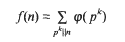
where φ denotes Euler's function. In this memoir we study the set w of sigmaphi numbers, that is, those composite natural numbers n which satisfy

The smallest such number is 65, and they appear to be moderately frequent. There are 290 sigma-phi numbers not exceeding 105 and 1,231 not exceeding 106. By comparison, we observe that the number of primes in these ranges is 9,592 and 78,498, respectively. Since the primes also satisfy the relationship (1.2) a sigma-phi number can be thought of as a kind of pseudo-prime. The motivation for studying sigma-phi numbers is that they should have similar properties to Carmichael numbers but be easier to study. A Carmichael number is a number n such that the least common multiple of the φ(pk) with pk||n divides n-1, i.e., by Korseldt's criterion, a number for which p-1||n-1 whenever p|n. The number of Carmichael numbers not exceeding 105 and 106 is 16 and 43, respectively. It seems that the counting functions for Carmichael and sigma-phi numbers have somewhat similar growth rates. The counts above are skewed by the fact that there are many sigma-phi numbers with exactly two prime factors but there are no Carmichael numbers of this kind.

On simultaneous diagonal inequalities, II
- Part of
-
- Journal:
- Mathematika / Volume 48 / Issue 1-2 / December 2001
- Published online by Cambridge University Press:
- 26 February 2010, pp. 191-202
- Print publication:
- December 2001
-
- Article
- Export citation
-
In this paper we continue the investigation begun in [11]. Let λ1…., λs and μ1, …, μs be real numbers, and define the forms


Further, let τ be a positive real number. Our goal is to determine conditions under which the system of inequalities

has a non-trivial integral solution. As has frequently been the case in work on systems of diophantine inequalities (see, for example, Brüdern and Cook [6] and Cook [7]), we were forced in [11] to impose a condition requiring certain coefficient ratios to be algebraic. A recent paper of Bentkus and Gotze [4] introduced a method for avoiding such a restriction in the study of positivede finite quadratic forms, and these ideas are in fact flexible enough to be applied to other problems. In particular, Freeman [10] was able to adapt the method to obtain an asymptotic lower bound for the number of solutions of a single diophantine inequality, thus finally providing the expected strengthening of a classical theorem of Davenport and Heilbronn [9]. The purpose of the present note is to apply these new ideas to the system of inequalities (1.1).
Continuous and discrete boundary value problems on the infinite interval: existence theory
- Part of
-
- Journal:
- Mathematika / Volume 48 / Issue 1-2 / December 2001
- Published online by Cambridge University Press:
- 26 February 2010, pp. 273-292
- Print publication:
- December 2001
-
- Article
- Export citation
Difference polynomials and their generalizations
- Part of
-
- Journal:
- Mathematika / Volume 48 / Issue 1-2 / December 2001
- Published online by Cambridge University Press:
- 26 February 2010, pp. 293-299
- Print publication:
- December 2001
-
- Article
- Export citation
An existence and uniqueness result for a phase-field model of diffusion-induced grain-boundary motion
-
- Journal:
- Proceedings of the Royal Society of Edinburgh. Section A: Mathematics / Volume 131 / Issue 6 / December 2001
- Published online by Cambridge University Press:
- 12 July 2007, pp. 1323-1344
- Print publication:
- December 2001
-
- Article
- Export citation
The effect of hydrodynamic dispersion on reactive flows in porous media
-
- Journal:
- European Journal of Applied Mathematics / Volume 12 / Issue 5 / October 2001
- Published online by Cambridge University Press:
- 28 November 2001, pp. 557-569
-
- Article
- Export citation
Hele-Shaw flows with time-dependent free boundaries involving a multiply-connected fluid region
-
- Journal:
- European Journal of Applied Mathematics / Volume 12 / Issue 5 / October 2001
- Published online by Cambridge University Press:
- 28 November 2001, pp. 571-599
-
- Article
- Export citation
Modelling the interactions between tumour cells and a blood vessel in a microenvironment within a vascular tumour
-
- Journal:
- European Journal of Applied Mathematics / Volume 12 / Issue 5 / October 2001
- Published online by Cambridge University Press:
- 28 November 2001, pp. 529-556
-
- Article
- Export citation
Regional blow-up for a higher-order semilinear parabolic equation
-
- Journal:
- European Journal of Applied Mathematics / Volume 12 / Issue 5 / October 2001
- Published online by Cambridge University Press:
- 28 November 2001, pp. 601-623
-
- Article
- Export citation
5 - Parabolic Harnack inequalities
-
- Book:
- Aspects of Sobolev-Type Inequalities
- Published online:
- 06 August 2010
- Print publication:
- 22 November 2001, pp 111-182
-
- Chapter
- Export citation
Bibliography
-
- Book:
- Aspects of Sobolev-Type Inequalities
- Published online:
- 06 August 2010
- Print publication:
- 22 November 2001, pp 183-188
-
- Chapter
- Export citation
Index
-
- Book:
- Aspects of Sobolev-Type Inequalities
- Published online:
- 06 August 2010
- Print publication:
- 22 November 2001, pp 189-190
-
- Chapter
- Export citation
4 - Two applications
-
- Book:
- Aspects of Sobolev-Type Inequalities
- Published online:
- 06 August 2010
- Print publication:
- 22 November 2001, pp 87-110
-
- Chapter
- Export citation
