Refine search
Actions for selected content:
26077 results in Abstract analysis
APPENDIX C - CONVEXITY
-
- Book:
- A User's Guide to Measure Theoretic Probability
- Published online:
- 29 March 2011
- Print publication:
- 10 December 2001, pp 307-316
-
- Chapter
- Export citation
Contents
-
- Book:
- A User's Guide to Measure Theoretic Probability
- Published online:
- 29 March 2011
- Print publication:
- 10 December 2001, pp vii-x
-
- Chapter
- Export citation
INDEX
-
- Book:
- A User's Guide to Measure Theoretic Probability
- Published online:
- 29 March 2011
- Print publication:
- 10 December 2001, pp 347-351
-
- Chapter
- Export citation
APPENDIX D - BINOMIAL AND NORMAL DISTRIBUTIONS
-
- Book:
- A User's Guide to Measure Theoretic Probability
- Published online:
- 29 March 2011
- Print publication:
- 10 December 2001, pp 317-328
-
- Chapter
- Export citation
APPENDIX A - MEASURES AND INTEGRALS
-
- Book:
- A User's Guide to Measure Theoretic Probability
- Published online:
- 29 March 2011
- Print publication:
- 10 December 2001, pp 289-300
-
- Chapter
- Export citation
CHAPTER 5 - CONDITIONING
-
- Book:
- A User's Guide to Measure Theoretic Probability
- Published online:
- 29 March 2011
- Print publication:
- 10 December 2001, pp 111-137
-
- Chapter
- Export citation
CHAPTER 7 - CONVERGENCE IN DISTRIBUTION
-
- Book:
- A User's Guide to Measure Theoretic Probability
- Published online:
- 29 March 2011
- Print publication:
- 10 December 2001, pp 169-192
-
- Chapter
- Export citation
CHAPTER 3 - DENSITIES AND DERIVATIVES
-
- Book:
- A User's Guide to Measure Theoretic Probability
- Published online:
- 29 March 2011
- Print publication:
- 10 December 2001, pp 53-76
-
- Chapter
- Export citation
CHAPTER 4 - PRODUCT SPACES AND INDEPENDENCE
-
- Book:
- A User's Guide to Measure Theoretic Probability
- Published online:
- 29 March 2011
- Print publication:
- 10 December 2001, pp 77-110
-
- Chapter
- Export citation
A Multidimensional Generalization of the Erdős–Szekeres Lemma on Monotone Subsequences
-
- Journal:
- Combinatorics, Probability and Computing / Volume 10 / Issue 6 / November 2001
- Published online by Cambridge University Press:
- 10 December 2001, pp. 557-565
-
- Article
- Export citation
CHAPTER 12 - MULTIVARIATE NORMAL DISTRIBUTIONS
-
- Book:
- A User's Guide to Measure Theoretic Probability
- Published online:
- 29 March 2011
- Print publication:
- 10 December 2001, pp 274-288
-
- Chapter
- Export citation
On the Edge Distribution of a Graph
-
- Journal:
- Combinatorics, Probability and Computing / Volume 10 / Issue 6 / November 2001
- Published online by Cambridge University Press:
- 10 December 2001, pp. 543-555
-
- Article
- Export citation
CHAPTER 11 - EXPONENTIAL TAILS AND THE LAW OF THE ITERATED LOGARITHM
-
- Book:
- A User's Guide to Measure Theoretic Probability
- Published online:
- 29 March 2011
- Print publication:
- 10 December 2001, pp 261-273
-
- Chapter
- Export citation
Frontmatter
-
- Book:
- A User's Guide to Measure Theoretic Probability
- Published online:
- 29 March 2011
- Print publication:
- 10 December 2001, pp i-vi
-
- Chapter
- Export citation
CHAPTER 6 - MARTINGALE ET AL.
-
- Book:
- A User's Guide to Measure Theoretic Probability
- Published online:
- 29 March 2011
- Print publication:
- 10 December 2001, pp 138-168
-
- Chapter
- Export citation
Packing Circuits into KN
-
- Journal:
- Combinatorics, Probability and Computing / Volume 10 / Issue 6 / November 2001
- Published online by Cambridge University Press:
- 10 December 2001, pp. 463-499
-
- Article
- Export citation
A phase transition phenomenon between the isometric and isomorphic extension problems for Hölder functions between Lp spaces
- Part of
-
- Journal:
- Mathematika / Volume 48 / Issue 1-2 / December 2001
- Published online by Cambridge University Press:
- 26 February 2010, pp. 253-271
- Print publication:
- December 2001
-
- Article
- Export citation
Uniqueness and critical spectrum of boundary spike solutions
-
- Journal:
- Proceedings of the Royal Society of Edinburgh. Section A: Mathematics / Volume 131 / Issue 6 / December 2001
- Published online by Cambridge University Press:
- 12 July 2007, pp. 1457-1480
- Print publication:
- December 2001
-
- Article
- Export citation
-
We study the properties of single boundary spike solutions for the following singularly perturbed problem
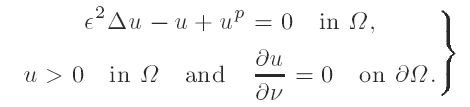 It is known that at a non-degenerate critical point of the mean curvature function H(P), there exists a single boundary spike solution. In this paper, we show that the single boundary spike solution is unique and moreover it has exactly (N − 1) small eigenvalues. We obtain the exact asymptotics of the small eigenvalues in terms of H(P).
Arakelyan's theorem and relations between two harmonic functions
- Part of
-
- Journal:
- Mathematika / Volume 48 / Issue 1-2 / December 2001
- Published online by Cambridge University Press:
- 26 February 2010, pp. 301-304
- Print publication:
- December 2001
-
- Article
- Export citation
-
It is shown that, if h and k are harmonic in ℝ2 and there exists a positive constant c so that

in ℝ2, where h+ = max {h, 0}, then it need not follow that h - k is identically a constant. The necessary counterexample is obtained by applying Arakelyan's theorem on approximation by an entire function in certain regions in ℝ2.

Maximal extension for linear spaces of real matrices with large rank
-
- Journal:
- Proceedings of the Royal Society of Edinburgh. Section A: Mathematics / Volume 131 / Issue 6 / December 2001
- Published online by Cambridge University Press:
- 12 July 2007, pp. 1481-1491
- Print publication:
- December 2001
-
- Article
- Export citation
