Refine search
Actions for selected content:
26079 results in Abstract analysis
New Radon–Nikodym ideals
- Part of
-
- Journal:
- Mathematika / Volume 47 / Issue 1-2 / December 2000
- Published online by Cambridge University Press:
- 26 February 2010, pp. 219-227
- Print publication:
- December 2000
-
- Article
- Export citation
-
Farah recently proved that many Borel P-ideals.
 on
on  satisfy the following requirement: any measurable homomorphism
 has a continuous lifting
  which is a homomorphism itself. Ideals having such a property were called Radon–Nikodym (RN) ideals. Answering some Farah's questions, it is proved that many non-P ideals, including, for instance, Fin ⊗ Fin, are Radon–Nikodym. To prove this result, another property of ideals called the Fubini property, is introduced, which implies RN and is stable under some important transformations of ideals.
 on
on  satisfy the following requirement: any measurable homomorphism
 has a continuous lifting
  which is a homomorphism itself. Ideals having such a property were called Radon–Nikodym (RN) ideals. Answering some Farah's questions, it is proved that many non-P ideals, including, for instance, Fin ⊗ Fin, are Radon–Nikodym. To prove this result, another property of ideals called the Fubini property, is introduced, which implies RN and is stable under some important transformations of ideals.
MTK volume 47 issue 1-2 Cover and Back matter
-
- Journal:
- Mathematika / Volume 47 / Issue 1-2 / December 2000
- Published online by Cambridge University Press:
- 26 February 2010, p. b1
- Print publication:
- December 2000
-
- Article
-
- You have access
- Export citation
MTK volume 47 issue 1-2 Cover and Front matter
-
- Journal:
- Mathematika / Volume 47 / Issue 1-2 / December 2000
- Published online by Cambridge University Press:
- 26 February 2010, pp. f1-f4
- Print publication:
- December 2000
-
- Article
-
- You have access
- Export citation
Sums of three cubes
- Part of
-
- Journal:
- Mathematika / Volume 47 / Issue 1-2 / December 2000
- Published online by Cambridge University Press:
- 26 February 2010, pp. 53-61
- Print publication:
- December 2000
-
- Article
- Export citation
A note on porosity and the Mazur intersection property
- Part of
-
- Journal:
- Mathematika / Volume 47 / Issue 1-2 / December 2000
- Published online by Cambridge University Press:
- 26 February 2010, pp. 267-272
- Print publication:
- December 2000
-
- Article
- Export citation
Asymptotic lower bounds for Diophantine inequalities
- Part of
-
- Journal:
- Mathematika / Volume 47 / Issue 1-2 / December 2000
- Published online by Cambridge University Press:
- 26 February 2010, pp. 127-159
- Print publication:
- December 2000
-
- Article
- Export citation
-
§1. Introduction. In 1946, Davenport and Heilbronn [9] proved a result which opened up the study of Diophantine inequalities. Suppose that Q(x) is a diagonal quadratic form with non-zero real coefficients in s variables. We write

The integral representation for a solution of the 2-d Dirichlet problem with boundary data on closed and open curves
- Part of
-
- Journal:
- Mathematika / Volume 47 / Issue 1-2 / December 2000
- Published online by Cambridge University Press:
- 26 February 2010, pp. 339-354
- Print publication:
- December 2000
-
- Article
- Export citation
Parallelizable manifolds and the fundamental group
- Part of
-
- Journal:
- Mathematika / Volume 47 / Issue 1-2 / December 2000
- Published online by Cambridge University Press:
- 26 February 2010, pp. 165-172
- Print publication:
- December 2000
-
- Article
- Export citation
Reconstruction of polytopes by convex pastings
- Part of
-
- Journal:
- Mathematika / Volume 47 / Issue 1-2 / December 2000
- Published online by Cambridge University Press:
- 26 February 2010, pp. 9-18
- Print publication:
- December 2000
-
- Article
- Export citation
-
Consider a convex polytope X and a family
 of convex sets, satisfying a given property P. Moreover, assume that is closed under operations of cutting and convex pasting along hyperplanes. Necessary and sufficient conditions are given to have
  . As a consequence, it follows that, if all simplices or small enough simplices have the property in question, then X also has that property.
 of convex sets, satisfying a given property P. Moreover, assume that
  . As a consequence, it follows that, if all simplices or small enough simplices have the property in question, then X also has that property.
Scattering of tidal waves by reefs and spits
- Part of
-
- Journal:
- Mathematika / Volume 47 / Issue 1-2 / December 2000
- Published online by Cambridge University Press:
- 26 February 2010, pp. 355-370
- Print publication:
- December 2000
-
- Article
- Export citation
Maximal sections and centrally symmetric bodies
- Part of
-
- Journal:
- Mathematika / Volume 47 / Issue 1-2 / December 2000
- Published online by Cambridge University Press:
- 26 February 2010, pp. 19-30
- Print publication:
- December 2000
-
- Article
- Export citation
Inscribing cubes and covering by rhombic dodecahedra via equivariant topology
- Part of
-
- Journal:
- Mathematika / Volume 47 / Issue 1-2 / December 2000
- Published online by Cambridge University Press:
- 26 February 2010, pp. 371-397
- Print publication:
- December 2000
-
- Article
- Export citation
Combinatorics and linear algebra of Freiman's isomorphism
- Part of
-
- Journal:
- Mathematika / Volume 47 / Issue 1-2 / December 2000
- Published online by Cambridge University Press:
- 26 February 2010, pp. 39-51
- Print publication:
- December 2000
-
- Article
- Export citation
-
An original linear algebraic approach to the basic notion of Freiman's isomorphism is developed and used in conjunction with a combinatorial argument to answer two questions, posed by Freiman about 35 years ago.
First, the order of growth is established of t(n), the number of classes isomorphic n-element sets of integers: t(n) = n(2 + σ(1))n. Second, it is proved linear Roth sets (sets of integers free of arithmetic progressions and having Freiman rank 1) exist and, moreover, the number
 of classes of such cardinality n is amazingly large; in fact, it is “the same as above”:
  .
.
 of classes of such cardinality n is amazingly large; in fact, it is “the same as above”:
  .
.Lusternik-Schnirelmann category and Morse decompositions
- Part of
-
- Journal:
- Mathematika / Volume 47 / Issue 1-2 / December 2000
- Published online by Cambridge University Press:
- 26 February 2010, pp. 299-305
- Print publication:
- December 2000
-
- Article
- Export citation
Frequency of oscillations of an error term related to the Euler function
- Part of
-
- Journal:
- Mathematika / Volume 47 / Issue 1-2 / December 2000
- Published online by Cambridge University Press:
- 26 February 2010, pp. 161-164
- Print publication:
- December 2000
-
- Article
- Export citation
-
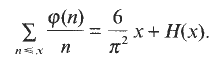
Let φ be the Euler function, and consider the error term H in the asymptotic formula
A functional analytic interpretation of the number of faces of a polyhedron
- Part of
-
- Journal:
- Mathematika / Volume 47 / Issue 1-2 / December 2000
- Published online by Cambridge University Press:
- 26 February 2010, pp. 1-7
- Print publication:
- December 2000
-
- Article
- Export citation
-
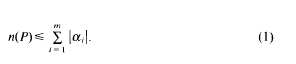
Let P⊂ℝ2 be a polyhedron, that is, the intersection of a finite number of closed half-spaces, and suppose that its characteristic function lP can be expressed as a linear combination
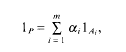
where each Ai is a relatively open and convex set. Let n(P) be the number of all non-empty facets of P. One of the main objectives of this paper is to show that
Factorization over local fields and the irreducibility of generalized difference polynomials
- Part of
-
- Journal:
- Mathematika / Volume 47 / Issue 1-2 / December 2000
- Published online by Cambridge University Press:
- 26 February 2010, pp. 173-196
- Print publication:
- December 2000
-
- Article
- Export citation
Un nouveau critère pour l'équation de Catalan
- Part of
-
- Journal:
- Mathematika / Volume 47 / Issue 1-2 / December 2000
- Published online by Cambridge University Press:
- 26 February 2010, pp. 63-73
- Print publication:
- December 2000
-
- Article
- Export citation
-
A new criterion on Catalan's equation is proved by elementary means

This shows, without appealing either to the theory of linear forms in logarithms, or to any computation, that (C) has no solution (x, y, p, q) with min {p, q}≤41, except (3,2, 2, 3).
A construction of laminates from rank-1 polygons
-
- Journal:
- Proceedings of the Royal Society of Edinburgh. Section A: Mathematics / Volume 130 / Issue 6 / December 2000
- Published online by Cambridge University Press:
- 11 July 2007, pp. 1311-1335
- Print publication:
- December 2000
-
- Article
- Export citation
The discrete fractional Fourier transform and Harper's equation
- Part of
-
- Journal:
- Mathematika / Volume 47 / Issue 1-2 / December 2000
- Published online by Cambridge University Press:
- 26 February 2010, pp. 281-297
- Print publication:
- December 2000
-
- Article
- Export citation
