Refine search
Actions for selected content:
26076 results in Abstract analysis
Ergodic properties and Weyl M-functions for random linear Hamiltonian systems
-
- Journal:
- Proceedings of the Royal Society of Edinburgh. Section A: Mathematics / Volume 130 / Issue 5 / October 2000
- Published online by Cambridge University Press:
- 11 July 2007, pp. 1045-1079
- Print publication:
- October 2000
-
- Article
- Export citation
Solutions of equivariance for a polynomial-like iterative equation
-
- Journal:
- Proceedings of the Royal Society of Edinburgh. Section A: Mathematics / Volume 130 / Issue 5 / October 2000
- Published online by Cambridge University Press:
- 11 July 2007, pp. 1153-1163
- Print publication:
- October 2000
-
- Article
- Export citation
Large-time behaviour of solutions to the dissipative nonlinear Schrödinger equation
-
- Journal:
- Proceedings of the Royal Society of Edinburgh. Section A: Mathematics / Volume 130 / Issue 5 / October 2000
- Published online by Cambridge University Press:
- 11 July 2007, pp. 1029-1043
- Print publication:
- October 2000
-
- Article
- Export citation
-
We study the Cauchy problem for the nonlinear Schrödinger equation with dissipation
 where L is a linear pseudodifferential operator with dissipative symbol ReL(ξ) ≥ C1|ξ|2/(1 + ξ2) and |L′(ξ)| ≤ C2(|ξ|+ |ξ|n) for all ξ ∈ R. Here, C1, C2 > 0, n ≥ 1. Moreover, we assume that L(ξ) = αξ2 + O(|ξ|2+γ) for all |ξ| < 1, where γ > 0, Re α > 0, Im α ≥ 0. When L(ξ) = αξ2, equation (A) is the nonlinear Schrödinger equation with dissipation ut − αuxx + i|u|2u = 0. Our purpose is to prove that solutions of (A) satisfy the time decay estimate
 under the conditions that u0 ∈ Hn,0 ∩ H0,1 have the mean value
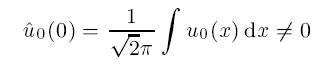 and the norm ‖u0‖Hn,0 + ‖u0‖H0,1 = ε is sufficiently small, where σ = 1 if Im α > 0 and σ = 2 if Im α = 0, and
 Therefore, equation (A) is considered as a critical case for the large-time asymptotic behaviour because the solutions of the Cauchy problem for the equation ut − αuxx + i|u|p−1u = 0, with p > 3 have the same time decay estimate ‖u‖L∞ = O(t−½) as that of solutions to the linear equation. On the other hand, note that solutions of the Cauchy problem (A) have an additional logarithmic time decay. Our strategy of the proof of the large-time asymptotics of solutions is to translate (A) to another nonlinear equation in which the mean value of the nonlinearity is zero for all time.
Invariant measures for Lévy flows of diffeomorphisms
-
- Journal:
- Proceedings of the Royal Society of Edinburgh. Section A: Mathematics / Volume 130 / Issue 5 / October 2000
- Published online by Cambridge University Press:
- 11 July 2007, pp. 925-946
- Print publication:
- October 2000
-
- Article
- Export citation
On the structure of simplicial affine semigroups
-
- Journal:
- Proceedings of the Royal Society of Edinburgh. Section A: Mathematics / Volume 130 / Issue 5 / October 2000
- Published online by Cambridge University Press:
- 11 July 2007, pp. 1017-1028
- Print publication:
- October 2000
-
- Article
- Export citation
Stability and existence of multiple periodic solutions for a quasilinear differential equation with maxima
-
- Journal:
- Proceedings of the Royal Society of Edinburgh. Section A: Mathematics / Volume 130 / Issue 5 / October 2000
- Published online by Cambridge University Press:
- 11 July 2007, pp. 1103-1118
- Print publication:
- October 2000
-
- Article
- Export citation
-
We study the stability of periodic solutions of the scalar delay differential equation
 where f(t) is a periodic forcing term and δ,p∈R. We study stability in the first approximation showing that the non-smooth equation (*) can be linearized along some ‘non-singular’ periodic solutions. Then the corresponding variational equation together with the Krasnosel'skij index are used to prove the existence of multiple periodic solutions to (*). Finally, we apply a generalization of Halanay's inequality to establish conditions for global attractivity in equations with maxima.
On interpolation of strictly singular operators, strictly co-singular operators and related operator ideals
-
- Journal:
- Proceedings of the Royal Society of Edinburgh. Section A: Mathematics / Volume 130 / Issue 5 / October 2000
- Published online by Cambridge University Press:
- 11 July 2007, pp. 971-989
- Print publication:
- October 2000
-
- Article
- Export citation
Homoclinic-Hopf interaction: an autoparametric bifurcation
-
- Journal:
- Proceedings of the Royal Society of Edinburgh. Section A: Mathematics / Volume 130 / Issue 5 / October 2000
- Published online by Cambridge University Press:
- 11 July 2007, pp. 999-1015
- Print publication:
- October 2000
-
- Article
- Export citation
One-sided extrapolation at infinity and singular integrals
-
- Journal:
- Proceedings of the Royal Society of Edinburgh. Section A: Mathematics / Volume 130 / Issue 5 / October 2000
- Published online by Cambridge University Press:
- 11 July 2007, pp. 1081-1102
- Print publication:
- October 2000
-
- Article
- Export citation
-
In this paper we prove, on one hand, extrapolation from infinity for the one-sided classes
, and on the other hand, the BMO-boundedness for one-sided singular integrals. We also provide several applications of our results.
Uniqueness and stability for the determination of boundary defects by electrostatic measurements
-
- Journal:
- Proceedings of the Royal Society of Edinburgh. Section A: Mathematics / Volume 130 / Issue 5 / October 2000
- Published online by Cambridge University Press:
- 11 July 2007, pp. 1119-1151
- Print publication:
- October 2000
-
- Article
- Export citation
Weakly invariant regions for reaction—diffusion systems and applications
-
- Journal:
- Proceedings of the Royal Society of Edinburgh. Section A: Mathematics / Volume 130 / Issue 5 / October 2000
- Published online by Cambridge University Press:
- 11 July 2007, pp. 1165-1180
- Print publication:
- October 2000
-
- Article
- Export citation
Quantitative continuation from a measurable set of solutions of elliptic equations
-
- Journal:
- Proceedings of the Royal Society of Edinburgh. Section A: Mathematics / Volume 130 / Issue 4 / August 2000
- Published online by Cambridge University Press:
- 11 July 2007, pp. 909-923
- Print publication:
- August 2000
-
- Article
- Export citation
The HELP inequality for lim-p Hamiltonian systems
-
- Journal:
- Proceedings of the Royal Society of Edinburgh. Section A: Mathematics / Volume 130 / Issue 4 / August 2000
- Published online by Cambridge University Press:
- 11 July 2007, pp. 699-720
- Print publication:
- August 2000
-
- Article
- Export citation
The initial value problem for the non-homogeneous Navier—Stokes equations with general slip boundary condition
-
- Journal:
- Proceedings of the Royal Society of Edinburgh. Section A: Mathematics / Volume 130 / Issue 4 / August 2000
- Published online by Cambridge University Press:
- 11 July 2007, pp. 827-835
- Print publication:
- August 2000
-
- Article
- Export citation
Generalized scalar curvature type equations on compact Riemannian manifolds
-
- Journal:
- Proceedings of the Royal Society of Edinburgh. Section A: Mathematics / Volume 130 / Issue 4 / August 2000
- Published online by Cambridge University Press:
- 11 July 2007, pp. 767-788
- Print publication:
- August 2000
-
- Article
- Export citation
Steady vortex in a uniform shear flow of an ideal fluid
-
- Journal:
- Proceedings of the Royal Society of Edinburgh. Section A: Mathematics / Volume 130 / Issue 4 / August 2000
- Published online by Cambridge University Press:
- 11 July 2007, pp. 801-812
- Print publication:
- August 2000
-
- Article
- Export citation
A connection formula for Sturm—Liouville spectral functions
-
- Journal:
- Proceedings of the Royal Society of Edinburgh. Section A: Mathematics / Volume 130 / Issue 4 / August 2000
- Published online by Cambridge University Press:
- 11 July 2007, pp. 789-791
- Print publication:
- August 2000
-
- Article
- Export citation
Asymptotics of solutions to a convection—diffusion equation on the half-line
-
- Journal:
- Proceedings of the Royal Society of Edinburgh. Section A: Mathematics / Volume 130 / Issue 4 / August 2000
- Published online by Cambridge University Press:
- 11 July 2007, pp. 837-853
- Print publication:
- August 2000
-
- Article
- Export citation
Timoshenko's beam equation as limit of a nonlinear one-dimensional von Kármán system
-
- Journal:
- Proceedings of the Royal Society of Edinburgh. Section A: Mathematics / Volume 130 / Issue 4 / August 2000
- Published online by Cambridge University Press:
- 11 July 2007, pp. 855-875
- Print publication:
- August 2000
-
- Article
- Export citation
Local linear independence of refinable vectors of functions
-
- Journal:
- Proceedings of the Royal Society of Edinburgh. Section A: Mathematics / Volume 130 / Issue 4 / August 2000
- Published online by Cambridge University Press:
- 11 July 2007, pp. 813-826
- Print publication:
- August 2000
-
- Article
- Export citation
-
This paper is devoted to a study of local linear independence of refinable vectors of functions. A vector of functions
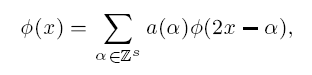 where a is a finitely supported sequence of r × r matrices called the refinement mask. A complete characterization for the local linear independence of the shifts of ϕ1,…,ϕr is given strictly in terms of the mask. Several examples are provided to illustrate the general theory. This investigation is important for construction of wavelets on bounded domains and nonlinear approximation by wavelets.
