Refine search
Actions for selected content:
26076 results in Abstract analysis
12 - The Six-Term Exact Sequence
-
- Book:
- An Introduction to K-Theory for C*-Algebras
- Published online:
- 31 December 2009
- Print publication:
- 20 July 2000, pp 209-218
-
- Chapter
- Export citation
Contents
-
- Book:
- An Introduction to K-Theory for C*-Algebras
- Published online:
- 31 December 2009
- Print publication:
- 20 July 2000, pp v-viii
-
- Chapter
- Export citation
General index
-
- Book:
- An Introduction to K-Theory for C*-Algebras
- Published online:
- 31 December 2009
- Print publication:
- 20 July 2000, pp 239-242
-
- Chapter
- Export citation
7 - Classification of AF-Algebras
-
- Book:
- An Introduction to K-Theory for C*-Algebras
- Published online:
- 31 December 2009
- Print publication:
- 20 July 2000, pp 109-132
-
- Chapter
- Export citation
Index of symbols
-
- Book:
- An Introduction to K-Theory for C*-Algebras
- Published online:
- 31 December 2009
- Print publication:
- 20 July 2000, pp 236-238
-
- Chapter
- Export citation
Conjugacy of half-linear second-order differential equations
-
- Journal:
- Proceedings of the Royal Society of Edinburgh. Section A: Mathematics / Volume 130 / Issue 3 / June 2000
- Published online by Cambridge University Press:
- 11 July 2007, pp. 517-525
- Print publication:
- June 2000
-
- Article
- Export citation
-
Focal point and conjugacy criteria for the half-linear second-order differential equation
 are obtained using the generalized Riccati transformation. An oscillation criterion is given in case when the function c(t) is periodic.
A priori bounds and global existence of solutions of the steady-state Sel'kov model
-
- Journal:
- Proceedings of the Royal Society of Edinburgh. Section A: Mathematics / Volume 130 / Issue 3 / June 2000
- Published online by Cambridge University Press:
- 11 July 2007, pp. 507-516
- Print publication:
- June 2000
-
- Article
- Export citation
Plane polynomial vector fields with prescribed invariant curves
-
- Journal:
- Proceedings of the Royal Society of Edinburgh. Section A: Mathematics / Volume 130 / Issue 3 / June 2000
- Published online by Cambridge University Press:
- 11 July 2007, pp. 633-649
- Print publication:
- June 2000
-
- Article
- Export citation
Geometric aspects of Sturm—Liouville problems I. Structures on spaces of boundary conditions
-
- Journal:
- Proceedings of the Royal Society of Edinburgh. Section A: Mathematics / Volume 130 / Issue 3 / June 2000
- Published online by Cambridge University Press:
- 11 July 2007, pp. 561-589
- Print publication:
- June 2000
-
- Article
- Export citation
The critical Fujita number for a semilinear heat equation in exterior domains with homogeneous Neumann boundary values
-
- Journal:
- Proceedings of the Royal Society of Edinburgh. Section A: Mathematics / Volume 130 / Issue 3 / June 2000
- Published online by Cambridge University Press:
- 11 July 2007, pp. 591-602
- Print publication:
- June 2000
-
- Article
- Export citation
-
Let D be a domain in Rn with bounded complement and let n ≠ 2. For the initial-boundary value problem
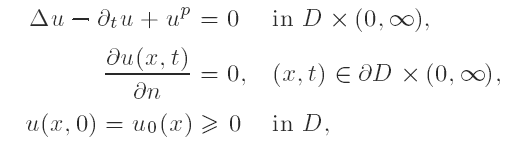 we prove that there are no non-trivial global (non-negative) solutions if 0 < n (p − 1) ≤ 2 and there exist both global non-trivial and non-global solutions if n (p − 1) > 2.
Plane Stokes flows with time-dependent free boundaries in which the fluid occupies a doubly-connected region
-
- Journal:
- European Journal of Applied Mathematics / Volume 11 / Issue 3 / June 2000
- Published online by Cambridge University Press:
- 01 June 2000, pp. 249-269
-
- Article
- Export citation
Rings graded by bisimple inverse semigroups
-
- Journal:
- Proceedings of the Royal Society of Edinburgh. Section A: Mathematics / Volume 130 / Issue 3 / June 2000
- Published online by Cambridge University Press:
- 11 July 2007, pp. 603-609
- Print publication:
- June 2000
-
- Article
- Export citation
Uniqueness theorem for the entire positive solutions of biharmonic equations in Rn
-
- Journal:
- Proceedings of the Royal Society of Edinburgh. Section A: Mathematics / Volume 130 / Issue 3 / June 2000
- Published online by Cambridge University Press:
- 11 July 2007, pp. 651-670
- Print publication:
- June 2000
-
- Article
- Export citation
Properties of steady states for thin film equations
-
- Journal:
- European Journal of Applied Mathematics / Volume 11 / Issue 3 / June 2000
- Published online by Cambridge University Press:
- 01 June 2000, pp. 293-351
-
- Article
- Export citation
Characterization of homogeneous scalar variational problems solvable for all boundary data
-
- Journal:
- Proceedings of the Royal Society of Edinburgh. Section A: Mathematics / Volume 130 / Issue 3 / June 2000
- Published online by Cambridge University Press:
- 11 July 2007, pp. 611-631
- Print publication:
- June 2000
-
- Article
- Export citation
-
It is known that the condition ‘either ∂L (F) ≠ Ø or there exist υ1,…,υq ∈ Rnsuch thatF ∈ int co {υ1,…,υq}
characterizes solvability of the problem
 with f(·) = 〈F,·〉.
We extend this result to the case of lower semicontinuous integrands L : Rn → R.
We also show that validity of this condition for all F ∈ Rn is both a necessary and sufficient requirement for solvability of all minimization problems with sufficiently regular Ω and f. Moreover, the assumptions on Ω and f can be completely dropped if L has sufficiently fast growth at infinity.
Boundary trace of the solutions of the prescribed Gaussian curvature equation
-
- Journal:
- Proceedings of the Royal Society of Edinburgh. Section A: Mathematics / Volume 130 / Issue 3 / June 2000
- Published online by Cambridge University Press:
- 11 July 2007, pp. 527-560
- Print publication:
- June 2000
-
- Article
- Export citation
Bifurcations of implicit differential equations
-
- Journal:
- Proceedings of the Royal Society of Edinburgh. Section A: Mathematics / Volume 130 / Issue 3 / June 2000
- Published online by Cambridge University Press:
- 11 July 2007, pp. 485-506
- Print publication:
- June 2000
-
- Article
- Export citation
-
In this paper we give a local classification of the integral curves of implicit differential equations
where F is a smooth function and p = dy/dx, at points where Fp = 0, Fpp ≠ 0 and where the discriminant {(x, y) : F = Fp = 0} has a Morse singularity. We also produce models for generic bifurcations of such equations and apply the results to the differential geometry of smooth surfaces. This completes the local classification of generic one-parameter families of binary differential equations (BDEs).
On the global bifurcation diagram for the one-dimensional Ginzburg–Landau model of superconductivity
-
- Journal:
- European Journal of Applied Mathematics / Volume 11 / Issue 3 / June 2000
- Published online by Cambridge University Press:
- 01 June 2000, pp. 271-291
-
- Article
- Export citation
An extension of Zermelo's model for ranking by paired comparisons
-
- Journal:
- European Journal of Applied Mathematics / Volume 11 / Issue 3 / June 2000
- Published online by Cambridge University Press:
- 01 June 2000, pp. 225-247
-
- Article
- Export citation
Free discontinuity problems generated by singular perturbation: the n−dimensional case
-
- Journal:
- Proceedings of the Royal Society of Edinburgh. Section A: Mathematics / Volume 130 / Issue 3 / June 2000
- Published online by Cambridge University Press:
- 11 July 2007, pp. 449-469
- Print publication:
- June 2000
-
- Article
- Export citation
-
We provide an approximation of some free discontinuity problems by local functionals with a singular perturbation of higher order. More precisely, we study the limiting behaviour of energies of the form
 where Hu denotes the Hessian matrix of u.
