Refine search
Actions for selected content:
26076 results in Abstract analysis
On extending Artin's conjecture to composite moduli
- Part of
-
- Journal:
- Mathematika / Volume 46 / Issue 2 / December 1999
- Published online by Cambridge University Press:
- 26 February 2010, pp. 373-390
- Print publication:
- December 1999
-
- Article
- Export citation
-
It is well known that, if p is prime, the multiplicative group (ℤ/pℤ)* of reduced residues is cyclic. A generator is called a primitive root; there are φ(p − 1) of them, where φ is Euler's function. Thus, (φ(p − 1)/(p−1) is the proportion of primitive roots modulo p in (ℤ/pℤ)*. Elliott has proved that φp − 1)/(p − 1) has a limiting distribution function [2], in the sense that

exists for all real numbers u.
On the scarcity of powerful binomial coefficients
- Part of
-
- Journal:
- Mathematika / Volume 46 / Issue 2 / December 1999
- Published online by Cambridge University Press:
- 26 February 2010, pp. 397-410
- Print publication:
- December 1999
-
- Article
- Export citation
-
Assuming the abc-conjecture, it is shown that there are only finitely many powerful binomial coefficients
 with 3≤k≤n/2 in fact, if q2 divides , then
  . Unconditionally, it is shown that there are N1/2+σ(1) powerful binomial coefficients in the top N rows of Pascal's Triangle.
 with 3≤k≤n/2 in fact, if q
 . Unconditionally, it is shown that there are N
Index to Volume 46
-
- Journal:
- Mathematika / Volume 46 / Issue 2 / December 1999
- Published online by Cambridge University Press:
- 26 February 2010, pp. 477-478
- Print publication:
- December 1999
-
- Article
- Export citation
Two-dimensional Stokes flow with suction and small surface tension
-
- Journal:
- European Journal of Applied Mathematics / Volume 10 / Issue 6 / December 1999
- Published online by Cambridge University Press:
- 01 December 1999, pp. 681-705
-
- Article
- Export citation
Two-dimensional Stokes and Hele-Shaw flows with free surfaces
-
- Journal:
- European Journal of Applied Mathematics / Volume 10 / Issue 6 / December 1999
- Published online by Cambridge University Press:
- 01 December 1999, pp. 635-680
-
- Article
- Export citation
On the Steinhaus tiling problem
- Part of
-
- Journal:
- Mathematika / Volume 46 / Issue 2 / December 1999
- Published online by Cambridge University Press:
- 26 February 2010, pp. 253-280
- Print publication:
- December 1999
-
- Article
- Export citation
Analytical and numerical treatment of a complex model for Hele-Shaw moving boundary value problems with kinetic undercooling regularization
-
- Journal:
- European Journal of Applied Mathematics / Volume 10 / Issue 6 / December 1999
- Published online by Cambridge University Press:
- 01 December 1999, pp. 561-579
-
- Article
- Export citation
A note on viscous sintering and quadrature identities
-
- Journal:
- European Journal of Applied Mathematics / Volume 10 / Issue 6 / December 1999
- Published online by Cambridge University Press:
- 01 December 1999, pp. 623-634
-
- Article
- Export citation
Compact measure spaces
- Part of
-
- Journal:
- Mathematika / Volume 46 / Issue 2 / December 1999
- Published online by Cambridge University Press:
- 26 February 2010, pp. 331-336
- Print publication:
- December 1999
-
- Article
- Export citation
On the convergence of Σ∞n = 1f(nx) for measurable functions
- Part of
-
- Journal:
- Mathematika / Volume 46 / Issue 2 / December 1999
- Published online by Cambridge University Press:
- 26 February 2010, pp. 337-341
- Print publication:
- December 1999
-
- Article
- Export citation
Editorial
-
- Journal:
- European Journal of Applied Mathematics / Volume 10 / Issue 6 / December 1999
- Published online by Cambridge University Press:
- 01 December 1999, pp. 511-512
-
- Article
-
- You have access
- Export citation
Sign changes of error terms related to the Euler function
- Part of
-
- Journal:
- Mathematika / Volume 46 / Issue 2 / December 1999
- Published online by Cambridge University Press:
- 26 February 2010, pp. 391-395
- Print publication:
- December 1999
-
- Article
- Export citation
-
Let φ(n) be the Euler function (i.e., φ(n) denotes the number of integers less than n which are relatively prime to n), and define
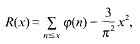
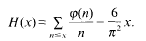
These functions were extensively studied by several mathematicians. One of the problems investigated concerns their sign changes. We say that a function fx) has a sign change at x = x0 if f(x0 −) f(x0 +) < 0, and f(x) has a sign change on the integer n if (n)f(n+1) < 0. The numbers of sign changes and sign changes on integers of f(x) in the interval [1, T] are denoted by Xf(T) and Nf(T), respectively.
Families of congruent curves and applications
- Part of
-
- Journal:
- Mathematika / Volume 46 / Issue 2 / December 1999
- Published online by Cambridge University Press:
- 26 February 2010, pp. 241-252
- Print publication:
- December 1999
-
- Article
- Export citation
Global solutions to the discrete coagulation equations
- Part of
-
- Journal:
- Mathematika / Volume 46 / Issue 2 / December 1999
- Published online by Cambridge University Press:
- 26 February 2010, pp. 433-442
- Print publication:
- December 1999
-
- Article
- Export citation
Time local existence of a moving boundary of the Hele-Shaw flow with suction
-
- Journal:
- European Journal of Applied Mathematics / Volume 10 / Issue 6 / December 1999
- Published online by Cambridge University Press:
- 01 December 1999, pp. 581-605
-
- Article
- Export citation
Prüfer domains and pure submodules of direct sums of ideals
- Part of
-
- Journal:
- Mathematika / Volume 46 / Issue 2 / December 1999
- Published online by Cambridge University Press:
- 26 February 2010, pp. 425-432
- Print publication:
- December 1999
-
- Article
- Export citation
Lower bounds for multilinear forms defined on Hilbert Spaces
- Part of
-
- Journal:
- Mathematika / Volume 46 / Issue 2 / December 1999
- Published online by Cambridge University Press:
- 26 February 2010, pp. 315-322
- Print publication:
- December 1999
-
- Article
- Export citation
-
In this paper, it is proved that, for any m unit vectors. x1…, xm in any n-dimensional real Hilbert space, there exists a unit vector x0 such that

for any y∈Sn−1. The exact value of the above integral is calculated, and these results used to improve some lower bounds for multilinear forms on real Hilbert spaces. An integral expression is also given for the complex case.
MTK volume 46 issue 2 Cover and Front matter
-
- Journal:
- Mathematika / Volume 46 / Issue 2 / December 1999
- Published online by Cambridge University Press:
- 26 February 2010, pp. f1-f2
- Print publication:
- December 1999
-
- Article
-
- You have access
- Export citation
Flow around a wedge of arbitrary angle in a Hele-Shaw cell
-
- Journal:
- European Journal of Applied Mathematics / Volume 10 / Issue 6 / December 1999
- Published online by Cambridge University Press:
- 01 December 1999, pp. 547-560
-
- Article
- Export citation
Solvability in Lp of the Neumann problem for a singular non-homogeneous Sturm-Liouville equation
- Part of
-
- Journal:
- Mathematika / Volume 46 / Issue 2 / December 1999
- Published online by Cambridge University Press:
- 26 February 2010, pp. 453-470
- Print publication:
- December 1999
-
- Article
- Export citation
-
Consider the equation

where
 ,
,  . The inversion problem for (1) is called regular in Lp if, uniformly in p∈[1, ∞] for any f(x)∈ Lp(R), equation (1) has a unique solution y(x)∈ Lp(R) of the form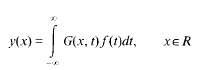
with
 . Here G(x, t) is the Green function corresponding to (1) and c is an absolute constant. For a given s∈[l, ∞], necessary and sufficient conditions are obtained for assertions (2) and (3) to hold simultaneously:
(2) the inversion problem for (1) is regular in Lp;
(3)
 for any f(x)∈LS(R).
 ,
,  . The inversion problem for (1) is called regular in L
 . Here G(x, t) is the Green function corresponding to (1) and c is an absolute constant. For a given s∈[l, ∞], necessary and sufficient conditions are obtained for assertions (2) and (3) to hold simultaneously:
 for any f(x)∈L