Refine search
Actions for selected content:
9086 results in Discrete Mathematics, Information Theory and Coding
SHORTEST DISTANCE IN MODULAR HYPERBOLA AND LEAST QUADRATIC NON-RESIDUE
- Part of
-
- Journal:
- Mathematika / Volume 62 / Issue 3 / 2016
- Published online by Cambridge University Press:
- 10 May 2016, pp. 860-865
- Print publication:
- 2016
-
- Article
- Export citation
-
In this paper, we study how small a box contains at least two points from a modular hyperbola $xy\equiv c\;(\text{mod}\;p)$ . There are two such points in a square of side length $p^{1/4+\unicode[STIX]{x1D716}}$ . Furthermore, it turns out that either there are two such points in a square of side length $p^{1/6+\unicode[STIX]{x1D716}}$ or the least quadratic non-residue is less than $p^{1/(6\sqrt{e})+\unicode[STIX]{x1D716}}$ .


METRIC RESULTS ON THE DISCREPANCY OF SEQUENCES $(a_{n}{\it\alpha})_{n\geqslant 1}$ MODULO ONE FOR INTEGER SEQUENCES $(a_{n})_{n\geqslant 1}$ OF POLYNOMIAL GROWTH
- Part of
-
- Journal:
- Mathematika / Volume 62 / Issue 2 / 2016
- Published online by Cambridge University Press:
- 05 February 2016, pp. 478-491
- Print publication:
- 2016
-
- Article
- Export citation
-
An important result of Weyl states that for every sequence $(a_{n})_{n\geqslant 1}$ of distinct positive integers the sequence of fractional parts of $(a_{n}{\it\alpha})_{n\geqslant 1}$ is uniformly distributed modulo one for almost all ${\it\alpha}$ . However, in general it is a very hard problem to calculate the precise order of convergence of the discrepancy of $(\{a_{n}{\it\alpha}\})_{n\geqslant 1}$ for almost all ${\it\alpha}$ . In particular, it is very difficult to give sharp lower bounds for the speed of convergence. Until now this was only carried out for lacunary sequences $(a_{n})_{n\geqslant 1}$ and for some special cases such as the Kronecker sequence $(\{n{\it\alpha}\})_{n\geqslant 1}$ or the sequence $(\{n^{2}{\it\alpha}\})_{n\geqslant 1}$ . In the present paper we answer the question for a large class of sequences $(a_{n})_{n\geqslant 1}$ including as a special case all polynomials $a_{n}=P(n)$ with $P\in \mathbb{Z}[x]$ of degree at least 2.


MTK volume 62 Issue 2 Cover and Back matter
-
- Journal:
- Mathematika / Volume 62 / Issue 2 / 2016
- Published online by Cambridge University Press:
- 28 April 2016, pp. b1-b6
- Print publication:
- 2016
-
- Article
-
- You have access
- Export citation
ORTHOGONAL COLORINGS OF THE SPHERE
- Part of
-
- Journal:
- Mathematika / Volume 62 / Issue 2 / 2016
- Published online by Cambridge University Press:
- 04 February 2016, pp. 492-501
- Print publication:
- 2016
-
- Article
- Export citation
-
An orthogonal coloring of the two-dimensional unit sphere $\mathbb{S}^{2}$ , is a partition of $\mathbb{S}^{2}$ into parts such that no part contains a pair of orthogonal points: that is, a pair of points at spherical distance ${\it\pi}/2$ apart. It is a well-known result that an orthogonal coloring of $\mathbb{S}^{2}$ requires at least four parts, and orthogonal colorings with exactly four parts can easily be constructed from a regular octahedron centered at the origin. An intriguing question is whether or not every orthogonal 4-coloring of $\mathbb{S}^{2}$ is such an octahedral coloring. In this paper, we address this question and show that if every color class has a non-empty interior, then the coloring is octahedral. Some related results are also given.


A LIMITING CASE OF ULTRASYMMETRIC SPACES
- Part of
-
- Journal:
- Mathematika / Volume 62 / Issue 3 / 2016
- Published online by Cambridge University Press:
- 01 June 2016, pp. 929-948
- Print publication:
- 2016
-
- Article
- Export citation
-
We study ultrasymmetric spaces in the case in which the fundamental function belongs to a limiting class of quasiconcave functions. In the process, we study limiting cases of $J$ interpolation spaces and establish new $J$ –
$J$ –  $K$ identities as well as a reiteration theorem for these limiting interpolation methods.


WARING’S PROBLEM WITH PIATETSKI-SHAPIRO NUMBERS
- Part of
-
- Journal:
- Mathematika / Volume 62 / Issue 2 / 2016
- Published online by Cambridge University Press:
- 17 February 2016, pp. 524-550
- Print publication:
- 2016
-
- Article
- Export citation
ON THE STRUCTURE OF SEPARABLE ${\mathcal{L}}_{\infty }$ -SPACES
- Part of
-
- Journal:
- Mathematika / Volume 62 / Issue 3 / 2016
- Published online by Cambridge University Press:
- 07 March 2016, pp. 685-700
- Print publication:
- 2016
-
- Article
- Export citation
-
Based on a construction method introduced by Bourgain and Delbaen, we give a general definition of a Bourgain–Delbaen space and prove that every infinite-dimensional separable ${\mathcal{L}}_{\infty }$ -space is isomorphic to such a space. Furthermore, we provide an example of a ${\mathcal{L}}_{\infty }$ and asymptotic $c_{0}$ space not containing $c_{0}$ .


A NOTE ON RANDOM MATRIX INTEGRALS, MOMENT IDENTITIES, AND CATALAN NUMBERS
- Part of
-
- Journal:
- Mathematika / Volume 62 / Issue 3 / 2016
- Published online by Cambridge University Press:
- 06 May 2016, pp. 811-817
- Print publication:
- 2016
-
- Article
- Export citation
BIG BIASES AMONGST PRODUCTS OF TWO PRIMES
- Part of
-
- Journal:
- Mathematika / Volume 62 / Issue 2 / 2016
- Published online by Cambridge University Press:
- 18 February 2016, pp. 502-507
- Print publication:
- 2016
-
- Article
- Export citation
-
We show that substantially more than a quarter of the odd integers of the form $pq$ up to $x$ , with $p,q$ both prime, satisfy $p\equiv q\equiv 3~(\text{mod}\,4)$ .


ON BILINEAR EXPONENTIAL AND CHARACTER SUMS WITH RECIPROCALS OF POLYNOMIALS
- Part of
-
- Journal:
- Mathematika / Volume 62 / Issue 3 / 2016
- Published online by Cambridge University Press:
- 16 May 2016, pp. 842-859
- Print publication:
- 2016
-
- Article
- Export citation
-
We give non-trivial bounds for the bilinear sums
where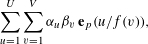 $$\begin{eqnarray}\mathop{\sum }_{u=1}^{U}\mathop{\sum }_{v=1}^{V}\unicode[STIX]{x1D6FC}_{u}\unicode[STIX]{x1D6FD}_{v}\,\mathbf{e}_{p}(u/f(v)),\end{eqnarray}$$ $\,\mathbf{e}_{p}(z)$ is a non-trivial additive character of the prime finite field $\mathbb{F}_{p}$ of $p$ elements, with integers $U$ ,
$U$ ,  $V$ , a polynomial $f\in \mathbb{F}_{p}[X]$ and some complex weights $\{\unicode[STIX]{x1D6FC}_{u}\}$ , $\{\unicode[STIX]{x1D6FD}_{v}\}$ . In particular, for $f(X)=aX+b$ , we obtain new bounds of bilinear sums with Kloosterman fractions. We also obtain new bounds for similar sums with multiplicative characters of $\mathbb{F}_{p}$ .


SMALL SOLUTIONS OF QUADRATIC CONGRUENCES, AND CHARACTER SUMS WITH BINARY QUADRATIC FORMS
- Part of
-
- Journal:
- Mathematika / Volume 62 / Issue 2 / 2016
- Published online by Cambridge University Press:
- 18 February 2016, pp. 551-571
- Print publication:
- 2016
-
- Article
- Export citation
-
Let $Q(x,y,z)$ be an integral quadratic form with determinant coprime to some modulus $q$ . We show that $q\,|\,Q$ for some non-zero integer vector $(x,y,z)$ of length $O(q^{5/8+{\it\varepsilon}})$ , for any fixed ${\it\varepsilon}>0$ . Without the coprimality condition on the determinant one could not necessarily achieve an exponent below $2/3$ . The proof uses a bound for short character sums involving binary quadratic forms, which extends a result of Chang.


PRIMES IN BEATTY SEQUENCES IN SHORT INTERVALS
- Part of
-
- Journal:
- Mathematika / Volume 62 / Issue 2 / 2016
- Published online by Cambridge University Press:
- 17 February 2016, pp. 572-586
- Print publication:
- 2016
-
- Article
- Export citation
OPPOSITE-SIGN KLOOSTERMAN SUM ZETA FUNCTION
- Part of
-
- Journal:
- Mathematika / Volume 62 / Issue 2 / 2016
- Published online by Cambridge University Press:
- 28 January 2016, pp. 406-429
- Print publication:
- 2016
-
- Article
- Export citation
-
We study the meromorphic continuation and the spectral expansion of the opposite-sign Kloosterman sum zeta function
for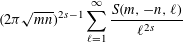 $$\begin{eqnarray}\displaystyle (2{\it\pi}\sqrt{mn})^{2s-1}\mathop{\sum }_{\ell =1}^{\infty }\frac{S(m,-n,\ell )}{\ell ^{2s}} & & \displaystyle \nonumber\end{eqnarray}$$ $m,n$ positive integers, to all $s\in \mathbb{C}$ . There are poles of the function corresponding to zeros of the Riemann zeta function and the spectral parameters of Maass forms. The analytic properties of this function are rather delicate. It turns out that the spectral expansion of the zeta function converges only in a left half-plane, disjoint from the region of absolute convergence of the Dirichlet series, even though they both are analytic expressions of the same meromorphic function on the entire complex plane.


MTK volume 62 Issue 3 Cover and Front matter
-
- Journal:
- Mathematika / Volume 62 / Issue 3 / 2016
- Published online by Cambridge University Press:
- 13 September 2016, pp. f1-f2
- Print publication:
- 2016
-
- Article
-
- You have access
- Export citation
MORE ON LOGARITHMIC SUMS OF CONVEX BODIES
- Part of
-
- Journal:
- Mathematika / Volume 62 / Issue 3 / 2016
- Published online by Cambridge University Press:
- 10 May 2016, pp. 818-841
- Print publication:
- 2016
-
- Article
- Export citation
-
We prove that the log-Brunn–Minkowski inequality (log-BMI) for the Lebesgue measure in dimension $n$ would imply the log-BMI and, therefore, theB-conjecture for any even log-concave measure in dimension $n$ . As a consequence, we prove the log-BMI and the B-conjecture for any even log-concave measure in the plane. Moreover, we prove that the log-BMI reduces to the following: for each dimension $n$ , there is a density $f_{n}$ , which satisfies an integrability assumption, so that the log-BMI holds for parallelepipeds with parallel facets, for the density $f_{n}$ . As a byproduct of our methods, we study possible log-concavity of the function $t\mapsto |(K+_{p}\cdot ~\text{e}^{t}L)^{\circ }|$ , where $p\geqslant 1$ and $K$ ,
$K$ ,  $L$ are symmetric convex bodies, which we are able to prove in some instances and, as a further application, we confirm the variance conjecture in a special class of convex bodies. Finally, we establish a non-trivial dual form of the log-BMI.


LOWER BOUND THEOREMS AND A GENERALIZED LOWER BOUND CONJECTURE FOR BALANCED SIMPLICIAL COMPLEXES
- Part of
-
- Journal:
- Mathematika / Volume 62 / Issue 2 / 2016
- Published online by Cambridge University Press:
- 01 February 2016, pp. 441-477
- Print publication:
- 2016
-
- Article
- Export citation
-
A $(d-1)$ -dimensional simplicial complex is called balanced if its underlying graph admits a proper $d$ -coloring. We show that many well-known face enumeration results have natural balanced analogs (or at least conjectural analogs). Specifically, we prove the balanced analog of the celebrated lower bound theorem (LBT) for normal pseudomanifolds and characterize the case of equality; we introduce and characterize the balanced analog of the Walkup class; and we propose the balanced analog of the generalized lower bound conjecture (GLBC) and establish some related results. We close with constructions of balanced manifolds with few vertices.


UPPER BOUND THEOREM FOR ODD-DIMENSIONAL FLAG TRIANGULATIONS OF MANIFOLDS
- Part of
-
- Journal:
- Mathematika / Volume 62 / Issue 3 / 2016
- Published online by Cambridge University Press:
- 01 June 2016, pp. 909-928
- Print publication:
- 2016
-
- Article
- Export citation
-
We prove that among all flag triangulations of manifolds of odd dimension $2r-1$ , with a sufficient number of vertices, the unique maximizer of the entries of the $f$ -, $h$ -, $g$ - and $\unicode[STIX]{x1D6FE}$ -vector is the balanced join of $r$ cycles. Our proof uses methods from extremal graph theory.


A GENERALIZATION OF THE DISCRETE VERSION OF MINKOWSKI’S FUNDAMENTAL THEOREM
- Part of
-
- Journal:
- Mathematika / Volume 62 / Issue 3 / 2016
- Published online by Cambridge University Press:
- 29 February 2016, pp. 637-652
- Print publication:
- 2016
-
- Article
- Export citation
-
One of the most fruitful results from Minkowski’s geometric viewpoint on number theory is his so-called first fundamental theorem. It provides an optimal upper bound for the volume of a $0$ -symmetric convex body whose only interior lattice point is the origin. Minkowski also obtained a discrete analog by proving optimal upper bounds on the number of lattice points in the boundary of such convex bodies. Whereas the volume inequality has been generalized to any number of interior lattice points already by van der Corput in the 1930s, a corresponding result for the discrete case remained to be proven. Our main contribution is a corresponding optimal relation between the number of boundary and interior lattice points of a $0$ -symmetric convex body. The proof relies on a congruence argument and a difference set estimate from additive combinatorics.


ON THE THETA OPERATOR FOR MODULAR FORMS MODULO PRIME POWERS
- Part of
-
- Journal:
- Mathematika / Volume 62 / Issue 2 / 2016
- Published online by Cambridge University Press:
- 22 January 2016, pp. 321-336
- Print publication:
- 2016
-
- Article
- Export citation
-
We consider the classical theta operator ${\it\theta}$ on modular forms modulo $p^{m}$ and level $N$ prime to $p$ , where $p$ is a prime greater than three. Our main result is that ${\it\theta}$ mod $p^{m}$ will map forms of weight $k$ to forms of weight $k+2+2p^{m-1}(p-1)$ and that this weight is optimal in certain cases when $m$ is at least two. Thus, the natural expectation that ${\it\theta}$ mod $p^{m}$ should map to weight $k+2+p^{m-1}(p-1)$ is shown to be false. The primary motivation for this study is that application of the ${\it\theta}$ operator on eigenforms mod $p^{m}$ corresponds to twisting the attached Galois representations with the cyclotomic character. Our construction of the ${\it\theta}$ -operator mod $p^{m}$ gives an explicit weight bound on the twist of a modular mod $p^{m}$ Galois representation by the cyclotomic character.


EXPONENTIAL SUMS OVER PRIMES IN SHORT INTERVALS AND AN APPLICATION TO THE WARING–GOLDBACH PROBLEM
- Part of
-
- Journal:
- Mathematika / Volume 62 / Issue 2 / 2016
- Published online by Cambridge University Press:
- 17 February 2016, pp. 508-523
- Print publication:
- 2016
-
- Article
- Export citation
-
Let ${\rm\Lambda}(n)$ be the von Mangoldt function, $x$ be real and $2\leqslant y\leqslant x$ . This paper improves the estimate for the exponential sum over primes in short intervals when
 $$\begin{eqnarray}S_{k}(x,y;{\it\alpha})=\mathop{\sum }_{x<n\leqslant x+y}{\rm\Lambda}(n)e(n^{k}{\it\alpha})\end{eqnarray}$$ $k\geqslant 3$ for ${\it\alpha}$ in the minor arcs. When combined with the Hardy–Littlewood circle method, this enables us to investigate the Waring–Goldbach problem concerning the representation of a positive integer $n$ as the sum of $s$
$s$  $k$ th powers of almost equal prime numbers, and improve the results of Wei and Wooley [On sums of powers of almost equal primes. Proc. Lond. Math. Soc. (3) 111(5) (2015), 1130–1162].


