Refine search
Actions for selected content:
9086 results in Discrete Mathematics, Information Theory and Coding
5 - The corner growth process: distributional results
-
- Book:
- The Surprising Mathematics of Longest Increasing Subsequences
- Published online:
- 05 October 2014
- Print publication:
- 02 February 2015, pp 273-332
-
- Chapter
- Export citation
1 - Longest increasing subsequences in random permutations
-
- Book:
- The Surprising Mathematics of Longest Increasing Subsequences
- Published online:
- 05 October 2014
- Print publication:
- 02 February 2015, pp 5-78
-
- Chapter
- Export citation
Easily Testable Graph Properties
- Part of
-
- Journal:
- Combinatorics, Probability and Computing / Volume 24 / Issue 4 / July 2015
- Published online by Cambridge University Press:
- 02 February 2015, pp. 646-657
-
- Article
- Export citation
-
A graph on n vertices is ε-far from a property $\mathcal{P}$ if one has to add or delete from it at least εn2 edges to get a graph satisfying $\mathcal{P}$. A graph property $\mathcal{P}$ is strongly testable if for every fixed ε > 0 it is possible to distinguish, with one-sided error, between graphs satisfying $\mathcal{P}$ and ones that are ε-far from $\mathcal{P}$ by inspecting the induced subgraph on a random subset of at most f(ε) vertices. A property is easily testable if it is strongly testable and the function f is polynomial in 1/ε, otherwise it is hard. We consider the problem of characterizing the easily testable graph properties, which is wide open, and obtain several results in its study. One of our main results shows that testing perfectness is hard. The proof shows that testing perfectness is at least as hard as testing triangle-freeness, which is hard. On the other hand, we show that being a cograph, or equivalently, induced P3-freeness where P3 is a path with 3 edges, is easily testable. This settles one of the two exceptional graphs, the other being C4 (and its complement), left open in the characterization by the first author and Shapira of graphs H for which induced H-freeness is easily testable. Our techniques yield a few additional related results, but the problem of characterizing all easily testable graph properties, or even that of formulating a plausible conjectured characterization, remains open.

Frontmatter
-
- Book:
- The Surprising Mathematics of Longest Increasing Subsequences
- Published online:
- 05 October 2014
- Print publication:
- 02 February 2015, pp i-iv
-
- Chapter
- Export citation
2 - The Baik–Deift–Johansson theorem
-
- Book:
- The Surprising Mathematics of Longest Increasing Subsequences
- Published online:
- 05 October 2014
- Print publication:
- 02 February 2015, pp 79-156
-
- Chapter
- Export citation
Preface
-
- Book:
- The Surprising Mathematics of Longest Increasing Subsequences
- Published online:
- 05 October 2014
- Print publication:
- 02 February 2015, pp ix-xii
-
- Chapter
- Export citation
Notes
-
- Book:
- The Surprising Mathematics of Longest Increasing Subsequences
- Published online:
- 05 October 2014
- Print publication:
- 02 February 2015, pp 335-339
-
- Chapter
- Export citation
3 - Erdős–Szekeres permutations and square Young tableaux
-
- Book:
- The Surprising Mathematics of Longest Increasing Subsequences
- Published online:
- 05 October 2014
- Print publication:
- 02 February 2015, pp 157-210
-
- Chapter
- Export citation
4 - The corner growth process: limit shapes
-
- Book:
- The Surprising Mathematics of Longest Increasing Subsequences
- Published online:
- 05 October 2014
- Print publication:
- 02 February 2015, pp 211-272
-
- Chapter
- Export citation
A Numerical Lower Bound for the Spectral Radius of Random Walks on Surface Groups
- Part of
-
- Journal:
- Combinatorics, Probability and Computing / Volume 24 / Issue 6 / November 2015
- Published online by Cambridge University Press:
- 29 January 2015, pp. 838-856
-
- Article
- Export citation
Lazy Cops and Robbers on Hypercubes
- Part of
-
- Journal:
- Combinatorics, Probability and Computing / Volume 24 / Issue 6 / November 2015
- Published online by Cambridge University Press:
- 29 January 2015, pp. 829-837
-
- Article
- Export citation
On the Length of a Random Minimum Spanning Tree
- Part of
-
- Journal:
- Combinatorics, Probability and Computing / Volume 25 / Issue 1 / January 2016
- Published online by Cambridge University Press:
- 23 January 2015, pp. 89-107
-
- Article
- Export citation
-
We study the expected value of the length Ln of the minimum spanning tree of the complete graph Kn when each edge e is given an independent uniform [0, 1] edge weight. We sharpen the result of Frieze [6] that limn→∞ $\mathbb{E}$(Ln) = ζ(3) and show thatwhere c1, c2 are explicitly defined constants.
 $$\mathbb{E}(L_n)=\zeta(3)+\frac{c_1}{n}+\frac{c_2+o(1)}{n^{4/3}},$$

Partial Shadows of Set Systems
- Part of
-
- Journal:
- Combinatorics, Probability and Computing / Volume 24 / Issue 5 / September 2015
- Published online by Cambridge University Press:
- 20 January 2015, pp. 825-828
-
- Article
- Export citation
-
The shadow of a system of sets is all sets which can be obtained by taking a set in the original system, and removing a single element. The Kruskal-Katona theorem tells us the minimum possible size of the shadow of $\mathcal A$ , if $\mathcal A$ consists of m r-element sets.
In this paper, we ask questions and make conjectures about the minimum possible size of a partial shadow for
$\mathcal A$ , which contains most sets in the shadow of $\mathcal A$ . For example, if  $\mathcal B$ is a family of sets containing all but one set in the shadow of each set of $\mathcal A$ , how large must $\mathcal B$ be?


UNIVALENT FUNCTIONS AND RADIAL GROWTH
- Part of
-
- Journal:
- Mathematika / Volume 61 / Issue 3 / September 2015
- Published online by Cambridge University Press:
- 16 January 2015, pp. 531-546
- Print publication:
- September 2015
-
- Article
- Export citation
-
We address a question raised by Anderson, Hayman and Pommerenke relating to a classical result on univalent functions $f$ in the unit disc due to Spencer, and involving the size of the set of ${\it\theta}\in [-{\it\pi},{\it\pi}]$ for which we have $\log |f(r\text{e}^{\text{i}{\it\theta}})|\neq o(\log (1/(1-r)))$ as $r\rightarrow 1.$ An answer is given in terms of a certain generalized capacity, and also in terms of Hausdorff measure. Further results regarding the radial growth of univalent functions are also established, and some examples are constructed which relate to the sharpness of these results.


ISOSPECTRALITY FOR GRAPH LAPLACIANS UNDER THE CHANGE OF COUPLING AT GRAPH VERTICES: NECESSARY AND SUFFICIENT CONDITIONS
- Part of
-
- Journal:
- Mathematika / Volume 62 / Issue 1 / 2016
- Published online by Cambridge University Press:
- 16 January 2015, pp. 210-242
- Print publication:
- 2016
-
- Article
- Export citation
-
Laplace operators on finite compact metric graphs are considered under the assumption that matching conditions at graph vertices are of types ${\it\delta}$ and ${\it\delta}^{\prime }$. Assuming rational independence of edge lengths, necessary and sufficient conditions for isospectrality of two Laplacians defined on the same graph are derived and scrutinized. It is proved that the spectrum of a graph Laplacian uniquely determines matching conditions for “almost all” graphs.


CONCAVITY PROPERTIES OF EXTENSIONS OF THE PARALLEL VOLUME
- Part of
-
- Journal:
- Mathematika / Volume 62 / Issue 1 / 2016
- Published online by Cambridge University Press:
- 13 January 2015, pp. 266-282
- Print publication:
- 2016
-
- Article
- Export citation
Combinatorial Structures on van der Waerden sets
- Part of
-
- Journal:
- Combinatorics, Probability and Computing / Volume 24 / Issue 6 / November 2015
- Published online by Cambridge University Press:
- 09 January 2015, pp. 929-953
-
- Article
- Export citation
-
In this paper we provide two results. The first one consists of an infinitary version of the Furstenberg–Weiss theorem. More precisely we show that every subset A of a homogeneous tree T such that
where T(n) denotes the nth level of T, for all n in a van der Waerden set, for some positive real δ, contains a strong subtree having a level set which forms a van der Waerden set.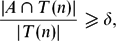 $\frac{|A\cap T(n)|}{|T(n)|}\geqslant\delta,$
 The second result is the following. For every sequence (mq )q∈ℕ of positive integers and for every real 0 < δ ⩽ 1, there exists a sequence (nq )q∈ℕ of positive integers such that for every D ⊆ ∪k ∏q=0 k-1[nq ] satisfying
for every k in a van der Waerden set, there is a sequence (Jq )q∈ℕ, where Jq is an arithmetic progression of length mq contained in [nq ] for all q, such that ∏q=0 k-1Jq ⊆ D for every k in a van der Waerden set. Moreover, working in an abstract setting, we may require Jq to be any configuration of natural numbers that can be found in an arbitrary set of positive density.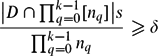 $\frac{\big|D\cap \prod_{q=0}^{k-1} [n_q]\big|s}{\prod_{q=0}^{k-1}n_q}\geqslant\delta$
The Sharp Threshold for Maximum-Size Sum-Free Subsets in Even-Order Abelian Groups
- Part of
-
- Journal:
- Combinatorics, Probability and Computing / Volume 24 / Issue 4 / July 2015
- Published online by Cambridge University Press:
- 09 January 2015, pp. 609-640
-
- Article
- Export citation
PRIMITIVE RECURSIVE BOUNDS FOR THE FINITE VERSION OF GOWERS’ $c_{0}$ THEOREM
- Part of
-
- Journal:
- Mathematika / Volume 61 / Issue 3 / September 2015
- Published online by Cambridge University Press:
- 07 January 2015, pp. 501-522
- Print publication:
- September 2015
-
- Article
- Export citation
-
We provide primitive recursive bounds for the finite version of Gowers’ $c_{0}$ theorem for both the positive and the general case. We also provide multidimensional versions of these results.


ON A SINGULAR INITIAL-VALUE PROBLEM FOR THE NAVIER–STOKES EQUATIONS
- Part of
-
- Journal:
- Mathematika / Volume 61 / Issue 2 / May 2015
- Published online by Cambridge University Press:
- 07 January 2015, pp. 277-294
- Print publication:
- May 2015
-
- Article
- Export citation
-
This paper presents a recent result for the problem introduced eleven years ago by Fraenkel and McLeod [A diffusing vortex circle in a viscous fluid. In IUTAM Symposium on Asymptotics, Singularities and Homogenisation in Problems of Mechanics, Kluwer (2003), 489–500], but described only briefly there. We shall prove the following, as far as space allows. The vorticity ${\it\omega}$ of a diffusing vortex circle in a viscous fluid has, for small values of a non-dimensional time, a second approximation ${\it\omega}_{A}+{\it\omega}_{1}$ that, although formulated for a fixed, finite Reynolds number ${\it\lambda}$ and exact for ${\it\lambda}=0$ (then ${\it\omega}={\it\omega}_{A}$), tends to a smooth limiting function as ${\it\lambda}\uparrow \infty$. In §§1 and 2 the necessary background and apparatus are described; §3 outlines the new result and its proof.


