Refine search
Actions for selected content:
9086 results in Discrete Mathematics, Information Theory and Coding
EXPANSION CONSTANTS AND HYPERBOLIC EMBEDDINGS OF FINITE GRAPHS
- Part of
-
- Journal:
- Mathematika / Volume 61 / Issue 1 / January 2015
- Published online by Cambridge University Press:
- 19 November 2014, pp. 1-13
- Print publication:
- January 2015
-
- Article
- Export citation
A SPLITTING PROCEDURE FOR BELLMAN FUNCTIONS AND THE ACTION OF DYADIC MAXIMAL OPERATORS ON $L^{p}$
- Part of
-
- Journal:
- Mathematika / Volume 61 / Issue 1 / January 2015
- Published online by Cambridge University Press:
- 19 November 2014, pp. 199-212
- Print publication:
- January 2015
-
- Article
- Export citation
-
The purpose of the paper is to introduce a novel “splitting” procedure which can be helpful in the derivation of explicit formulas for various Bellman functions. As an illustration, we study the action of the dyadic maximal operator on $L^{p}$. The associated Bellman function $\mathfrak{B}_{p}$, introduced by Nazarov and Treil, was found explicitly by Melas with the use of combinatorial properties of the maximal operator, and was later rediscovered by Slavin, Stokolos and Vasyunin with the use of the corresponding Monge–Ampère partial differential equation. Our new argument enables an alternative simple derivation of $\mathfrak{B}_{p}$.


INTERPOLATION OF HILBERT AND SOBOLEV SPACES: QUANTITATIVE ESTIMATES AND COUNTEREXAMPLES
- Part of
-
- Journal:
- Mathematika / Volume 61 / Issue 2 / May 2015
- Published online by Cambridge University Press:
- 19 November 2014, pp. 414-443
- Print publication:
- May 2015
-
- Article
- Export citation
-
This paper provides an overview of interpolation of Banach and Hilbert spaces, with a focus on establishing when equivalence of norms is in fact equality of norms in the key results of the theory. (In brief, our conclusion for the Hilbert space case is that, with the right normalizations, all the key results hold with equality of norms.) In the final section we apply the Hilbert space results to the Sobolev spaces $H^{s}({\rm\Omega})$ and $\widetilde{H}^{s}({\rm\Omega})$, for $s\in \mathbb{R}$ and an open ${\rm\Omega}\subset \mathbb{R}^{n}$. We exhibit examples in one and two dimensions of sets ${\rm\Omega}$ for which these scales of Sobolev spaces are not interpolation scales. In the cases where they are interpolation scales (in particular, if ${\rm\Omega}$ is Lipschitz) we exhibit examples that show that, in general, the interpolation norm does not coincide with the intrinsic Sobolev norm and, in fact, the ratio of these two norms can be arbitrarily large.


An Extension of the Hajnal–Szemerédi Theorem to Directed Graphs
-
- Journal:
- Combinatorics, Probability and Computing / Volume 24 / Issue 5 / September 2015
- Published online by Cambridge University Press:
- 28 October 2014, pp. 754-773
-
- Article
- Export citation
-
Hajnal and Szemerédi proved that every graph G with |G| = ks and δ(G)⩾ k(s − 1) contains k disjoint s-cliques; moreover this degree bound is optimal. We extend their theorem to directed graphs by showing that every directed graph $\vv G$ with | $\vv G$ | = ks and δ( $\vv G$ ) ⩾ 2k(s − 1) − 1 contains k disjoint transitive tournaments on s vertices, where δ( $\vv G$ )= minv∈V ( $\vv G$ )d −(v)+d +(v). Our result implies the Hajnal–Szemerédi theorem, and its degree bound is optimal. We also make some conjectures regarding even more general results for multigraphs and partitioning into other tournaments. One of these conjectures is supported by an asymptotic result.

Query Complexity of Sampling and Small Geometric Partitions
-
- Journal:
- Combinatorics, Probability and Computing / Volume 24 / Issue 5 / September 2015
- Published online by Cambridge University Press:
- 21 October 2014, pp. 733-753
-
- Article
- Export citation
-
In this paper we study the following problem.
Discrete partitioning problem (DPP). Let $\mathbb{F}_q$ Pn denote the n-dimensional finite projective space over $\mathbb{F}_q$ . For positive integer k ⩽ n, let {Ai }i = 1 N be a partition of ( $\mathbb{F}_q$ Pn )k such that:
-
(1) for all i ⩽ N, Ai = ∏ j=1 k Aj i (partition into product sets),
-
(2) for all i ⩽ N, there is a (k − 1)-dimensional subspace Li ⊆
$\mathbb{F}_q$ Pn such that Ai ⊆ (Li) k.
DPP arises in an approach that we propose for proving lower bounds for the query complexity of generating random points from convex bodies. It is also related to other partitioning problems in combinatorics and complexity theory. We conjecture an asymptotically optimal partition for DPP and show that it is optimal in two cases: when the dimension is low (k = n = 2) and when the factors of the parts are structured, namely factors of a part are close to being a subspace. These structured partitions arise naturally as partitions induced by query algorithms. Our problem does not seem to be directly amenable to previous techniques for partitioning lower bounds such as rank arguments, although rank arguments do lie at the core of our techniques.
-

FROM KHINCHIN’S CONJECTURE ON STRONG UNIFORMITY TO SUPERUNIFORM MOTIONS
- Part of
-
- Journal:
- Mathematika / Volume 61 / Issue 3 / September 2015
- Published online by Cambridge University Press:
- 20 October 2014, pp. 591-707
- Print publication:
- September 2015
-
- Article
- Export citation
-
We attempt to develop a new chapter of the theory of uniform distribution; we call it strong uniformity. Strong uniformity in a nutshell means that we combine Lebesgue measure with the classical theory of uniform distribution, basically founded by Weyl in his famous paper from 1916 [Über die Gleichverteilung von Zahlen mod Eins, Math. Ann.77 (1916), 313–352], which is built around nice test sets, such as axis-parallel rectangles and boxes. We prove the continuous version of the well-known Khinchin’s conjecture [Eins Satz über Kettenbrüche mit arithmetischen Adwendungen, Math. Z.18 (1923), 289–306] in every dimension $d\geqslant 2$ (the discrete version turned out to be false—it was disproved by Marstrand [On Khinchin’s conjecture about strong uniform distribution, Proc. Lond. Math. Soc. (3) 21 (1970), 540–556]). We consider an arbitrarily complicated but fixed measurable test set $S$ in the $d$-dimensional unit cube, and study the uniformity of a typical member of some natural families of curves, such as all torus lines or billiard paths starting from the origin, with respect to $S$. In the two-dimensional case we have the very surprising superuniformity of the typical torus lines and billiard paths. In dimensions ${\geqslant}3$ we still have strong uniformity, but not superuniformity. However, in dimension three we have the even more striking super-duper uniformity for two-dimensional rays (replacing the torus lines). Finally, we indicate how to exhibit superuniform motions on every “reasonable” plane region (e.g., the circular disk) and on every “reasonable” closed surface (sphere, torus and so on).


FRACTIONAL SOBOLEV–POINCARÉ AND FRACTIONAL HARDY INEQUALITIES IN UNBOUNDED JOHN DOMAINS
- Part of
-
- Journal:
- Mathematika / Volume 61 / Issue 2 / May 2015
- Published online by Cambridge University Press:
- 20 October 2014, pp. 385-401
- Print publication:
- May 2015
-
- Article
- Export citation
Sperner's Problem for G-Independent Families
-
- Journal:
- Combinatorics, Probability and Computing / Volume 24 / Issue 3 / May 2015
- Published online by Cambridge University Press:
- 15 October 2014, pp. 528-550
-
- Article
- Export citation
Maximizing the Number of Independent Sets of a Fixed Size
-
- Journal:
- Combinatorics, Probability and Computing / Volume 24 / Issue 3 / May 2015
- Published online by Cambridge University Press:
- 14 October 2014, pp. 521-527
-
- Article
- Export citation
Simplifying Inclusion–Exclusion Formulas
-
- Journal:
- Combinatorics, Probability and Computing / Volume 24 / Issue 2 / March 2015
- Published online by Cambridge University Press:
- 14 October 2014, pp. 438-456
-
- Article
- Export citation
-
Let $\mathcal{F}$ = {F1, F2,. . ., Fn} be a family of n sets on a ground set S, such as a family of balls in ℝd. For every finite measure μ on S, such that the sets of $\mathcal{F}$ are measurable, the classical inclusion–exclusion formula asserts thatthat is, the measure of the union is expressed using measures of various intersections. The number of terms in this formula is exponential in n, and a significant amount of research, originating in applied areas, has been devoted to constructing simpler formulas for particular families $\[\mu(F_1\cup F_2\cup\cdots\cup F_n)=\sum_{I:\emptyset\ne I\subseteq[n]} (-1)^{|I|+1}\mu\biggl(\bigcap_{i\in I} F_i\biggr),\]$$\mathcal{F}$. We provide an upper bound valid for an arbitrary $\mathcal{F}$: we show that every system $\mathcal{F}$ of n sets with m non-empty fields in the Venn diagram admits an inclusion–exclusion formula with mO(log2n) terms and with ±1 coefficients, and that such a formula can be computed in mO(log2n) expected time. For every ϵ > 0 we also construct systems with Venn diagram of size m for which every valid inclusion–exclusion formula has the sum of absolute values of the coefficients at least Ω(m2−ϵ).

‘The Asymptotic Number of Connected d-Uniform Hypergraphs’ — CORRIGENDUM
-
- Journal:
- Combinatorics, Probability and Computing / Volume 24 / Issue 1 / January 2015
- Published online by Cambridge University Press:
- 14 October 2014, pp. 373-375
-
- Article
-
- You have access
- Export citation
Diagonal Asymptotics for Products of Combinatorial Classes
-
- Journal:
- Combinatorics, Probability and Computing / Volume 24 / Issue 1 / January 2015
- Published online by Cambridge University Press:
- 10 October 2014, pp. 354-372
-
- Article
- Export citation
Evaluations of Topological Tutte Polynomials
-
- Journal:
- Combinatorics, Probability and Computing / Volume 24 / Issue 3 / May 2015
- Published online by Cambridge University Press:
- 10 October 2014, pp. 556-583
-
- Article
- Export citation
SHARP CONSTANTS IN THE POINCARÉ, STEKLOV AND RELATED INEQUALITIES (A SURVEY)
- Part of
-
- Journal:
- Mathematika / Volume 61 / Issue 2 / May 2015
- Published online by Cambridge University Press:
- 10 October 2014, pp. 328-344
- Print publication:
- May 2015
-
- Article
- Export citation
Optimal Codes in the Enomoto-Katona Space
-
- Journal:
- Combinatorics, Probability and Computing / Volume 24 / Issue 2 / March 2015
- Published online by Cambridge University Press:
- 09 October 2014, pp. 382-406
-
- Article
- Export citation
ON IMPROVING ROTH’S THEOREM IN THE PRIMES
- Part of
-
- Journal:
- Mathematika / Volume 61 / Issue 1 / January 2015
- Published online by Cambridge University Press:
- 09 October 2014, pp. 49-62
- Print publication:
- January 2015
-
- Article
- Export citation
-
Let $A\subset \{1,\dots ,N\}$ be a set of prime numbers containing no non-trivial arithmetic progressions. Suppose that $A$ has relative density ${\it\alpha}=|A|/{\it\pi}(N)$, where ${\it\pi}(N)$ denotes the number of primes in the set $\{1,\dots ,N\}$. By modifying Helfgott and De Roton’s work [Improving Roth’s theorem in the primes. Int. Math. Res. Not. IMRN2011 (4) (2011), 767–783], we improve their bound and show that
 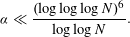 $$\begin{eqnarray}{\it\alpha}\ll \frac{(\log \log \log N)^{6}}{\log \log N}.\end{eqnarray}$$


Set Systems Containing Many Maximal Chains
-
- Journal:
- Combinatorics, Probability and Computing / Volume 24 / Issue 3 / May 2015
- Published online by Cambridge University Press:
- 09 October 2014, pp. 480-485
-
- Article
- Export citation
-
The purpose of this short problem paper is to raise the following extremal question on set systems: Which set systems of a given size maximise the number of (n + 1)-element chains in the power set $\mathcal{P}$(1,2,. . .,n)? We will show that for each fixed α > 0 there is a family of α2n sets containing (α + o(1))n! such chains, and that this is asymptotically best possible. For smaller set systems we conjecture that a ‘tower of cubes’ construction is extremal. We finish by mentioning briefly a connection to an extremal problem on posets and a variant of our question for the grid graph.

A Binary Deletion Channel With a Fixed Number of Deletions
-
- Journal:
- Combinatorics, Probability and Computing / Volume 24 / Issue 3 / May 2015
- Published online by Cambridge University Press:
- 07 October 2014, pp. 486-489
-
- Article
- Export citation
CPC volume 23 issue 6 Cover and Back matter
-
- Journal:
- Combinatorics, Probability and Computing / Volume 23 / Issue 6 / November 2014
- Published online by Cambridge University Press:
- 06 October 2014, pp. b1-b8
-
- Article
-
- You have access
- Export citation
CPC volume 23 issue 6 Cover and Front matter
-
- Journal:
- Combinatorics, Probability and Computing / Volume 23 / Issue 6 / November 2014
- Published online by Cambridge University Press:
- 06 October 2014, pp. f1-f2
-
- Article
-
- You have access
- Export citation
