Refine search
Actions for selected content:
9086 results in Discrete Mathematics, Information Theory and Coding
MTK volume 61 Issue 1 Cover and Back matter
-
- Journal:
- Mathematika / Volume 61 / Issue 1 / January 2015
- Published online by Cambridge University Press:
- 06 February 2015, pp. b1-b2
- Print publication:
- January 2015
-
- Article
-
- You have access
- Export citation
ON CONFIGURATIONS WHERE THE LOOMIS–WHITNEY INEQUALITY IS NEARLY SHARP AND APPLICATIONS TO THE FURSTENBERG SET PROBLEM
- Part of
-
- Journal:
- Mathematika / Volume 61 / Issue 1 / January 2015
- Published online by Cambridge University Press:
- 07 January 2015, pp. 145-161
- Print publication:
- January 2015
-
- Article
- Export citation
-
In this paper, we consider the so-called “Furstenberg set problem” in high dimensions. First, following Wolff’s work on the two-dimensional real case, we provide “reasonable” upper bounds for the problem for $\mathbb{R}$ or $\mathbb{F}_{p}$. Next we study the “critical” case and improve the “trivial” exponent by ${\rm\Omega}(1/n^{2})$ for $\mathbb{F}_{p}^{n}$. Our key tool in obtaining this lower bound is a theorem about how things behave when the Loomis–Whitney inequality is nearly sharp, as it helps us to reduce the problem to dimension two.


MTK volume 61 Issue 1 Cover and Front matter
-
- Journal:
- Mathematika / Volume 61 / Issue 1 / January 2015
- Published online by Cambridge University Press:
- 06 February 2015, pp. f1-f2
- Print publication:
- January 2015
-
- Article
-
- You have access
- Export citation
Decomposing Random Graphs into Few Cycles and Edges
- Part of
-
- Journal:
- Combinatorics, Probability and Computing / Volume 24 / Issue 6 / November 2015
- Published online by Cambridge University Press:
- 29 December 2014, pp. 857-872
-
- Article
- Export citation
A Short Proof of the Random Ramsey Theorem
- Part of
-
- Journal:
- Combinatorics, Probability and Computing / Volume 25 / Issue 1 / January 2016
- Published online by Cambridge University Press:
- 22 December 2014, pp. 130-144
-
- Article
- Export citation
-
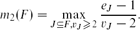
In this paper we give a short proof of the Random Ramsey Theorem of Rödl and Ruciński: for any graph F which contains a cycle and r ≥ 2, there exist constants c, C > 0 such that
where $$\begin{equation*}\Pr[G_{n,p} \rightarrow (F)_r^e] =\begin{cases}1-o(1) &p\ge Cn^{-1/m_2(F)},\\o(1) &p\le cn^{-1/m_2(F)},\end{cases}\end{equation*}$$The proof of the 1-statement is based on the recent beautiful hypergraph container theorems by Saxton and Thomason, and Balogh, Morris and Samotij. The proof of the 0-statement is elementary.
 $$\begin{equation*}m_2(F) = \max_{J\subseteq F, v_J\ge 2} \frac{e_J-1}{v_J-2}.\end{equation*}$$
Minimum Number of Monotone Subsequences of Length 4 in Permutations
- Part of
-
- Journal:
- Combinatorics, Probability and Computing / Volume 24 / Issue 4 / July 2015
- Published online by Cambridge University Press:
- 19 December 2014, pp. 658-679
-
- Article
- Export citation
-
We show that for every sufficiently large n, the number of monotone subsequences of length four in a permutation on n points is at least
Furthermore, we characterize all permutations on [n] that attain this lower bound. The proof uses the flag algebra framework together with some additional stability arguments. This problem is equivalent to some specific type of edge colourings of complete graphs with two colours, where the number of monochromatic K4 is minimized. We show that all the extremal colourings must contain monochromatic K4 only in one of the two colours. This translates back to permutations, where all the monotone subsequences of length four are all either increasing, or decreasing only. \begin{equation*}\binom{\lfloor{n/3}\rfloor}{4} + \binom{\lfloor{(n+1)/3}\rfloor}{4} + \binom{\lfloor{(n+2)/3}\rfloor}{4}.\end{equation*}
Representation Theory
- A Combinatorial Viewpoint
-
- Published online:
- 18 December 2014
- Print publication:
- 05 February 2015

Applied Algebra and Number Theory
-
- Published online:
- 18 December 2014
- Print publication:
- 11 December 2014
13 - A quasi-Monte Carlo method for the coagulation equation
-
-
- Book:
- Applied Algebra and Number Theory
- Published online:
- 18 December 2014
- Print publication:
- 11 December 2014, pp 216-234
-
- Chapter
- Export citation
18 - On the linear complexity of multisequences, bijections between ℤahlen and ℕumber tuples, and partitions
-
-
- Book:
- Applied Algebra and Number Theory
- Published online:
- 18 December 2014
- Print publication:
- 11 December 2014, pp 307-335
-
- Chapter
- Export citation
16 - Index bounds for value sets of polynomials over finite fields
-
-
- Book:
- Applied Algebra and Number Theory
- Published online:
- 18 December 2014
- Print publication:
- 11 December 2014, pp 280-296
-
- Chapter
- Export citation
4 - Discrepancy bounds for low-dimensional point sets
-
-
- Book:
- Applied Algebra and Number Theory
- Published online:
- 18 December 2014
- Print publication:
- 11 December 2014, pp 58-90
-
- Chapter
- Export citation
7 - Point sets of minimal energy
-
-
- Book:
- Applied Algebra and Number Theory
- Published online:
- 18 December 2014
- Print publication:
- 11 December 2014, pp 109-125
-
- Chapter
- Export citation
Frontmatter
-
- Book:
- Applied Algebra and Number Theory
- Published online:
- 18 December 2014
- Print publication:
- 11 December 2014, pp i-iv
-
- Chapter
- Export citation
1 - Some highlights of Harald Niederreiter's work
-
-
- Book:
- Applied Algebra and Number Theory
- Published online:
- 18 December 2014
- Print publication:
- 11 December 2014, pp 1-21
-
- Chapter
- Export citation
17 - Rational points of the curve over
-
-
- Book:
- Applied Algebra and Number Theory
- Published online:
- 18 December 2014
- Print publication:
- 11 December 2014, pp 297-306
-
- Chapter
- Export citation
6 - A heuristic formula estimating the keystream length for the general combination generator with respect to a correlation attack
-
-
- Book:
- Applied Algebra and Number Theory
- Published online:
- 18 December 2014
- Print publication:
- 11 December 2014, pp 102-108
-
- Chapter
- Export citation
8 - The cross-correlation measure for families of binary sequences
-
-
- Book:
- Applied Algebra and Number Theory
- Published online:
- 18 December 2014
- Print publication:
- 11 December 2014, pp 126-143
-
- Chapter
- Export citation
Formulae and Asymptotics for Coefficients of Algebraic Functions
-
- Journal:
- Combinatorics, Probability and Computing / Volume 24 / Issue 1 / January 2015
- Published online by Cambridge University Press:
- 11 December 2014, pp. 1-53
-
- Article
- Export citation
Gaussian Distribution of Trie Depth for Strongly Tame Sources
-
- Journal:
- Combinatorics, Probability and Computing / Volume 24 / Issue 1 / January 2015
- Published online by Cambridge University Press:
- 11 December 2014, pp. 54-103
-
- Article
- Export citation
