Refine search
Actions for selected content:
9084 results in Discrete Mathematics, Information Theory and Coding
CHAPTER 5 - MULTIPLIER THEOREMS
-
- Book:
- Symmetric Designs
- Published online:
- 16 March 2010
- Print publication:
- 20 January 1983, pp 188-222
-
- Chapter
- Export citation
INDEX
-
- Book:
- Symmetric Designs
- Published online:
- 16 March 2010
- Print publication:
- 20 January 1983, pp 304-306
-
- Chapter
- Export citation
CHAPTER 4 - DIFFERENCE SETS
-
- Book:
- Symmetric Designs
- Published online:
- 16 March 2010
- Print publication:
- 20 January 1983, pp 120-187
-
- Chapter
- Export citation
Contents
-
- Book:
- Symmetric Designs
- Published online:
- 16 March 2010
- Print publication:
- 20 January 1983, pp vii-viii
-
- Chapter
- Export citation
REFERENCES
-
- Book:
- Symmetric Designs
- Published online:
- 16 March 2010
- Print publication:
- 20 January 1983, pp 294-303
-
- Chapter
- Export citation
The square mean of Dirichlet series associated with cusp forms
-
- Journal:
- Mathematika / Volume 29 / Issue 2 / December 1982
- Published online by Cambridge University Press:
- 26 February 2010, pp. 278-295
- Print publication:
- December 1982
-
- Article
- Export citation
-
Let

be a cusp form of even integral weight k > 2 for the full modular group. Then the Dirichlet series

is absolutely convergent for σ > ½(k + 1). Hecke showed that LF is an entire function of s satisfying the functional equation

Further lattice packings in high dimensions
-
- Journal:
- Mathematika / Volume 29 / Issue 2 / December 1982
- Published online by Cambridge University Press:
- 26 February 2010, pp. 171-180
- Print publication:
- December 1982
-
- Article
- Export citation
-
Barnes and Sloane recently described a “general construction” for lattice packings of equal spheres in Euclidean space. In the present paper we simplify and further generalize their construction, and make it suitable for iteration. As a result we obtain lattice packings in ℝm with density Δ satisfying
 , as m → ∞ where
  is the smallest value of k for which the k-th iterated logarithm of m is less than 1. These appear to be the densest lattices that have been explicitly constructed in high-dimensional space. New records are also established in a number of lower dimensions, beginning in dimension 96.
 , as
, as  is the smallest value of
 Irrationality of lattices in finite characteristic
-
- Journal:
- Mathematika / Volume 29 / Issue 2 / December 1982
- Published online by Cambridge University Press:
- 26 February 2010, pp. 227-230
- Print publication:
- December 1982
-
- Article
- Export citation
-
Let q = pn, p a rational prime, and let
 be the finite field with q elements. The polynomial ring
  is considered as an analogue of the ring of rational integers ℤ. Completing the quotient field
  with respect to the normalized valuation at ∞, and then taking algebraic closure, we obtained the field k∞ whose elements will be called “numbers”.
 be the finite field with
  is considered as an analogue of the ring of rational integers ℤ. Completing the quotient field
  with respect to the normalized valuation at ∞, and then taking algebraic closure, we obtained the field
 Further solutions of the Falkner–Skan equation for β = – 1 and γ = 0
- Part of
-
- Journal:
- Mathematika / Volume 29 / Issue 2 / December 1982
- Published online by Cambridge University Press:
- 26 February 2010, pp. 231-248
- Print publication:
- December 1982
-
- Article
- Export citation
-
We consider the Falkner–Skan equation
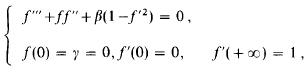
in the special case β = – 1. It is known that this equation may be integrated twice to get the Riccati equation

Packing and covering with convex discs
-
- Journal:
- Mathematika / Volume 29 / Issue 2 / December 1982
- Published online by Cambridge University Press:
- 26 February 2010, pp. 181-193
- Print publication:
- December 1982
-
- Article
- Export citation
Connectivity and freely rolling convex bodies
- Part of
-
- Journal:
- Mathematika / Volume 29 / Issue 2 / December 1982
- Published online by Cambridge University Press:
- 26 February 2010, pp. 249-259
- Print publication:
- December 1982
-
- Article
- Export citation
MTK volume 29 issue 2 Back matter
-
- Journal:
- Mathematika / Volume 29 / Issue 2 / December 1982
- Published online by Cambridge University Press:
- 26 February 2010, p. b1
- Print publication:
- December 1982
-
- Article
-
- You have access
- Export citation
On the Riemann zeta-function ζ(s)—Gaps between sign changes of S(t)
-
- Journal:
- Mathematika / Volume 29 / Issue 2 / December 1982
- Published online by Cambridge University Press:
- 26 February 2010, pp. 264-269
- Print publication:
- December 1982
-
- Article
- Export citation
-
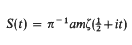
Denote by N(t) the number of zeros β + iγ of ζ(s), s = σ + it, with 0 < β < 1 and 0 < γ < t. It is well known that
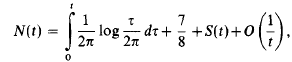
where
Power mean values of the Riemann zeta-function
-
- Journal:
- Mathematika / Volume 29 / Issue 2 / December 1982
- Published online by Cambridge University Press:
- 26 February 2010, pp. 202-212
- Print publication:
- December 1982
-
- Article
- Export citation
-
The classical mean value theorem for Dirichlet's polynomials states that

see H. L. Montgomery [7]. This formula is very useful in the theory of the Riemann zeta-function ζ(s). From the approximate functional equation

where | χ(½ + it)| = 1, u, v ≥ 1, 2πuv = t (see E. C. Titchmarsh [8]) it follows that χ(½ + it) can be well approximated by Dirichlet's polynomials of length N< t½.
MTK volume 29 issue 2 Front matter
-
- Journal:
- Mathematika / Volume 29 / Issue 2 / December 1982
- Published online by Cambridge University Press:
- 26 February 2010, pp. f1-f2
- Print publication:
- December 1982
-
- Article
-
- You have access
- Export citation
The recognition of certain Hausdorff like measures
- Part of
-
- Journal:
- Mathematika / Volume 29 / Issue 2 / December 1982
- Published online by Cambridge University Press:
- 26 February 2010, pp. 260-263
- Print publication:
- December 1982
-
- Article
- Export citation
-
For a metric space <Ω, ρ> and a ‘measure function’ h, the Hausdorff measure mh on Ω is denned by applying Method II to the premeasure defined by τ(E) = h(d(E)), E ⊆ Ω, where
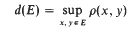
with d(Φ) = 0, is the diameter of E. The set function mh is then a metric outer measure. There are many variations on this definition producing measures also associated with the name Hausdorff. Here we are concerned with those measures which arise when there is a restriction on the sets E for which τ is defined. Such measures arise, for example, as net measures, Rogers [1]. Also we might find it useful to have τ defined only on disks, or only on squares, or only on rectangles with a given relation between vertical and horizontal sides.
Slices of L. Fejes Tóth's sausage conjecture
- Part of
-
- Journal:
- Mathematika / Volume 29 / Issue 2 / December 1982
- Published online by Cambridge University Press:
- 26 February 2010, pp. 194-201
- Print publication:
- December 1982
-
- Article
- Export citation
-
Let
 be k non-overlapping translates of the unit d-ball Bd in euclidean d-space Ed. Let Ck denote the convex hull of their centres and let Sk be a segment of length 2(k– 1). Furthermore, let Vd denote the d-volume. L. Fejes Tóth conjectured in [1], that, for d ≥ 5,
 be
be 
On the Mertens conjecture for cusp forms
-
- Journal:
- Mathematika / Volume 29 / Issue 2 / December 1982
- Published online by Cambridge University Press:
- 26 February 2010, pp. 213-226
- Print publication:
- December 1982
-
- Article
- Export citation
-
Let f be a non-zero cusp form of weight k on SL(2, ℤ) with Fourier expansion
 We assume further that f is normalized (a(1) = 1) and that f is an eigenfunction of the Hecke operators. Define
 We assume further that
Exponential sums connected with Ramanujan's function τ(n)
-
- Journal:
- Mathematika / Volume 29 / Issue 2 / December 1982
- Published online by Cambridge University Press:
- 26 February 2010, pp. 270-277
- Print publication:
- December 1982
-
- Article
- Export citation
-
This paper contains estimates of several exponential sums involving Fourier coefficients of certain modular forms. Although the questions which we consider date back, in some cases, to the twenties, our motivation is modern. All of these sums are connected with one approach to the problem of calculating the norm of the Poincaré 0-operator. In this section we state our results (and their antecedents) and then describe their relevance to the θ-operator problem. For simplicity we state and prove all our results for the modular cusp form of weight six, the famous discriminant function

Local cohomology and modules of generalized fractions
- Part of
-
- Journal:
- Mathematika / Volume 29 / Issue 2 / December 1982
- Published online by Cambridge University Press:
- 26 February 2010, pp. 296-306
- Print publication:
- December 1982
-
- Article
- Export citation
-
The purpose of this paper is to provide additional evidence to support our view that the modules of generalized fractions introduced in [8] are worth further investigation: we show that, for a module M over a (commutative, Noetherian) local ring A (with identity) having maximal ideal m and dimension n, the n-th local cohomology module
 may be viewed as a module of generalized fractions of M with respect to a certain triangular subset of An + 1, and we use this work to formulate Hochster's ‘Monomial Conjecture’ [2, Conjecture 1]; in terms of modules of generalized fractions and to make a quick deduction of one of Hochster's results which supports that conjecture.
 may be viewed as a module of generalized fractions of