Refine search
Actions for selected content:
9084 results in Discrete Mathematics, Information Theory and Coding
MTK volume 29 issue 1 Front matter
-
- Journal:
- Mathematika / Volume 29 / Issue 1 / June 1982
- Published online by Cambridge University Press:
- 26 February 2010, pp. f1-f2
- Print publication:
- June 1982
-
- Article
-
- You have access
- Export citation
Totally ordered measure spaces and their Lp algebras
- Part of
-
- Journal:
- Mathematika / Volume 29 / Issue 1 / June 1982
- Published online by Cambridge University Press:
- 26 February 2010, pp. 42-54
- Print publication:
- June 1982
-
- Article
- Export citation
-
This paper is concerned with two aspects of the theory of measures on compact totally ordered spaces (the topology is to be the order topology). In Section 2, we clarify a recent construction of Sapounakis [11, 12] and, in so doing, we are able to say a little more about it. It should be added here that Sapounakis had other ends in view. To be precise, let I be the closed unit interval [0, 1] and let λ be Lebesgue measure on I. We shall construct another totally ordered set Ĩ which is compact in its order topology, a continuous increasing surjection τ : Ĩ → I with the property that card τ−1(t) = 2 for all t ∈ ]0,1[ (these brackets denote the open interval), and a measure
 on Ĩ such that τ() = λ. Then the following theorem holds.
 on Ĩ such that τ(
On the representation of even integers as sums of two almost-primes in algebraic number fields
-
- Journal:
- Mathematika / Volume 29 / Issue 1 / June 1982
- Published online by Cambridge University Press:
- 26 February 2010, pp. 93-108
- Print publication:
- June 1982
-
- Article
- Export citation
A measure invariant under group endomorphisms
- Part of
-
- Journal:
- Mathematika / Volume 29 / Issue 1 / June 1982
- Published online by Cambridge University Press:
- 26 February 2010, pp. 116-118
- Print publication:
- June 1982
-
- Article
- Export citation
On the presentation of stratified sets and singular varieties
- Part of
-
- Journal:
- Mathematika / Volume 29 / Issue 1 / June 1982
- Published online by Cambridge University Press:
- 26 February 2010, pp. 135-170
- Print publication:
- June 1982
-
- Article
- Export citation
Covering and packing properties of bounded sequences of convex sets
-
- Journal:
- Mathematika / Volume 29 / Issue 1 / June 1982
- Published online by Cambridge University Press:
- 26 February 2010, pp. 18-31
- Print publication:
- June 1982
-
- Article
- Export citation
Mean values of superharmonic functions on half-spaces
-
- Journal:
- Mathematika / Volume 29 / Issue 1 / June 1982
- Published online by Cambridge University Press:
- 26 February 2010, pp. 55-57
- Print publication:
- June 1982
-
- Article
- Export citation
-
Hyperplane mean values of non-negative subharmonic functions have been studied in many papers, of which [2] and [3] are examples. Recently, Armitage [1] began a study of hyperplane means of non-negative superharmonic functions. One of his results [1, Theorem 2] shows that, if w is a positive superharmonic function on

and n/(n + 1) p < 1, then

as t → ∞, while another [1, Theorem 1] shows that, if 0 < p ≤ n/(n + l), then the integral in (1) is always infinite. However, he did not present a complete analogue of the result of Flett and Brawn [2, 3], which states that, if Ф: [0, ∞ [ → [0, ∞ [ is a non-decreasing convex function such that Ф(u)/u → 0 as u → 0 +, and w is a nonnegative subharmonic function on Rn × ]0, ∞ [, then under certain conditions on the size of w, the integral mean
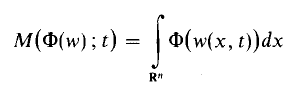
tends to zero as t → ∞. In this note we present an analogue for superharmonic functions of the above result, in which the mean M(Ф(w); t) is shown to tend to infinity with t, provided that Ф(u)/u → ∞ as u → 0 +, and which therefore generalizes (1). It might be expected that, in dealing with the superharmonic case, the function Ф would have to be concave, so that Ф(w) would also be superharmonic. It turns out that this condition is unnecessary.
A parity problem from sieve theory
-
- Journal:
- Mathematika / Volume 29 / Issue 1 / June 1982
- Published online by Cambridge University Press:
- 26 February 2010, pp. 1-6
- Print publication:
- June 1982
-
- Article
- Export citation
Sets of finite sets satisfying union conditions
-
- Journal:
- Mathematika / Volume 29 / Issue 1 / June 1982
- Published online by Cambridge University Press:
- 26 February 2010, pp. 128-134
- Print publication:
- June 1982
-
- Article
- Export citation
Hausdorff dimension and the exceptional set of projections
- Part of
-
- Journal:
- Mathematika / Volume 29 / Issue 1 / June 1982
- Published online by Cambridge University Press:
- 26 February 2010, pp. 109-115
- Print publication:
- June 1982
-
- Article
- Export citation
Cubic Diophantine inequalities
-
- Journal:
- Mathematika / Volume 29 / Issue 1 / June 1982
- Published online by Cambridge University Press:
- 26 February 2010, pp. 83-92
- Print publication:
- June 1982
-
- Article
- Export citation
-
Let λ1, …, λ8 be any non-zero real numbers not all of the same sign and not all in rational ratios. According to a theorem of Davenport and Roth [3], given a real number κ, the inequality

has infinitely many solutions in positive integers for any ε > 0. Recently Liu, Ng and Tsang [5] gave a refinement of this result: for any δ > 0, the inequality

has infinitely many solutions in positive integers. In the present note we obtain a better exponent.
Boundary measures of solutions of partial differential equations
- Part of
-
- Journal:
- Mathematika / Volume 29 / Issue 1 / June 1982
- Published online by Cambridge University Press:
- 26 February 2010, pp. 67-82
- Print publication:
- June 1982
-
- Article
- Export citation
Modules of generalized fractions
- Part of
-
- Journal:
- Mathematika / Volume 29 / Issue 1 / June 1982
- Published online by Cambridge University Press:
- 26 February 2010, pp. 32-41
- Print publication:
- June 1982
-
- Article
- Export citation
-
The construction, for a module M over a commutative ring A (with identity) and a multiplicatively closed subset S of A, of the module of fractions S-1M is, of course, one of the most basic ideas in commutative algebra. The purpose of this note is to present a generalization which constructs, for a positive integer n and what is called a triangular subset U of An = A × A × … × A (n factors), a module U-n M of generalized fractions, a typical element of which has the form
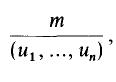
where m∈ M and (u1, … un)∈U.
Squarefree numbers on short intervals
-
- Journal:
- Mathematika / Volume 29 / Issue 1 / June 1982
- Published online by Cambridge University Press:
- 26 February 2010, pp. 7-17
- Print publication:
- June 1982
-
- Article
- Export citation
-
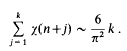
It is a familiar fact that the sequence of K-free numbers, i.e. those having no K-th power divisor greater than 1, has asymptotic density 1/ζ(K). Let χ(K) denote the characteristic function of this sequence, χ(2) = χ. Roth [5] proved that, if k/(n3/13(log n)4/13) → ∞, then
Low-Reynolds-number flow between converging spheres
- Part of
-
- Journal:
- Mathematika / Volume 29 / Issue 1 / June 1982
- Published online by Cambridge University Press:
- 26 February 2010, pp. 58-66
- Print publication:
- June 1982
-
- Article
- Export citation
Simplicial faces and sections of a convex polytope
-
- Journal:
- Mathematika / Volume 29 / Issue 1 / June 1982
- Published online by Cambridge University Press:
- 26 February 2010, pp. 119-127
- Print publication:
- June 1982
-
- Article
- Export citation
Cesàro means and recurrence in dynamic thermoelasticity
-
- Journal:
- Mathematika / Volume 28 / Issue 2 / December 1981
- Published online by Cambridge University Press:
- 26 February 2010, pp. 211-230
- Print publication:
- December 1981
-
- Article
- Export citation
Minimal width and diameter of lattice-point-free convex bodies
-
- Journal:
- Mathematika / Volume 28 / Issue 2 / December 1981
- Published online by Cambridge University Press:
- 26 February 2010, pp. 255-264
- Print publication:
- December 1981
-
- Article
- Export citation
-
Let K be a convex body (compact convex set with interior points) in d-dimensional euclidean space Ed, let D(K) denote its diameter, Δ(K) its minimal width, and
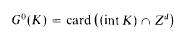
the number of lattice points (points of Ed with integer coordinates) in the interior of K. If G0(K) = 0, we call K lattice-point-free; in what follows, K will always be a lattice-point-free convex body.
Lifting properties and uniform regularity of lebesgue measures on topological spaces
- Part of
-
- Journal:
- Mathematika / Volume 28 / Issue 2 / December 1981
- Published online by Cambridge University Press:
- 26 February 2010, pp. 198-205
- Print publication:
- December 1981
-
- Article
- Export citation
Convex bodies which tile space by translation: Acknowledgement of priority
-
- Journal:
- Mathematika / Volume 28 / Issue 2 / December 1981
- Published online by Cambridge University Press:
- 26 February 2010, p. 191
- Print publication:
- December 1981
-
- Article
- Export citation
