Refine search
Actions for selected content:
9084 results in Discrete Mathematics, Information Theory and Coding
Eigenvalues and triangles in graphs
- Part of
-
- Journal:
- Combinatorics, Probability and Computing / Volume 30 / Issue 2 / March 2021
- Published online by Cambridge University Press:
- 28 September 2020, pp. 258-270
-
- Article
- Export citation
-
Bollobás and Nikiforov (J. Combin. Theory Ser. B. 97 (2007) 859–865) conjectured the following. If G is a Kr+1-free graph on at least r+1 vertices and m edges, then ${\rm{\lambda }}_1^2(G) + {\rm{\lambda }}_2^2(G) \le (r - 1)/r \cdot 2m$, where λ1 (G)and λ2 (G) are the largest and the second largest eigenvalues of the adjacency matrix A(G), respectively. In this paper we confirm the conjecture in the case r=2, by using tools from doubly stochastic matrix theory, and also characterize all families of extremal graphs. Motivated by classic theorems due to Erdös and Nosal respectively, we prove that every non-bipartite graph of order and size contains a triangle if one of the following is true: (i) ${{\rm{\lambda }}_1}(G) \ge \sqrt {m - 1} $ and $G \ne {C_5} \cup (n - 5){K_1}$, and (ii) ${{\rm{\lambda }}_1}(G) \ge {{\rm{\lambda }}_1}(S({K_{[(n - 1)/2],[(n - 1)/2]}}))$ and $G \ne S({K_{[(n - 1)/2],[(n - 1)/2]}})$, where $S({K_{[(n - 1)/2],[(n - 1)/2]}})$ is obtained from ${K_{[(n - 1)/2],[(n - 1)/2]}}$ by subdividing an edge. Both conditions are best possible. We conclude this paper with some open problems.
Finding tight Hamilton cycles in random hypergraphs faster
- Part of
-
- Journal:
- Combinatorics, Probability and Computing / Volume 30 / Issue 2 / March 2021
- Published online by Cambridge University Press:
- 23 September 2020, pp. 239-257
-
- Article
- Export citation
-
In an r-uniform hypergraph on n vertices, a tight Hamilton cycle consists of n edges such that there exists a cyclic ordering of the vertices where the edges correspond to consecutive segments of r vertices. We provide a first deterministic polynomial-time algorithm, which finds a.a.s. tight Hamilton cycles in random r-uniform hypergraphs with edge probability at least C log3 n/n.
Our result partially answers a question of Dudek and Frieze, who proved that tight Hamilton cycles exist already for p = ω(1/n) for r = 3 and p = (e + o(1))/n for $r \ge 4$ using a second moment argument. Moreover our algorithm is superior to previous results of Allen, Böttcher, Kohayakawa and Person, and Nenadov and Škorić, in various ways: the algorithm of Allen et al. is a randomized polynomial-time algorithm working for edge probabilities $p \ge {n^{ - 1 + \varepsilon}}$, while the algorithm of Nenadov and Škorić is a randomized quasipolynomial-time algorithm working for edge probabilities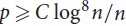 $p \ge C\mathop {\log }\nolimits^8 n/n$.


Maker–Breaker percolation games I: crossing grids
- Part of
-
- Journal:
- Combinatorics, Probability and Computing / Volume 30 / Issue 2 / March 2021
- Published online by Cambridge University Press:
- 15 September 2020, pp. 200-227
-
- Article
-
- You have access
- Open access
- Export citation
Triangle-degrees in graphs and tetrahedron coverings in 3-graphs
- Part of
-
- Journal:
- Combinatorics, Probability and Computing / Volume 30 / Issue 2 / March 2021
- Published online by Cambridge University Press:
- 09 September 2020, pp. 175-199
-
- Article
-
- You have access
- Open access
- Export citation
-
We investigate a covering problem in 3-uniform hypergraphs (3-graphs): Given a 3-graph F, what is c1(n, F), the least integer d such that if G is an n-vertex 3-graph with minimum vertex-degree $\delta_1(G)>d$ then every vertex of G is contained in a copy of F in G?
We asymptotically determine c1(n, F) when F is the generalized triangle $K_4^{(3)-}$, and we give close to optimal bounds in the case where F is the tetrahedron $K_4^{(3)}$ (the complete 3-graph on 4 vertices).
This latter problem turns out to be a special instance of the following problem for graphs: Given an n-vertex graph G with $m> n^2/4$ edges, what is the largest t such that some vertex in G must be contained in t triangles? We give upper bound constructions for this problem that we conjecture are asymptotically tight. We prove our conjecture for tripartite graphs, and use flag algebra computations to give some evidence of its truth in the general case.


Hamiltonian Berge cycles in random hypergraphs
- Part of
-
- Journal:
- Combinatorics, Probability and Computing / Volume 30 / Issue 2 / March 2021
- Published online by Cambridge University Press:
- 08 September 2020, pp. 228-238
-
- Article
- Export citation
-
In this note we study the emergence of Hamiltonian Berge cycles in random r-uniform hypergraphs. For $r\geq 3$ we prove an optimal stopping time result that if edges are sequentially added to an initially empty r-graph, then as soon as the minimum degree is at least 2, the hypergraph with high probability has such a cycle. In particular, this determines the threshold probability for Berge Hamiltonicity of the Erdős–Rényi random r-graph, and we also show that the 2-out random r-graph with high probability has such a cycle. We obtain similar results for weak Berge cycles as well, thus resolving a conjecture of Poole.

Dirac’s theorem for random regular graphs
- Part of
-
- Journal:
- Combinatorics, Probability and Computing / Volume 30 / Issue 1 / January 2021
- Published online by Cambridge University Press:
- 28 August 2020, pp. 17-36
-
- Article
- Export citation
-
We prove a ‘resilience’ version of Dirac’s theorem in the setting of random regular graphs. More precisely, we show that whenever d is sufficiently large compared to $\epsilon > 0$, a.a.s. the following holds. Let $G'$ be any subgraph of the random n-vertex d-regular graph $G_{n,d}$ with minimum degree at least
  $$(1/2 + \epsilon )d$$. Then $G'$ is Hamiltonian.
This proves a conjecture of Ben-Shimon, Krivelevich and Sudakov. Our result is best possible: firstly the condition that d is large cannot be omitted, and secondly the minimum degree bound cannot be improved.


Resilience of the rank of random matrices
- Part of
-
- Journal:
- Combinatorics, Probability and Computing / Volume 30 / Issue 2 / March 2021
- Published online by Cambridge University Press:
- 28 August 2020, pp. 163-174
-
- Article
- Export citation
-
Let M be an n × m matrix of independent Rademacher (±1) random variables. It is well known that if $n \leq m$, then M is of full rank with high probability. We show that this property is resilient to adversarial changes to M. More precisely, if $m \ge n + {n^{1 - \varepsilon /6}}$, then even after changing the sign of (1 – ε)m/2 entries, M is still of full rank with high probability. Note that this is asymptotically best possible as one can easily make any two rows proportional with at most m/2 changes. Moreover, this theorem gives an asymptotic solution to a slightly weakened version of a conjecture made by Van Vu in [17].

Breaking bivariate records
- Part of
-
- Journal:
- Combinatorics, Probability and Computing / Volume 30 / Issue 1 / January 2021
- Published online by Cambridge University Press:
- 18 August 2020, pp. 105-123
-
- Article
- Export citation
Monochromatic cycle partitions in random graphs
- Part of
-
- Journal:
- Combinatorics, Probability and Computing / Volume 30 / Issue 1 / January 2021
- Published online by Cambridge University Press:
- 14 August 2020, pp. 136-152
-
- Article
-
- You have access
- Open access
- Export citation
-
Erdős, Gyárfás and Pyber showed that every r-edge-coloured complete graph Kn can be covered by 25 r2 log r vertex-disjoint monochromatic cycles (independent of n). Here we extend their result to the setting of binomial random graphs. That is, we show that if $p= p(n) = \Omega(n^{-1/(2r)})$, then with high probability any r-edge-coloured G(n, p) can be covered by at most 1000r4 log r vertex-disjoint monochromatic cycles. This answers a question of Korándi, Mousset, Nenadov, Škorić and Sudakov.
Many disjoint triangles in co-triangle-free graphs
- Part of
-
- Journal:
- Combinatorics, Probability and Computing / Volume 30 / Issue 1 / January 2021
- Published online by Cambridge University Press:
- 14 August 2020, pp. 153-162
-
- Article
- Export citation
Improved Ramsey-type results for comparability graphs
- Part of
-
- Journal:
- Combinatorics, Probability and Computing / Volume 29 / Issue 5 / September 2020
- Published online by Cambridge University Press:
- 13 August 2020, pp. 747-756
-
- Article
- Export citation
-
Several discrete geometry problems are equivalent to estimating the size of the largest homogeneous sets in graphs that happen to be the union of few comparability graphs. An important observation for such results is that if G is an n-vertex graph that is the union of r comparability (or more generally, perfect) graphs, then either G or its complement contains a clique of size $n^{1/(r+1)}$.
This bound is known to be tight for $r=1$. The question whether it is optimal for $r\ge 2$ was studied by Dumitrescu and Tóth. We prove that it is essentially best possible for $r=2$, as well: we introduce a probabilistic construction of two comparability graphs on n vertices, whose union contains no clique or independent set of size $n^{1/3+o(1)}$.
Using similar ideas, we can also construct a graph G that is the union of r comparability graphs, and neither G nor its complement contain a complete bipartite graph with parts of size $cn/{(log n)^r}$. With this, we improve a result of Fox and Pach.


Robustness of randomized rumour spreading
- Part of
-
- Journal:
- Combinatorics, Probability and Computing / Volume 30 / Issue 1 / January 2021
- Published online by Cambridge University Press:
- 12 August 2020, pp. 37-78
-
- Article
-
- You have access
- Open access
- Export citation
A quantitative Lovász criterion for Property B
- Part of
-
- Journal:
- Combinatorics, Probability and Computing / Volume 29 / Issue 6 / November 2020
- Published online by Cambridge University Press:
- 07 August 2020, pp. 956-960
-
- Article
- Export citation
Approximately counting bases of bicircular matroids
- Part of
-
- Journal:
- Combinatorics, Probability and Computing / Volume 30 / Issue 1 / January 2021
- Published online by Cambridge University Press:
- 06 August 2020, pp. 124-135
-
- Article
- Export citation
On the subgraph query problem
- Part of
-
- Journal:
- Combinatorics, Probability and Computing / Volume 30 / Issue 1 / January 2021
- Published online by Cambridge University Press:
- 27 July 2020, pp. 1-16
-
- Article
- Export citation
Large triangle packings and Tuza’s conjecture in sparse random graphs
- Part of
-
- Journal:
- Combinatorics, Probability and Computing / Volume 29 / Issue 5 / September 2020
- Published online by Cambridge University Press:
- 22 July 2020, pp. 757-779
-
- Article
- Export citation
Pseudorandom hypergraph matchings
- Part of
-
- Journal:
- Combinatorics, Probability and Computing / Volume 29 / Issue 6 / November 2020
- Published online by Cambridge University Press:
- 22 July 2020, pp. 868-885
-
- Article
- Export citation
A note on distinct distances
- Part of
-
- Journal:
- Combinatorics, Probability and Computing / Volume 29 / Issue 5 / September 2020
- Published online by Cambridge University Press:
- 16 July 2020, pp. 650-663
-
- Article
- Export citation
-
We show that, for a constant-degree algebraic curve γ in ℝD, every set of n points on γ spans at least Ω(n4/3) distinct distances, unless γ is an algebraic helix, in the sense of Charalambides [2]. This improves the earlier bound Ω(n5/4) of Charalambides [2].
We also show that, for every set P of n points that lie on a d-dimensional constant-degree algebraic variety V in ℝD, there exists a subset S ⊂ P of size at least Ω(n4/(9+12(d−1))), such that S spans $\left({\begin{array}{*{20}{c}} {|S|} \\ 2 \\\end{array}} \right)$ distinct distances. This improves the earlier bound of Ω(n1/(3d)) of Conlon, Fox, Gasarch, Harris, Ulrich and Zbarsky [4].
Both results are consequences of a common technical tool.

Constructing families of cospectral regular graphs
- Part of
-
- Journal:
- Combinatorics, Probability and Computing / Volume 29 / Issue 5 / September 2020
- Published online by Cambridge University Press:
- 30 June 2020, pp. 664-671
-
- Article
- Export citation
Ramsey properties of randomly perturbed graphs: cliques and cycles
-
- Journal:
- Combinatorics, Probability and Computing / Volume 29 / Issue 6 / November 2020
- Published online by Cambridge University Press:
- 30 June 2020, pp. 830-867
-
- Article
- Export citation
