Refine search
Actions for selected content:
9084 results in Discrete Mathematics, Information Theory and Coding
Cycle partitions of regular graphs
- Part of
-
- Journal:
- Combinatorics, Probability and Computing / Volume 30 / Issue 4 / July 2021
- Published online by Cambridge University Press:
- 18 December 2020, pp. 526-549
-
- Article
- Export citation
-
Magnant and Martin conjectured that the vertex set of any d-regular graph G on n vertices can be partitioned into $n / (d+1)$ paths (there exists a simple construction showing that this bound would be best possible). We prove this conjecture when $d = \Omega(n)$, improving a result of Han, who showed that in this range almost all vertices of G can be covered by $n / (d+1) + 1$ vertex-disjoint paths. In fact our proof gives a partition of V(G) into cycles. We also show that, if $d = \Omega(n)$ and G is bipartite, then V(G) can be partitioned into n/(2d) paths (this bound is tight for bipartite graphs).


Counting Hamilton cycles in Dirac hypergraphs
- Part of
-
- Journal:
- Combinatorics, Probability and Computing / Volume 30 / Issue 4 / July 2021
- Published online by Cambridge University Press:
- 17 December 2020, pp. 631-653
-
- Article
- Export citation
-
A tight Hamilton cycle in a k-uniform hypergraph (k-graph) G is a cyclic ordering of the vertices of G such that every set of k consecutive vertices in the ordering forms an edge. Rödl, Ruciński and Szemerédi proved that for $k\ge 3$, every k-graph on n vertices with minimum codegree at least $n/2+o(n)$ contains a tight Hamilton cycle. We show that the number of tight Hamilton cycles in such k-graphs is ${\exp(n\ln n-\Theta(n))}$. As a corollary, we obtain a similar estimate on the number of Hamilton ${\ell}$-cycles in such k-graphs for all ${\ell\in\{0,\ldots,k-1\}}$, which makes progress on a question of Ferber, Krivelevich and Sudakov.


Near-perfect clique-factors in sparse pseudorandom graphs
- Part of
-
- Journal:
- Combinatorics, Probability and Computing / Volume 30 / Issue 4 / July 2021
- Published online by Cambridge University Press:
- 11 December 2020, pp. 570-590
-
- Article
- Export citation
-
We prove that, for any $t \ge 3$, there exists a constant c = c(t) > 0 such that any d-regular n-vertex graph with the second largest eigenvalue in absolute value λ satisfying $\lambda \le c{d^{t - 1}}/{n^{t - 2}}$ contains vertex-disjoint copies of kt covering all but at most ${n^{1 - 1/(8{t^4})}}$ vertices. This provides further support for the conjecture of Krivelevich, Sudakov and Szábo (Combinatorica 24 (2004), pp. 403–426) that (n, d, λ)-graphs with n ∈ 3ℕ and $\lambda \le c{d^2}/n$ for a suitably small absolute constant c > 0 contain triangle-factors. Our arguments combine tools from linear programming with probabilistic techniques, and apply them in a certain weighted setting. We expect this method will be applicable to other problems in the field.


Large complete minors in random subgraphs
- Part of
-
- Journal:
- Combinatorics, Probability and Computing / Volume 30 / Issue 4 / July 2021
- Published online by Cambridge University Press:
- 03 December 2020, pp. 619-630
-
- Article
- Export citation
-
Let G be a graph of minimum degree at least k and let Gp be the random subgraph of G obtained by keeping each edge independently with probability p. We are interested in the size of the largest complete minor that Gp contains when p = (1 + ε)/k with ε > 0. We show that with high probability Gp contains a complete minor of order $\tilde{\Omega}(\sqrt{k})$, where the ~ hides a polylogarithmic factor. Furthermore, in the case where the order of G is also bounded above by a constant multiple of k, we show that this polylogarithmic term can be removed, giving a tight bound.

Generalizations of the Ruzsa–Szemerédi and rainbow Turán problems for cliques
- Part of
-
- Journal:
- Combinatorics, Probability and Computing / Volume 30 / Issue 4 / July 2021
- Published online by Cambridge University Press:
- 19 November 2020, pp. 591-608
-
- Article
-
- You have access
- Open access
- Export citation
-
Considering a natural generalization of the Ruzsa–Szemerédi problem, we prove that for any fixed positive integers r, s with r < s, there are graphs on n vertices containing $n^{r}e^{-O\left(\sqrt{\log{n}}\right)}=n^{r-o(1)}$ copies of Ks such that any Kr is contained in at most one Ks. We also give bounds for the generalized rainbow Turán problem ex (n, H, rainbow - F) when F is complete. In particular, we answer a question of Gerbner, Mészáros, Methuku and Palmer, showing that there are properly edge-coloured graphs on n vertices with $n^{r-1-o(1)}$ copies of Kr such that no Kr is rainbow.

Lipschitz bijections between boolean functions
- Part of
-
- Journal:
- Combinatorics, Probability and Computing / Volume 30 / Issue 4 / July 2021
- Published online by Cambridge University Press:
- 16 November 2020, pp. 513-525
-
- Article
- Export citation
-
We answer four questions from a recent paper of Rao and Shinkar [17] on Lipschitz bijections between functions from {0, 1}n to {0, 1}. (1) We show that there is no O(1)-bi-Lipschitz bijection from Dictator to XOR such that each output bit depends on O(1) input bits. (2) We give a construction for a mapping from XOR to Majority which has average stretch $O(\sqrt{n})$, matching a previously known lower bound. (3) We give a 3-Lipschitz embedding $\phi \colon\{0,1\}^n \to \{0,1\}^{2n+1}$ such that
  $${\rm{XOR }}(x) = {\rm{ Majority }}(\phi (x))$$ for all $x \in \{0,1\}^n$. (4) We show that with high probability there is an O(1)-bi-Lipschitz mapping from Dictator to a uniformly random balanced function.


Making Kr+1-free graphs r-partite
- Part of
-
- Journal:
- Combinatorics, Probability and Computing / Volume 30 / Issue 4 / July 2021
- Published online by Cambridge University Press:
- 10 November 2020, pp. 609-618
-
- Article
-
- You have access
- Open access
- Export citation
Tail bounds on hitting times of randomized search heuristics using variable drift analysis
- Part of
-
- Journal:
- Combinatorics, Probability and Computing / Volume 30 / Issue 4 / July 2021
- Published online by Cambridge University Press:
- 05 November 2020, pp. 550-569
-
- Article
-
- You have access
- Export citation
Subgraph counts for dense random graphs with specified degrees
- Part of
-
- Journal:
- Combinatorics, Probability and Computing / Volume 30 / Issue 3 / May 2021
- Published online by Cambridge University Press:
- 05 November 2020, pp. 460-497
-
- Article
- Export citation
Disjointness graphs of segments in the space
- Part of
-
- Journal:
- Combinatorics, Probability and Computing / Volume 30 / Issue 4 / July 2021
- Published online by Cambridge University Press:
- 04 November 2020, pp. 498-512
-
- Article
- Export citation
-
The disjointness graph G = G(𝒮) of a set of segments 𝒮 in ${\mathbb{R}^d}$,
  $$d \ge 2$$, is a graph whose vertex set is 𝒮 and two vertices are connected by an edge if and only if the corresponding segments are disjoint. We prove that the chromatic number of G satisfies $\chi (G) \le {(\omega (G))^4} + {(\omega (G))^3}$, where ω(G) denotes the clique number of G. It follows that 𝒮 has Ω(n1/5) pairwise intersecting or pairwise disjoint elements. Stronger bounds are established for lines in space, instead of segments.
We show that computing ω(G) and χ(G) for disjointness graphs of lines in space are NP-hard tasks. However, we can design efficient algorithms to compute proper colourings of G in which the number of colours satisfies the above upper bounds. One cannot expect similar results for sets of continuous arcs, instead of segments, even in the plane. We construct families of arcs whose disjointness graphs are triangle-free (ω(G) = 2), but whose chromatic numbers are arbitrarily large.


A discrepancy version of the Hajnal–Szemerédi theorem
- Part of
-
- Journal:
- Combinatorics, Probability and Computing / Volume 30 / Issue 3 / May 2021
- Published online by Cambridge University Press:
- 30 October 2020, pp. 444-459
-
- Article
- Export citation
The minimum perfect matching in pseudo-dimension 0 < q < 1
- Part of
-
- Journal:
- Combinatorics, Probability and Computing / Volume 30 / Issue 3 / May 2021
- Published online by Cambridge University Press:
- 27 October 2020, pp. 374-397
-
- Article
-
- You have access
- Open access
- Export citation
-
It is known that for Kn,n equipped with i.i.d. exp (1) edge costs, the minimum total cost of a perfect matching converges to $\zeta(2)=\pi^2/6$ in probability. Similar convergence has been established for all edge cost distributions of pseudo-dimension $q \geq 1$. In this paper we extend those results to all real positive q, confirming the Mézard–Parisi conjecture in the last remaining applicable case.


A simplified disproof of Beck’s three permutations conjecture and an application to root-mean-squared discrepancy
- Part of
-
- Journal:
- Combinatorics, Probability and Computing / Volume 30 / Issue 3 / May 2021
- Published online by Cambridge University Press:
- 26 October 2020, pp. 398-411
-
- Article
- Export citation
-
A k-permutation family on n vertices is a set-system consisting of the intervals of k permutations of the integers 1 to n. The discrepancy of a set-system is the minimum over all red–blue vertex colourings of the maximum difference between the number of red and blue vertices in any set in the system. In 2011, Newman and Nikolov disproved a conjecture of Beck that the discrepancy of any 3-permutation family is at most a constant independent of n. Here we give a simpler proof that Newman and Nikolov’s sequence of 3-permutation families has discrepancy $\Omega (\log \,n)$. We also exhibit a sequence of 6-permutation families with root-mean-squared discrepancy $\Omega (\sqrt {\log \,n} )$; that is, in any red–blue vertex colouring, the square root of the expected squared difference between the number of red and blue vertices in an interval of the system is $\Omega (\sqrt {\log \,n} )$.


Mixing properties of colourings of the ℤd lattice
- Part of
-
- Journal:
- Combinatorics, Probability and Computing / Volume 30 / Issue 3 / May 2021
- Published online by Cambridge University Press:
- 19 October 2020, pp. 360-373
-
- Article
- Export citation
-
We study and classify proper q-colourings of the ℤd lattice, identifying three regimes where different combinatorial behaviour holds. (1) When $q\le d+1$, there exist frozen colourings, that is, proper q-colourings of ℤd which cannot be modified on any finite subset. (2) We prove a strong list-colouring property which implies that, when $q\ge d+2$, any proper q-colouring of the boundary of a box of side length $n \ge d+2$ can be extended to a proper q-colouring of the entire box. (3) When $q\geq 2d+1$, the latter holds for any $n \ge 1$. Consequently, we classify the space of proper q-colourings of the ℤd lattice by their mixing properties.


Frozen (Δ + 1)-colourings of bounded degree graphs
- Part of
-
- Journal:
- Combinatorics, Probability and Computing / Volume 30 / Issue 3 / May 2021
- Published online by Cambridge University Press:
- 19 October 2020, pp. 330-343
-
- Article
- Export citation
-
Let G be a graph on n vertices and with maximum degree Δ, and let k be an integer. The k-recolouring graph of G is the graph whose vertices are k-colourings of G and where two k-colourings are adjacent if they differ at exactly one vertex. It is well known that the k-recolouring graph is connected for $k\geq \Delta+2$. Feghali, Johnson and Paulusma (J. Graph Theory 83 (2016) 340–358) showed that the (Δ + 1)-recolouring graph is composed by a unique connected component of size at least 2 and (possibly many) isolated vertices.
In this paper, we study the proportion of isolated vertices (also called frozen colourings) in the (Δ + 1)-recolouring graph. Our first contribution is to show that if G is connected, the proportion of frozen colourings of G is exponentially smaller in n than the total number of colourings. This motivates the use of the Glauber dynamics to approximate the number of (Δ + 1)-colourings of a graph. In contrast to the conjectured mixing time of O(nlog n) for
$k\geq \Delta+2$ colours, we show that the mixing time of the Glauber dynamics for (Δ + 1)-colourings restricted to non-frozen colourings can be Ω(n2). Finally, we prove some results about the existence of graphs with large girth and frozen colourings, and study frozen colourings in random regular graphs.

A non-increasing tree growth process for recursive trees and applications
- Part of
-
- Journal:
- Combinatorics, Probability and Computing / Volume 30 / Issue 1 / January 2021
- Published online by Cambridge University Press:
- 19 October 2020, pp. 79-104
-
- Article
- Export citation
-
We introduce a non-increasing tree growth process $((T_n,{\sigma}_n),\, n\ge 1)$, where Tn is a rooted labelled tree on n vertices and σn is a permutation of the vertex labels. The construction of (Tn, σn) from (Tn−1, σn−1) involves rewiring a random (possibly empty) subset of edges in Tn−1 towards the newly added vertex; as a consequence Tn−1 ⊄ Tn with positive probability. The key feature of the process is that the shape of Tn has the same law as that of a random recursive tree, while the degree distribution of any given vertex is not monotone in the process.
We present two applications. First, while couplings between Kingman’s coalescent and random recursive trees were known for any fixed n, this new process provides a non-standard coupling of all finite Kingman’s coalescents. Second, we use the new process and the Chen–Stein method to extend the well-understood properties of degree distribution of random recursive trees to extremal-range cases. Namely, we obtain convergence rates on the number of vertices with degree at least $c\ln n$, c ∈ (1, 2), in trees with n vertices. Further avenues of research are discussed.

Independent dominating sets in graphs of girth five
- Part of
-
- Journal:
- Combinatorics, Probability and Computing / Volume 30 / Issue 3 / May 2021
- Published online by Cambridge University Press:
- 15 October 2020, pp. 344-359
-
- Article
- Export citation
-
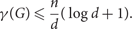
Let $\gamma(G)$ and
  $${\gamma _ \circ }(G)$$ denote the sizes of a smallest dominating set and smallest independent dominating set in a graph G, respectively. One of the first results in probabilistic combinatorics is that if G is an n-vertex graph of minimum degree at least d, then
 $$\begin{equation}\gamma(G) \leq \frac{n}{d}(\log d + 1).\end{equation}$$
In this paper the main result is that if G is any n-vertex d-regular graph of girth at least five, then
for some constant c independent of d. This result is sharp in the sense that as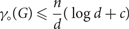 $$\begin{equation}\gamma_(G) \leq \frac{n}{d}(\log d + c)\end{equation}$$ $d \rightarrow \infty$, almost all d-regular n-vertex graphs G of girth at least five have
 $$\begin{equation}\gamma_(G) \sim \frac{n}{d}\log d.\end{equation}$$
Furthermore, if G is a disjoint union of ${n}/{(2d)}$ complete bipartite graphs $K_{d,d}$, then ${\gamma_\circ}(G) = \frac{n}{2}$. We also prove that there are n-vertex graphs G of minimum degree d and whose maximum degree grows not much faster than d log d such that ${\gamma_\circ}(G) \sim {n}/{2}$ as $d \rightarrow \infty$. Therefore both the girth and regularity conditions are required for the main result.


Covering and tiling hypergraphs with tight cycles
- Part of
-
- Journal:
- Combinatorics, Probability and Computing / Volume 30 / Issue 2 / March 2021
- Published online by Cambridge University Press:
- 13 October 2020, pp. 288-329
-
- Article
- Export citation
-
A k-uniform tight cycle $C_s^k$ is a hypergraph on s > k vertices with a cyclic ordering such that every k consecutive vertices under this ordering form an edge. The pair (k, s) is admissible if gcd (k, s) = 1 or k / gcd (k,s) is even. We prove that if $s \ge 2{k^2}$ and H is a k-uniform hypergraph with minimum codegree at least (1/2 + o(1))|V(H)|, then every vertex is covered by a copy of $C_s^k$. The bound is asymptotically sharp if (k, s) is admissible. Our main tool allows us to arbitrarily rearrange the order in which a tight path wraps around a complete k-partite k-uniform hypergraph, which may be of independent interest.
For hypergraphs F and H, a perfect F-tiling in H is a spanning collection of vertex-disjoint copies of F. For $k \ge 3$, there are currently only a handful of known F-tiling results when F is k-uniform but not k-partite. If s ≢ 0 mod k, then $C_s^k$ is not k-partite. Here we prove an F-tiling result for a family of non-k-partite k-uniform hypergraphs F. Namely, for $s \ge 5{k^2}$, every k-uniform hypergraph H with minimum codegree at least (1/2 + 1/(2s) + o(1))|V(H)| has a perfect $C_s^k$-tiling. Moreover, the bound is asymptotically sharp if k is even and (k, s) is admissible.


Tight Hamilton cycles in cherry-quasirandom 3-uniform hypergraphs
- Part of
-
- Journal:
- Combinatorics, Probability and Computing / Volume 30 / Issue 3 / May 2021
- Published online by Cambridge University Press:
- 12 October 2020, pp. 412-443
-
- Article
-
- You have access
- Open access
- Export citation
-
We employ the absorbing-path method in order to prove two results regarding the emergence of tight Hamilton cycles in the so-called two-path or cherry-quasirandom 3-graphs.
Our first result asserts that for any fixed real α > 0, cherry-quasirandom 3-graphs of sufficiently large order n having minimum 2-degree at least α(n – 2) have a tight Hamilton cycle.
Our second result concerns the minimum 1-degree sufficient for such 3-graphs to have a tight Hamilton cycle. Roughly speaking, we prove that for every d, α > 0 satisfying d + α > 1, any sufficiently large n-vertex such 3-graph H of density d and minimum 1-degree at least $\alpha \left({\matrix{{n - 1} \cr 2 \cr } } \right)$ has a tight Hamilton cycle.

Sharp bounds for decomposing graphs into edges and triangles
- Part of
-
- Journal:
- Combinatorics, Probability and Computing / Volume 30 / Issue 2 / March 2021
- Published online by Cambridge University Press:
- 12 October 2020, pp. 271-287
-
- Article
-
- You have access
- Open access
- Export citation
-
For a real constant α, let $\pi _3^\alpha (G)$ be the minimum of twice the number of K2’s plus α times the number of K3’s over all edge decompositions of G into copies of K2 and K3, where Kr denotes the complete graph on r vertices. Let $\pi _3^\alpha (n)$ be the maximum of $\pi _3^\alpha (G)$ over all graphs G with n vertices.
The extremal function $\pi _3^3(n)$ was first studied by Győri and Tuza (Studia Sci. Math. Hungar. 22 (1987) 315–320). In recent progress on this problem, Král’, Lidický, Martins and Pehova (Combin. Probab. Comput. 28 (2019) 465–472) proved via flag algebras that $\pi _3^3(n) \le (1/2 + o(1)){n^2}$. We extend their result by determining the exact value of $\pi _3^\alpha (n)$ and the set of extremal graphs for all α and sufficiently large n. In particular, we show for α = 3 that Kn and the complete bipartite graph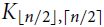 ${K_{\lfloor n/2 \rfloor,\lceil n/2 \rceil }}$ are the only possible extremal examples for large n.


