Refine search
Actions for selected content:
6997 results in Mathematical modeling and methods
MODELLING DYNAMIC STRAINS ON ICE SHELVES RESULTING FROM FLEXURAL AND EXTENSIONAL MOTIONS FORCED BY OCEAN WAVE PACKETS
- Part of
-
- Journal:
- The ANZIAM Journal / Volume 68 / 2026
- Published online by Cambridge University Press:
- 13 February 2026, e4
-
- Article
-
- You have access
- Open access
- HTML
- Export citation
FLEXURAL GRAVITY WAVE INTERACTION BY MULTIPLE THIN POROELASTIC PLATES IN FINITE-DEPTH WATER
-
- Journal:
- The ANZIAM Journal / Volume 68 / 2026
- Published online by Cambridge University Press:
- 11 February 2026, e3
-
- Article
- Export citation
A PARALLELIZABLE LOSSLESS IMAGE COMPRESSION ALGORITHM FOR STANDARD AND PATHOLOGY IMAGES
- Part of
-
- Journal:
- The ANZIAM Journal / Volume 68 / 2026
- Published online by Cambridge University Press:
- 23 January 2026, e1
-
- Article
- Export citation
A SIMPLE MODEL OF A “FIRENADO”
- Part of
-
- Journal:
- The ANZIAM Journal / Volume 68 / 2026
- Published online by Cambridge University Press:
- 01 January 2026, e2
-
- Article
-
- You have access
- Open access
- HTML
- Export citation
ANALYSIS OF FOURTH-ORDER DIFFERENCE APPROXIMATION SCHEMES FOR FRACTIONAL DIFFUSION EQUATIONS
- Part of
-
- Journal:
- The ANZIAM Journal / Volume 67 / 2025
- Published online by Cambridge University Press:
- 15 December 2025, e40
-
- Article
-
- You have access
- Open access
- HTML
- Export citation
-
Two fourth-order difference approximations for fractional derivatives based on Lubich-type second-order approximation with different shifts are derived. These approximations are applied to the space fractional diffusion equation with the Crank–Nicolson scheme. Here, we analyse the stability and convergence of these schemes and prove that they are unconditionally stable and convergent for a fractional order $\alpha $ ranging from $1$ to $2$. Numerical examples are presented to show that both schemes converge, and we obtain the correct convergence rates and unconditional stability.


Appendix - Linear Algebra and Matrix Theory Basics
-
- Book:
- Dynamics of Mechanical Systems
- Published online:
- 20 November 2025
- Print publication:
- 04 December 2025, pp 211-219
-
- Chapter
- Export citation
4 - Dynamics of a Rigid Body
-
- Book:
- Dynamics of Mechanical Systems
- Published online:
- 20 November 2025
- Print publication:
- 04 December 2025, pp 100-125
-
- Chapter
- Export citation
6 - Lagrangian Dynamics
-
- Book:
- Dynamics of Mechanical Systems
- Published online:
- 20 November 2025
- Print publication:
- 04 December 2025, pp 151-179
-
- Chapter
- Export citation
Index
-
- Book:
- Dynamics of Mechanical Systems
- Published online:
- 20 November 2025
- Print publication:
- 04 December 2025, pp 220-222
-
- Chapter
- Export citation
5 - Multibody Dynamics: A Twist–Wrench Formulation
-
- Book:
- Dynamics of Mechanical Systems
- Published online:
- 20 November 2025
- Print publication:
- 04 December 2025, pp 126-150
-
- Chapter
- Export citation
3 - Particle Dynamics
-
- Book:
- Dynamics of Mechanical Systems
- Published online:
- 20 November 2025
- Print publication:
- 04 December 2025, pp 50-99
-
- Chapter
- Export citation
Dedication
-
- Book:
- Dynamics of Mechanical Systems
- Published online:
- 20 November 2025
- Print publication:
- 04 December 2025, pp v-vi
-
- Chapter
- Export citation
1 - Introduction
-
- Book:
- Dynamics of Mechanical Systems
- Published online:
- 20 November 2025
- Print publication:
- 04 December 2025, pp 1-8
-
- Chapter
- Export citation
7 - Linearized Dynamics
-
- Book:
- Dynamics of Mechanical Systems
- Published online:
- 20 November 2025
- Print publication:
- 04 December 2025, pp 180-210
-
- Chapter
- Export citation
Contents
-
- Book:
- Dynamics of Mechanical Systems
- Published online:
- 20 November 2025
- Print publication:
- 04 December 2025, pp vii-viii
-
- Chapter
- Export citation
Preface
-
- Book:
- Dynamics of Mechanical Systems
- Published online:
- 20 November 2025
- Print publication:
- 04 December 2025, pp xi-xii
-
- Chapter
- Export citation
Frontmatter
-
- Book:
- Dynamics of Mechanical Systems
- Published online:
- 20 November 2025
- Print publication:
- 04 December 2025, pp i-iv
-
- Chapter
- Export citation
2 - Kinematics
-
- Book:
- Dynamics of Mechanical Systems
- Published online:
- 20 November 2025
- Print publication:
- 04 December 2025, pp 9-49
-
- Chapter
- Export citation
AN ANALYSIS OF RIEMANN SOLUTIONS FOR THE NONHOMOGENEOUS AW–RASCLE MODEL OF TRAFFIC FLOW WITH THE BORN–INFELD EQUATION OF STATE
- Part of
-
- Journal:
- The ANZIAM Journal / Volume 67 / 2025
- Published online by Cambridge University Press:
- 01 December 2025, e39
-
- Article
- Export citation
-
This paper focuses on the Aw–Rascle model of traffic flow for the Born–Infeld equation of state with Coulomb-like friction, whose Riemann problem is solved with the variable substitution method. Four kinds of nonself-similar solutions are derived. The delta shock occurs in the solutions, although the system is strictly hyperbolic with a genuinely nonlinear characteristic field and a linearly degenerate characteristic field. The generalized Rankine–Hugoniot relation and entropy condition for the delta shock are clarified. The delta shock can be used to describe the serious traffic jam. Under the impact of the friction term, the rarefaction wave (R), shock wave (S), contact discontinuity (J) and delta shock ( $\delta $) are bent into parabolic curves. Furthermore, it is proved that the $S+J$ solution and $\delta $ solution of the nonhomogeneous Aw–Rascle model tend to be the $\delta $ solution of the zero-pressure Euler system with friction; the $R+J$ solution and $R+\mbox {Vac}+J$ solution tend to be the vacuum solution of the zero-pressure Euler system with friction.


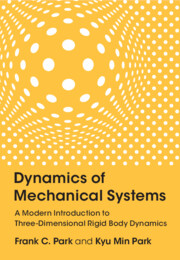
Dynamics of Mechanical Systems
- A Modern Introduction to Three-Dimensional Rigid Body Dynamics
-
- Published online:
- 20 November 2025
- Print publication:
- 04 December 2025
