Refine listing
Actions for selected content:
228 results in 46Exx
Angelicity and the boundary problem
- Part of
-
- Journal:
- Mathematika / Volume 45 / Issue 1 / June 1998
- Published online by Cambridge University Press:
- 26 February 2010, pp. 105-112
- Print publication:
- June 1998
-
- Article
- Export citation
On metrizable E with Cp(E) ≇ Cp(E) × Cp(E)
- Part of
-
- Journal:
- Mathematika / Volume 42 / Issue 1 / June 1995
- Published online by Cambridge University Press:
- 26 February 2010, pp. 49-55
- Print publication:
- June 1995
-
- Article
- Export citation
On Baire-1/4 functions and spreading models
- Part of
-
- Journal:
- Mathematika / Volume 41 / Issue 2 / December 1994
- Published online by Cambridge University Press:
- 26 February 2010, pp. 251-265
- Print publication:
- December 1994
-
- Article
- Export citation
Topological games and optimization problems
- Part of
-
- Journal:
- Mathematika / Volume 41 / Issue 1 / June 1994
- Published online by Cambridge University Press:
- 26 February 2010, pp. 117-132
- Print publication:
- June 1994
-
- Article
- Export citation
On the space of continuous functions on a dyadic set
- Part of
-
- Journal:
- Mathematika / Volume 38 / Issue 1 / June 1991
- Published online by Cambridge University Press:
- 26 February 2010, pp. 42-49
- Print publication:
- June 1991
-
- Article
- Export citation
Topological spaces with dense subspaces that are homeomorphic to complete metric spaces and the classification of C(K) Banach spaces
- Part of
-
- Journal:
- Mathematika / Volume 34 / Issue 1 / June 1987
- Published online by Cambridge University Press:
- 26 February 2010, pp. 101-107
- Print publication:
- June 1987
-
- Article
- Export citation
Espaces К-analytiques et espaces de Baire de fonctions continues
- Part of
-
- Journal:
- Mathematika / Volume 32 / Issue 2 / December 1985
- Published online by Cambridge University Press:
- 26 February 2010, pp. 218-228
- Print publication:
- December 1985
-
- Article
- Export citation
-
Le point de départ de ce travail est le résultat suivant.
THÉORÈME (I. Namioka). Soient X et Y deux espaces compacts et

Si f est continue quand on munit
(Y) de la topologie de convergence simple alors X contient un Gδ dense en tout point duquel f reste continue quand on munit(Y) de la topologie de la convergence uniform.

The sequential stability index of a function space
- Part of
-
- Journal:
- Mathematika / Volume 20 / Issue 2 / December 1973
- Published online by Cambridge University Press:
- 26 February 2010, pp. 210-213
- Print publication:
- December 1973
-
- Article
- Export citation
-
One of the substantial differences between real and complex analysis is the behaviour of pointwise sequential limits of functions. It is well known that, if f(z) is a bounded analytic function in D = {z∈ C: |z| < 1}, then there exists a sequence {pn(z): n = 1,2,…} of polynomials such that
(i) ‖Pn‖ ≤ ‖f‖ for all n = 1,2,3,…, and
(ii) for each z ∈ D, Pn(Z) → f(z) as n → ∞,
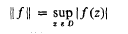
where we have used the notation