To save content items to your account,
please confirm that you agree to abide by our usage policies.
If this is the first time you use this feature, you will be asked to authorise Cambridge Core to connect with your account.
Find out more about saving content to .
To save content items to your Kindle, first ensure no-reply@cambridge.org
is added to your Approved Personal Document E-mail List under your Personal Document Settings
on the Manage Your Content and Devices page of your Amazon account. Then enter the ‘name’ part
of your Kindle email address below.
Find out more about saving to your Kindle.
Note you can select to save to either the @free.kindle.com or @kindle.com variations.
‘@free.kindle.com’ emails are free but can only be saved to your device when it is connected to wi-fi.
‘@kindle.com’ emails can be delivered even when you are not connected to wi-fi, but note that service fees apply.
The debut of a Japanese exhibit at the 1867 Exposition Universelle prompted a new enthusiasm for Japan (dubbed japonisme) that soon gripped artistic and literary circles in Paris. Camille Saint-Saëns's one-act opera La princesse jaune, which premiered at the Opéra-Comique in 1872, emerged at the height of this fervour. At first glance, it might seem that La princesse jaune simply followed the trend. Yet, on closer examination it is possible to understand its story of an infatuated young artist as a playful, subversive commentary on japonisme. This article thus poses the question: How might we understand La princesse jaune as a parody? To answer this, I begin by considering its protagonist as a mockery of the elitist and exclusive japoniste subcultures that emerged in the wake of the Exposition. Borrowing from William Cheng's concept of ‘opera en abyme’, I then consider the opera's dream sequence, examining how its shifting diegesis highlights the fragile and ephemeral nature of the Orientalist dream. Ultimately, I argue that reading La princesse jaune as a parody allows us not only to reframe the work within Saint-Saëns's œuvre, but also to reassess its place within the wider contexts of nineteenth-century operatic Orientalism.
This chapter examines the current state of jazz in Australia through the lens of notable practitioners—Andrea Keller, Simon Barker, Gian Slater, Kristin Berardi, Phil Slater and Jamie Oehlers. Presented as a panel discussion, the participants explore the term ‘jazz’ as it is perceived both by audiences and the practitioners themselves, discuss the challenges of presenting original music in a country as isolated as Australia, and question whether there is an audible Australian jazz ‘dialect’.
This Introduction provides an account of how Music in Australia has been conceptualised in previous music histories. It shows that music historians have sought to draw boundaries around what Australian music is by emphasizing the milestones of European settlement, and have often struggled to reconcile Indigenous music making and non-Indigenous music into one account of music in Australia. It explores also the history of cultural institutions in Australia that have built the foundations for music in Australia. Stepping back to look at these cultural institutions and the wide ranging music making in the past and present, the introduction summarises the book’s contents across the themes of Continuities, Encounters, Diversities and Institutions.
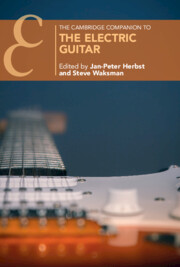
The electric guitar is one of the most important musical instruments and cultural artifacts of the 20th and 21st centuries and enjoys popularity worldwide. Designed for students, this Companion explores electric guitar technology and performance, and the instrument's history and cultural impact. Chapters focused on the social significance of the electric guitar draw attention to the ways in which gender and race have shaped and been shaped by it, the ecology of electric guitar manufacturing, and the participation of electric guitarists in online communities. Contributions on electric guitar history stretch the chronology backwards in time and broaden our ideas of what belongs in that history, and those addressing musical style investigate the cultural value of virtuosity while providing material analysis of electric guitar technique. The Companion's final section considers the electric guitar's global circulation, particularly in Africa, the Afro-Caribbean, and Southeast Asia.
As practised by Nicholas Cook, Philip Tagg, and Nicolai Graakjær, the analysis of advertising music has largely concentrated on how advertising works to communicate meaning. Within media and communications studies, such a focus is seen as a distraction — albeit a fascinating one. For Sut Jhally, for example, advertising has pernicious social and ecological effects and advertising scholars’ goal should be to understand ‘what work advertising does’ in order to mitigate them. This examination of a Ford automobile advert featuring Nina Simone’s ‘I Wish I Knew …’ (1967) shows how music analysis might contribute to this pressing project.
How does the process of screening orchestral music direct and focus audience attention? Visualization strategies can have a profound impact on how we appreciate music and can guide us to listen in very specific ways. Just as particular conductors and orchestras have interpretative identities, so do multi-camera directors. There has, however, been scant research on the influence of strategies and methods used in the visualization of orchestral concert music. Nicholas Cook suggested that musical enjoyment is spoiled by the ‘monstrous close-up’1 and Keith Negus explained that broadcasters believe that viewers will direct their attention to whatever instrument is most noticeable to the ear, ‘as if music audiences are similar to those following the ball in a tennis or football match’.2 The close-up is not solely about chasing action, though; it is also central to the continuity editing system, which is designed to maintain a continuous and clear narrative across time and space.3 Edits are not just about faithfully following or capturing action; they also have dramatic and psychological implications.
Moerane was a family man who spent much of his life in rural communities and was attuned to their traditions. This chapter explores 17 songs about family, community and traditional life. They have features in common with songs discussed in Chapters 7 and 9, but their lyrics and musical styles – sometimes drawing on traditional sources – set them apart. Moerane was knowledgeable about Sotho folk music, although he explicitly quotes it only in his symphonic poem Fatše La Heso. Because Western elements dominate his choral language, his use of traditional elements elsewhere are at risk of being overlooked. Half the songs discussed in this chapter are for female voices, with content associated with children or children's games.
Moerane uses SATB in eight songs: ‘Mankokotsane (The Rain Game), Alina, Ha Ke Balahē (Who Says I’m Running Away?), Letsatsi (The Sun), Liphala (Whistles), Matlala (Matlala), Morena Tlake (King Vulture) and Seotsanyana (Rock Kestrel). He uses four female voices (SSAA) in Liflaga (Flags), three (SAA) in ‘Mankholikholi (Yellow-billed Kite), Bonukunyana (My Little Baby!), Ma-Homemakers (Ingoma Ka Zenzele) (Homemakers), Mosele (Mosele), Sa ‘Mokotsane (Wailing) and Sekolo Se Koetsoe (School's Out); and two (SA) in Pelo Le Moea (Heart And Soul) and Nonyana Tse Ntle (Beautiful Birds). I begin with the smallest social unit in these 17 songs, that of ‘family’, and proceed outwards to works that speak of community, tradition and history.
Songs about family
Bonukunyana, Ma-Homemakers, Mosele, Sa ‘Mokotsane, Pelo Le Moea and Alina all tell of family love. Bonukunyana survives as a fragment (the ending), but this and the title indicate a song composed to soothe a baby. (One of the folk songs Moerane quotes in Fatše La Heso is a lullaby.) Under ‘Remarks’ in Bonukunyana's listing in the SAMRO ‘Catalogue’ are the words ‘From “Setsoto” Junior Poems’. Moerane attributes the lyrics of six other songs to ‘Setsoto’, which implies drawing on the traditional: ‘Mankokotsane, Ha Ke Balahē, Mosele, Letsatsi, Pelo Le Moea and Ngeloi La Me. These songs all have short texts and relate to a Sotho children's story, rhyme or game song.
This study explores the experience of concert piano technicians who work on pianos played by the top tier of concert pianists in the world. They identify as craftspeople with a strong sense of vocation, who are autonomous, skilled, yet connected. They consider their pianos to be alive, with their own personalities and agency, needing to be tamed, loved, and negotiated with. The connection between their human fingers and the body of the piano is experienced as one of sensation and vibration rather than conscious thought, leading to ‘flow’. Findings are contextualized through qualitative psychology, Actor Network, and Material Engagement Theory.
During the ragtime craze at the turn of the twentieth century, the popular repertoire of “coon songs” was coupled with a robust style of vocal delivery called “coon shouting.” This vocal technique was associated with white women—the most famous “coon shouters” of the day—who, like the performers of the nineteenth-century minstrel show, claimed to have studied so-called authentic Black performance in order to replicate it on stage. Performing the “coon song” repertoire, these women sang, often from a Black male protagonist's point of view, about the trials and tribulations of Black life and romance. How did the dynamics of race, gender, and sexuality in this repertoire change when it was performed by Black women? This article addresses this question by examining caricatures of Black womanhood within the “coon song” genre and by exploring the phenomenon of Black women performing the “coon song” repertoire, using the career of vaudeville performer Dora Dean (1872–1949) as a case study. I track Dean's participation in the “coon song” craze through an archival survey of sheet music and newspaper reviews dating from the height of her career (ca. 1896–1914). Using these sources, I explore the recurring theme of racial passing and the ubiquity of caricatures derived from blackface minstrelsy within Dean's “coon song” repertoire. I argue that Dean successfully navigated stereotypes of Black women's femininity, sexuality, and morality in her performances of “coon songs” and, in the process, subverted stereotypes of Black life, romance, and vocal sound.
This article discusses a music treatise written in 1812 by the Catholic Armenian polymath Minas Bzhshkean (1777–1851). The article focuses on the historical and intellectual context in which the idea of notational reform emerged within the Armenian diaspora. Bzhshkean was born in the Ottoman Empire but educated at the Mekhitarist monastery of San Lazzaro in Venice, which was the leading intellectual centre of the Armenian Enlightenment. By discussing Bzhshkean’s use of sources from multiple cultural and intellectual traditions (including European authors such as Rousseau), the article provides a new perspective on music and Enlightenment in global context.
The orchestral work discussed in the previous chapter is anomalous within Moerane's output and struggles, to be seen as on a par with similar works in any country's classical orchestral repertoire. Moerane's choral music, on the other hand, emerged in a very different way, along a very different trajectory – the other of the two ‘parallel streams’ of composition in southern Africa. Moerane composed short unaccompanied choral works throughout his life, and had a ready platform for their performance and reception: choral competitions in African communities. However, the skills Moerane learnt during his BMus studies placed him in a class of his own here too, even though he was on familiar performance terrain. The reason why many of the works that he wrote were never performed or even known until recently may have been because they were too ‘difficult’ in their harmonies and vocal writing.
The Catalogue of Works by Michael Mosoeu Moerane given in the Appendix (hereafter the Catalogue) and on the ACE website, lists for the first time all Moerane's known works. They are presented by genre: the orchestral work, followed by original choral works for SATB (soprano, alto, tenor, bass), then SSAA, SAA, SA, and Moerane's eight arrangements of American spirituals, which are scored for various voices. This is a publisher's grouping, made for sales purposes, so it says nothing about the style of the music, the subject matter of the lyrics, or how the music was originally performed. Let me begin, then, with a sociocultural grouping based on the musical and textual expressions in the songs. For this purpose, I adapt Thembela Vokwana's categorisation of African choral music generally into three successive historical ‘expressions’:
• Expressions modelled on European music with texts often borrowed from the literature of the English canonic masters read in schools as well as the Bible, and identifying strongly with the work of the European mission.
• Expressions based on European models with texts of an independent and often more secular orientation, inspired by social themes in African societies and related to a burgeoning African nationalism.
• Expressions derived from European models with sections incorporating components of traditional music or based throughout on such components, and related to protest against political and social injustice.