To save content items to your account,
please confirm that you agree to abide by our usage policies.
If this is the first time you use this feature, you will be asked to authorise Cambridge Core to connect with your account.
Find out more about saving content to .
To save content items to your Kindle, first ensure no-reply@cambridge.org
is added to your Approved Personal Document E-mail List under your Personal Document Settings
on the Manage Your Content and Devices page of your Amazon account. Then enter the ‘name’ part
of your Kindle email address below.
Find out more about saving to your Kindle.
Note you can select to save to either the @free.kindle.com or @kindle.com variations.
‘@free.kindle.com’ emails are free but can only be saved to your device when it is connected to wi-fi.
‘@kindle.com’ emails can be delivered even when you are not connected to wi-fi, but note that service fees apply.
A student asked a good, hard question, recently. I was stumped, till the answer struck me – more or less the way the apple is said to have bonked Newton on the head – next morning as I cycled to work.
The “Cortex Debug/Program Connector” is a standardized hardware interface used both to program the internal flash memory and to debug program code by single-stepping program instructions and reading and writing the internal registers of the CPU.
In the previous chapter we saw that positive feedback can be useful – though it is the underdog in feedback circuitry, less important than the great strategy of negative feedback. It can make a switching circuit decisive, and it allows construction of oscillators.
In this chapter we will begin with an introduction to interrupts, then learn how to configure I/O pins for input, first to read a pushbutton and then to scan a matrix keyboard. We will also look at creating Finite State Machines in the microcontroller.
We are going to configure the SERCOM with the simplest of the three protocols, SPI, requiring only a clock and data line along with an optional device select line.
Spatial intensity modulation in amplified laser beams, particularly hot spots, critically constrains attainable pulse peak power due to the damage threshold limitations of four-grating compressors. This study demonstrates that the double-smoothing grating compressor (DSGC) configuration effectively suppresses modulation through directional beam smoothing. Our systematic investigation validated the double-smoothing effect through numerical simulations and experimental measurements, with comprehensive spatiotemporal analysis revealing excellent agreement between numerical and practical pulse characteristics. Crucially, the DSGC enables a 1.74 times energy output boost compared to conventional compressors. These findings establish the DSGC as a pivotal advancement for next-generation ultrahigh-power laser systems, providing a viable pathway toward hundreds of PW output through optimized spatial energy redistribution.
Generalised two-dimensional (2-D) fluid dynamics is characterised by a relationship between a scalar field $q$, called generalised vorticity, and the stream function $\psi$,namely $q = (-\nabla ^2)^{\frac {\alpha }{2}} \psi$. We study the transition of cascades in generalised 2-D turbulence by systematically varying the parameter $\alpha$ and investigating its influential role in determining the directionality (inverse, forward or bidirectional) of these cascades. We derive upper bounds for the dimensionless dissipation rates of generalised energy $E_G$ and enstrophy $\Omega _G$ as the Reynolds number tends to infinity. These findings corroborate numerical simulations, illustrating the inverse cascade of $E_G$ and forward cascade of $\Omega _G$ for $\alpha \gt 0$, contrasting with the reverse behaviour for $\alpha \lt 0$. The dependence of dissipation rates on system parameters reinforces these observed transitions, substantiated by spectral fluxes and energy spectra, which hint at Kolmogorov-like scalings at large scales but discrepancies at smaller scales between numerical and theoretical estimates. These discrepancies are possibly due to non-local transfers, which dominate the dynamics as we go from positive to negative values of $\alpha$. Intriguingly, the forward cascade of $E_G$ for $\alpha \lt 0$ reveals similarities to three-dimensional turbulence, notably the emergence of vortex filaments within a 2-D framework, marking a unique feature of this generalised model.
Steady-state Bloch wave systems at resonance with fixed frequencies and amplitudes are investigated using the homotopy analysis method. Nonlinear waves propagate over a stationary undulating bottom topography of infinite extent, modelled as a superposition of two waveforms. The wave systems are classified as type 1 if the primary transmitted and resonant wave components have equal energies, and type 2 if the energy distribution is unequal. Two subtypes of type 2 are identified, distinguished by their responses to frequency detuning and bottom topography: the wave steepness in subtype 1 shows monotonic variations with detuning, while in subtype 2 it exhibits a peak at a particular detuning value, indicating downward resonance that intensifies with greater wave steepness. A pair of peaks in wave steepness arises in each subtype at certain values of the angle $\theta$ between the waveforms of the bottom topography. In both subtypes, the peaks are slightly affected by the ratio $k_{{b}1}/k_{{b}2}$ of the two bottom wave vectors, and significantly affected by the propagation angle $\alpha$ of the primary transmitted wave, but remain stable under changes to other topographic parameters. As the topography amplitude and $\theta$ vary, significant additional contributions to the total energy of the wave system appear from components other than resonant and primary transmitted waves. The most pronounced effects occur with changes in $\theta$, with the additional components accounting for up to 12 % of the total energy. This study provides an enriched understanding of resonant Bloch wave systems and a basis for improving the effectiveness of wave energy converters.
Understanding the dynamics of flames at small scales opens up opportunities to enhance the performance of small-scale power generation devices, micro-reactors, fire safety devices and numerous other systems that confine combustion to micro/meso scales. The current study investigates the dynamics of laminar premixed methane–air flames in meso-scale channels. A cylindrical quartz tube, functioning as an optically accessible meso-scale combustor, is externally heated by a primary heater to facilitate the auto-ignition of the reactant mixture flowing through the tube. Experiments were conducted over a wide range of Reynolds numbers ($Re$) and equivalence ratios ($\Phi$). Apart from the previously documented observations of unsteady flames with repetitive extinction and ignition (FREI) characteristics, this study identifies an additional unsteady propagating flame (PF) regime. While FREI appeared at stoichiometric and fuel-rich conditions, PFs were observed at the equivalence ratio of $0.8$. Unlike the FREI regime, where the flame extinguishes after a characteristic travel distance, PFs continue to travel till they reach the upstream end of the combustor tube, where they extinguish upon encountering a meshed constriction. These flames are associated with a characteristic heat release rate oscillation that couples with the pressure fluctuations at frequencies close to the natural harmonic of the combustor tube. The study further investigates how variations in the wall temperature profile affect the dynamics of FREI and PF regimes. To achieve this, a secondary heater is introduced at varying distances from the primary heater, effectively imposing distinct bimodal wall heating profiles over the combustor tube. The observations and trends from the study were justified using simplified theoretical arguments based on the estimate of the mean flow temperature of the reactant mixture and a flame propagation model that accounts for wall heat losses. The novel findings from this work provide valuable insights that can significantly impact the design and development of advanced micro/meso-scale combustion systems.
The reflection of multiple incident shock waves that converge to a single point on the reflecting surface is studied in this paper. The number of the incident shocks, denoted $K$, is arbitrary. The interaction between the reflected shock of one incident shock and the other incident shocks may produce various possible configurations, such as type-I, type-II and type-IV shock interferences. The number of possible reflection configurations is shown to be an exponential function of ($K-1$) with base 2. The possibility of pre-, middle- and post-Mach reflections, which means Mach reflection occurs for the first, middle and last incident shock, is revealed through numerical simulation for $K=3$. For the particular case where the incident shocks are produced by equal variation of wedge surface deflection, the conventional von Neumann condition and detachment condition for the $k\mathrm{th}$ incident shock to have Mach reflection are derived. It is shown that the von Neumann condition for regular reflection is lowered and the detachment condition for Mach reflection is elevated as $k$ increases. The shock reflection patterns for $ K=1,2,\ldots ,10$ are obtained by numerical simulations. We observe a shock interaction train structure, where we have pre-Mach reflection followed by ($K-1$) type-I or type-II shock interferences. We also observe that the Mach stem height decreases with $K$ well above the von Neumann condition and becomes non-monotonic near the von Neumann condition.
The evolution of turbulent spots in a flat plate boundary layer is examined using time-resolved tomographic particle image velocimetry (Tomo-PIV) experiments and direct numerical simulation (DNS). The characteristics of flow structures are examined using timelines and material surfaces. Both the numerical and experimental results reveal a notable behaviour in the developmental process of turbulent spots: the development of low-speed streaks at the spanwise edges of turbulent spots, followed by the subsequent formation of hairpin vortices. The behaviour of these low-speed streaks is further investigated using timelines and material surfaces generated for a series of regions and development times. The results indicate that these low-speed streaks exhibit characteristic wave behaviour. The low-speed streaks are observed to lift up as three-dimensional (3-D) waves, with high-shear layers forming at the interface of these waves. These induced high-shear layers become unstable and evolve into vortices, which contribute to the expansion of the turbulent spot. These findings show the significant role of 3-D waves in the development of turbulent spots, supporting the hypothesis that 3-D waves serve as initiators of vortices at the bounding surface of a turbulent spot.
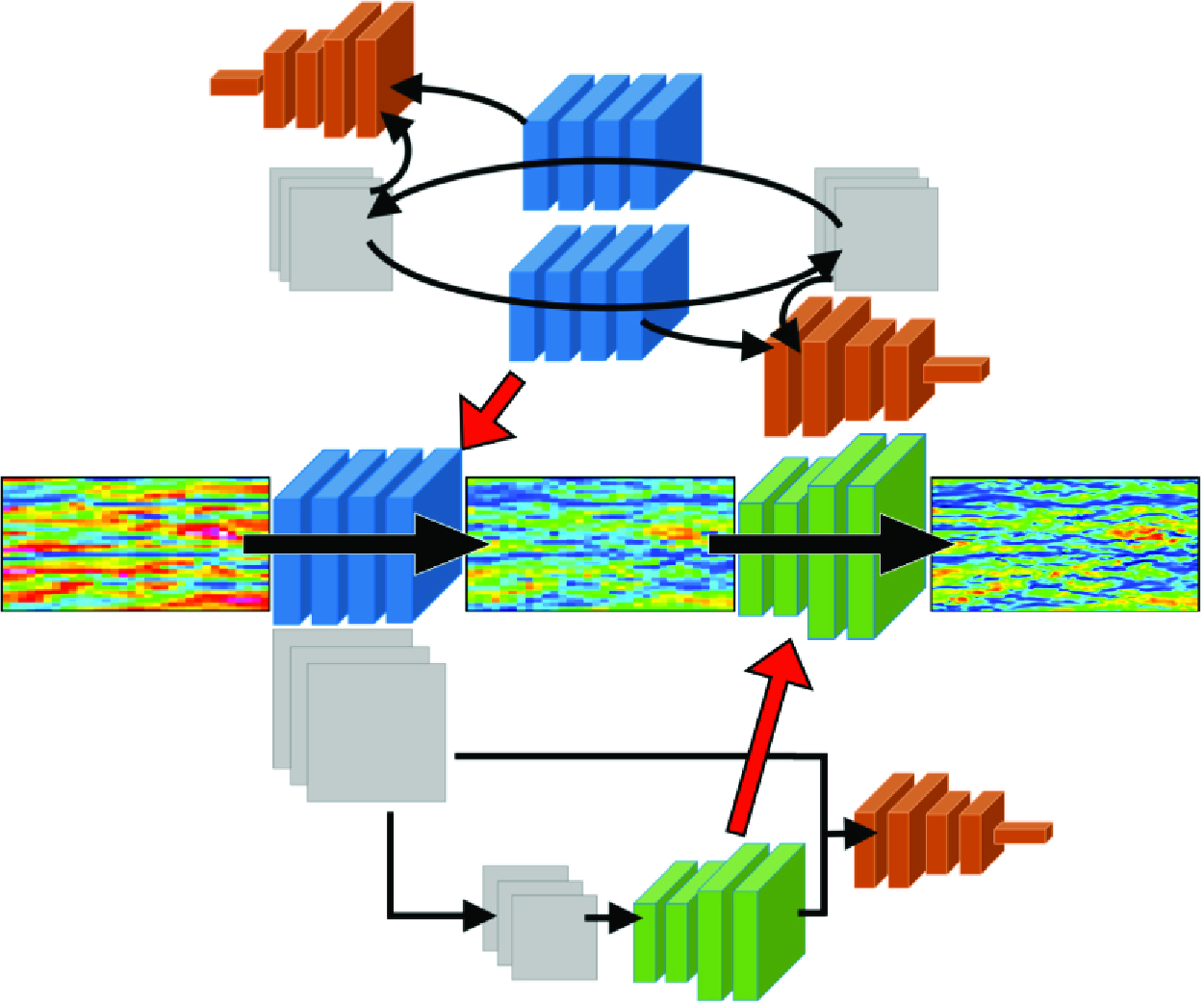
The greatest challenge in pressure reconstruction from the measured velocity fields is that the error of material acceleration is significantly contaminated due to error propagation. Particularly for flows with moving boundaries, accurate boundary velocities are difficult to obtain due to error propagation, and a complex boundary processing technique is needed to treat the moving boundaries. The present work proposes a machine-learning-based method to determine the pressure for incompressible flows with moving boundaries. The proposed network consists of two neural networks: one network, named the boundary network, is used to track the Lagrangian boundary points; the other physics-informed neural network, named the flow network, is adopted to approximate the flow fields. These two networks are coupled by imposing boundary conditions. We further propose a new dynamic weight strategy for the loss terms to guarantee convergence and stability. The performance of the proposed method is validated by two examples: the flow over an oscillating cylinder and the flow around a swimming fish. The proposed method can accurately determine the pressure fields and boundary motion from synthetic particle image velocimetry (PIV) flow fields. Moreover, this method can also predict the boundary and pressure at a given instant without supervised data. Finally, this method was applied to reconstruct the pressure from the two-dimensional and three-dimensional PIV velocities of the left ventricle. All of the results indicate that the proposed method can accurately reconstruct the pressure fields for flows with moving boundaries and is a novel method for surface pressure estimation.
Reflection of a rightward-moving shock over a steady oblique shock, equivalent to a shock-on-shock interaction, is typically studied with post-formed shock waves. Law, Felthun and Skews (Shock Waves, vol. 13, 2003, pp. 381–394) reported post-formed expansion fan (PFEF) reflection for second-family incident shock. Here, we show that PFEF reflection also exists for first-family incident shock. We derive the critical condition for PFEF reflection in the shock speed Mach number and incident shock angle plane. Our findings indicate PFEF emergence near type post-I region. Numerical simulations reveal that PFEF with rising incident angle can intersect the incident shock, triple point or Mach stem, echoing the Hillier (J. Fluid Mech., vol. 575, 2007, pp. 399–424) three-type classification of shock–expansion fan interactions. The complex shock reflection pattern is essentially composed of an upstream structure linked to the moving shock wave, and a downstream structure linked to the unperturbed oblique shock wave. Under the conditions investigated, the upstream structure is characterized by a Mach reflection of the incident shock over the wall, potentially featuring a triple point formed within the Mach stem. Below this triple point, there is a curved segment of the Mach stem that is close to the wall. As the inclined angle increases, the curved shock may expand and interact with the incident shock, leading to an asymmetric regular reflection, which is a phenomenon that has not been observed previously. The downstream structure is a double $\lambda$ shock structure, with the lower shock resulting from the generation of recompression shock waves.
Local shearing motions in turbulence form small-scale shear layers, which are unstable to perturbations at approximately 30 times the Kolmogorov scale. This study conducts direct numerical simulations of passive-scalar mixing layers in a shear-free turbulent front to investigate mixing enhancements induced by such perturbations. The initial turbulent Reynolds number based on the Taylor microscale is $ Re_\lambda = 72$ or 202. The turbulent front develops by entraining outer fluid. Weak sinusoidal velocity perturbations are introduced locally, either inside or outside the turbulent front, or globally throughout the flow. Perturbations at this critical wavelength promote small-scale shear instability, complicating the boundary geometry of the scalar mixing layer at small scales. This increases the fractal dimension and enhances scalar diffusion outward from the scalar mixing layer. Additionally, the promoted instability increases the scalar dissipation rate and turbulent scalar flux at small scales, facilitating faster scalar mixing. The effects manifest locally; external perturbations intensify mixing near the boundary, while internal perturbations affect the entire turbulent region. The impact of perturbations is consistent across different Reynolds numbers when the amplitudes normalised by the Kolmogorov velocity are the same, indicating that even weaker perturbations can enhance scalar mixing at higher Reynolds numbers. The mean scalar dissipation rate increases by up to 50 %, even when the perturbation energy is only 2.5 % of the turbulent kinetic energy. These results underscore the potential to leverage small-scale shear instability for efficient mixing enhancement in applications such as chemically reacting flows.
Interactions play a significant role in the formation and evolution of galaxies in the Universe. The galaxy systems, NGC 7252 and NGC 5291, are two nearby interacting systems that are hosting tidal dwarf galaxies (TDGs) and star-forming knots. The present work aims (a) to determine the attenuation-corrected star formation rate (SFR) of the interacting system NGC 7252, (b) to compare the star formation in the NGC 7252 system with that of the NGC 5291 system, and (c) to explore the relation between surface densities of gas and SFR in these two systems. The study utilises high-resolution FUV and NUV imaging data from the ultraviolet imaging telescope on board AstroSat. Six star-forming regions, including the merger remnant, were identified in the NGC 7252 system. The SFR corrected for attenuation of the knots in the NGC 7252 system is determined using the continuum slope $\beta$ calculated from the FUV-NUV colour. It has been observed that the attenuation-corrected SFR values of the knots in this system fall within the range of SFR values determined for the NGC 5291 knots. The TDGs in both systems adhere to the same Kennicutt–Schmidt relation as regular spiral galaxies.
Obscuration in active galactic nuclei (AGN) provides valuable insights into the nature of the material surrounding the central engine. Compton-thick AGN (CTAGN), characterised by a column density of $N_{\mathrm{H}} \geq 1.5 \times 10^{24} \ \mathrm{cm}^{-2}$, are heavily obscured by substantial amounts of dust and gas. While X-ray observations are primarily used to determine this column density, our understanding of obscuration properties in the sub-mm regime, particularly for CTAGN, remains limited. In this study, we analyse archival data from the Atacama Large Millimetre/sub-millimetre Array (ALMA) for both CTAGN and non-CTAGN sources, as identified by the 70-month catalogue of the all-sky hard X-ray Swift/Burst Alert Monitor survey and other X-ray surveys. Integrated intensity maps (moment 0) of CO(3–2) emission reveal a concentrated distribution of dense gas around the nucleus. Utilising a constant CO-to-H2 conversion factor, $X_{\mathrm{CO}} = 2.2 \times 10^{20} \ \mathrm{cm}^{-2} \ (\mathrm{K\ km\ s}^{-1})^{-1}$, we find that the derived molecular hydrogen column densities, $N_{\mathrm{H_2}}$, are generally lower than the total hydrogen column densities, $N_{\mathrm{H}}$, obtained from X-ray observations. However, the $N_{\mathrm{H_2}}$ values derived in this work are slightly higher than those reported in previous studies due to the adoption of a higher CO-to-H2 conversion factor. This discrepancy between $N_{\mathrm{H}}$ and $N_{\mathrm{H_2}}$ is consistent with prior findings that X-ray-derived column densities are typically higher, except in the case of non-CTAGN, where $N_{\mathrm{H_2}}$ can exceed $N_{\mathrm{H}}$. Statistical analysis using Kendall and Spearman tests reveals a positive monotonic relationship between $N_{\mathrm{H}}$ and $N_{\mathrm{H_2}}$, although the correlation is not statistically significant. This suggests a complex interplay of factors influencing these properties. The optically thick nature of CO in dense regions may contribute to the observed discrepancies. Our results highlight the importance of adopting an accurate CO-to-H2 conversion factor to derive reliable column densities, which could serve as an alternative method for identifying CTAGN. Further investigations with more comprehensive data sets and refined methodologies are needed to better understand the relationship between sub-millimetre and X-ray properties in AGNs.
The effects of diffraction, reflection, and mutual coupling on the spectral smoothness of radio telescopes become increasingly important at low frequencies, where the observing wavelength may be significant compared with the antenna or array dimensions. These effects are important for both traditional parabolic antennas, which are prone to the ‘standing wave’ phenomenon caused by interference between direct and scattered wavefronts, and aperture arrays, such as the SKA-Low, MWA, HERA, and LOFAR which have more complicated scattering geometries and added dependence on pointing direction (scan angle). Electromagnetic modelling of these effects is computationally intensive and often only possible at coarse frequency resolution. Therefore, using the example of SKA-Low station configurations, we investigate the feasibility of parameterising scattering matrices and separating antenna and array contributions to telescope chromaticity. This allows deeper insights into the effect on spectral smoothness and frequency-dependent beam patterns of differing antenna configurations. Even for the complicated SKA-Low element design, band-limited delay-space techniques appear to produce similar results to brute-force electromagnetic models and allow for faster computation of station beam hypercubes (position, frequency, and polarisation-dependent point spread functions) at arbitrary spectral resolution. As such techniques could facilitate improvements in the design of low-frequency spectral-line surveys, we conduct a simulated Cosmic Dawn experiment using different observing techniques and station configurations.