Refine search
Actions for selected content:
238152 results in Physics and Astronomy
Turbulent jet theory via Lie symmetry analysis: the free plane jet
-
- Journal:
- Journal of Fluid Mechanics / Volume 991 / 25 July 2024
- Published online by Cambridge University Press:
- 22 August 2024, A12
-
- Article
-
- You have access
- Open access
- HTML
- Export citation
-
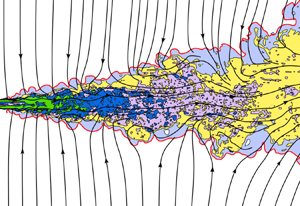
A theory of incompressible turbulent plane jets (TPJs) is proposed by advancing an improved boundary layer approximation over the limiting classical – retaining more terms in the momentum balance equations. A pressure deficit inside the jet (with respect to the ambient) must exist due to transverse turbulence (Miller & Comings, J. Fluid Mech., vol. 3, 1957, pp. 1–16; Hussain & Clarke, Phys. Fluids, vol. 20, 1977, pp. 1416–1426). Contrary to the universally accepted invariance of the total momentum flux $J_T(x)$ (non-dimensionalized by its inlet value) as a function of the streamwise distance $x$, we prove that $J_T(x) >1$ – a condition that all TPJs must satisfy; surprisingly, prior theories and most experiments do not satisfy this condition. This motivated us to apply Lie symmetry analysis with translational and dilatational transformations of the modified equations (incorporating $J_T>1$), which yields scaling laws for key jet measures: the mean streamwise and transverse velocities $U(x,y)$ and $V(x,y)$, the turbulence intensities, the Reynolds shear stress $-\rho \,\overline {u'v'}(x,y)$, the mean pressure $P(x,y)$, etc. Experiments satisfying $J_T(x)>1$ validate our predictions for all jet measures, including, among others, the profiles of $U$,
$U$,  $V$ and $-\rho \,\overline {u'v'}$. We further predict $U \sim x^{-0.24}$, $V \sim x^{-0.45}$, $-\rho \,\overline {u'v'}\sim x^{-0.69}$, the mass flux $Q_m \sim x^{0.55}$, and $J_T$ increases to approximately 1.5. Contrary to the classical linear jet spread, we find sublinear spread, with the jet half-width growing like $b(x)\sim x^{0.79}$, indicating a narrower jet. Our predictions differ notably from most results reported in the literature. These contradictions demand revisiting jet studies involving carefully designed facilities and boundary conditions, and highly resolved simulations.


Thermal vortex ring: vortex-dynamics analysis of a high-resolution simulation
-
- Journal:
- Journal of Fluid Mechanics / Volume 991 / 25 July 2024
- Published online by Cambridge University Press:
- 22 August 2024, A18
-
- Article
-
- You have access
- Open access
- HTML
- Export citation
-
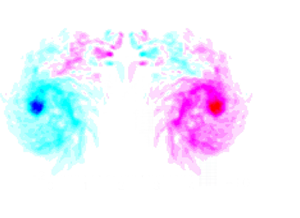
A high-resolution simulation of a thermal vortex ring is analysed from the point of view of the vortex dynamics. A power-spectrum analysis of vortex-ring sections suggests that the simulated flows are overall ‘two dimensional’ in the large-scale limit, being dominated by axisymmetric components, but with a substantial contribution from the non-axisymmetric component at small scales. Contribution of the non-axisymmetric components is negligible in budgets of volume integrals of the vorticity and potential vorticity as well as the impulse (moments of the vorticity weighted by $s^n$ with $n=-1$, 0, 1, where $s$ is the distance from the vertical axis of the vortex ring). A concise description of the dynamics is obtained as a function of geometrical factors together with these three integral variables. Analysis shows that the geometrical factors are fairly close to constant with time, and thus, a redundant closed description of the system is obtained in the similarity regime after spin up of the vortex ring. This redundancy leads to a constraint on the geometrical factors, which is reasonably satisfied by the simulation. A closed description is also obtained over the initial spin-up period of the vortex ring by adding a phenomenologically derived prognostic equation for the source for the volume integral of the potential vorticity (with $n=-1$). Analysis of the budget supports this description.


On the low-frequency dynamics of turbulent separation bubbles
-
- Journal:
- Journal of Fluid Mechanics / Volume 991 / 25 July 2024
- Published online by Cambridge University Press:
- 22 August 2024, A11
-
- Article
- Export citation
-
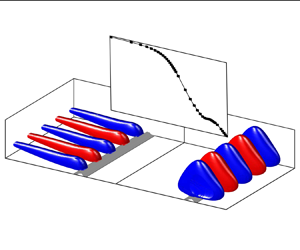
The low-frequency modal and non-modal linear dynamics of an incompressible, pressure-gradient-induced turbulent separation bubble (TSB) are investigated, with the objective of studying the mechanism responsible for the low-frequency contraction and expansion (breathing) commonly observed in experimental studies. The configuration of interest is a TSB generated on a flat test surface by a succession of adverse and favourable pressure gradients. The base flow selected for the analysis is the average TSB from the direct numerical simulation of Coleman et al. (J. Fluid Mech., vol. 847, 2018, pp. 28–70). Global mode analysis reveals that the eigenmodes of the linear operator are damped for all frequencies and wavenumbers. Furthermore, the least damped eigenmode appears to occur at zero frequency and low, non-zero spanwise wavenumber when scaled with the separation length. Resolvent analysis is then employed to examine the forced dynamics of the flow. At low frequency, a region of low, non-zero spanwise wavenumber is also discernible, where the receptivity appears to be driven by the identified weakly damped global mode. The corresponding optimal energy gain is shown to have the shape of a first-order, low-pass filter with a cut-off frequency consistent with the low-frequency unsteadiness in TSBs. The results from resolvent analysis are compared to the unsteady experimental database of Le Floc'h et al. (J. Fluid Mech., vol. 902, 2020, A13) in a similar TSB flow. The alignment between the optimal response and the first spectral proper orthogonal decomposition mode computed from the experiments is shown to be close to $95\,\%$, while the spanwise wavenumber of the optimal response is consistent with that of the low-frequency breathing motion captured experimentally. This indicates that the fluctuations observed experimentally at low frequency closely match the response computed from resolvent analysis. Based on these results, we propose that the forced dynamics of the flow, driven by the weakly damped global mode, serve as a plausible mechanism for the origin of the low-frequency breathing motion commonly observed in experimental studies of TSBs.

The impact of diffusiophoresis on hydrodynamic dispersion and filtration in porous media
-
- Journal:
- Journal of Fluid Mechanics / Volume 991 / 25 July 2024
- Published online by Cambridge University Press:
- 22 August 2024, A8
-
- Article
-
- You have access
- Open access
- HTML
- Export citation
Exact coherent structures in two-dimensional turbulence identified with convolutional autoencoders
-
- Journal:
- Journal of Fluid Mechanics / Volume 991 / 25 July 2024
- Published online by Cambridge University Press:
- 22 August 2024, A10
-
- Article
-
- You have access
- Open access
- HTML
- Export citation
-
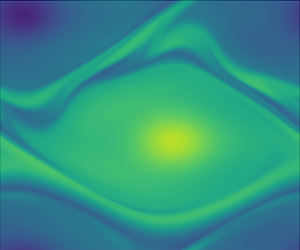
Convolutional autoencoders are used to deconstruct the changing dynamics of two-dimensional Kolmogorov flow as $Re$ is increased from weakly chaotic flow at $Re=40$ to a chaotic state dominated by a domain-filling vortex pair at $Re=400$. ‘Latent Fourier analysis’ (Page et al., Phys. Rev. Fluids 6, 2021, p. 034402) reveals a detached class of bursting dynamics at $Re=40$ which merge with the low-dissipation dynamics as $Re$ is increased to $100$ and provides an efficient representation within which to find unstable periodic orbits (UPOs) using recurrent flow analysis. Focusing on initial guesses with energy in higher latent Fourier wavenumbers allows a significant number of high-dissipation-rate UPOs associated with the bursting events to be found for the first time. At $Re=400$, the UPOs discovered at lower $Re$ move away from the attractor, and an entirely different embedding structure is formed within the network devoid of small-scale vortices. Here latent Fourier projections identify an associated ‘large-scale’ UPO which we believe to be a finite- $Re$ continuation of a solution to the Euler equations.


Prandtl number dependence of flow topology in quasi-two-dimensional turbulent Rayleigh–Bénard convection
-
- Journal:
- Journal of Fluid Mechanics / Volume 991 / 25 July 2024
- Published online by Cambridge University Press:
- 22 August 2024, A14
-
- Article
- Export citation
-
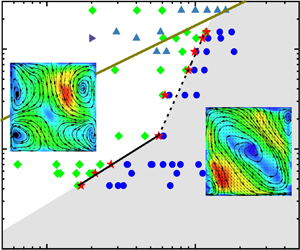
To date, a comprehensive understanding of the influence of the Prandtl number ( $Pr$) on flow topology in turbulent Rayleigh–Bénard convection (RBC) remains elusive. In this study, we present an experimental investigation into the evolution of flow topology in quasi-two-dimensional turbulent RBC with $7.0 \leq Pr \leq 244.2$ and $2.03\times 10^{8} \leq Ra \leq 2.81\times 10^{9}$. Particle image velocimetry (PIV) measurements reveal the flow transitions from multiple-roll state to single-roll state with increasing $Ra$, and the transition is hindered with increasing $Pr$, i.e. the transitional Rayleigh number $Ra_t$ increases with $Pr$. We mapped out a phase diagram on the flow topology change on $Ra$ and $Pr$, and identified the scaling of $Ra_t$ on $Pr$:
$Pr$: 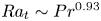 $Ra_t \sim Pr^{0.93}$ in the low $Pr$ range, and $Ra_t \sim Pr^{3.3}$ in the high $Pr$ range. The scaling in the low $Pr$ range is consistent with the model of balance of energy dissipation time and plume travel time that we proposed in our previous study, while the scaling in the high $Pr$ range implies a new governing mechanism. For the first time, the scaling of $Re$ on $Ra$ and $Pr$ is acquired through full-field PIV velocity measurement, $Re \sim Ra^{0.63}\,Pr^{-0.87}$. We also propose that increasing horizontal velocity promotes the formation of the large-scale circulation (LSC), especially for the high $Pr$ case. Our proposal was verified by achieving LSC through introducing horizontal driving force $Ra_H$ by tilting the convection cell with a small angle.


On the flow dynamics around a surface-mounted cube and boundary layer effects
-
- Journal:
- Journal of Fluid Mechanics / Volume 991 / 25 July 2024
- Published online by Cambridge University Press:
- 22 August 2024, A17
-
- Article
-
- You have access
- Open access
- HTML
- Export citation
-
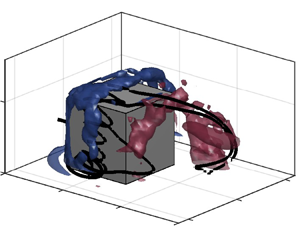
Motivated by contradicting or insufficient information regarding the large-scale flow dynamics around surface-mounted finite-height square prisms of small aspect ratio, the present study investigates the dominant vortex shedding and low-frequency dynamics around a surface-mounted cube. These flow modes were obtained from the spectral proper orthogonal decomposition of large-eddy simulation results, at a Reynolds number of $\textit {Re}=1\times 10^4$ and two different types of boundary layer: a thin and laminar boundary layer with thickness $\delta /D=0.2$ and a thick and turbulent boundary layer with $\delta /D=0.8$. The main antisymmetric mode pair revealed a new flow pattern with the alternate shedding of streamwise flow structures, indicating a transition from the half-loops of taller prisms to only streamwise strands (i.e. no vertical core) for smaller aspect ratio. The formation process of the streamwise structures is due to a reorientation of the vorticity of the arch vortex in the streamwise direction characteristic of the shed structures. The low-frequency drift mode affected the length of the recirculation region, the strength of vortex shedding, and the near-wall flow field and pressure distribution on the cube's faces, leading to low-frequency variations in the fluctuating drag and normal force coefficients. These large-scale flow dynamics were similar for both boundary layers, but minor differences were identified, related mostly to the occurrence of flow attachment and the formation of a headband vortex for the thicker boundary layer.


Asymptotics of the centre-mode instability in viscoelastic channel flow: with and without inertia
-
- Journal:
- Journal of Fluid Mechanics / Volume 991 / 25 July 2024
- Published online by Cambridge University Press:
- 22 August 2024, A13
-
- Article
-
- You have access
- Open access
- HTML
- Export citation
-
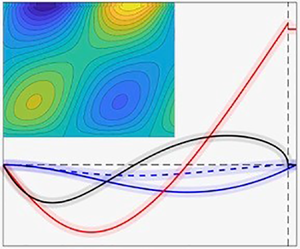
Motivated by the recent numerical results of Khalid et al. (Phys. Rev. Lett., vol. 127, 2021, 134502), we consider the large-Weissenberg-number ( $W$) asymptotics of the centre mode instability in inertialess viscoelastic channel flow. The instability is of the critical layer type in the distinguished ultra-dilute limit where $W(1-\beta )=O(1)$ as $W \rightarrow \infty$ ( $\beta$ is the ratio of solvent-to-total viscosity). In contrast to centre modes in the Orr–Sommerfeld equation, $1-c=O(1)$ as $W \rightarrow \infty$, where $c$ is the phase speed normalised by the centreline speed as a central ‘outer’ region is always needed to adjust the non-zero cross-stream velocity at the critical layer down to zero at the centreline. The critical layer acts as a pair of intense ‘bellows’ which blows the flow streamlines apart locally and then sucks them back together again. This compression/rarefaction amplifies the streamwise-normal polymer stress which in turn drives the streamwise flow through local polymer stresses at the critical layer. The streamwise flow energises the cross-stream flow via continuity which in turn intensifies the critical layer to close the cycle. We also treat the large-Reynolds-number ( $Re$) asymptotic structure of the upper (where $1-c=O(Re^{-2/3})$) and lower branches of the $Re$–
$Re$– $W$ neutral curve, confirming the inferred scalings from previous numerical computations. Finally, we remark that the viscoelastic centre-mode instability was actually first observed in viscoelastic Kolmogorov flow by Boffetta et al. (J. Fluid Mech., vol. 523, 2005, pp. 161–170).


Linear stability of stratified, rotating, viscous plane Couette–Poiseuille flow
-
- Journal:
- Journal of Fluid Mechanics / Volume 991 / 25 July 2024
- Published online by Cambridge University Press:
- 22 August 2024, A16
-
- Article
-
- You have access
- Open access
- HTML
- Export citation
Low-frequency unsteadiness mechanisms of unstart flow in an inlet with rectangular-to-elliptical shape transition under off-design condition at a Mach number of 4
-
- Journal:
- Journal of Fluid Mechanics / Volume 991 / 25 July 2024
- Published online by Cambridge University Press:
- 22 August 2024, A9
-
- Article
- Export citation
Collisionless kinetic theory for saltation over a rigid, bumpy bed
-
- Journal:
- Journal of Fluid Mechanics / Volume 991 / 25 July 2024
- Published online by Cambridge University Press:
- 22 August 2024, A15
-
- Article
- Export citation
Numerical study of a generic ship's airwake for understanding bi‐stability mechanism
-
- Journal:
- Journal of Fluid Mechanics / Volume 991 / 25 July 2024
- Published online by Cambridge University Press:
- 20 August 2024, A6
-
- Article
-
- You have access
- Open access
- HTML
- Export citation
-
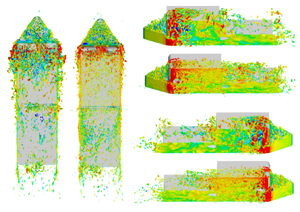
A distinguishing feature of the bi-stable wake is that the wake persists in either of two preferred states for a sufficiently long time. Aiming to understand the persistence mechanism, this paper numerically investigates the airwake characteristics of the Chalmers ship model (CSM) using large eddy simulation with a wall-adapting local-eddy viscosity model and is complemented by experimental testings for validations. There are two cases of interest: (i) the baseline CSM with a sharp-edged superstructure front that induces massive boundary layer separation; (ii) the front-rounded (FR) CSM with suppressed flow separation. During a characteristic time ( $t^*$) of 1142 (26.5 s), the baseline case has a frequently switching wake, whereas the FR wake maintains a stable asymmetric structure with only one switch attempt. To understand the different wake behaviours, the study starts by analysing wake flow structures, vortex cores and the wake dynamics, followed by investigating the instantaneous flow physics. Results suggest that the baseline wake has a weak bi-stable pattern, whereas the FR wake behaves similarly to a reflectional symmetry breaking state of a potential bi-stable wake. The wake switching is found to be driven by the tilting of (vertical-oriented) $z$-vorticity sheets from either side of the base toward the centre. This tilting behaviour is subjected to the high-magnitude vorticity that sheds from the upstream flow separation at the front sharp edges. With the sharp edges rounded in the FR case, the upstream vorticity is mitigated and the tilting effect is significantly reduced, leading to a more stable wake structure. The reasoning provided in the paper potentially explains the persistence mechanism of the bi-stable wake.


Jet mixing enhancement with Bayesian optimization, deep learning and persistent data topology
-
- Journal:
- Journal of Fluid Mechanics / Volume 991 / 25 July 2024
- Published online by Cambridge University Press:
- 20 August 2024, A5
-
- Article
- Export citation
-
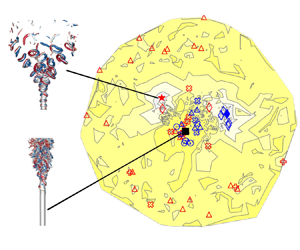
We optimize jet mixing using large eddy simulations (LES) at a Reynolds number of $3000$. Key methodological enablers consist of Bayesian optimization, a surrogate model enhanced by deep learning and persistent data topology for physical interpretation. The mixing performance is characterized by an equivalent jet radius ( $R_{eq}$) derived from the streamwise velocity in a plane located $8$ diameters downstream. The optimization is performed in a 22-dimensional actuation space that comprises most known excitations. This search space parameterizes the distributed actuation imposed on the bulk flow and at the periphery of the nozzle in the streamwise and radial directions. The momentum flux measures the energy input of the actuation. The optimization quadruples the jet radius $R_{eq}$ with a $7$-armed blooming jet after around $570$ evaluations. The control input requires $2\,\%$ momentum flux of the main flow, which is one order of magnitude lower than an ad hoc dual-mode excitation. Intriguingly, a pronounced suboptimum in the search space is associated with a double-helix jet, a new flow pattern. This jet pattern results in a mixing improvement comparable to the blooming jet. A state-of-the-art Bayesian optimization converges towards this double-helix solution. The learning is accelerated and converges to another better optimum by including a deep-learning-enhanced surrogate model trained along the optimization. Persistent data topology extracts the global and many local minima in the actuation space. These minima can be identified with flow patterns beneficial to the mixing.


Fully developed flow through shrouded-fin arrays: exact and asymptotic solutions
-
- Journal:
- Journal of Fluid Mechanics / Volume 991 / 25 July 2024
- Published online by Cambridge University Press:
- 20 August 2024, A2
-
- Article
-
- You have access
- Open access
- HTML
- Export citation
-
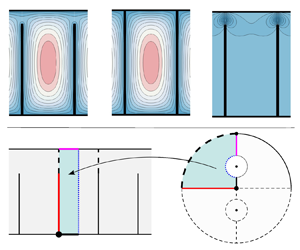
The flow resistance, i.e. friction factor times Reynolds number ( $\,f\,{Re}$), of longitudinal-fin heat sinks with or without clearance between a shroud and the tips of the fins is an important parameter in thermal design. This is because it dictates the caloric resistance of the heat sink, i.e. change in bulk temperature of the fluid flowing through it. When there is no clearance and the common and oft-valid assumption of negligible fin thickness is invoked, $f\,{Re}$ corresponds to simply that of a rectangular duct. However, with clearance, only numerical results are available as per the well-known study by Sparrow, Baliga and Patankar (ASME J. Heat Transfer, vol. 100, 1978). We develop analytical formulae for $f\,{Re}$ for fully developed flow with clearance. The exact solution is provided by an integral formula derived via conformal mappings. Additionally, simple formulae are derived via asymptotic expansions in three cases: (1) the fin spacing is small compared to the fin height and clearance; (2) the clearance is small compared to the fin spacing, which is small compared to the fin height; (3) the same as case (2) but valid for larger clearances. The different asymptotic formulae are compared to the exact formula, and together cover almost the entire relevant parameter range (for fin spacing and clearance) with errors of less than 15 %. A formula for the limiting case of no clearance is shown to be more accurate, for any fin spacing, than a widely used correlation from the literature.


Transition delay in a Mach 6 boundary layer using steady blowing and suction strips
-
- Journal:
- Journal of Fluid Mechanics / Volume 991 / 25 July 2024
- Published online by Cambridge University Press:
- 20 August 2024, R3
-
- Article
-
- You have access
- Open access
- HTML
- Export citation
Transport scaling in porous media convection
-
- Journal:
- Journal of Fluid Mechanics / Volume 991 / 25 July 2024
- Published online by Cambridge University Press:
- 20 August 2024, A4
-
- Article
-
- You have access
- Open access
- HTML
- Export citation
-
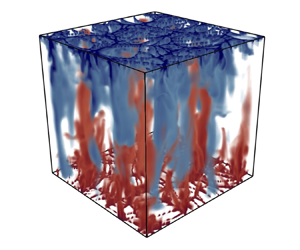
We present a theory to describe the Nusselt number, $\operatorname {\mathit {Nu}}$, corresponding to the heat or mass flux, as a function of the Rayleigh–Darcy number, $\operatorname {\mathit {Ra}}$, the ratio of buoyant driving force over diffusive dissipation, in convective porous media flows. First, we derive exact relationships within the system for the kinetic energy and the thermal dissipation rate. Second, by segregating the thermal dissipation rate into contributions from the boundary layer and the bulk, which is inspired by the ideas of the Grossmann and Lohse theory (J. Fluid Mech., vol. 407, 2000; Phys. Rev. Lett., vol. 86, 2001), we derive the scaling relation for $\operatorname {\mathit {Nu}}$ as a function of $\operatorname {\mathit {Ra}}$ and provide a robust theoretical explanation for the empirical relations proposed in previous studies. Specifically, by incorporating the length scale of the flow structure into the theory, we demonstrate why heat or mass transport differs between two-dimensional and three-dimensional porous media convection. Our model is in excellent agreement with the data obtained from numerical simulations, affirming its validity and predictive capabilities.


Three-dimensional generative adversarial networks for turbulent flow estimation from wall measurements
-
- Journal:
- Journal of Fluid Mechanics / Volume 991 / 25 July 2024
- Published online by Cambridge University Press:
- 20 August 2024, A1
-
- Article
-
- You have access
- Open access
- HTML
- Export citation
Effect of pitch on nonlinear dynamics of helical vortex disturbed by long-wave instability
-
- Journal:
- Journal of Fluid Mechanics / Volume 991 / 25 July 2024
- Published online by Cambridge University Press:
- 20 August 2024, R2
-
- Article
- Export citation
Thermoelectrohydrodynamic convection in a finite cylindrical annulus under microgravity
-
- Journal:
- Journal of Fluid Mechanics / Volume 991 / 25 July 2024
- Published online by Cambridge University Press:
- 20 August 2024, A7
-
- Article
-
- You have access
- Open access
- HTML
- Export citation
Numerical validation of scaling laws for stratified turbulence
-
- Journal:
- Journal of Fluid Mechanics / Volume 991 / 25 July 2024
- Published online by Cambridge University Press:
- 20 August 2024, R1
-
- Article
-
- You have access
- Open access
- HTML
- Export citation
