Contents
Paper
Frozen (Δ + 1)-colourings of bounded degree graphs
- Part of:
-
- Published online by Cambridge University Press:
- 19 October 2020, pp. 330-343
-
- Article
- Export citation
-
Let G be a graph on n vertices and with maximum degree Δ, and let k be an integer. The k-recolouring graph of G is the graph whose vertices are k-colourings of G and where two k-colourings are adjacent if they differ at exactly one vertex. It is well known that the k-recolouring graph is connected for $k\geq \Delta+2$. Feghali, Johnson and Paulusma (J. Graph Theory 83 (2016) 340–358) showed that the (Δ + 1)-recolouring graph is composed by a unique connected component of size at least 2 and (possibly many) isolated vertices.
In this paper, we study the proportion of isolated vertices (also called frozen colourings) in the (Δ + 1)-recolouring graph. Our first contribution is to show that if G is connected, the proportion of frozen colourings of G is exponentially smaller in n than the total number of colourings. This motivates the use of the Glauber dynamics to approximate the number of (Δ + 1)-colourings of a graph. In contrast to the conjectured mixing time of O(nlog n) for
$k\geq \Delta+2$ colours, we show that the mixing time of the Glauber dynamics for (Δ + 1)-colourings restricted to non-frozen colourings can be Ω(n2). Finally, we prove some results about the existence of graphs with large girth and frozen colourings, and study frozen colourings in random regular graphs.

Independent dominating sets in graphs of girth five
- Part of:
-
- Published online by Cambridge University Press:
- 15 October 2020, pp. 344-359
-
- Article
- Export citation
-
Let $\gamma(G)$ and
  $${\gamma _ \circ }(G)$$ denote the sizes of a smallest dominating set and smallest independent dominating set in a graph G, respectively. One of the first results in probabilistic combinatorics is that if G is an n-vertex graph of minimum degree at least d, then
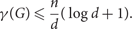 $$\begin{equation}\gamma(G) \leq \frac{n}{d}(\log d + 1).\end{equation}$$
In this paper the main result is that if G is any n-vertex d-regular graph of girth at least five, then
for some constant c independent of d. This result is sharp in the sense that as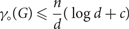 $$\begin{equation}\gamma_(G) \leq \frac{n}{d}(\log d + c)\end{equation}$$ $d \rightarrow \infty$, almost all d-regular n-vertex graphs G of girth at least five have
 $$\begin{equation}\gamma_(G) \sim \frac{n}{d}\log d.\end{equation}$$
Furthermore, if G is a disjoint union of ${n}/{(2d)}$ complete bipartite graphs $K_{d,d}$, then ${\gamma_\circ}(G) = \frac{n}{2}$. We also prove that there are n-vertex graphs G of minimum degree d and whose maximum degree grows not much faster than d log d such that ${\gamma_\circ}(G) \sim {n}/{2}$ as $d \rightarrow \infty$. Therefore both the girth and regularity conditions are required for the main result.


Mixing properties of colourings of the ℤd lattice
- Part of:
-
- Published online by Cambridge University Press:
- 19 October 2020, pp. 360-373
-
- Article
- Export citation
-
We study and classify proper q-colourings of the ℤd lattice, identifying three regimes where different combinatorial behaviour holds. (1) When $q\le d+1$, there exist frozen colourings, that is, proper q-colourings of ℤd which cannot be modified on any finite subset. (2) We prove a strong list-colouring property which implies that, when $q\ge d+2$, any proper q-colouring of the boundary of a box of side length $n \ge d+2$ can be extended to a proper q-colouring of the entire box. (3) When $q\geq 2d+1$, the latter holds for any $n \ge 1$. Consequently, we classify the space of proper q-colourings of the ℤd lattice by their mixing properties.


The minimum perfect matching in pseudo-dimension 0 < q < 1
- Part of:
-
- Published online by Cambridge University Press:
- 27 October 2020, pp. 374-397
-
- Article
-
- You have access
- Open access
- Export citation
-
It is known that for Kn,n equipped with i.i.d. exp (1) edge costs, the minimum total cost of a perfect matching converges to $\zeta(2)=\pi^2/6$ in probability. Similar convergence has been established for all edge cost distributions of pseudo-dimension $q \geq 1$. In this paper we extend those results to all real positive q, confirming the Mézard–Parisi conjecture in the last remaining applicable case.


A simplified disproof of Beck’s three permutations conjecture and an application to root-mean-squared discrepancy
- Part of:
-
- Published online by Cambridge University Press:
- 26 October 2020, pp. 398-411
-
- Article
- Export citation
-
A k-permutation family on n vertices is a set-system consisting of the intervals of k permutations of the integers 1 to n. The discrepancy of a set-system is the minimum over all red–blue vertex colourings of the maximum difference between the number of red and blue vertices in any set in the system. In 2011, Newman and Nikolov disproved a conjecture of Beck that the discrepancy of any 3-permutation family is at most a constant independent of n. Here we give a simpler proof that Newman and Nikolov’s sequence of 3-permutation families has discrepancy $\Omega (\log \,n)$. We also exhibit a sequence of 6-permutation families with root-mean-squared discrepancy $\Omega (\sqrt {\log \,n} )$; that is, in any red–blue vertex colouring, the square root of the expected squared difference between the number of red and blue vertices in an interval of the system is $\Omega (\sqrt {\log \,n} )$.


Tight Hamilton cycles in cherry-quasirandom 3-uniform hypergraphs
- Part of:
-
- Published online by Cambridge University Press:
- 12 October 2020, pp. 412-443
-
- Article
-
- You have access
- Open access
- Export citation
-
We employ the absorbing-path method in order to prove two results regarding the emergence of tight Hamilton cycles in the so-called two-path or cherry-quasirandom 3-graphs.
Our first result asserts that for any fixed real α > 0, cherry-quasirandom 3-graphs of sufficiently large order n having minimum 2-degree at least α(n – 2) have a tight Hamilton cycle.
Our second result concerns the minimum 1-degree sufficient for such 3-graphs to have a tight Hamilton cycle. Roughly speaking, we prove that for every d, α > 0 satisfying d + α > 1, any sufficiently large n-vertex such 3-graph H of density d and minimum 1-degree at least $\alpha \left({\matrix{{n - 1} \cr 2 \cr } } \right)$ has a tight Hamilton cycle.

A discrepancy version of the Hajnal–Szemerédi theorem
- Part of:
-
- Published online by Cambridge University Press:
- 30 October 2020, pp. 444-459
-
- Article
- Export citation
Subgraph counts for dense random graphs with specified degrees
- Part of:
-
- Published online by Cambridge University Press:
- 05 November 2020, pp. 460-497
-
- Article
- Export citation