To save content items to your account,
please confirm that you agree to abide by our usage policies.
If this is the first time you use this feature, you will be asked to authorise Cambridge Core to connect with your account.
Find out more about saving content to .
To save content items to your Kindle, first ensure no-reply@cambridge.org
is added to your Approved Personal Document E-mail List under your Personal Document Settings
on the Manage Your Content and Devices page of your Amazon account. Then enter the ‘name’ part
of your Kindle email address below.
Find out more about saving to your Kindle.
Note you can select to save to either the @free.kindle.com or @kindle.com variations.
‘@free.kindle.com’ emails are free but can only be saved to your device when it is connected to wi-fi.
‘@kindle.com’ emails can be delivered even when you are not connected to wi-fi, but note that service fees apply.
A conflict arises when one or more individuals, groups or organizations disagree, creating internal or external tensions that can cause damage. This is particularly serious in operating theatres, where decisions involving life or death are common. Indeed, in this particular context, the multiplicity of stakeholders, the divergence of opinions and decisions related to patient care, the frequency of critical situations, stress and the limitation of resources are established causes of disagreement and tension.
Objectives
To identify factors associated with the alteration of conflict management quality among anesthesia and resuscitation technicians (ART).
Methods
This is an observational, multicenter, cross-sectional and analytical study, enrolling all ART exercising at the two teaching hospitals of Sousse (Tunisia) over a two month period(March 1, 2022 to April 30, 2022). Conflict management was assessed using the Conflict Handling Style Scale.
Results
Our study involved 50 participants, only eight of whom reported having had previous training in communication and conflict management. Conflicts in the hospital were rated frequent to very frequent by 58% of participants. Task conflicts were the most reported (74%). The main causes of conflict were lack of leadership (60%), unequal distribution of tasks (42%) and workload (28%). The main repercussions of the conflicts were the delay in patients care (60%), therapeutic errors (42%), and the cancellation or postponement of some acts (34%). The main factors associated with impaired conflict management abilities were age<40 years (p=0,03), tobacco consumption (p=0,001), and number of dependent children<2 p<10-3).
Conclusions
In light of our results, it would be useful and urgent to develop the soft skills of our human resources, particularly in terms of communication and conflict management.
Precision medicine is a promising approach to improving the prevention, prediction and treatment of disease, based on individual characteristics and biomarkers/genetic variants shared by specific subgroups of patients.
Objectives
This study aims to address the new paradigm of precision medicine in psychiatry and to discuss, through the literature, its emerging clinical framework.
Methods
We conducted an exhaustive review of the scientific literature using PubMed database and Google Scholar, with “Precision Medicine in Psychiatry” as keywords.
Results
Our review revealed that while psychiatrists have long practiced a personalized therapeutic approach with, for example, treatment choices guided by individual criteria, the methods for achieving this objectively have until now been largely lacking. This dilemma has begun to be resolved with the implementation of data analysis methods such as machine learning and large-scale genomic analysis studies. The goals of precision psychiatry involved the delineation of genetic risk factors using GWAS, the redefinition of the functional domains involved in mental disorders and pharmacological repositioning. The highly polygenic nature of mental disorders and the failure of GWAS to confirm the role of candidate genes have suggested that a systems genetic approach that considers function at the network level would provide a better approach to the problem of linking heterogeneous genetic risk factors and brain mechanisms. In addition, the growing evidence that certain disorders such as psychotic disorders are syndromes rather than diseases in their own right suggests that many conditions currently recognized as such may have similar underlying patterns of cognitive dysfunction and neurobiological abnormalities that will need to be reclassified.
Conclusions
The application of precision medicine in psychiatry is still in its infancy. Numerous research programs creating large multimodal databases with multiple data on brain imaging, genetics, etc. will soon support the clinical deployment of precision medicine in psychiatry.
The DiSCoVeR Project: ‘Examining the synergistic effects of a cognitive control videogame and a self-administered non-invasive brain stimulation on alleviating depression’ is a double-blind, sham controlled, randomized controlled trial investigating the feasibility and efficacy of an innovative, self-applied treatment approach for patients diagnosed with major depressive disorder. The trial is conducted at three clinical trial sites (Hadassah, Israel; Riga Stradiņš University, Latvia; Ludwig-Maximilian-University, Germany). The treatment approach combines prefrontal transcranial direct current stimulation with a videogame designed to enhance cognitive and emotional control. This treatment is self-applied at home and remotely monitored. At the beginning of the intervention the patients are randomized in an active group receiving both active stimulation and videogame and the other group receiving sham stimulation and visually similar but not active videogame.
Objectives
The present interims analysis after half of the patients included examines patients’ intrinsic motivation after completing the first five sessions (of 30) of the treatment. We also examine patients’ interest/enjoyment, perceived competence, effort, felt pressure/tension, and perceived choice following the first week of treatment. Intrinsic motivation has been associated with enhanced learning and performance, so it can be used as one of the predictors for patient compliance.
Methods
At the end of the 5th session, the patients filled in the Intrinsic Motivation Inventory (IMI) including the following subscales: interest/enjoyment, perceived choice, perceived competence, effort/importance and felt pressure/tension (scored on a 7-point Likert scale, ranging from 1 “not at all true” to 7 “very true”).
Results
This report includes the first 55 patients randomized (27 patients in the active group and 28 patients in placebo group) for the DiSCoVeR trial. Patients rated their overall interest/enjoyment at 4.50 out of 7 (SD±0.17 95% CI 4.16 to 4.84), their perceived choice at 5.55 (SD±0.16; 95% CI 5.23 to 5.87), their perceived competence at 4.52 (SD±0.15; 95%CI 4.22 to 4.82), their effort/importance at 5.07 (SD±0.16; 95%CI 4.74 to 5.40) and their pressure/tension at 3.00 (SD±0.13; 95% CI 2.73 to 3.26).
Conclusions
We conclude that overall patients were quite interested in the treatment and had inherent pleasure while doing the sessions, felt that it was their choice to do them, felt that they performed the task quite effectively, were invested in doing the sessions and the experienced pressure and tension were low. The perceived choice and competence are positive predictors of intrinsic motivation. This aligns with the previous published data of a smaller patient subset (L. Konosonoka et al Medicina (Kaunas) 2022;58(Supplement 1):72) with the standard deviations being smaller in our larger patient sample.
The COVID-19 pandemic has had a wide-ranging impact on economic and social phenomena worldwide, particularly affecting mental health. However, these impacts have varied significantly across countries. Previous studies have shown that the groups more vulnerable to mental health problems also differ across countries and societies(Gunnel et al. Lancet Psy 2020; 7(6) 468-471, Pirkis et al. Lancet Psy 2021; 8(7) 579-588, Nomura et al. Psy Res 2021; 295 113622). Therefore, by examining changes in self-harm and suicide attempts, which constitute mental health emergencies, at the community level, we can explore the COVID-19 pandemic’s impact on the deterioration of mental health in various age groups within the region and identify the groups most vulnerable to mental health problems.
Objectives
The aim of this study is to examine the relationship between the COVID-19 pandemic and changes in the number of emergency room visits due to suicide attempts or self-harm in teenagers and young adults in Incheon, a metropolitan city in the capital area of South Korea.
Methods
We conducted a retrospective data analysis on the medical records of patients who visited the regional emergency center of Incheon Medical Institution from January 2018 to December 2022 due to suicide attempts or self-harm. As our statistical method, we employed interrupted time series analysis to determine whether the COVID-19 pandemic has a statistically significant correlation with the trend changes in the number of emergency room visits related to suicide attempts or self-harm. This study was approved by the Institutional Review Board of Gil Medical Center, Gachon University of Korea(IRB approval number GFIRB2022-335).
Results
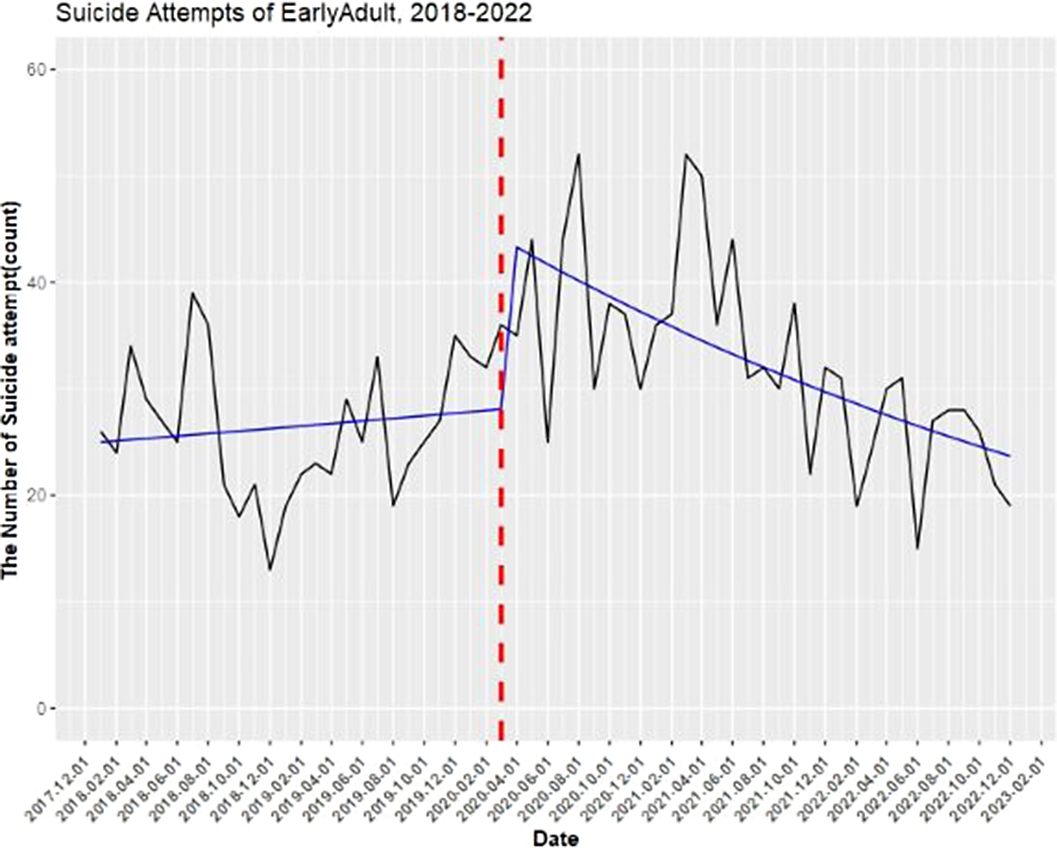
The data of 4,030 subjects(35.8% male; n=1,443) who visited the regional emergency center during the study period were analyzed. A total of 556 (13.79%) of the study participants were minors under the age of 19, and a total of 1,789 (44.39%) were young adults aged 20-39. The analysis revealed an increasing trend in the number of emergency room visits due to elevated suicidality in teenagers and young adults (20-39 years old) following the COVID-19 pandemic(figure 1 & figure 2).
Image:
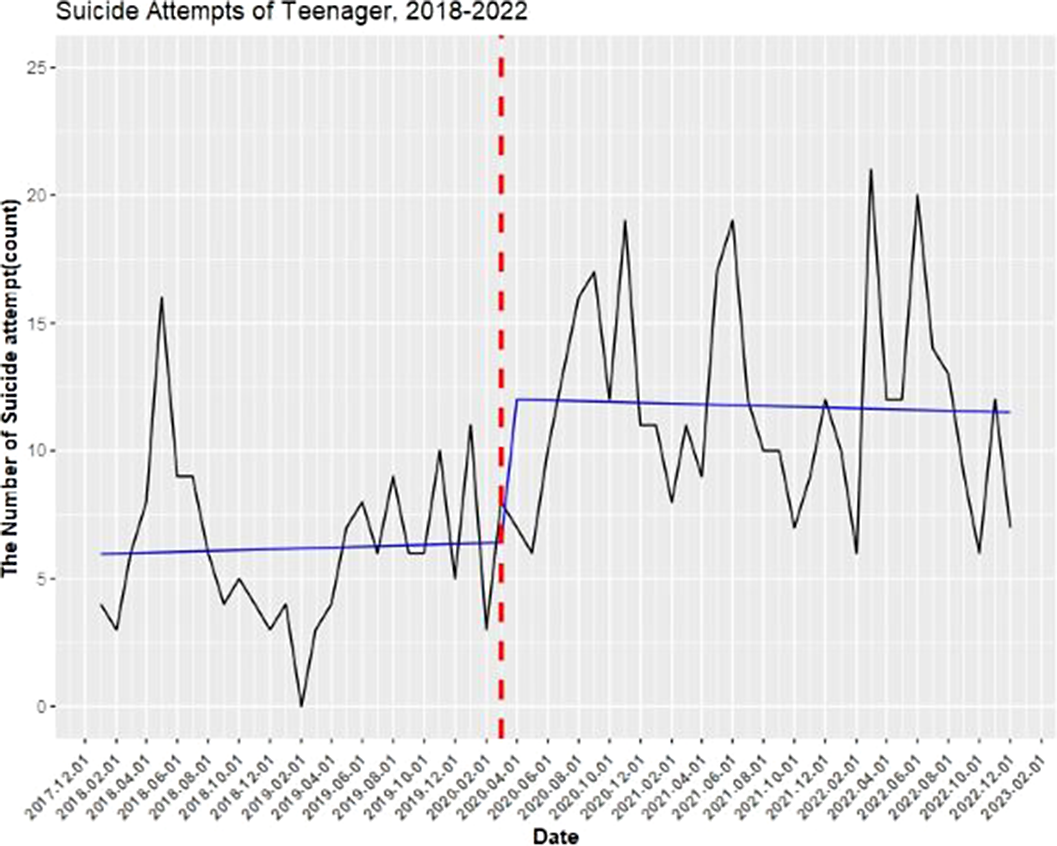
Image 2:
Conclusions
While suicide attempts and visits to the emergency room due to self-harm increased both before and after COVID-19, it is noteworthy that past suicide attempts are the most significant risk factor for future suicide attempts. Therefore, the data on vulnerable groups presented in this study can be instrumental for effective prevention and follow-up management of suicide attempts within the field of community psychiatry.
Freshwater biodiversity is increasingly at risk wherever land uses such as agriculture exert multiple stressors that degrade habitat quality. Although stream macroinvertebrates act as bioindicators for monitoring these impacts, their responses are context-specific: examining drivers of community composition is therefore important to understand the results of monitoring efforts. In a primarily agricultural landscape, 15 sites across the Sydenham River watershed, Ontario, Canada, were assessed for in-stream habitat quality and stream macroinvertebrate diversity. We predicted that community assemblage would be driven by differences in surficial geology across branch (east branch versus north branch) and catchment position (main stem versus tributary). We found that the main stem of the east branch was characterised by significantly higher proportions (P = 0.053) and abundance (P = 0.038) of Ephemeroptera–Plecoptera–Trichoptera (EPT) taxa than north branch sites were, and sites in the east and north branch tributaries were characterised by significantly lower Hilsenhoff Biotic Index (HBI) scores (P = 0.088). Redundancy analysis found that substrate size was the main driver of community composition, generating a model that described these patterns across branch and catchment position. Our findings suggest that EPT abundance and HBI scores were the variables that were most effective at revealing differences in stream communities due to agricultural impacts and that sediment size is an important driver of these patterns.
Manifestations of phantom ringing syndrome are widely seen in healthy population. Are there any interrelations between this phenomenon and personal psychological characteristics that are connected with the level of their mental health?
Objectives
To determine the specificity of interrelations of phantom ringing syndrome related anxiety and personal self-esteem in university students
Methods
The anonymous survey covered 546 undergraduate university students. The questions were centered on the students’ patterns of their personal smartphone use.
Results
The research showed that manifestations of phantom ringing syndrome is available in 189 students, or in every third student (34.6%), who use mobile phones. It is equally represented in males (49.7%) and females (50.2). Clinically, it is characterized by a higher level of anxiety, which reliably correlates (p<0.01) with the level of stress (r=.17), level of nervousness caused by absence of a mobile phone (r=.18), the frequency of headache (r=.15), the frequency of medication consumption related to chronic somatic disease (r=.15). We also established valid negative interrelations between the level of phantom ringing syndrome related anxiety and the personal self-esteem based on the parameters of religious belief (r=-.15), personal attractiveness (r=-.16), mind (r=-.17), happiness (r=-.24), liveliness (r=-.25) and well-being (r=-.15). We have not found any proof of valid interrelations with self-assessment of health.
Conclusions
The received results prove that phantom ringing syndrome related anxiety is connected with the personal self-esteem, the level of the perceived stress and some other clinical manifestations
Recent clinical and preclinical evidences suggested that neuroinflammation is a key factor which interacts with the neurobiological correlates of major depressive disorder, which are the (i) dysregulation of the hypothalamic-pituitary-adrenal axis, (ii) depletion of brain serotonin and (iii) alteration of neurogenesis in the dentate gyrus of the hippocampus.
The gut bacterial has major impact on the brain development, behaviour and host immune system through the microbiota-gut-brain axis.
Objectives
The objective of the research is to establish the role inflammation induced by gut dysbiosis plays in behavioural changes of patients suffering from major depressive disorders.
Methods
Clinical data and preclinical experiments were used to elucidate the role gastrointestinal bacterial play in the development and functional physiology of the nervous system and because of the bidirectional communication between the enteric nervous system in the gut and the central nervous system, through the vagal plexus, blood circulation and endocrine system; it was discovered that the appropriate population of intestinal microbiota affect the immunological state of the brain.
Results
The intestinal microbiota has been able to maintain the attenuation and regulation of pro-inflammatory biomarkers in the brain and such had assisted in the healthy state of the brain; however, a disruption of gastrointestinal organisms in a condition called dysbiosis could result in breakdown of protective gastrointestinal mucosa barrier resulting in leaky gut and consequently, the permeability of the gut lining and migration of some bacteria, to the brain through the vagal networks and other channels.
These pathophysiological cascades appear to be triggered or sustained and reinforced by chronic inflammatory condition involving increased circulating markers of inflammation, which are able to cross the blood brain barrier to activate the microglia.
Conclusions
Studies in depression suggest that inflammatory biomarkers such as C-reactive protein can be used to enrich samples for anti-inflammatory clinical trials for depression that target inflammation-related symptoms such as anhedonia and anxiety.
Although, still at the developmental stages, imaging of neuroinflammation will help establish a target in the brain to further facilitate the testing of anti-inflammatory therapies for depression.
Serotonin syndrome is a potentially life-threatening condition that is precipitated by the use of serotonergic medications, Selective Serotonin Reuptake Inhibitors (SSRIs) and Monoamine Oxidase Inhibitors (MAOIs). It usually occurs when high doses of serotonergic drugs are prescribed. It is a medical emergency that requires prompt recognition, cessation of offending drugs and supportive therapy.
Objectives
We present a case of serotonin syndrome that occurred in a patient who was prescribed a low dose of sertraline, and aim to highlight the importance of early detection of this severe condition.
Methods
Details of the case were described. Information was gathered based on medical records.
Results
Patient M was a 29-year-old Malay male with a history of major depressive disorder, who was previously trialed on fluvoxamine 100mg every night but subsequently switched to and maintained on sertraline 75mg every night in 2020. He then defaulted follow up appointments. In 2023, he presented to the emergency services for a suicide attempt and was diagnosed with major depressive disorder with psychotic features. He was restarted on sertraline 50mg every night and risperidone 0.5mg every night was newly started. Two days later, sertraline was increased to 100mg every night. Two days following this increase, he was noted to have altered mental state, fever of 39.3-degree celcius, tachycardia of 120 beats per minute, ocular clonus and generalized hyperreflexia. Sertraline and risperidone were immediately stopped. Blood tests including creatine kinase, lumbar puncture and magnetic resonance imaging (MRI) of the brain did not show any abnormalities. After stopping of the medications, the patient’s symptoms resolved within 24 hours. Based on clinical symptoms and a normal creatine kinase level, neuroleptic malignant syndrome (NMS) was ruled out. Subsequently, he was restarted on risperidone 0.5mg and mirtazapine 7.5mg every night. He developed symptoms of serotonin syndrome with a low dose of sertraline. Symptoms resolved after the discontinuation of the SSRI.
Conclusions
In this case, differential diagnoses of serotonin syndrome were also considered, such as NMS, encephalitis, meningitis and thyroid storm. NMS was less likely due to the rapid onset of onset and resolution of symptoms. Encephalitis and meningitis were unlikely in view of normal MRI brain and lumbar puncture findings.
There have been case reports of serotonin syndrome developing with lower doses of an SSRI in the pediatric population. There is, however, a lack of literature describing serotonin syndrome with low doses of SSRI in the adult population. To avoid a missed diagnosis, clinicians should monitor closely for SSRI toxicity, including serotonin syndrome, even when low doses of serotonergic drugs are used.
The COVID-19 pandemic has certainly become a stressful event for medical workers, so the aim of this research was to study the pandemic-specific working conditions that may be associated with the professional burnout of medical workers in Russia.
Objectives
To study the pandemic-specific working conditions that may be associated with the professional burnout of medical workers in Russia.
Methods
The Maslach Burnout Inventory (MBI) was used to measure the level of professional burnout. It was filled out by medical workers from January 2021 to November 2022.
The sample consisted of 314 medical workers (57 men and 255 women), whose average age was 36.97±11.93. According to the level of education, the sample included specialists with secondary general education (4.14%), with secondary special education (19.4%), with incomplete higher education (11.46%), with higher education (59.87%) and PhD (5.1%). 35 people (11%) of the surveyed medical workers worked in the red zone.
Results
Working in the red zone is significantly associated with Emotional Exhaustion (p=0.002) and Depersonalization (p=0.002), but not with a Reduction in Professionalism.
The working conditions of medical workers who were significantly associated simultaneously with Emotional Exhaustion, Depersonalization and Reduction of professionalism (respectively): (1) Lack of confidence in support from the health system and the state in case of illness (r=0.170, p=0.002; r=0.202, p=0.000; r=-0.171, 0. 002); (2) Inability to meet the usual personal needs (daily routine, nutrition, communication with loved ones) as employment increases at work (r=0.200, p=0.000; r=0.154, p=0.006; r=-0.186, 0. 001); (3) Lack of confidence in their own professional competence in the fight against COVID-19 due to lack of knowledge about COVID-19 (r=0.202, p=0.000; r=0.148, p=0.009; r=-0.211, 0. 000); (4) Lack of confidence in their own effectiveness in the fight against COVID-19 due to the increase in the volume of work and the expansion of the scope of professional responsibilities (r=0.234, p=0.000; r=0.152, p=0.007; r=-0.177, 0. 002); (5) Lack of access to up-to-date information about COVID-19 (r=0.190, p=0.001; r=0.158, p=0.005; r=-0.140, 0. 013).
The Emotional Exhaustion scale is also associated with the fear of getting infected and getting sick with COVID-19 (r=0.125; p=0.026), as well as the lack of quick access to testing when COVID-19 symptoms appear (r=0.169; p=0.003).
Conclusions
Thus, not only work in the red zone, but also many specific working conditions during the COVID-19 pandemic can become a provocateur factor for the deterioration of the emotional state of medical workers.
Disclosure: Research is supported by the Russian Science Foundation, project No. 21-18-00624.
Globally, there is a mental health crisis, and anxiety is the most prevalent mental health condition. However, the impact of the COVID-19 pandemic (COVID) on generalized anxiety disorder (GAD) prevalence has not been quantified across European countries, and such impact could establish a new baseline of GAD estimates in European countries.
Objectives
To assess GAD by severity level before and during COVID in 5 European countries, using the 7-Item GAD Questionnaire (GAD-7).
Methods
Adults (age 18+) in France, Germany, UK, Italy, and Spain completed a short survey in May 2020 to assess the impact of COVID on their mental health. All respondents had previously participated in the National Health and Wellness Survey, a nationally representative survey of the adult general population in each country, before COVID (December 2019–March 2020). In both surveys, respondents completed the GAD-7. GAD symptoms were defined by GAD-7 score as mild (5-9), moderate (10-14), and severe GAD (≥15). Positive screen was defined as GAD-7 score ≥10. Positive screen and GAD symptom severity prevalence were reported for the pooled European sample and by country, both before and during COVID. Chi-square and McNemar’s tests were used to evaluate the difference in GAD severity across countries and changes over baseline in GAD positive screen during COVID. P-values were reported for both tests.
Results
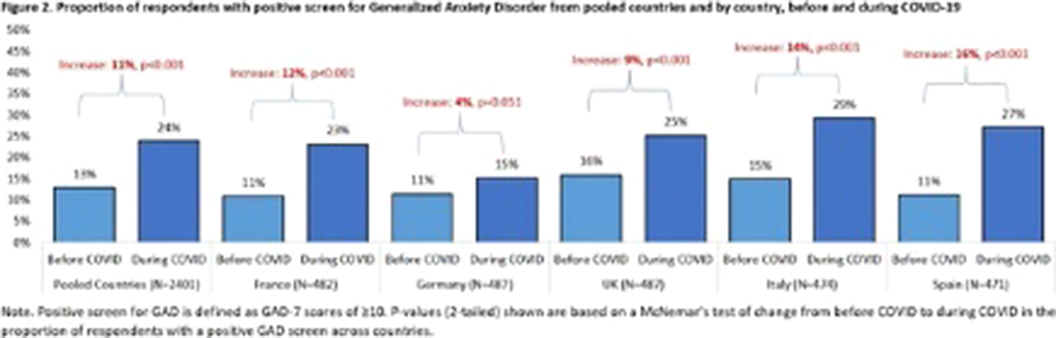
In total, 2401 adults were included in analysis (France, n=482; Germany, n=487; UK, n=487; Italy, n=474; Spain, n=471). Prior to COVID, 311 (13%) screened positive for GAD, with 208 (9%) moderate and 103 (4%) severe in the pooled European sample. During COVID, the distribution of GAD symptoms almost doubled, as 576 (24%) screened positive for GAD, and shifted towards greater severity with 337 (14%) moderate and 239 (10%) severe in the pooled European sample (Figure 1). Before COVID, the prevalence of positive screen ranged from 11% (France, Germany, Spain) to 16% (UK). Statistically significant increases in positive screen over baseline levels were observed across all countries (p<0.01), except Germany. Spain was the most impacted by COVID (increase: 16%), followed by Italy, France, and UK (increase: 14%, 12%, and 9%, respectively). Germany was the least affected, overall (increase: 4%) (Figure 2).
Image:
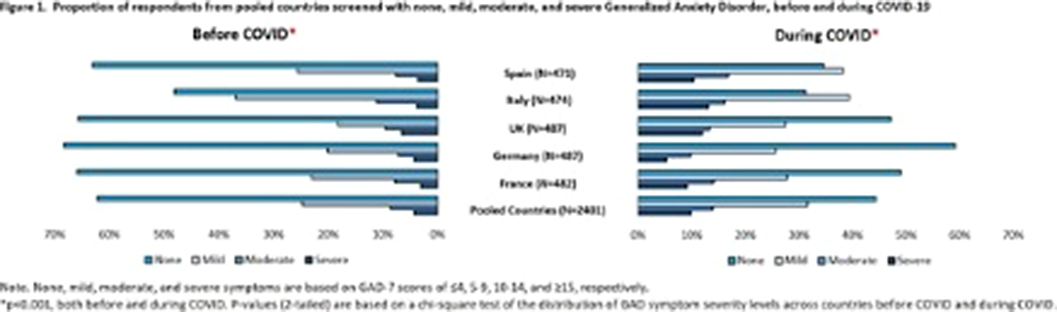
Image 2:
Conclusions
During COVID, estimates of positive screen for GAD increased substantially to 24% across 5 European countries. Surges in positive screen and GAD symptom severity were observed in all 5 countries, with more profound impact in Spain, Italy, France, and UK. With new baseline GAD estimates, the country-specific data of COVID impact on GAD could help to inform appropriate allocation of mental health resources.
Disclosure of Interest
D. Karlin Employee of: MindMed, S. Suponcic Shareolder of: Eli Lilly, Stryker, Abbott, Amgen, Consultant of: MindMed, Becton Dickinson Company, CSL Behring, N. Chen Consultant of: MindMed, C. Steinhart Employee of: MindMed, P. Duong Employee of: MindMed
Most patients with mental disorders exhibit multiple comorbidities. Without doubt the presence of multiple co-occurring somatic and mental disorders is associated with a higher insurance spending for the psychiatric patients. The details of this association need to be elucidated.
Objectives
The aim of current study was 1) to delineate the typical nonmental comorbidities that occur among mental patients, and 2) to investigate social health insurance spending on comorbidities compared to the direct mental care costs of the same population. The analysis offers unique insight into the health care spending, since it focuses not only the costs of psychiatric care but reflects the whole range of treatments delivered to this group.
Methods
A database with the claim records of the Hungarian NHIF was created including direct healthcare costs for mental diagnosis. Patients were recorded either in primary or in specialist care with at least one mental health diagnosis in the last pre-pandemic year (2019). Adopting a case-control design, spending and comorbidities were compared to the control group, which comprised patients who did not have any mental diagnosis. Cases and controls were matched on demographic characteristics like age, gender, place of residence with deprivation index and marital status..
Results
Mental problems affected in 2019 more than 1,5 million persons in Hungary. Half of them did not access specialist care but were only seen with the mental diagnosis by a GP. Direct insurance spending for mental care is around 156 million EUR/year with 4% of the total direct health spending. Besides these costs another 665 million EUR (+17% of all health spending) were reimbursed for the same patient group for the treatment of other diseases. With regards to affected patient numbers, the three most important comorbidities were cardio-vascular conditions (34% of mental patients with 14% of all spending of the group); diseases of the digestive system (29% vs 14%); and musco-sceletal conditions (28% / 9% ) In terms of spending three other disease groups also have to be considered as of high significance: carcinomas (4% patients vs 13% of spending); neurological disorders (13% /vs 7%); and diseases of the endocrine, nutritional and metabolic system (24% vs 6%).
Conclusions
The analysis aims to raise awareness for the complex issues of comorbidities of mental patients. We see that this patient group suffers heavily from other conditions the costs of which is much higher than the direct mental care costs. A better understanding of the coexistence of somatic and mental disorders and a holistic approach of treatment (care integration, reimbursement across different types of care, etc.) would be desirable.
Kambó is considered an “ancestral medicine” by the indigenous tribes of the western region of the Amazon.
Objectives
Through this clinical case, the aim is to present the particularities of the symptoms and management of patients with consumption of not so common substances, such as Kambo or salvia divinorum, as well as the evolution that will occur in a patient with a previous diagnosis of a Depressive Episode.
Methods
We present the case of a 23-year-old male, Gestalt therapy student. History of tobacco, THC, and recent use of salvia divinorum and Kambo. He began follow-up by psychiatry in a private setting three years ago due to a severe depressive episode, having required treatment with antidepressants, antipsychotics and benzodiazepines, and having been triggered by a serious assault. The episode is resolved and follow-up is discontinued. Family history of depressive syndrome and suicide.
He resumed contact through the Emergency Department, requiring hospital admission due to symptoms compatible with a manic episode with psychotic symptoms. It begins with behavioral alterations and global insomnia that are related to the consumption of some substance, initially unknown to them, making the skin lesions they presented suspect the consumption of kambo.
Results
We assess the risk of consuming these substances, which are sometimes used as alternative therapies, and especially in this type of patient, who is more vulnerable and perhaps seeks a way out of the problems they present.
Conclusions
In our case, it triggered a manic episode with psychotic symptoms, which consisted of delusional ideation of mystical content accompanied by auditory hallucinations. The episode took about a month to subside, despite treatment. Subsequently, there have been more episodes with similar characteristics, and they have not been associated with the consumption of kambó, but have been linked to the consumption of “natural medicinal substances.”
Generalized Algebraic Data Types (GADTs) are a syntactic generalization of the usual algebraic data types (ADTs), such as lists, trees, etc. ADTs’ standard initial algebra semantics (IAS) in the category $\mathit{Set}$ of sets justify critical syntactic constructs – such as recursion, pattern matching, and fold – for programming with them. In this paper, we show that semantics for GADTs that specialize to the IAS for ADTs are necessarily unsatisfactory. First, we show that the functorial nature of such semantics for GADTs in $\mathit{Set}$ introduces ghost elements, i.e., elements not writable in syntax. Next, we show how such ghost elements break parametricity. We observe that the situation for GADTs contrasts dramatically with that for ADTs, whose IAS coincides with the parametric model constructed via their Church encodings in System F. Our analysis reveals that the fundamental obstacle to giving a functorial IAS for GADTs is the inherently partial nature of their map functions. We show that this obstacle cannot be overcome by replacing $\mathit{Set}$ with other categories that account for this partiality.
The glucagon-like peptide-1 (GLP-1) receptor agonist Semaglutide has been widely used to manage type 2 diabetes due to its favourable effects on glycemic control and weight reduction. Proved to be safe in adults and elderly patients with renal or hepatic disorders demanding no dose modification. Affective symptoms are not listed as side effects in the product information. However, there is a recent investigation going on by the European Medicines Agency (EMA) after three flagged cases of suicidal thoughts in Iceland. In contrast, the Food and Drug Administration (FDA) recommend that patients with this treatment are monitored for suicidal thoughts or behaviour.
Objectives
This case study explores the possible relationship between Semaglutide treatment and the onset of a manic episode in a 57-year-old male with no history of psychiatric disorders.
Methods
We present a 57-year-old male with no psychiatric history of interests, with a previous good functioning. A one-week history of disruptive behaviours started, characterized by excessive cheerfulness, heightened euphoria, and reduced need for sleep. Family members describe a complex situation at home, with frequent outings by the patient, engaging in conversations with strangers, getting lost, and becoming more irritable with them. The patient and family relate this mood change after initiating Semaglutide for diabetes control, starting at 7mg doses. The temporal relationship between the initiation of Semaglutide therapy, precisely a dose escalation to 7mg, and the onset of manic symptoms prompted family members to notify the patient’s endocrinologist. Due to the inability to manage the patient at home and his unpredictability, they sought help at the emergency department, resulting in a psychiatric admission. Imaging and analytical tests show no significant abnormalities.
Results
During his stay in the psychiatry department, semaglutide dosage was reduced, and treatment with Aripiprazole was initiated at doses of 5mg, given the metabolic profile associated with medical comorbidities (obesity, chronic renal failure and diabetes). Subsequent clinical observations showed a gradual resolution of manic symptoms and an improvement in the patient’s overall mental state.
Conclusions
This case highlights the importance of monitoring and recognizing potential neuropsychiatric side effects associated with Semaglutide therapy, particularly in individuals without a prior psychiatric history. Further research is warranted to elucidate the underlying mechanisms linking Semaglutide with mood disturbances and to identify risk factors that may predispose certain patients to develop manic states in response to this GLP-1RA. Clinicians should remain vigilant and consider alternative treatment options if such side effects occur, ensuring comprehensive management of patients receiving Semaglutide for diabetes control.
It is well established that migrants have a 2 to 4 times increase in psychosis risk. However, estimates are highly heterogeneous and vary considerably depending on origin and destination country. It also seems that the relationship between migration and psychosis is complex.
Objectives
In this review, we aim to explore the moderators, mediators and mechanisms behind migration psychosis.
Methods
We searched PubMed using the following terms: “psychosis,” “psychotic,” “migra*”, “immigra*”, “schizophreni*.” “pathogene*”. We limited the search to studies published after 2010 and we screened the title, abstract, and full text. We included a total of 47 studies in this narrative review.
Results
Moderators identified in the literature were country of origin, vitamin D deficiency, male sex, and psychosocial adversity (e.g. exposure to war). Mediators were mostly social, namely discrimination, social exclusion and ethnic minority status, low ethnic density, as well as language distance, unstable housing, and unemployment. Most of the studies we retrieved found that substance use did not fully explain the increased risk for psychosis among migrants. We found that potential pathophysiological mechanisms include stress-induced alterations in dopaminergic neurotransmission, functional and structural alterations in ventral anterior cingulate cortex, as well as possible stress-resultant neuroinflammation.
Conclusions
This review highlights the pathway from psychosocial hardships to neurobiological alterations leading to migration psychosis. Further research is needed to translate these findings into developing preventive measures and tailoring treatment modalities to the migrant population.
Consideration of the reserve problem would be incomplete without an analysis of the cytoprotective mechanism. The predominant molecular hallmark of aging and degeneration is the accumulation of altered gene products. Moreover, several conditions, including protein, lipid, or glucose oxidation, disrupt redox homeostasis and lead to the accumulation of unfolded or misfolded proteins in the aging brain in case of AD, and other neurodegenerative diseases that have as a common denominator abnormal protein production, mitochondrial dysfunction and oxidative stress. Some authors classify aging, pathological aging, and neurodegeneration as “protein conformational diseases”.
Objectives
scientific publications
Methods
analytical review
Results
The central nervous system has evolved a conserved unfolded protein response mechanism to cope with the accumulation of misfolded proteins. As one of the main intracellular redox systems involved in neuroprotection, the vitagene system becomes a potential neurohormetic target for novel cytoprotective interventions. Vitagens encode the cytoprotective heat shock proteins (Hsp) Hsp70 and heme oxygenase-1, as well as thioredoxin reductase and sirtuins. The cellular stress response is the ability of a cell to withstand stressful conditions, including the heat shock response. The production of heat shock proteins, including protein chaperones, is necessary for the folding and repair of damaged proteins, which promotes cell survival to avoid apoptosis.«Molecular chaperone» are proteins that function as part of an ancient defense system in our cells. They promote cell survival by sequestering damaged proteins and preventing their aggregation. Chaperone complexes are involved in the regulation of mitochondrial functions, assembly of the cytoplasmic proteolytic system of brain cells. The cellular response to stress requires the activation of survival pathways that are under the control of protective genes called vitagens. Vitagens are involved in the production of heat-shock protein molecules, glutathione, and bilirubin. They have antioxidant and anti-apoptotic activity and provide protection against oxidative stress.
Conclusions
Studies have shown that the heat shock response contributes to the maintenance of cellular homeostasis, the establishment of a cytoprotective state in a wide range of human diseases, including inflammation, cancer, aging, and neurodegenerative disorders. Endogenous proteins can be manipulated by food or pharmacological compounds, which represents an innovative approach to therapeutic intervention in neurodegenerative disorders, actually influencing reserve mechanisms and adaptive capacity.
Ageist beliefs and attitudes may restrict the opportunities for older adults to participate actively in their communities, resulting in strong effects on mental health.
Objectives
This study has three objectives: 1) To investigate the effect of ageism on older adults’ civic activities; 2) To analyze the influence of ageism on mental health; and 3) To explore the impact of civic participation on older adults’ mental health.
Methods
This qualitative study included 391 older people from three different nationalities (Portuguese, Brazilian and English) ranging in age from 65 to 88 years old. All the interviews went through the process of content analysis.
Results
For the first objective, findings encompass four major themes: (1) Social disapproval (86%); (2) Perceived Ineptitude (84%); (3) Anticipated Failure (83%); and (4) Inability to Contribute (77%). For the second objective, findings indicated six categories: (1) Helplessness and Despair (89%); (2) Rage (81%); (3) Self-Perceived Inability (77%); (4) Sense of Unimportance (71%); (5) Anxiety (68%); and (6) Outbursts of Emotion (63%). For the third objective, the following five major subjects emerged: (1) Meaningfulness (81%); (2) Embracing Social Belonging (80%); (3) Cognitive Abilities (71%); (4) Personal Empowerment (67%); (5) Emotional Expression (54%). Additionally, findings indicated that the most verbalized themes for the three objectives were the same across the three nationalities.
Conclusions
The results of this study offered insight into how ageism, mental health, and civic engagement are related. Ageism seems to have a negative impact on mental health. Ageism also made it difficult for people to participate in civic life, which has been linked to better mental health. These findings emphasize the need to identify ageism and encourage inclusive civic involvement to improve older individuals’ mental health.
Burnout syndrome arises as a result of chronic workplace stress that has either been inadequately managed or entirely unaddressed, leading to symptomatic manifestations of emotional exhaustion (EE), depersonalization (DP), and a decreased sense of professional accomplishment (PA).
Objectives
This study evaluated the prevalence of burnout and investigated its correlation with resilience among healthcare professionals in Morocco.
Methods
A self-administered questionnaire survey was conducted in April 2023, comprehensively using the Connor-Davidson Resilience Scale (CD-RISC) and the Maslach Burnout Inventory (MBI) among 296 healthcare professionals stationed across three institutions located in the Casablanca-Settat region.
Results
A total of 158 responses were obtained. Surprisingly, the results indicate that EE was highly prevalent, impacting 43.7% of respondents, while DP was notably affected 44.9% of participants. Conversely, PA was diminished in 58.2% of the respondents. It is worth noting that 44.3% of the participants displayed reduced levels of resilience. Furthermore, statistically significant correlations were observed between resilience and all three dimensions of burnout. Upon gender stratification, the analysis showed that resilience was significantly associated with two burnout dimensions, EE and PA, among male respondents, whereas among their female counterparts, resilience demonstrated a noteworthy correlation with all three dimensions of burnout.
Conclusions
These findings emphasize the pervasive nature of burnout among healthcare professionals and highlight deficiencies in resilience. It is crucial to consider these factors when crafting healthcare policies and devising focused approaches to effectively prevent and manage burnout.
Bipolar disorder (BD) is characterised by heterogeneous phenotypic manifestations that may affect the achievement of a timely diagnosis delaying its therapeutic management. Increased circulating levels of pro-inflammatory cytokines and cortisol (CORT) have been observed in BD patients in addition to decreased levels of Brain-Derived-Neurotrophic Factor (BDNF) suggesting that the interaction among these mediators may play a role in the occurrence of affective episodes overall disrupting brain plasticity. However, knowledge on BD etiopathogenesis is still limited, including the causal relationship with inflammatory and neuroendocrine markers.
Objectives
To assess whether variations in peripheral neuroendocrine and inflammatory markers during acute phases of the disease and euthymia might predict the occurrence of affective episodes; to evaluate whether the interplay among these biomarkers might be exploited as a signature of BD.
Methods
We are currently recruiting BD patients during depressive or manic/hypomanic phases together with age- and sex-matched healthy controls (CTRLs). Complete blood count, pro-inflammatory, anti-inflammatory cytokines and BDNF will be assessed in serum; salivary cortisol awakening response test will be used to evaluate hypothalamic-pituitary-adrenal axis activity. MADRS, YMRS and HAM-A will be used to assess psychiatric symptoms, PSP and C-SSRS for global functioning and suicidal risk, IPSS and SRRS for stress levels and CIRS to evaluate physical comorbidities. All assessments will be carried out at the time of recruitment (T0) and after 3 (T1) and 6 (T2) months.
Results
Data have been so far collected on 28 BD patients (18 males, 10 females, age: 48.31±11.3) and 26 CTRLs (16 males, 10 females, age: 46.82±10.86). At T0, BD were characterised by a greater total number of white cells (7.83±1.86 BD vs. 6.78±1.87 CTRL, p<0.05), mean number of neutrophils (4.89±1.49 BD vs. 3.92±1.45 CTRL, p<0.05) and neutrophil/lymphocyte ratio (NLR) (2.52±1.1 BD vs. 1.9±0.69 CTRL, p<0.05). Moreover, BD patients showed overall a greater BMI (30.5±6.6 BD vs. 24.45±3.86 CTRL, p<.001). No difference was observed among groups with respect to sex and age.
Conclusions
Although preliminary, these results suggest that the active phases of BD are associated with a low-grade inflammatory state, potentially related to a different metabolic set-point in BD patients. Ultimately, this study will allow us to evaluate whether the presence of affective symptoms is correlated with fluctuations in the levels of inflammatory mediators, salivary cortisol and BDNF and to establish a reliable and highly predictive BD signature.
“Funded by: Bando Ricerca Indipendente ISS 2021-2023 to A. Berry project code ISS20-9286e4091f8e”
This is a 13-year-old female patient admitted to the psychiatric unit active suicidal ideation.
Objectives
the objective is to show through a clinical case how vortioxetine can be safe in adolescents.
Methods
Case report and literature review
Results
She has a history of daily consumption of at least 2 units of cannabis per day. She presents high emotional distress secondary to academic failure, consuming the substance as a coping strategy. Due to prohibition and control by her parents, the patient stopped taking the substance, presenting severe depressive symptoms, self-injury and suicide ideation. For this reason she is admitted to the inpatient psychiatric unit. The electrocardiogram performed on admission shows a corrected QT index of 524. Exploring physical symptoms, she recognized episodes of syncope and palpitations. Coordination was made with cardiology, who performed an echocardiogram with normal results and began follow-up with them without prescribing medication. It was agreed not to use drugs that could prolong the QT index. Evaluating the clinical situation, it was decided to start treatment with Vortioxetine up to 10 mg. With this treatment there was no worsening of the electrocardiogram and the patient’s mood improved, anxiety and ideas of death were remitted
Conclusions
This work aims to show how vortioxetine has been effective and safe at the cardiological level in the case of moderate-severe depression in an adolescent with prolonged QT index
