To save content items to your account,
please confirm that you agree to abide by our usage policies.
If this is the first time you use this feature, you will be asked to authorise Cambridge Core to connect with your account.
Find out more about saving content to .
To save content items to your Kindle, first ensure no-reply@cambridge.org
is added to your Approved Personal Document E-mail List under your Personal Document Settings
on the Manage Your Content and Devices page of your Amazon account. Then enter the ‘name’ part
of your Kindle email address below.
Find out more about saving to your Kindle.
Note you can select to save to either the @free.kindle.com or @kindle.com variations.
‘@free.kindle.com’ emails are free but can only be saved to your device when it is connected to wi-fi.
‘@kindle.com’ emails can be delivered even when you are not connected to wi-fi, but note that service fees apply.
This book will inform and inspire librarians, archivists, curators and technologists to make better use of data to help inform decision-making, the development of new services and the improvement of the user experience. With the wealth of data available to library and cultural heritage institutions, analytics are the key to understanding their users and improving the systems and services they offer. Using case studies to provide real-life examples of current developments and services, and packed full of practical advice and guidance for libraries looking to realize the value of their data, this will be an essential guide for librarians and information professionals.
In an environment where increasing amounts of information (and fake news) flood the internet on websites and social media, the information professional's job is getting harder. It is important that they are skilled at finding and using the appropriate information and assisting users in working out what information they need and the best way of getting it. Expert Internet Searching provides library and information professionals with in-depth practical information on how to search the internet quickly and effectively to help their users and make their lives easier. Now fully revised for its fifth edition, this book covers the basics of search before going into detail on how to run advanced and complex searches using a variety of different search engines. This edition has been updated to include current trends in search, such as social media search, fake news, and discussion of the authority and validity of search results. It will ensure that information professionals, whether complete beginners or more experienced, are able to work efficiently to obtain accurate information in a timely fashion.
This landmark textbook is an essential primer for students and practitioners interested in information seeking, needs and behaviour, user studies and information literacy. Introduction to Information Behaviour uses a combination of theory and practical context to map out what information behaviour is and what we currently know about it, before addressing how it can be better understood in the future. Nigel Ford argues that new understandings of information behaviour research may help maximise the quality and effectiveness of the way information is presented, sought, discovered, evaluated and used.
Every profession needs an introductory text to its core body of knowledge. This brand new, definitive text from renowned authors Gobinda Chowdhury, Paul F. Burton, David McMenemy and Alan Poulter provides an introduction to librarianship for students and new entrants to the profession. This handbook is the first to give a complete overview of all aspects of professional librarianship in the 21st century, and to offer an up-to-date, authoritative analysis of modern libraries and librarianship. The key areas covered are: libraries and information services: evolution or revolution; information resources and services; information organization and access; library and information users and society; library technologies; library and information management; and, LIS education and training. Each chapter in this user-friendly text features clear learning aims and objectives and a list of revision questions to test and consolidate knowledge and understanding. Mapping onto course content for library and information studies internationally, this handbook is a single source of introductory explanations of library and information concepts for the student. It is also the quintessential primer for new professionals.
Memory institutions such as libraries, archives, galleries and museums all share pressing concerns about preserving heritage, whether in the form of material and documentary cultural artefacts in collections, or in the form of new digitally born material. Recent incidents of natural disaster and cultural genocide, together with the global turn to digitization, have forced librarians, archivists and curators to rethink and restructure their primary modes of operation. Preservation management now sits at the top of the agenda for heritage institutions around the world, as collection development policies and practices are negotiated between libraries, museums, archives, funding agencies and governments. Historically separate cultural institutions are now converging to share limited resources, develop compatible ideologies and co-ordinate distributed collections. This forward-looking collection charts the diversity of preservation management in the contemporary information landscape, and offers guidance on preservation methods for the sustainability of collections from a range of international experts. The authors are connected to a wide international network of professional associations and NGOs, and have been selected not only for their specific expertise, but for the contribution they are making to the future of preservation management. The chapters cover: managing the documentary heritage: issues for the present and future; preservation policy and planning; intangible heritage: museums and preservation; surrogacy and the artefact; moving with the times in search of permanence; a valuation model for paper conservation research; preservation of audiovisual media: traditional to interactive formats; challenges of managing the digitally born artefact; preserving cultural heritage in times of conflict; and access and the social contract in memory institutions redefining 'the collection' in the 21st century. There is urgent need for heritage management initiatives and robust disaster planning that will safeguard our cultural heritage and recognize the right of the end-user to ownership of it. This is an informed and essential guide to managing collection and preservation strategies for anyone working in the library, archive, museum or broader cultural heritage sectors.
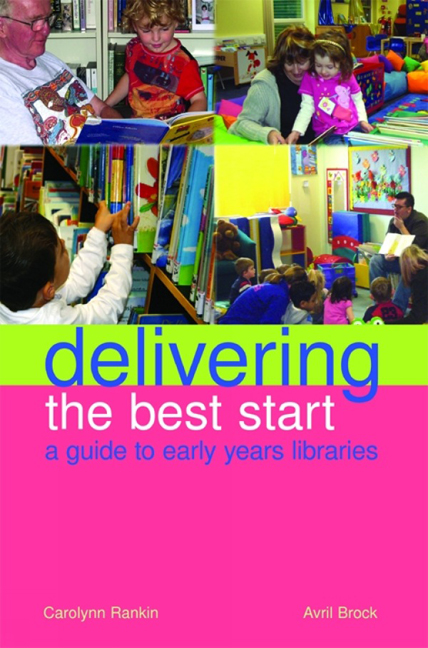
There is no doubt that reading with young children is important, and libraries are uniquely placed to support the development of literacy skills in pre-school children. This book is a pioneering practical guide for library and information professionals involved in strategically planning or delivering services and programmes in early years libraries. Drawing on the authors' research and examples from best practice - what other people have tried and what works well - this book equips practitioners with knowledge and ideas, and will encourage the reader to work with other key professionals in the field. Key areas covered include: the background and context of early years literacy; the role of the early years professional, interdisciplinary team work, and how to involve parents and carers; buildings and space, including planning and designing spaces for the childrens' libraries of the future; managing resources and collection development; planning projects and running literacy sessions; and case studies of successful pre-school library initiatives from around the world. User-friendly and accessible, each chapter is clearly structured and sets outs the background to the topic, the key issues for practitioners, practical ideas and resources for service provision, and recommended further reading. The book also includes checklists and 'how to' practical guidance, useful information on relevant organisations, and links to helpful websites. An essential purchase for all library and information professionals working with young children, this book is also suitable for students of library and information studies, childhood studies, and practitioners undertaking NVQ qualifications. The book is also a useful starting point for those wanting a background in early years literacy.
One of the biggest challenges faced by any organization today is that of managing electronic records, a vital but complex undertaking involving multiple roles within the organization and strategies that are still evolving. Bringing together for the first time the views, experience and expertise of international experts in the records management field in the public and the private sectors, this book covers the theory and practice of managing electronic records as business and information assets. It focuses on the strategies, systems and procedures necessary to ensure that electronic records are appropriately created, captured, organized and retained over time to meet business and legal requirements. In addition to chapters covering principles, research and developments, there are case studies relating to practice and lessons learned. The chapters are written by a fully international line-up of contributors. This book explores issues and addresses solutions, not only for records professionals but also for information, IT and business administration specialists, who, as key stakeholders in managing electronic information, may have taken on crucial roles in managing electronic records in their organization.
This directory is a handy on-volume discovery tool that will allow readers to locate rare book and special collections in the British Isles and has been fully updated since the second edition was published in 1997.
Evidence-based practice is a paradigm that originated within healthcare but is rapidly migrating to other fields. It involves applying the results from rigorous research studies to professional practice in order to improve the quality of services to clients. Familiarity with these methods has caused an increasing number of information professionals to turn a critical eye to their own practice. Is it possible to adapt this model to librarianship and information work? To what extent are its skills and techniques transferable to the various areas of professional practice? Is it desirable for information professionals to integrate research findings into their day-to-day decision-making? These and other related issues are discussed in this book, the first to examine this key topic in depth. It is divided into three parts: The Context for Evidence-based Information Practice; Skills And Resources for Evidence-based Information Practice; and Using the Evidence Base in Practice. This last part explores each of the six domains of evidence-based librarianship identified in research, to demonstrate the application of evidence-based information practice in a practical decision-making context. These chapters with their associated Special Topics present concise summaries of evidence-based information practice within generic areas of work, together with practical examples of the application of evidence-based principles and methods. This book is of wide interest to all new and established information professionals, both those in fields such as healthcare where the evidence-based paradigm is already impacting on their work, and those in other fields encountering it for the first time. It is a core text in departments of library and information work.
Web 2.0 technologies have been seen by many information professionals as critical to the future development of library services. This has led to the use of the term Library 2.0 to denote the kind of service that is envisaged. There has been considerable debate about what Library 2.0 might encompass, but, in the context of information literacy, it can be described as the application of interactive, collaborative, and multimedia technologies to web-based library services and collections. These developments challenge librarians involved in information literacy with more complex and diverse web content, a range of exciting new tools with which to teach, and a steep learning curve to adjust to the constant change of the Web 2.0 world.This edited collection from an international team of experts provides a practically based overview of emerging Library 2.0 tools and technologies for information literacy practitioners; addresses the impact of the adoption of these technologies on information literacy teaching; provides case study exemplars for practitioners to help inform their practice; and examines the implications of Library 2.0 for the training of information literacy professionals.Key topics include: School Library 2. 0 - new skills, new knowledge, new futures; information literacy, Web 2.0 and public libraries; the blog as an assessment tool; using Wikipedia to eavesdrop on the scholarly conversation; information literacy and RSS feeds; library instruction on the go - podcasting; sparking Flickrs of insight into controlled vocabularies and subject searching; joining the YouTube conversation to teach information literacy; going beyond Google; and, teaching information literacy through digital games. This book, which will be continually updated by blog ('Information Literacy Meets Library 2.0'), is essential reading for all library and information practitioners and policy makers with responsibility for developing and delivering information literacy programmes to their users. It will also be of great interest to students of library and information studies.
An authoritative and truly global exploration of current research in digital libraries. Internationally-renowned academics discuss what has been achieved with digital libraries and what we can expect in the future through the prism of research. The increasing number of digital libraries in all sectors and the pressure of ever demanding and diverse user needs has encouraged development of user-centred interfaces, intelligent search and retrieval capabilities, effective metadata description and contents organisation. In addition to the two editors who are renowned for their works in digital library research, this collection brings together established international names in the field such as Elena Maceviciute, Suliman Hawamdeh, Chris Yang, Stefan Gradmann, Michael Fraser, Tom Wilson and Ali Shiri to analyse these developments in relation to users and information access and the future trends and challenges that practitioners will face. Providing an invaluable resource for LIS students, academics and researchers interested in digital libraries and access, it is also a useful introduction to developments for those developing, managing or just starting out with digital libraries.
In today's hectic and challenging world of website management, it is increasingly important for cultural heritage institutions to make the most out of their presence online. No longer is it enough to maintain a single site; nowadays, the environment is fragmented and complex, made up of a multiplicity of social media presences all intermeshed in subtle and potentially confusing ways. One of the best ways of dealing with this environment is to put strategic thinking at the core of the solution. This allows web stakeholders to take control of their web presence in a holistic way and from there begin to shape and grow it in powerful, measurable ways. This timely book provides a complete guide for any institution looking to build or maintain a cultural heritage web presence. Peppered with examples and case studies of current practice from large and small cultural heritage institutions, it advises administrators and website managers on the best strategic approach, as well as offering hints and tips on best practice. The chapters cover: evaluating what you have now; building a strategic approach; content; marketing; policies and guidelines; traffic and metrics; the social web (Web 2.0 ); the website project process; away from the browser; and, bringing it all together. Scattered throughout the text can be found references to an accompanying website to this book. This offers examples, templates and other downloadable information which the reader will be able to adapt for the needs of their individual organization. This essential book offers valuable, readable and above all practical guidance on how to make a cultural heritage web presence work, both for smaller institutions who are running their website on a shoestring and for larger ones who have more extensive resources at their command.
The web is changing from a web of documents to a web of data; from a web that can be read by humans, to one that can be read by machines. These are fascinating advances for anyone interested in the changing nature of the web and the way we access information. The technologies being forged in this new landscape will provide a host of opportunities for library and information professionals to shape the information landscape of the future. This book is a wide-ranging introduction to the emerging web of data and the semantic web, exploring technologies including APIs, microformats and linked data. Its topical commentary and practical examples drawn from the international LIS community explore how information professionals can harness the power of this new phenomenon to inform strategy and become facilitators of access to data. Key topics covered include: open data: a semantic web - one that's meaningful to computers data silos; the semantic web- the RDF vision embedded semantics; and, the library and the web of data the future of the librarian and the web of data. This is essential reading for library and information professionals and for LIS students and researchers. It will also be of value to information architects, web developers and all those interested in making sure that people have access to the information they need.
Libraries today are faced with rapidly shifting populations of users with differing needs, who require a range of new communications links that are transforming our concept of the library space. This developing role has created a set of new and complex challenges for those delivering library services. There is no such thing as the 'perfect' library building. However, a well designed building will enable a project both to gain local acceptance more easily and to ease the process of securing planning permission. It also needs to be cost effective to run, support the organization's objectives well, offer an improved service to the user and make an impact on the community. This much needed book takes as its starting point the fact that few architects know very much about libraries, and fewer librarians know about architectural planning and design. It steers a clear path for library managers through the language and processes that they need to understand as members of a team overseeing the planning of a new library building project, major refurbishment or remodelling of an existing library. Key topics of this title include: twenty-first century libraries; developing a business case; project management; the design/project team; selecting an architect; partnership and community engagement; the design brief; design quality; space planning and access; occupancy and post-occupancy evaluation; and, building libraries for the future. Appendices offer top tips and checklists, together with a glossary of common terms used within the construction environment to help further de-mystify the design process for librarians. This practical and accessible book is an invaluable guide not only for new entrants to the library profession, but also for experienced practitioners who are approaching for the first time the important task of creating a new library or major refurbishment of existing facilities. It will also be of great relevance to architects unfamiliar with library building requirements.
In all organizations, the value and volume of unstructured information is significantly greater than that of structured data. Organizations rely on folder structures and information architecture to locate information on shared drives and intranets, but become overwhelmed by the amount of new content. They need better search solutions to provide rapid and accurate access to the increasing mass of information from internal servers and external information services, and to meet compliance and governance requirements such as Freedom of Information legislation. The array of web and enterprise search engines now becoming available meets this need. This unique book is designed to help organizations to understand, specify and implement desktop, website, intranet and enterprise search applications. The technology of search is presented in a non-technical way to enable you to understand the benefits and issues of each type of search solution, from the traditional high-end range to the newer plug-and-play solutions. Fully supported by references to web resources and other further reading, the book covers: how search works; the search business; making a business case for search; specifying and selecting a search engine; optimizing search performance; search usability; desktop search; implementing web search; implementing search for an intranet; enterprise search; multilingual search; and future directions for search. An appendix offers profiles of 40 search software vendors worldwide. Whether you are an enterprise knowledge manager, information professional, website owner, e-commerce director, or anyone responsible for implementing your organization's internal search strategy, this book will give you crucial guidance to be found nowhere else. It also provides essential awareness of the issues for all those on information science courses around the world.
First published in 1959, "Walford's Guide to Reference Material" achieved international recognition as a leading bibliographic tool across all subject areas. "The New Walford (TNW) Volume 1: Science, Technology and Medicine" is the first volume of a radically different guide. Published in a three-volume cycle, "TNW" points you to an expertly chosen selection of key, quality resources - accessible via the web and in print - in each subject field (unlike leading search engines). "TNW" has a much simpler subject classification than its predecessor, with resources within the 12 groupings divided between about 100 distinct and generally recognizable subject fields, and then allocated to one of just 13 standard resource categories. The classification is supplemented by a detailed topic index, and each subject grouping has a short introductory essay, highlighting the distinctive features of its reference resources. Each resource is given a succinct description, leading the busy user straight to its key features. This new reference book is valuable for information professionals worldwide who need to suggest resources to people who are relatively unfamiliar with the nuances of a topic and who are asking, 'Where should I start?' The focus is on resources that are most likely to be found and used within public, government, education or business information services. It is also intended for LIS professionals responsible for developing and revising a reference collection, research workers and students. "TNW": is the paper portal to the world of reference resources.
All librarians and libraries have information policies, and so do most people. The big issues, like censorship or intellectual property ownership and use, crowd our minds but the process of decision making is the same at every level and in every context, whether we are concerned with government secrets, advertising standards, or our children's reading and viewing habits. This book examines the issues from varying standpoints, including the human rights approach, the commercial approach, and the states-interest approach. These are all placed within the context of arguments about the public sphere. The working librarian has to be in a position to justify every stock purchase and information access decision, and in the strategies they follow to legitimate the library. The form and construction of arguments and the discussion of issues in this book will give librarians the context and arguments they need to identify and apply appropriate information policies and strategies. Key areas addressed in the book include: the information policy problem; policy sectors; information regimes; and, policies and strategies: models and cases. This book is essential reading for library students, researchers and policy makers as well as for all LIS practitioners wishing to widen their awareness of the important issues surrounding information policy.
Designed for the digital world and an expanding universe of metadata users, RDA: Resource Description and Access is the new, unified cataloguing standard. Benefits of RDA include: a structure based on the conceptual models of FRBR (functional requirements for bibliographic data) and FRAD (functional requirements for authority data) to help catalogue users find the information they need more easily; a flexible framework for content description of digital resources that also serves the needs of libraries organizing traditional resources; a better fit with emerging technologies, enabling institutions to introduce efficiencies in data capture and storage retrieval. The online RDA Toolkit (www.rdatoolkit.org) provides a one-stop resource for evaluating and implementing RDA, and is the most effective way to interact with the new standard. It includes searchable and browseable RDA instructions; two views of RDA content, by table of contents and by element set; user-created and sharable Workflows and Mappings—tools to customize RDA to support your organization's training, internal processes, and local policies; Library of Congress Policy Statements (LCPS) and links to other relevant cataloguing resources; and the full text of AACR2 with links to RDA. This full-text print version of RDA offers a snapshot that serves as an offline access point to help solo and part-time cataloguers evaluate RDA, as well as to support training and classroom use in any size institution. An index is included. The online RDA Toolkit includes PDFs, but purchasing the print version offers a convenient, time-saving option. Keep up with our update schedule. A new print accumulation of RDA will be issued once all of the reworded chapters are complete (expectd September 2013). All changes made to RDA up to and including the 2013 RDA Update will be included. Annual print updates are expected to this accumulation beginning in mid 2014 and every year thereafter.
Rarely does the organization have more than one intranet manager, and intranet management is often only one of their many responsibilities. There are very few intranet conferences around the world, and only recently have intranet communities of practice been established in Europe. Universities and colleges do not offer courses in intranet management, and there is little in the way of continuous professional development support. It is also very difficult to obtain access to intranets in other organizations. Despite the widespread implementation of intranets over the last few years there is virtually no professional literature available on intranet management to which to turn for ideas and examples of good practice. This book fills that gap, offering a wealth of practical advice on intranet management, based on the work of the author as an intranet consultant over the past fifteen years. It includes areas such as: managing intranets - opportunities and challenges; defining user requirements; making a business case; developing a content strategy; enhancing collaboration; managing technology; specifying and selecting software; using Microsoft SharePoint for intranets; operational planning; establishing the intranet team; managing intranet projects; evaluating risks; enhancing the user experience; marketing the intranet; measuring user satisfaction; creating the governance framework; writing an intranet strategy; and, intranets and information management. An appendix offers guidelines for social media use. At the end of each chapter there is a short list of websites and other resources that provide additional commentary and insight on the topics that have been covered. These resources can also be found at our associated website, where new and revised resources will also be listed. This book offers invaluable guidance to all information professionals involved in the development of an intranet for their organization, and will also be of great interest to a wide range of managers with responsibility for internal communications, personal management, risk management, information management and information technology.
Imagine a records management (RM) future where the user community collectively describes the value and properties of a record using the wisdom of the crowd; where records retention, description and purpose are determined by their users, within general boundaries defined by the records manager. It may sound far-fetched, but could represent a way forward for managing records. It has never been more apparent that RM as traditionally practised will soon no longer be fit for purpose. With the increasing plurality of information sources and systems within an organization, as the deluge of content increases, so the percentage of the organization's holdings that can be formally classed as records declines. In the Web 2.0 world new technology is continually changing the way users create and use information. RM must change its approach fundamentally if it is to have a role to play in this new world.This provocative new book challenges records managers to find time amidst the daily operational pressures to debate the larger issues thrown up by the new technological paradigm we are now entering, and the threat it poses to established theory and practice. A range of stimulating ideas are put up for discussion: why not, for instance, embrace folksonomies rather than classification schemes and metadata schemas as the main means of resource discovery for unstructured data? Adopt a ranking system that encourages users to rate how useful they found content as part of the appraisal process? Let the content creator decide whether there should be any access restrictions on the content they have created? This is a thought-provoking book which questions received wisdom and suggests radical new solutions to the very real issues RM faces. Every records manager needs to read this challenging book, and those that do may never think about their profession in quite the same way again.