To save content items to your account,
please confirm that you agree to abide by our usage policies.
If this is the first time you use this feature, you will be asked to authorise Cambridge Core to connect with your account.
Find out more about saving content to .
To save content items to your Kindle, first ensure no-reply@cambridge.org
is added to your Approved Personal Document E-mail List under your Personal Document Settings
on the Manage Your Content and Devices page of your Amazon account. Then enter the ‘name’ part
of your Kindle email address below.
Find out more about saving to your Kindle.
Note you can select to save to either the @free.kindle.com or @kindle.com variations.
‘@free.kindle.com’ emails are free but can only be saved to your device when it is connected to wi-fi.
‘@kindle.com’ emails can be delivered even when you are not connected to wi-fi, but note that service fees apply.
This book celebrates and acknowledges the contribution Professor Peter Brophy has made over a career spanning 37 years to the field of library and information studies. Whilst reflecting on his work, it is forward looking and challenging, and offers strategies for the future direction of library and information services in the virtual era. Following an introduction and tribute to Peter on his retirement, the text is contributed by an international team of acknowledged leaders in their fields, and focuses on four key themes that have preoccupied Peter during his career and that remain of pre-eminent importance for the future of the profession: libraries, learning and distance learning; widening access to information; changing directions of information delivery; and, performance, quality and leadership. The book concludes with a comprehensive bibliography of Peter's work. This timely book addresses issues and concerns transferable across different areas of the information sector, including academic, public and special libraries, and will be stimulating reading for anyone working, studying, or teaching within the profession.
The role of the librarian increasingly involves delivering information literacy using a range of teaching methods, from delivering induction sessions to informal one-to-one support on a day-to-day basis. Although this is increasingly recognized, many practitioners do not have teaching qualifications and are often left to fulfil a role for which they feel ill-equipped. Even when they do have teaching qualifications, these are often gained from mainstream courses that do not always adequately address the delivery of information literacy. This book is a much-needed sourcebook to support library staff in the delivery of information literacy teaching, by providing practical guidance on tried and tested ideas and techniques for sessions. Full of hints and tips grounded in learning theory, it is a practical reference tool designed to be dipped into as needed when planning teaching and training. Where applicable the activities are mapped to models of information literacy, with guidance on adapting ideas for different levels and contexts. Advice is given on activities in the following areas such as: designing sessions; preparing sessions; delivering sessions; different types of sessions; teaching by topic; creating teaching / support materials; assessing learning; evaluating teaching sessions; and, e-learning. This easy-to-use book is an invaluable source of inspiration for any librarian involved in teaching information literacy, whether they are new to teaching or experienced but in search of fresh ideas.
Despite the fact that e-books have been in existence for decades in various guises and added to library collections for several years now, there has been a noticeable lack of published manuals on the subject. This is doubtless owing to the rapidly evolving nature of the market. There is now a plethora of different types of digital object that may be termed 'e-books' and a bewildering number of business and access models to match. Moreover the pace of change shows no sign of abating, but there is an increasing amount of popular interest in e-books, and what is needed is practical information to assist library and information professionals managing collections of e-books and doing their best to inform their users right now. This timely book, the first of its kind to provide a practical appraisal of e-books, aims to fill that need by addressing the key questions: Where do e-books come from and what are the key business models that support them? What needs to change before e-books become universally and easily used? What will the e-book landscape look like in ten years' time? How can you be sure you are building a good collection that your users can access easily? And what about money and budgets? This book is divided into five parts: the production and distribution of e-books; planning and developing an e-book collection; delivering e-books to library readers; engaging readers with e-books; and, the future of e-books. This book is a ready reference source for any library and information professional with an interest in e-books and their development. It is essential background reading for library managers wishing to develop an e-book collection from scratch or for those responsible for maintaining an existing e-book collection. It will also have plenty to interest publishers, who need to be aware of the issues faced by libraries managing e-book collections, and will be of great value to students of librarianship and information studies, and those on publishing related courses.
Concern about children's reading is an international issue highlighted by continuing OECD research. Government actions such as the priority given to reading in the review of the National Curriculum reflect current UK concern. Reading is an essential life skill not only for an individual's development and life chances but for social cohesion and a developed democracy. In an era of public spending cuts it is important to reflect upon the impact that libraries can have in growing readers for the future. This much-needed book provides valuable evidence of successes so far both nationally and internationally, and offers ideas for future development as well as inspiration for current practice. An edited collection contributed by expert practitioners, it covers all aspects of promoting reading to and with children and young people from birth right through to teenage years, including the following key topics: it's never too soon to start - the importance of Bookstart; how children begin to read; creating young readers - teachers and librarians at work; literacy, libraries and literature in New Zealand; the Summer Challenge in libraries - a continuing success; Stockport does Book Idol - a case study linking libraries and schools to inspire reading for pleasure; there and back again - restoring reading to the classroom; promoting excellence - shadowing the CILIP Carnegie and Kate Greenaway medals; choice and motivation - local book awards; the sport of reading - the international Kids' Lit Quiz; adventure in the book trade - libraries and partnerships; the hard to reach reader in the 21st century; and, creative reading and insideadog.com.au. Offering future scoping for managers and aiming to inspire partnership and cooperation, this will be invaluable reading for practitioners and students of librarianship in both the public and school sectors. It will also be of great interest to all teachers, consultants and educators concerned with literacy and reading, and to policy makers in both the school and library sectors.
This is the definitive handbook for all new information professionals wanting to thrive in their careers. Drawing together the experiences and advice of rising stars in the information world it provides a comprehensive and dynamic resource which will help you to understand and tackle every challenge you encounter in the information world. Each chapter will interweave expert and cutting-edge narrative introducing the topic with international case studies from all sectors examining personal experiences and how these have shaped their roles. Advice, practical exercises and activities will guide the reader in their own professional development. Some of the topics covered include: utilizing technologies and social media; engaging stakeholders and promoting library services and the information role; user analysis, metrics, quantitative measures and SWOT analysis; generating funding and how to do more with less; getting involved in digital preservation; managing people and communication skills; up-skilling and professional development; and, networking, promoting yourself and staying up to date. This is essential reading for all new professionals in academic, public and special libraries, archives and records management and those who want to further develop their career. It's also an invaluable guide for students of these disciplines hoping to get to grips with the profession.
Many organizations are moving away from managing records and information in paper form to setting up electronic records management (ERM) systems. There is a range of reasons for this: economic considerations may be the driver for change, or government policy initiatives may be coming into play. Whatever the whyfor in your organization, this book provides straightforward, practical guidance on how to prepare for and enable ERM. It sets out and explains the issues organizations need to consider in selecting a system, and the procedures required for effective implementation. Help is also given with the complexities of managing hybrid records during an interim period between paper and electronic record management. The book is divided into three main parts covering the preparation for ERM, and its design and implementation. The key areas covered are: the underlying principles; the context; making a business case for ERM; the main issues for design; the information survey; the file plan; appraisal methodology; preservation; access; the main issues for implementation; project management; procurement; change management; training; the future of information management. This essential guide should be on the desk of any library and information professional, records manager, archivist or knowledge manager involved in planning and introducing an ERM system, whether in a public or private sector organization.
This textbook provides an overview of the digital information landscape and explains the implications of the technological changes for the information industry, from publishers and broadcasters to the information professionals who manage information in all its forms. This fully-updated second edition includes examples of organizations and individuals who are seizing on the opportunities thrown up by this once-in-a-generation technological shift providing a cutting-edge guide to where we are going both as information consumers and in terms of broader societal changes. One of the key themes of the book is the way that organizations, public and commercial, are blurring their traditional lines of responsibility. Amazon is moving from simply selling books to offering the hardware and software for reading them. Apple still makes computer hardware but also manages one of the world’s leading marketplaces for music and software applications. Google maintains its position as the most popular internet search engine but has also digitized millions of copies of books from leading academic libraries and backed the development of the world’s most popular computing platform, Android. At the heart of these changes are the emergence of cheap computing devices for decoding and presenting digital information and a network which allows the bits and bytes to flow freely, for the moment at least, from producer to consumer.
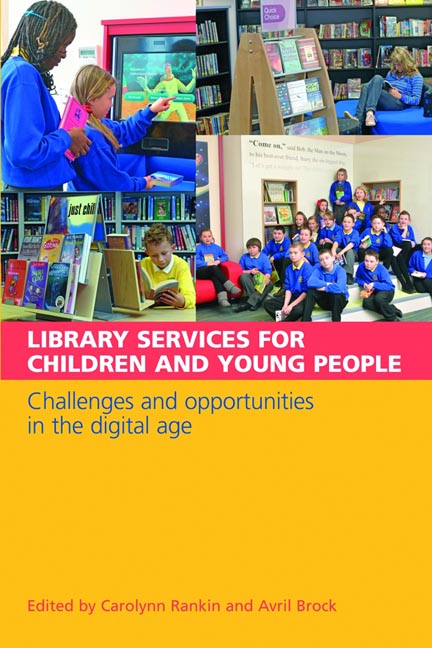
This book provides a sound background to all aspects of library provision for 6 - 18 year olds. It is designed to support the strategic planning and delivery of library services and programmes at a local community level or in schools. The book outlines a vision for children's library services in the next decade and carves out a strategy for engaging with the challenges and opportunities for children's librarians and policy makers in the Google environment. This book aims to be an accessible, informative and inspiring text offering practitioners the knowledge, ideas and confidence to work in partnership with other key professionals in delivering services and programmes. It provides an evidence base, which promotes and encourages the development of effective library services for children and young people. The case studies, scenarios and vignettes, drawn from UK and international sources, show that the key issues have an international dimension, and the similarities and differences in service provision will be of interest to many. In addition to the two editors, chapters are contributed by a range of internationally known practitioners and academics, offering a wide perspective. Case studies at the end of each section complement themes and practices from previous chapters while rooting the discussion in a specific context. This book is essential reading for all senior library practitioners, children's librarians and school librarians, subject co-ordinators, and managers in schools. It will also be of value for all postgraduate students on CILIP accredited library and information management courses.
Measuring the performance of a library's services is a crucial part of good library management, since without a firm grasp of what is actually being achieved it is impossible to move forward to improved service. The key measure is no longer size and quality of bookstock, but the impact of staff effort and resources on the population the library is intended to serve. Analysing this enables evidence of benefits to be presented, providing the ultimate justification for the service's existence. This important book is the first to provide an accessible account of current thinking and research on the evaluation of library services, both traditional and - importantly - electronic. Illustrated throughout with a range of internationally based examples across the different library sectors, it is structured to focus primarily on the intended service user (outcome and impact perspectives), then to look at service management (output and process issues) and the building blocks of services (inputs), and finally to draw together these strands by examining some of the broader frameworks for evaluation that have emerged. Each chapter features a list of key resources, and the extensive appendices offer practical guidance on data collection methods, the analysis of data and the presentation of results. The key areas addressed include: background and theoretical considerations; user satisfaction and impact on users; social and economic impact; inputs, processes and outputs; staff and infrastructure; services for all; and, standards, benchmarking and the balanced scorecard. The emphasis on both principles and techniques in this book means that it is perfect reading for busy LIS practitioners but it is also eminently suitable for LIS students and researchers trying to get to grips with this complex area.
Distributed learning is now in the mainstream of educational practice. Learning is routinely delivered to citizens in their locality, at home or at work as well as in more formal settings in educational institutions. Supporting such endeavours, professional librarians have moved from the theoretical 'library without walls' of little more than a decade ago to widespread implementation across the world. Information and communications technologies (ICTs) are now almost universally exploited by libraries to deliver their services, utilizing the world wide web as the medium of choice, so that more and more users are accessing services remotely. As a result libraries have broken down the barriers of physical location and take for granted that their services will be delivered to their clients wherever they may be. Ever more sophisticated applications are being launched to meet escalating demand from users. This edited collection is drawn from the fifth Libraries Without Walls Conference, held in 2003, which addressed the key strategic issues arising from international, regional and cross-sectoral approaches to the provision of library services to distant users. It is recognized as the premier resource for all needing to keep updated on distance learner and virtual library issues.
Education and training have been transformed in the 21st century as a result of changing patterns of work and culture, and learners increasingly expect technology-rich and flexible learning opportunities. Nowadays, learning takes place in a wide range of physical spaces, for example in educational or training organizations, in the workplace or at home, as well as in both public and private virtual spaces. Information professionals currently face the challenge of providing end-user education and staff training to very large and diverse groups, whilst integrating the use of ICT into their teaching. But there seems to be a tendency within the LIS literature to focus solely on the methodologies of face-to-face learning or of e-learning, and this is a lost opportunity.This book offers a holistic blended learning approach, combining the best of traditional and new approaches to learning and teaching to make best use of the advantages of each while minimizing the disadvantages. It provides information professionals with a practical guide to the design and delivery of such training programmes, illustrated with a broad range of library-based examples, checklists and case studies.This book covers key areas which include: tools and technologies in the classroom - virtual communication tools, social-networking software, e-learning systems, m-learning, and models of teaching and learning; planning and designing blended learning programmes; using individual and group learning activities; working as an e-tutor; developing online communities of interest and practice; and, managing blended learning projects - working in collaborative and multi-professional teams. This unique book will be of great value to any information professionals, whatever their previous level of experience, involved in establishing and delivering training and learning programmes and end-user education. It will also benefit staff developers in schools, colleges and higher education; library and information students; independent consultants and trainers; and, information suppliers such as database providers.
This established text is the only introduction to qualitative research methodologies in the field of library and information management. Its extensive coverage encompasses all aspects of qualitative research work from conception to completion, and all types of study in a variety of settings from multi-site projects to data organization. The book features many case studies and examples, and offers a comprehensive manual of practice designed for LIS professionals. This new edition has been thoroughly revised and includes three new chapters. It has been updated to take account of the substantial growth in the amount and quality of web-based information relevant to qualitative research methods and practice, and the many developments in software applications and resources. The authors have identified a clear need for a new chapter on the evaluation of existing research, as a gateway into new research for information professionals. The final chapter, 'Human Resources In Knowledge Management', takes the form of a model case study, and is an 'ideal' qualitative investigation in an information setting. It exemplifies many of the approaches to qualitative research discussed in earlier chapters. Directed primarily at the beginner researcher, this book also offers a practical refresher in this important area for the more experienced researcher. It is a useful tool for all practitioners and researchers in information organizations, whether libraries, archives, knowledge management centres, record management centres, or any other type of information service provider.
This practical guide offers innovative tips and reliable best practice to enable new and experienced library and information professionals to evaluate their current provision and develop their service to meet the evolving needs of the research community. Interacting effectively with information is at the heart of all research, consequently information professionals have a key role to play in facilitating the development of researchers who are able to operate confidently and successfully in the information world. Grounded in current theory and informed by practitioners from around the world, this practical book offers a wide range of ideas and methods to assist library and information professionals in developing and managing their role in the research environment.
The handbook examines methods of innovative librarianship in academic and art school libraries. Serving as a field guide to academic art libraries in the twenty-first century, it integrates theory and practice as demonstrated by creative professionals working in the field of art librarianship. While much attention has been paid to art librarianship as it exists in museum settings, the focus on academic art and design school information services has not been as intensive. This essential handbook addresses that gap in the professional literature and examines methods of innovative librarianship in academic and art school libraries. The book offers guidelines for information professionals working in art and design environments who support and anticipate the information needs of artists, designers, architects, and the historians who study those disciplines.
There are huge challenges facing the library and information science profession owing to the rapidly changing environment in which it exists. Librarians need to be 'blended professionals' who can take all their professional skills and experience, and adapt them to different business models, strategic challenges and communities of practice. This topical edited collection will stimulate strategic and innovative thinking and question the status quo. It will be a 'must read' for leaders and future leaders of the profession, who will be challenged to align library services with the changing demands of the academic community and the work environment. Edited by a thought leader with an international reputation, it will bring together renowned authors from across the globe who are breaking traditional moulds and boundaries in a way that will have a profound impact on the way libraries and library services are conceptualized in the years to come. They represent the key links in the knowledge chain: authors, publishers, academics, community knowledge creators, librarians and institutions; the student perspective will also be provided. The five most compelling messages the book will contain are: engage in and support eLearning; be involved in institutional knowledge and information management strategies; support students and academic staff in the virtual learning space as well as in the library and on the web; be prepared to acquire, manage and make accessible information that is not traditionally the province of the library; and, new paradigms for services, and funding for services, will be necessary. This book is essential reading for all library managers and educators who wish to add real value to their organization by thinking strategically and informing decision making at organizational level. It will also be of great value to academic administrators and government policy analysts involved with learning and teaching.
Most libraries, archives and museums are confronting the challenges of providing digital access to their collections. This guide offers guidance covering the end-to-end process of digitizing collections, from selecting records for digitization to choosing suppliers and equipment and dealing with documents that present individual problems.
Working together is a particular strength of information professionals, in all sectors. In the area of health information in particular, the potential for using the Internet for collaborative working is immense. Since it was first formally described in 2004, what is currently known as Web 2.0 has affected every library and information sector. Web 2.0 has tremendous potential to transform health information delivery still further. Although there have been many individual articles examining Web 2.0 applications and methods of working, and there are many individual examples of best practice, substantive works that synthesise this experience in one volume are rare. This new book is designed to meet this need, by drawing together international case studies and reflections on using Web 2.0. Topics covered include: RSS to social networking, information literacy to supporting clinical care, and more. The book blends practical insights, theory and reflective approaches to offer a cohesive overview of how Web 2.0 is already changing health and medical information work. Main strands include: Enhancing medical, nursing and health education; Information literacy in a health information environment; Supporting research; Supporting clinical care; Developing a service presence using Web 2.0; and, Using social networking to develop an outreach service. Although the focus of the book is health information, it would be relevant to anyone who would like to gain an insight into this innovative and cost-effective method of delivering and sharing information. It is equally relevant for those new to Web 2.0, or those with more experience wishing to gain further insight into its application.
Are we at a turning point in digital information? The expansion of the internet was unprecedented; search engines dealt with it in the only way possible - scan as much as they could and throw it all into an inverted index. But now search engines are beginning to experiment with deep web searching and attention to taxonomies, and the semantic web is demonstrating how much more can be done with a computer if you give it knowledge. What does this mean for the skills and focus of the information science (or sciences) community? Should information designers and information managers work more closely to create computer based information systems for more effective retrieval? Will information science become part of computer science and does the rise of the term informatics demonstrate the convergence of information science and information technology - a convergence that must surely develop in the years to come? Issues and questions such as these are reflected in this monograph, a collection of essays written by some of the most pre-eminent contributors to the discipline. These peer reviewed perspectives capture insights into advances in, and facets of, information science, a profession in transition. With an introduction from Jack Meadows the key papers are: Meeting the challenge, by Brian Vickery; The developing foundations of information science, by David Bawden; The last 50 years of knowledge organization, by Stella G Dextre Clarke; On the history of evaluation in IR, by Stephen Robertson; The information user, by Tom Wilson A; The sociological turn in information science, by Blaise Cronin; From chemical documentation to chemoinformatics, by Peter Willett; Health informatics, by Peter A Bath; Social informatics and sociotechnical research, by Elisabeth Davenport; The evolution of visual information retrieval, by Peter Enser; Information policies, by Elizabeth Orna; Disparity in professional qualifications and progress in information handling, by Barry Mahon; Electronic scholarly publishing and open access, by Charles Oppenheim; Social software: fun and games, or business tools? by Wendy A Warr; and, Bibliometrics to webometrics, by Mike Thelwall. This monograph previously appeared as a special issue of the "Journal of Information Science", published by Sage. Reproduced here as a monograph, this important collection of perspectives on a skill set in transition from a prestigious line-up of authors will now be available to information studies students worldwide and to all those working in the information science field.
'Collections management' is a relatively new term in the museums and cultural heritage sector, and yet it is fundamental to what museums do and why they exist. The term is sometimes synonymous with database systems for collections information, but in its wider sense, it encompasses all the core activities of collecting, displaying and providing access to museum objects. Caring for collections today requires a wide knowledge of legal and ethical considerations, such as due diligence and immunity from seizure, and of recent developments in the areas of sustainability, security and economics. This timely book addresses the key principles and strategies for looking after culturally significant objects and their associated information as well as the relevant laws and codes of ethics. It then moves on to the practical processes involved, such as classification, contracts and loans. As such, it is a landmark publication and the first comprehensive and practical guide to collections management. Key chapters include: legal and ethical issues; basic practice; documentation; movement and storage; acquisitions and loans; exhibitions and displays; and, access. Procedures are based on international museum practice and presented in a simple step-by-step process that will act as a guide for any transaction. This is backed up by examples of real policies and documents drawn from major museums, together with suggestions for additional resources. This essential guide covers everything a collections manager needs to know, whatever the size and type of collection, and will be of immense value to everyone in the cultural heritage sector, including museum professionals, curators of private collections, museum studies students and anyone responsible for caring for items of cultural significance.
CILIP: the Chartered Institute of Library and Information Professionals represents the largest professional body of librarians and information professionals in the UK. Its purpose and ambition is to promote and support the people who work to deliver a vision of a fair and economically prosperous society underpinned by literacy, access to information and the transfer of knowledge.It is the leading voice for information, library and knowledge practitioners, working to advocate strongly, provide unity through shared values and develop skills and excellence.