To save content items to your account,
please confirm that you agree to abide by our usage policies.
If this is the first time you use this feature, you will be asked to authorise Cambridge Core to connect with your account.
Find out more about saving content to .
To save content items to your Kindle, first ensure no-reply@cambridge.org
is added to your Approved Personal Document E-mail List under your Personal Document Settings
on the Manage Your Content and Devices page of your Amazon account. Then enter the ‘name’ part
of your Kindle email address below.
Find out more about saving to your Kindle.
Note you can select to save to either the @free.kindle.com or @kindle.com variations.
‘@free.kindle.com’ emails are free but can only be saved to your device when it is connected to wi-fi.
‘@kindle.com’ emails can be delivered even when you are not connected to wi-fi, but note that service fees apply.
The origins, evolution and impact of the Australia New Zealand Closer Economic Relations Trade Agreement are examined in this book. ANZCERTA is often referred to as a benchmark for trade agreements. Not only does the book examine the agreement and how it evolved, but it also provides lessons for others, particularly in ASEAN, as they work on regional on bilateral economic relations. The special features of the Agreement are identified, and its evolution is charted. Current debates are reviewed, and assessments of its impact are discussed. Ten lessons for the designers of other agreements are presented.
The book looks at how religion in Singapore is being subjected to the processes of modernisation and change. The Singapore State has consciously brought religion under its guidance. It has exercised strong bureaucratic and legal control over the functioning of all religions in Singapore. The Chinese community and the Buddhist Sangha have responded to this by restructuring their temple institutions into large multi-functional temple complexes. There has been quite a few books written on the role of the Singapore State but, so far, none has been written on the topic - the relationship between state, society and religion. It will help to fill the missing gap in the scholarly literature on this area. This is also a topic of great significance in many Asian, particularly Southeast Asian, countries and it will serve as an important book for future reference in this area of research and comparative studies.
From 2001 to 2006, Prime Minister Thaksin Shinawatra transformed Thailand's international role from one of obscurity into a kind of regional hegemon. Thaksin's diplomatic ambitions were reflected in his myriad of grandiose foreign policy initiatives, designed to locate Thailand at the forefront of regional politics and reinstall the Thai sphere of influence over weaker neighbouring states. He abolished the traditional bending-with-the-wind foreign policy, revamped the Thai Foreign Ministry, and empowered Thai envoys through the CEO Ambassadors programme. But in this process, Thaksin was accused of exploiting foreign policy to enrich his business empire. Thaksin's reinvention of Thailand as an up-and-coming regional power was therefore tainted by conflicts of interest and the absence of ethical principles in the country's foreign policy.
There is growing international evidence that the effectiveness of health services stems primarily from the extent to which the incentives facing providers and consumers are aligned with "better health" objectives. Efficiency in health service provision requires that providers and consumers have incentives to use healthcare resources in ways that generate the maximum health gains. Equity in at least one sense requires that consumers requiring the same care are treated equally, irrespective of their ability to pay. Efficiency in the use of health services requires that consumers are knowledgeable about the services on offer and which are most appropriate to their needs. Although these principles are enshrined in the design of every health system in the world, they have proven extremely difficult to apply in practice. Healthcare providers have financial obligations to their families as well as professional obligations to their patients. Health service consumers generally lack information about both their health and health services so that they under-consume or over-consume healthcare. The papers in this volume are selected from an international conference organized by the CDRI, Cambodia that tried to deal with some of these issues. With participation of international and local experts, it aimed at collecting major experiences and innovative solutions from inside and outside the country to improve health sector performance, with particular focus on institutions, motivations and incentives.
This book addresses the rise of China and its impact on Southeast Asia's economies and businesses, especially on those of ethnic Chinese. It also discusses Southeast Asian government policies, particularly their economic and business policies, towards local Chinese, and Southeast Asian Chinese businesses, both conglomerates and SMEs, in an era of globalization. Leading experts from the Southeast Asian region were invited to write the papers, presenting the most up-to-date analyses on the subject.
The ending of the Cold War opened a new debate across the Pacific about the meaning of security and the new regional multilateral institutions that were beginning to emerge.The first edition of the The Asia-Pacific Security Lexicon, published in 2002, identified and defined the key concepts and ideas central to security discourse in the region.This second edition updates all of the entries and examines the origins and meanings of some of the new terms in common usage in a different historical setting, among them "terrorism", "pre-emption", "preventive war", "a la carte multilateralism", "coalition of the willing" and China's "peaceful rise". And it looks at how concepts such as "human security" and "non-traditional security" have evolved and found new adherents.Both a diplomatic handbook and theoretical exploration, the Lexicon is based on the analysis of more than 3,000 books, articles, conference reports, and speeches. It does not aim to resolve the disagreements about how words are used. Rather, it makes their evolution clearer for academics and practitioners seeking consensual knowledge.
An increasing number of women's groups are working independently in Thailand to promote women's rights. The aim of this study is to document the strategies adopted by a selection of these groups, and the programs that they are implementing in Thailand, in order to understand how cultural specificity (of mobility and education) guides their participation, and how gender relations are formed and transformed. While attempting to synthesize the disparate data collected on Thai women and their organizations, the authors have tried to evolve an analytical framework to study the meaning and significance of women's lives and efforts.
"Sustainability science addresses the central challenge facing global society of how to reduce poverty and meet demands of a large human population desiring a good life while simultaneously maintaining the environment that provides the life support system on which long-term prosperity depends. This book provides evidence and insight into key elements of what is required to achieve sustainability by framing important policy questions and illustrating the consequences of policy alternatives in systems with complex interactions." – Stephen Polasky, University of Minnesota"Sustainability Science can be both fundamental and practical, both deep and interdisciplinary. This application of Sustainability Science to Pacific watersheds illustrates its promise." – Peter Vitousek, Stanford University
Launched in 1992, Regional Outlook is an annual publication of the Institute of Southeast Asian Studies, published every January. Designed for the busy executive, professional, diplomat, journalist or interested observer, Regional Outlook provides a succinct analysis of current political and economic trends shaping the region, and the outlook for the forthcoming two years. This forward-looking book contains focused political commentaries and economic forecasts on all ten countries in Southeast Asia, as well as a select number of topical pieces of significance to the region.
Southeast Asian Affairs, of which there are now thirty in the series, is an annual review of significant developments and trends in the region. Though the emphasis is on ASEAN countries, developments in the broader Asia-Pacific region are not ignored. Readable and easily understood analyses are offered of major political, economic, social, and strategic developments within Southeast Asia.The contributions can be divided into two broad categories. There are those which provide an analysis of major developments during 2002 in individual Southeast Asian countries and in the region generally. Then there are the theme articles of a more specialised nature which deal with topical problems of concern.The volume contains twenty articles dealing with such major themes as international conflict and co-operation, political stability, and economic growth and development.
"Indonesia is one of the few countries that came through the global economic crisis in 2008-09 with positive economic growth. Despite some recorded positive domestic economic performances, Indonesia faces new challenges as its economy keeps growing and the global economy remains uncertain. A new economic development paradigm is needed to overcome old problems (poverty and unemployment, inadequate infrastructure, corruption, a complex regulatory environment, and unequal resource distribution among regions) with global market opportunities. This book provides a new perspective on how Indonesians economic policies should be developed by considering its past and future challenges."- Firmanzah, Professor of Economics and Dean of Faculty of Economics, University of Indonesia
Launched in 1992, Regional Outlook is an annual publication of the Institute of Southeast Asian Studies, published every January. Designed for the busy executive, professional, diplomat, journalist, or interested observer, Regional Outlook aims to provide a succinct analysis of current political and economic trends shaping the region, and the outlook for the forthcoming two years. This forward-looking book contains focused political commentaries and economic forecasts on all ten countries in Southeast Asia, as well as a select number of topical pieces of significance to the region.
A burgeoning Japanese role in the Asia-Pacific region has been one of the most contentious issues to the Southeast Asian countries in recent years with its positive and negative implications. It is thus timely and significant to come to terms with Japan's "design" in the region from a historical perspective. Attributing Japan's active involvement in Southeast Asian affairs to the proclamation of the so-called Fukuda Doctrine of August 1977, this study traces the origins of Japan's political role in the region and analyses the development and effects of the very first Japanese foreign policy doctrine. As perhaps the most exclusive scrutiny on the Fukuda Doctrine as well as on Japan-ASEAN relations, this study renders a comprehensive history of Japan-Southeast Asia relations in the post-war period.
In conveying his condolences to VR Nathan's wife, Prime Minister Lee Hsien Loong said that "as chairman of Hindu Endowments Board, VR Nathan had served the Indian community with distinction and unwavering commitment". Lee also said that VR "had done much for inter-religious harmony in Singapore". Soon after, Zainul Abidin Rasheed, then Senior Minister of State for Foreign Affairs, said in Parliament that he was "very amazed" when he saw at VR's funeral leaders of different faiths paying their last respects and offering prayers. That perhaps is the ultimate tribute any Singaporean of faith could hope for. This is the story of what made an unemployed immigrant from India with little education transform into an ideal Singaporean — successful in his career, yet caring for fellow citizens.
This book examines Indonesia's business environment since reformasi began in 1985 -- what stayed the same, what changed, and would could change. Economic recovery has been hesitant. Regime change and political reform have created uncertainties that have deepened reluctance to invest. A raft of government-instigated changes have left their imprint: decentralization, privatization, new company legislation, anti-corruption efforts, nationalization of debt-ridden banks, and firms being forced into receivership. More cautious lending practices by remaining financial institutions have imposed a credit crunch. Increased worker militancy and minimum wage rises have led some international firms to reconsider their presence in Indonesia. Changes in the business environment have caused a redefinition of private enterprise-government relations, inducing firms to re-examine their organization and management. The book includes insights of distinguished and stimulating speakers from business, independent research organizations, and academic institutions in Indonesia, Australia and elsewhere.
The recovery of the Asia-Pacific region from the global economic crisis of 2008–2009 is underway but incomplete. Risks range from slow growth and persistent unemployment to re-emerging international imbalances and financial volatility. While early policy responses to the crisis were successful in avoiding a larger calamity, new policy strategies are now needed to resolve imbalances among the United States, China, and other economies, and to build robust demand in the medium term.This report, drafted by an international team of experts for the Pacific Economic Cooperation Council (PECC), provides a policy framework for completing the recovery and achieving sustained growth beyond it. The report identifies priorities for replacing stimulus programmes with structural reforms, and for launching new growth engines to drive investment and employment throughout the Asia-Pacific region.Led by Professor Peter Petri (Brandeis University/East-West Center), the team included eminent scholars from China, Japan, the United States and other countries. The report presents a regional strategy as well as separate, detailed analyses of the challenges facing China, Advanced Asia, Southeast Asia, North America, and South America. It concludes that inclusive, balanced, sustained growth in the region is feasible, but will require structural reforms that change economic relationships within economies and among them, and substantial international cooperation in implementing coherent national policies.
Singapore is America's closest security partner in Southeast Asia. The United States has decided to help India become a major world power in the twenty-first century, an objective that is furthered by the nuclear agreement between them. Singapore's relationship with India is an increasingly pertinent feature of Southeast Asia's political and strategic landscape. Whether these three realities, taken together, lay the basis of a triangular relationship among Singapore, America, and India is the question that this book seeks to answer. The book begins with a review of the notion of Pax Americana and goes on to describe the state of bilateral relations among the three countries as they have evolved since the end of the Cold War. Subsequently, it analyses three core issues – the Global War on Terror, the rise of China, and the agency of democracy in international relations – that play a defining role in relations among Singapore, the United States, and India. The book concludes by suggesting some directions in which these relations might move.
In this book, the focus is on how developing economies in Southeast Asia ride on the wave of globalization that brings about benefits and economic growth with expanding trade and investment linkages. The central concept used in this study is production networks and industrial clusters. With examples from Indonesia and Malaysia (electronics industry), Singapore (biomedical science industry), and Thailand (automotive industry), the book explains how production networks and industrial clusters have played crucial roles in their industrial development.This book also discusses the progress of regional economic cooperation as well as the development of supply chain management and logistics in Southeast Asia, which facilitate the extension of production networks into a broader area.
The challenges in using and managing natural resources in Indonesia are immense. They include ensuring that resource utilisation benefits most Indonesians; optimising the rate of exploitation of mineral reserves, bearing in mind the interests of future generations; and achieving sustainable forest and maritime exploitation. Recent rapid political change under reformasi and decentralisation may seem to have provided opportunities for a long-term development path that embraces both resource sustainability and equity issues. However, they have also generated an environment of political uncertainty, weak law enforcement, increased insecurity of property rights and local conflicts. This situation, together with the post-crisis imperative of restoring socio-economic progress, has created a pressing need to address the challenges of proper utilisation and management of natural resources. This book examines these and related issues from a political, socio-economic, and environmental standpoint.
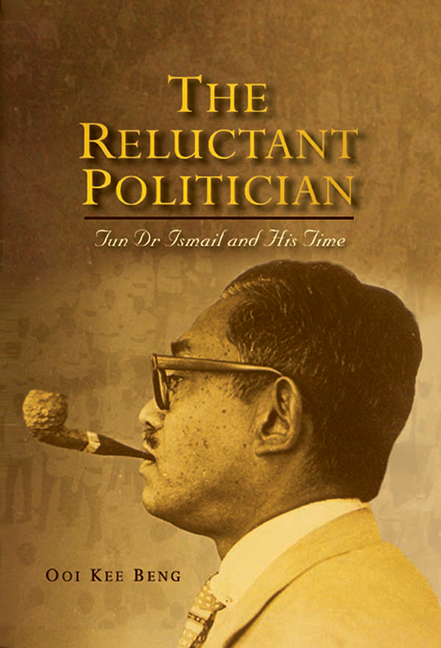
This is the long-awaited biography of Malaysia's powerful Home Affairs Minister and Deputy Prime Minister Tun Dr Ismail Abdul Rahman, who passed away of a heart attack on 2 August 1973. It is based on his private papers and on numerous interviews with his relatives and with people who knew him well, including Ghafar Baba, Musa Hitam, Tengku Razaleigh Hamzah, Robert Kuok, Lee Kuan Yew and Ghazalie Shafie. New perspectives are provided about the struggle for independence, Malaysia's relationship with Singapore, the origins of Southeast Asian regionalism, the internal conflicts of the ruling party UMNO, MCA-UMNO ties, the fatal illness of Tun Abdul Razak Hussein, the May 13 riots, and the New Economic Policy. This book contains not only new facts about Malaysian and Singaporean history, but also insights into the processes of decolonization and nation building.