To save content items to your account,
please confirm that you agree to abide by our usage policies.
If this is the first time you use this feature, you will be asked to authorise Cambridge Core to connect with your account.
Find out more about saving content to .
To save content items to your Kindle, first ensure no-reply@cambridge.org
is added to your Approved Personal Document E-mail List under your Personal Document Settings
on the Manage Your Content and Devices page of your Amazon account. Then enter the ‘name’ part
of your Kindle email address below.
Find out more about saving to your Kindle.
Note you can select to save to either the @free.kindle.com or @kindle.com variations.
‘@free.kindle.com’ emails are free but can only be saved to your device when it is connected to wi-fi.
‘@kindle.com’ emails can be delivered even when you are not connected to wi-fi, but note that service fees apply.
The Greek tragedy that unfolded during the eurozone crisis (2010–15) was the height of a period of ‘high neoliberalism’ that has been particularly prevalent since 1992. This dynamic has been visible in Europe in four specific areas, namely 1) the global rise of neoliberalism (including in internet regulation), 2) the Single Market (with the liberalisation of the football market, the Bolkestein directive, the role of the Court of Justice, and legislative Darwinism), 3) competition policy (with merger control, state aid control, and the liberalisation of new sectors), and 4) the monetary union, from its miraculous beginnings to the Greek tragedy of the eurozone crisis. However, neoliberalism was not exclusive. The epic debates surrounding the Bolkestein directive led to the protection of services of general interest. The eurozone crisis triggered a belated redistribution. In competition policy as well, the older approach of ‘public interest’(which struck a balance between liberty, solidarity and community) has made a comeback in a new guise under Commissioner Vestager, in what could be called an ‘excess of market power’ approach.
The recruitment and retention of voluntary referees is challenging for nonprofit sport organizations. This study examines the trickle-down effect of role models on the retention of already active referees and the recruitment of new referees in German football (soccer). Secondary panel data on the number of referees and role models (i.e., referees promoted to the status of a Bundesliga or FIFA referee) were collected for the 21 regional football associations. The regression results show that the presence of role models has a statistically significant and positive effect on the number of existing referees. The number of new referees is positively affected by referees who were promoted to the status of a first Bundesliga referee, but not by those promoted to the status of a FIFA referee. The findings suggest that nonprofit sport organizations should capitalize on the effect of role models to a greater extent.
Community sport foundations (CSFs), like other non-profit organizations, are increasingly employing social media such as Twitter to communicate their mission and activities to their diverse stakeholder groups. However, the way these CSFs utilize social media for communicating such practices remains unclear. Through a mixed-method approach of content analysis of tweets from 22 CSFs established by English professional football clubs and interviews with key individuals within these CSFs (n = 7), this study examines the extent to which CSFs’ core activities are being communicated through Twitter and identifies the strategies employed for doing so. Reflecting the target audiences CSFs are seeking to reach through Twitter and the challenges associated with communication about projects involving marginalized groups, tweets largely concern programs related to sports participation and education. The most frequently employed communication strategy is to inform, rather than interact or engage with stakeholders. However, CSFs with higher organizational capacity attempt to go beyond mere informing towards engaging with stakeholder groups that relate to their social agenda, highlighting the importance of trained and dedicated social media personnel in optimizing CSFs’ use of Twitter for communication.
Body composition (BC) offers essential insights into the physical condition and performance capacity of athletes. Several factors can influence athletes’ BC, such as nutrition, which can improve lean mass (LM) and body fat percentage (%BF). This longitudinal observational study aimed to investigate the factors influencing BC in professional female football players, including hormones, dietary habits and physical activity, as these are relevant to their sport performance and health. Data related to dietary habits, dual-energy X-ray absorptiometry measurements, serum hormones, menstruation and global position system metrics were collected in November 2023 and late March 2024 from thirty-eight female football players from the Real Sociedad team. Of the thirty-eight players enrolled, thirty-five completed all assessments and were included in the final analyses. Spearman correlations and linear regression analyses were performed. Statistically significant models were executed for %BF and LM (adjusted R2 = 0·55 and 0·47, respectively). For %BF, total testosterone had a positive influence, while high-speed running per minute, follicle-stimulating hormone, distance covered per minute, prolactin and fat intake influenced negatively. In the LM model, positive associations were total testosterone, progesterone, age, adrenocorticotropic hormone and carbohydrate intake, while insulin, distance covered per minute and sex hormone binding globulin had negative associations. These results emphasise the complexity of the factors influencing BC in female football players. Personalising and periodising carbohydrate intake and monitoring training loads are crucial to prevent adverse effects such as higher %BF and muscle catabolism. Establishing healthy nutritional practices is essential for long-term health and performance.
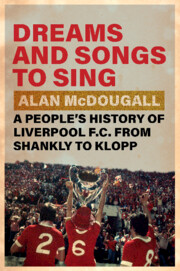
Dreams and Songs to Sing is a unique people's history of the triumphs and tragedies of one of the biggest teams in sport. From Shankly to Klopp, Alan McDougall takes us on a global tour of Liverpool FC's history, viewed through the eyes of the people who've been there all along: the supporters. He weaves together interviews with fans from around the world, poignant farewells to Shankly, birthday cards to Michael Owen, letters from grieving Italians after Heysel, and eyewitness accounts of Hillsborough to tell the inseparable story of the club and the city. This is a history which crosses borders of class, gender, race, and nation, ranging well beyond the pitch but never forgetting the crowds and matches at the heart of it all. Rarely does sports writing have this much intelligence and soul, powerfully combining the personal with the universal, and the everyday with the epic.
Globally, prejudicial attitudes toward women persist. By taking anti-discriminatory stances, value-oriented organizations – e.g., political parties and religious denominations – can tap into group identities to shape their members’ attitudes. We know much less about the role of organizations that are not inherently value-oriented – such as sports teams – in accomplishing the same. Yet, as various campaigns by sports teams worldwide indicate, this is precisely what non-value-oriented organizations increasingly attempt to do. Can football team fandom be leveraged to promote gender-egalitarian attitudes? We address this question with data from a national survey in Brazil and a survey experiment conducted in partnership with a major Brazilian football club. We find that while football team identity is salient and may be leveraged to change displayed social attitudes, the Club’s anti-sexism campaign inadvertently increased men’s expressed prejudice toward women in football – although it may have also improved institutional trust among women.
This chapter explores the 1936 professional soccer season in Rio de Janeiro, and the best-of-three final between the Flamengo and Fluminense clubs. The chapter concentrates on the emergence of Black players in an increasingly professional league, and their creation of a distinctive Brazilian style of play.
In 2020, two retired NFL players sued the league for “explicitly and deliberately” discriminating against Black players who filed claims for damages in the league’s billion-dollar concussion settlement. The league had, their suit revealed, directed clinicians to implement a practice known as race norming, which built into the evaluation process an assumption that Black retired players had lower preexposure cognitive functioning than their white peers – and increased the likelihood that their claims would be denied. The epilogue contextualizes the scandal in relation to the career of one of the plaintiffs, the former defensive lineman Kevin Henry, to reveal how norming – of race, gender, compensation – had pervaded his athletic life long before the NFL denied his claim.
The numerous scandals that have marred the world of football suggest that reform is badly needed. As governing bodies like FIFA and UEFA fail to make meaningful improvements, calls for public regulation are gaining ground. This article explores what the European Union (EU) could do to effect change. Although long hailed as a powerful sports regulator, there is a widespread feeling that the EU’s regulatory potential remains unfulfilled. The article argues that the Union is in a unique position to leave a positive mark on football governance if it decides to regulate the sport more extensively. Three options are outlined: increasing the intensity of scrutiny exercised under the internal market rules, changing the approach towards cooperation with football stakeholders, or enacting a European Sports Act. After examining the benefits and drawbacks of each route, it will be claimed that, on balance, the most promising avenue is EU legislation which sets out minimum governance standards as well as substantive requirements, including on human rights, gender equality, and athlete welfare. The conclusion will offer some reflections on what would need to happen for the proposal to materialize, discussing the role of advocacy coalitions and crises in bringing about regulatory change.
As some of the most intensively devoted football fans in Germany, ultras coordinate crowd atmosphere in the arena to support their respective clubs on the field while actively positioning themselves against sport’s governing bodies, whom they see as corrupted by the strategies used to transform professional football from a game into a capitalist industry. Focusing on travel and transportation as a key feature of hardcore fandom, I examine the relationship between ultras’ activities in transit to games and their congregation in public spaces (on the streets, on trains, at rest stops, in stadia), in which quotidian ambience is often hijacked and repurposed as an estranged form of public address. I focus on the dynamic ways that ultras move through space as a means of charting the stages in which fan scenes become crowds, and crowds are mobilized as a means of protesting against the alienating dynamics of modern football, the contrasting stylistics of which result in divergent outsider interpretations and reactions from the state, the German Football Association (DFB), the media, and onlookers confronted by ultras’ public transgressions. Through the fan scene’s ability to coordinate movement and heighten bodily capacity, varied expressions of antisocial behavior become a means of harnessing fans’ own disaffection in a way that reclaims public space as it conjures a heightened emotive environment.
Consumption of 300 mg of a New Zealand berry extract containing 105 mg anthocyanins for 7 days has been shown to increase running distance during repeated sprints to exhaustion(1). The supplemented group also displayed higher blood lactate concentration over the first thirty minutes of recovery time(1). However, there is limited research available on the acute effects of berry-derived anthocyanins on sports performance. We aimed to evaluate the effect of a single dose of 12 g of a New Zealand berry anthocyanin-enriched powder (NZBP) supplement containing 120 mg of anthocyanins on sprint performance in a randomised controlled crossover trial using the modified Loughborough Intermittent Shuttle Test (m-LIST). The m-LIST protocol consisted of 6 x 15-min blocks divided into four blocks of “prescribed-pace” activity (blocks 1 - 4) (participants exercise based on audible signals) followed by two blocks of “self-paced” (blocks 5, 6) running (no audible signals) with a 3-min rest period between each block. Each block consisted of repeated sequences of 3x20 m walks at 5.4 km/h, 1x15 m sprint, 3x20 m run and 3x20 m jog. Fourteen recreationally active males (mean ± SD age: 29.53 ± 9.35 years, height: 170.84 ± 24.13 cm, weight: 76.24 ± 8.26 kg, V˙O2max: 46.64 ± 4.40 mL∙kg-1∙min-1) participated in three indoor sessions. The first session focused on a multistage fitness test (beep test) to determine V˙O2max and the run and jog prescribed speeds for blocks 1 to 4. For the main trial visits (minimum 7-day wash-out period in between), participants consumed a body weight adjusted standardised dinner (lasagna, garlic bread, banana, and salad greens) and arrived at the laboratory fasted the next morning (between 6-7:30 am). They then consumed the study supplement (NZBP supplement or placebo mixed with 100 ml water) along with the standardised breakfast (100 g yogurt, 50 g granola, and 30 ml milk). One hour after breakfast the participants undertook a 10-min standardised warm-up, followed by the m-LIST protocol. No significant differences (two-way repeated measures ANOVA; p = 0.286) were found in average sprint speed from blocks 1 to 6 within or between NZBP and placebo groups. No effect of supplementation and no interaction effect was observed for sprint distance, sprint time, heart rate, reaction time, movement, or blood lactate concentration. The observed changes induced by repeated sprints on ratings of feeling scale, felt arousal scale, and perceived exertion (p = <0.001, all) were also not affected by supplementation (p = 0.679, p = 0.288, p = 0.327 respectively). Thus, an acute dose of NZBP containing 120 mg anthocyanins under the conditions reported here did not improve repeated sprint performance in recreationally active males.
The language of human rights is a prominent tool of choice to push for moral principles such as justice, equity, and fairness in the social, economic, and political spheres. Simultaneously, the concept and practice of human rights have attracted critiques. Relativism is one such enduring critique. Relativists advocate due and reasonable consideration towards cultural diversity and specificity of diverse human communities, within the limits allowed by universality of human rights. The relativist critique featured prominently in the debates surrounding Qatar’s hosting of the FIFA World Cup 2022. Commentators have spoken about Qatar’s scrutiny often moving beyond legitimate human rights criticism, uninformed activism being counterproductive; and the appropriateness of, largely, Western and maximalist ideals of human rights being applied without accounting for local needs and peculiarities. In this Article, I bring together the literature on the relativist critique and the FIFA World Cup Qatar 2022 as a case study, to examine the usefulness and limitation of human rights as a language of critique to achieve meaningful transformative change in sporting contexts. I focus on the debates surrounding the rights of migrant workers and the rights of the LGBTQIA+ community; and argue that while human rights advocacy had a notable impact in relation to FIFA World Cup Qatar 2022, it is a tale full of cautions and lessons.
In the early fifteenth century it was still the norm for local witnesses to be called to swear to the age of a young person to prove that they were old enough to inherit property. The sworn statements of these witnesses, given orally in ENglish but recorded in Latin translation provide interesting and often amusing details about the lives of ordinary people.
One of the miracles associated with king Henry VI (for whom an application for canonisation was unsuccessfully made) is included here from the anonymous collection of miracles made around 1500. This miracle involves the healing of a painful injury to the groin incurred in a country football match, a sport which the writer disparages.
To investigate adolescents’ experiences with the food selection at the sport arena.
Design:
Four focus group interviews were conducted with 4–6 participants each. Interviews were recorded and transcribed verbatim. The transcripts were coded in NVivo and the analysis was guided by thematic analysis.
Setting:
Adolescents from handball and football clubs in Oslo and Viken, Norway, participated in the study.
Participants:
A total of nine boys (11–14 years old) and ten girls (11–14 years old) participated in the study.
Results:
We identified four main themes: interest for healthy food; experiences with the food selection at the sports arena; factors influencing participants’ food choices at the sports arena and expectations related to a healthy food selection at the sports arena. Adolescents across the focus groups experienced the food selection at the sports arena as unhealthy. Price, marketing and availability of unhealthy food were important factors that influenced their food choices at the sports arena. The trainer appeared to motivate the participants to eat healthy.
Conclusions:
Participants wished for a healthier food selection at the sports arena. Cost of food emerged as a factor that influenced their food choices. Our study also indicates that marketing of unhealthy food and beverages should be restricted, to influence adolescence food choice towards healthier alternatives.
This chapter surveys the interaction between Puccini’s works and various forms of popular culture since the mid-twentieth century. The author examines how Puccini’s music quickly came to be widely absorbed into the popular musical memory through a wide variety of genres. It surveys early recordings of Puccini’s arias and their association with particular recording stars such as Caruso. A discussion of the use of Puccini’s music in films from the 1930s to the present follows, analysing the ways in which it has been employed as a device in films ranging from gentle romances to violent Hollywood blockbusters, sometimes symbolising the essence of Italianness. The author then discusses how excerpts from Puccini’s music have been incorporated into popular songs of a wide range of types and how Puccini arias have made their way into the world of popular television via talent shows, sports programming (notably the use of ‘Nessun dorma’ for the Italia 90 World Cup), chat shows, and advertising.
From 2016 to 2019, the backlash in Brazil against so-called gender ideology framed gender dissidence as a reason for the country’s perceived decline, playing a central role in the rise of Bolsonarismo, a movement increasingly identified as fascist. In this gender-hostile environment, I examine Brazil’s first trans men’s soccer team, the Meninos Bons de Bola (MBB), and its use of nudity as a response to the political shift rightward and to tell a story about the precarity of minoritized groups across the Americas. The team’s changing approach to trans representation exposes the period as a watershed in Brazilian politics. The MBB’s naked protest during this time of governmental change reveals resistance to the machinations of Brazilian fascism, including censorship, backlash, and shaming. By asserting that the MBB were never just about futebol, the team uses the national sport to enact trans politics and to claim belonging beyond the bounds of normative citizenship.
To examine Nigerian footballers’ knowledge and attitudes towards sport-related concussion (SRC) and associated contextual factors.
Methods:
A cross-sectional study design was used with an online questionnaire distributed to Nigerian footballers affiliated with a registered team. The questionnaire included demographic information and the Rosenbaum Concussion Knowledge and Attitudes Survey (RoCKAS-ST). The concussion knowledge index (CKI, 0–25) and attitude index (CAI, 15–75) were calculated. The association between various contextual factors with “high” knowledge and attitude were determined.
Results:
A total of 331 participants completed the questionnaire from 10 football clubs. Mean CKI and CAI scores were 14.0 ± 3.0 (56.2 ± 13.2%) and 54.5 ± 9.4 (72.6 ± 12.5%), respectively, and the association between scores was considered large (r = 0.530; 28%). A small proportion (n = 25; 7.6%) of participants reported a previous diagnosis of an SRC, with a further 40 (12.1%) suspecting they have suffered SRC. Thirty-five participants (10.6%) reported sustaining a SRC but did not seek medical help. Results indicated that men were at 4.8 times greater odds of having a “high[er]” CKI than women, and that those with 5–10 years playing experience had lower odds of a “high” CKI than those with >10 years’ experience. Men had 7 times greater odds of having a “high” CAI than women.
Conclusion:
The results of this study suggest that Nigerian footballers have a moderate level of SRC knowledge, satisfactory symptom recognition, and high SRC attitudes. Those working with Nigerian football may consider these findings when seeking strategies to improve concussion knowledge, potentially by improving attitudes and considering sex and playing experience.
Do people cheat more when they have something to gain, or when they have something to lose? The answer to this question isn’t straightforward, as research is mixed when it comes to understanding how unethical people will be when they might acquire something good versus avoid something bad. To wit, research has found that people cheat more in a loss (vs. gain) frame, yet research on regulatory focus has found that people cheat more in a promotion focus (where the focus is on acquiring gains) than in a prevention focus (where the focus is on avoiding losses). Through a large-scale field study containing 332,239 observations including 27,350 transgressions, we address the contradictory results of gain/loss frames and regulatory focus on committing unethical behavior in a context that contains a high risk of detecting unethical behavior (NFL football games). Our results replicated the separate effects of more cheating in a loss frame, and more cheating in a promotion focus. Furthermore, our data revealed a heretofore undocumented crossover interaction, in accordance with regulatory fit, which could disentangle past results: Specifically, we found promotion focus is associated with more cheating in a loss (vs. gain) frame, whereas prevention focus is associated with more cheating in a gain (vs. loss) frame. In gridiron football, this translates to offensive players fouling more when their team is losing (vs. winning) and defensive players fouling more when their team is winning (vs. losing).