Refine search
Actions for selected content:
115 results
Collective versus individual dispersion dynamics: vortex-ring modification across suspensions and polymer solutions
-
- Journal:
- Journal of Fluid Mechanics / Volume 1037 / 25 June 2026
- Published online by Cambridge University Press:
- 22 June 2026, A47
-
- Article
-
- You have access
- Open access
- HTML
- Export citation
Velocity jump of Newtonian droplets in viscoelastic fluids: analytical and experimental study
-
- Journal:
- Journal of Fluid Mechanics / Volume 1035 / 25 May 2026
- Published online by Cambridge University Press:
- 28 May 2026, A41
-
- Article
- Export citation
-
This study presents a combined analytical and experimental investigation into the rising dynamics of Newtonian droplets in viscoelastic fluids, focusing on discontinuous transitions in droplet velocity. Although velocity jumps have been observed in gas bubbles, this work is the first systematic investigation of the phenomenon in Newtonian droplets. Analytically, a triple-perturbation approach is developed using Reynolds (Re), Deborah (De) and capillary (Ca) numbers as expansion parameters. The surrounding viscoelastic medium is modelled using the nonlinear-Giesekus constitutive equation. The analysis reveals that increasing Deborah number intensifies and reorients normal stresses – particularly the polar ( $\theta$-direction) and hoop components – along the droplet interface. These stresses migrate rearward with increasing elasticity, resulting in localised elongational flows and concentrated radial stresses near the rear stagnation point, which indicates the onset of elastic instabilities. Experimentally, Newtonian droplets are introduced into a variety of exterior fluids: (i) quasilinear Boger fluids, which are constant-viscosity viscoelastic solutions that isolate elastic effects; and (ii) a strongly nonlinear viscoelastic solution, which exhibits both high elasticity and significant shear-thinning behaviour. Equivalent Newtonian fluids of matched viscosity are also used as controls. Viscoelastic fluids are solutions of polyacrylamide in the water–glycerine mixture. Across all experiments, the dimensionless ranges were $\textit{Re}\approx 6\times 10^{-4}{-}4.59$, $\textit{De}\approx 0.057{-}0.802$ and $\textit{Ca}\approx 0.0026{-}0.638$, framing the scope of applicability. The experimental observations challenge the classical expectation of smooth droplet motion and demonstrate that Newtonian droplets in viscoelastic environments can exhibit sharp, weak or no velocity jumps, depending on the balance between elasticity, viscosity and deformability.

Fractal geometry of turbulent-kinetic-energy isosurfaces in turbulent pipe flows with polymer additives
-
- Journal:
- Journal of Fluid Mechanics / Volume 1034 / 10 May 2026
- Published online by Cambridge University Press:
- 07 May 2026, A53
-
- Article
- Export citation
-
The addition of polymers to turbulent pipe flows induces significant drag reduction and fundamentally modifies turbulent flow structures. This study presents a fractal dimension analysis of polymeric turbulent pipe flows using velocity fields captured via two-dimensional particle image velocimetry in the streamwise-radial plane. Two experimental datasets were generated: one by varying the polymer concentration at a constant Reynolds number ( $\textit{Re}$) and another by varying $\textit{Re}$ at a fixed polymer concentration. Friction factors were measured concurrently to quantify the extent of drag reduction. The two-dimensional fractal dimension was evaluated for isosurfaces of turbulent kinetic energy. While Newtonian turbulence exhibits a nearly constant fractal dimension at length scales exceeding a critical threshold, the introduction of polymers causes the fractal dimension to decrease monotonically with increasing concentration. Conversely, the fractal dimension remains insensitive to changes in the Reynolds number. The ratio of the critical length scale to the Kolmogorov scale varies according to both $\textit{Re}$ and polymer concentration; however, this scale ratio becomes independent of both parameters once the maximum drag reduction asymptote is reached. Spatial analysis of the one-dimensional fractal dimension across radial positions helps to further reveal the evolution of turbulence fractality. The results demonstrate that while flow inertia promotes the formation of space-filling structures, viscoelastic effects smooth these structures and transition them towards sheet-like or linear geometries. Finally, the correlation between the fractal dimension and turbulence intermittency is discussed.


Hyaluronic acid-coated polymer-siRNA nanovectors for evadingmacrophage uptake and STAT3 gene silencing in breast cancercells
-
- Journal:
- Cambridge Materials: Health / Volume 1 / 2026
- Published online by Cambridge University Press:
- 10 April 2026, e1
-
- Article
-
- You have access
- Open access
- HTML
- Export citation
Subgrid-scale statistics and energy transfer in polymer-laden turbulence determined from tomographic particle image velocimetry measurements
-
- Journal:
- Journal of Fluid Mechanics / Volume 1030 / 10 March 2026
- Published online by Cambridge University Press:
- 04 March 2026, A43
-
- Article
- Export citation
-
To investigate how polymers influence energy transfer in three-dimensional turbulence, we conduct experiments in homogeneous bulk turbulence generated by a von Kármán swirling flow, using tomographic particle image velocimetry. A filtering approach is applied to the measured three-dimensional velocity fields to extract subgrid-scale (SGS) statistics, focusing on the filtered strain-rate tensor and SGS stress tensor. We find that polymer additives induce significant changes in the tensorial geometry: the strain-rate tensor shows a tendency towards an eigenvalue ratio of $1 : 0 : -1$, while the SGS stress tensor favours a $2 : -1 : -1$ configuration. The local energy flux – quantified by the inner product of the strain-rate and SGS stress tensors – is systematically suppressed by polymers and becomes increasingly intermittent. This suppression is linked to a reduced energy transfer efficiency, associated with the misalignment between the principal eigendirections of the two tensors. Anisotropic effects are also observed in the energy flux components, indicating that polymers affect vertical and horizontal energy transfer differently. Finally, the obtained SGS statistics allow for an a priori assessment of SGS models. Our results reveal that the nonlinear gradient model significantly outperforms the Smagorinsky model, particularly in polymer-laden turbulence. The diminished alignment between the strain-rate and SGS stress tensors may underlie the limitations of the Smagorinsky model, which assumes a scalar eddy-viscosity closure. These results provide new experimental insights into the SGS dynamics of polymeric turbulence and highlight the potential of nonlinear models for large-eddy simulations of viscoelastic flows.


Measured small-scale properties in turbulent Rayleigh–Bénard convection with polymer additives
-
- Journal:
- Journal of Fluid Mechanics / Volume 1028 / 10 February 2026
- Published online by Cambridge University Press:
- 04 February 2026, A31
-
- Article
- Export citation
Linking the rheology of thermal amorphous materials to molecular-scale physics
-
- Journal:
- Journal of Fluid Mechanics / Volume 1027 / 25 January 2026
- Published online by Cambridge University Press:
- 19 January 2026, A32
-
- Article
-
- You have access
- Open access
- HTML
- Export citation
Dynamics of poro-viscoelastic wetting with large swelling
-
- Journal:
- Journal of Fluid Mechanics / Volume 1025 / 25 December 2025
- Published online by Cambridge University Press:
- 19 December 2025, A58
-
- Article
-
- You have access
- Open access
- HTML
- Export citation
Efficient turbulent drag reduction using targeted polymer additives
-
- Journal:
- Journal of Fluid Mechanics / Volume 1024 / 10 December 2025
- Published online by Cambridge University Press:
- 10 December 2025, A60
-
- Article
-
- You have access
- Open access
- HTML
- Export citation
-
The effectiveness of polymer drag reduction by targeted injection is studied in comparison with that of a uniform concentration (or polymer ocean) in a turbulent channel flow. Direct numerical simulations are performed using a pseudo-spectral code to solve the coupled equations of a viscoelastic fluid using the finitely extensible nonlinear elastic dumbbell model with the Peterlin approximation. Light and heavy particles are used to carry the polymer in some cases, and polymer is selectively injected into specific flow regions in the other cases. Drag reduction is computed for a polymer ocean at a viscosity ratio of $\beta = 0.9$ for simulation validation, and then various methods of polymer addition at $\beta = 0.95$ are compared for their drag-reduction performance and general effect on the flow. It was found that injecting polymer directly into regions of high axial strain inside and around coherent vortical structures was the most effective at reducing drag, while injecting polymer very close to the walls was the least effective. The targeting methods achieved up to 2.5 % higher drag reduction than an equivalent polymer ocean, offering a moderate performance boost in the low drag-reduction regime.


Energy, enstrophy and helicity transfers in polymeric turbulence
-
- Journal:
- Journal of Fluid Mechanics / Volume 1024 / 10 December 2025
- Published online by Cambridge University Press:
- 01 December 2025, A21
-
- Article
-
- You have access
- Open access
- HTML
- Export citation
-
We investigate the scale-by-scale transfers of energy, enstrophy and helicity in homogeneous and isotropic polymeric turbulence using direct numerical simulations. The study relies on the exact scale-by-scale budget equations, derived from the governing model equations, that fully capture the back-reaction of polymers on the fluid dynamics. Polymers act as dynamic sinks and sources and open alternative routes for interscale transfer whose significance is modulated by their elasticity, quantified through the Deborah number ( ${\textit{De}}$). Polymers primarily deplete the nonlinear energy cascade at small scales, by attenuating intense forward and inverse transfer events. At sufficiently high ${\textit{De}}$, a polymer-driven flux emerges and dominates at small scales, transferring on average energy from larger to smaller scales, while allowing for localised backscatter. For enstrophy, polymers inhibit the stretching of vorticity, with fluid–polymer interactions becoming the primary enstrophy source at high ${\textit{De}}$. Accordingly, an analysis of the small-scale flow topology reveals that polymers promote two-dimensional straining states and enhance the occurrence of shear and planar extensional flows, while suppressing extreme rotation events. Helicity, injected at large scales, exhibits a transfer mechanism analogous to energy, being dominated by nonlinear dynamics at large scales and by polymer-induced fluxes at small scales. Polymers enhance the breakdown of small-scale mirror symmetry, as indicated by a monotonic increase in relative helicity with ${\textit{De}}$ across all scales.


1 - Introduction
-
- Book:
- Introduction to Biomaterials
- Published online:
- 01 December 2025
- Print publication:
- 20 November 2025, pp 1-18
-
- Chapter
- Export citation
Delivery of macromolecular drugs: An update
-
- Journal:
- Quarterly Reviews of Biophysics / Volume 58 / 2025
- Published online by Cambridge University Press:
- 18 November 2025, e19
-
- Article
- Export citation
Transient rod climbing in a viscoelastic fluid
-
- Journal:
- Journal of Fluid Mechanics / Volume 1021 / 25 October 2025
- Published online by Cambridge University Press:
- 16 October 2025, A10
-
- Article
-
- You have access
- Open access
- HTML
- Export citation
Linear and nonlinear instabilities in highly shear-thinning fluid flow through a pipe
-
- Journal:
- Journal of Fluid Mechanics / Volume 1020 / 10 October 2025
- Published online by Cambridge University Press:
- 29 September 2025, A10
-
- Article
-
- You have access
- Open access
- HTML
- Export citation
The role of vortex stretching in drag reduction of polymer-laden turbulent flow
-
- Journal:
- Journal of Fluid Mechanics / Volume 1019 / 25 September 2025
- Published online by Cambridge University Press:
- 17 September 2025, A32
-
- Article
-
- You have access
- Open access
- HTML
- Export citation
Extensional rheology of dilute suspensions of spheres in polymeric liquids
-
- Journal:
- Journal of Fluid Mechanics / Volume 1018 / 10 September 2025
- Published online by Cambridge University Press:
- 05 September 2025, A40
-
- Article
-
- You have access
- Open access
- HTML
- Export citation
-
The extensional rheology of dilute suspensions of spheres in viscoelastic/polymeric liquids is studied computationally. At low polymer concentration $c$ and Deborah number $\textit{De}$ (imposed extension rate times polymer relaxation time), a wake of highly stretched polymers forms downstream of the particles due to larger local velocity gradients than the imposed flow, indicated by $\Delta \textit{De}_{\textit{local}}\gt 0$. This increases the suspension’s extensional viscosity with time and $\textit{De}$ for $De \lt 0.5$. When $\textit{De}$ exceeds 0.5, the coil-stretch transition value, the fully stretched polymers from the far-field collapse in regions with $\Delta \textit{De}_{\textit{local}} \lt 0$ (lower velocity gradient) around the particle’s stagnation points, reducing suspension viscosity relative to the particle-free liquid. The interaction between local flow and polymers intensifies with increasing $c$. Highly stretched polymers impede local flow, reducing $\Delta \textit{De}_{\textit{local}}$, while $\Delta \textit{De}_{\textit{local}}$ increases in regions with collapsed polymers. Initially, increasing $c$ aligns $\Delta \textit{De}_{\textit{local}}$ and local polymer stretch with far-field values, diminishing particle–polymer interaction effects. However, beyond a certain $c$, a new mechanism emerges. At low $c$, fluid three particle radii upstream exhibits $\Delta \textit{De}_{\textit{local}} \gt 0$, stretching polymers beyond their undisturbed state. As $c$ increases, however, $\Delta \textit{De}_{\textit{local}}$ in this region becomes negative, collapsing polymers and resulting in increasingly negative stress from particle–polymer interactions at large $\textit{De}$ and time. At high $c$, this negative interaction stress scales as $c^2$, surpassing the linear increase of particle-free polymer stress, making dilute sphere concentrations more effective at reducing the viscosity of viscoelastic liquids at larger $\textit{De}$ and $c$.
$c$.


Viscoelastic thin-film lubrication in finite-width channels
-
- Journal:
- Journal of Fluid Mechanics / Volume 1018 / 10 September 2025
- Published online by Cambridge University Press:
- 01 September 2025, A16
-
- Article
-
- You have access
- Open access
- HTML
- Export citation
-
Lubricant viscoelasticity arises due to a finite polymer relaxation time ( $\lambda$) which can be exploited to enhance lubricant performance. In applications such as bearings, gears, biological joints, etc., where the height-to-length ratio ( $H_0 / \ell _x$) is small and the shear due to the wall velocity ( $U_0$) is high, a simplified two-dimensional computational analysis across the channel length and height reveals a finite increase in the load-carrying capacity of the film purely due to polymer elasticity. In channels with a finite length-to-width ratio, $a$, the spanwise effects can be significant, but the resulting mathematical model is computationally intensive. In this work, we propose simpler reduced-order models, namely via (i) a first-order perturbation in the Deborah number ( $\lambda U_0 / \ell _x$) and (ii) the viscoelastic Reynolds approach extended from Ahmed & Biancofiore (J. Non-Newtonian Fluid Mech., vol. 292, 2021, 104524). We predict the variation in the net vertical force exerted on the channel walls (for a fixed film height) versus increasing viscoelasticity, modelled using the Oldroyd-B constitutive relation, and the channel aspect ratio. The models predict an increase in the net force, which is zero for the Newtonian case, versus both the Deborah number and the channel aspect ratio. Interestingly, for a fixed $\textit{De}$, this force varies strongly between the two limiting cases (i) $a \ll 1$, an infinitely wide channel, and (ii) $a \gg 1$, an infinitely short channel, implying a change in the polymer response. Furthermore, we observe a different trend (i) for a spanwise-varying channel, in which a peak is observed between the two limits, and (ii) for a spanwise-uniform channel, where the largest load value is for $a \ll 1$. When $a$ is O( $1$), the viscoelastic response varies strongly and spanwise effects cannot be ignored.


Sustainable design approaches for thermoplastics in additive manufacturing
-
- Journal:
- Proceedings of the Design Society / Volume 5 / August 2025
- Published online by Cambridge University Press:
- 27 August 2025, pp. 2971-2980
-
- Article
-
- You have access
- Open access
- HTML
- Export citation
Direct numerical simulation of power-law fluids over smooth and rough surfaces
-
- Journal:
- Journal of Fluid Mechanics / Volume 1016 / 10 August 2025
- Published online by Cambridge University Press:
- 29 July 2025, A13
-
- Article
- Export citation
-
Direct numerical simulation (DNS) studies of power-law (PL) fluids are performed for purely viscous-shear-thinning ( $n\in [0.5,0.75]$), Newtonian ( $n=1$) and purely viscous-shear-thickening ( $n=2.0$) fluids, considering two Reynolds numbers ( $Re_{\tau }\in [395,590]$), and both smooth and rough surfaces. We carefully designed a numerical experiment to isolate key effects and simplify the complex problem of turbulent flow of non-Newtonian fluids over rough surfaces, enabling the development of a theoretical model to explain the observed phenomena and provide predictions. The DNS results of the present work were validated against literature data for smooth and rough Newtonian turbulent flows, as well as smooth shear-thinning cases. A new analytical expression for the mean velocity profile – extending the classical Blasius $1/7$ profile to power-law fluids – was proposed and validated. In contrast to common belief, the decrease in $n$ leads to smaller Kolmogorov length scales and the formation of larger structures, requiring finer grids and longer computational domains for accurate simulations. Our results confirm that purely viscous shear-thinning fluids exhibit drag reduction, while shear-thickening fluids display an opposite trend. Interestingly, we found that viscous-thinning turbulence shares similarities with Newtonian transitional flows, resembling the behaviour of shear-thinning, extensional-thickening viscoelastic fluids. This observation suggests that the extensional and elastic effects in turbulent flows within constant cross-section geometries may not be significant. However, the shear-thickening case exhibits characteristics similar to high-Reynolds-number Newtonian turbulence, suggesting that phenomena observed in such flows could be studied at significantly lower Reynolds numbers, reducing computational costs. In the analysis of rough channels, we found that the recirculation bubble between two roughness elements is mildly influenced by the thinning nature of the fluid. Moreover, we observed that shear-thinning alters the flow in the fully rough regime, where the friction factor typically reaches a plateau. Our results indicate the possibility that, at sufficiently high Reynolds numbers, this plateau may not exist for shear-thinning fluids. Finally, we provide detailed turbulence statistics for different rheologies, allowing, for the first time, an in-depth study of the effects of rheology on turbulent flow over rough surfaces.


Electro-osmotic flow of semi-dilute polyelectrolyte solutions in nanochannels
-
- Journal:
- Journal of Fluid Mechanics / Volume 1013 / 25 June 2025
- Published online by Cambridge University Press:
- 13 June 2025, A11
-
- Article
- Export citation
-
This paper presents a theoretical model for the electro-osmotic flow (EOF) of semi-dilute polyelectrolyte (PE) solutions in nanochannels. We use mean-field theories to describe the properties of electric double layer and viscosity of PE solutions that are prerequisites for constructing the EOF model. The EOF model is validated via a good match to the existing experimental results. Based on the validated EOF model, we conduct a comprehensive analysis of EOF of semi-dilute PE solutions in nanochannels. First, we observe considerable EOF of PE solutions in the uncharged nanochannels, which is in stark contrast to EOF of simple electrolyte solutions. The analyses show that the EOF of PE solutions in uncharged nanochannels is triggered by the external electric field acting on the near-wall non-electroneutral regions resulting from the confinement-induced inhomogeneous distribution of PE monomers. Although the solutions are electroneutral as a whole, the presence of local non-electroneutral regions and the mismatch between non-electroneutral regions and high-viscosity regions lead to the net EOF in uncharged nanochannels. Furthermore, we reveal that the EOF mobility $\mu _{{eof}}$ in uncharged nanochannels exhibits a scaling law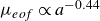 $\mu _{{eof}} \propto a^{-0.44}$ (wherein $a$ denotes monomer Kuhn length) and is inversely proportional to the PE chain length, while it decreases nonlinearly with the charge fraction of the PE chains. Moreover, the EOF mobility reaches its maximum at specific bulk monomer concentration, and increases with the nanochannel height before converging to that under no confinement. Second, we analyse the EOF of PE solutions in nanochannels with various wall effects, such as surface charge density, slip length and adsorption length. When the surface charge is absent, the adsorption length significantly influences the direction and magnitude of the EOF, whereas the slip length has no effect. When the wall becomes increasingly charged, the influence of adsorption length on EOF gradually diminishes, while the importance of the slip length progressively intensifies and the EOF is highly influenced by the co-action of various wall effects in a complicated manner. When the surface wall is oppositely charged to polymer monomers, the EOF mobility varies nonlinearly with the surface charge density, while a zero net flow of EOF followed by a direction reversal is discovered when the wall is likely charged to polymer monomers.


