
Contents
JFM Rapids

Enhancing the heat-transfer rate by inhomogeneous porous boundary in turbulent convection
-
- Published online by Cambridge University Press:
- 05 February 2026, R1
-
- Article
- Export citation

Viscosity contrast destabilises radial Rayleigh–Taylor flow
-
- Published online by Cambridge University Press:
- 09 February 2026, R2
-
- Article
- Export citation
Focus on Fluids

Reducing complex physics to its phase dynamics
-
- Published online by Cambridge University Press:
- 04 February 2026, F1
-
- Article
-
- You have access
- HTML
- Export citation
JFM Papers

Planar intrusions from a source in quiescent and flowing ambients
-
- Published online by Cambridge University Press:
- 26 January 2026, A1
-
- Article
-
- You have access
- Open access
- HTML
- Export citation
-
We experimentally investigate the structure and evolution of planar, inertia-dominated intrusions from a constant source into linearly stratified ambients that are either quiescent or uniformly flowing. The source is either a negatively buoyant plume or a diffuser at the level of neutral buoyancy. The intrusions generated by plumes in a quiescent ambient form self-similar wedges, with constant thickness at the source $(2.5\pm 0.3)\sqrt {Q/N}$ and the wedge lengthening in time $t$ as $(0.32\pm 0.03)\sqrt {\textit{NQ}}\,t$, where $N$ is the buoyancy frequency, and $Q$ is the areal supply rate. In a flowing ambient, the intrusions remain self-similar with the same functional dependence on parameters. However, they become increasingly asymmetric as the ambient flow speed increases, and for speeds greater than approximately $0.3\sqrt {\textit{NQ}}$, there is no upstream propagation. Intrusions generated by diffusers are structurally different and not clearly self-similar. Immediately adjacent to the source, they thicken significantly through a turbulent, entraining hydraulic jump. Beyond this is a gently thinning region that lengthens over time. Ahead of this is a more rapidly tapering nose. Both the area of these intrusions and the front positions increase as power laws in time, with exponents between $0.6$ and $0.7$. With an ambient flow, this overall structure persists with asymmetry. We compare our experimental observations for plume-generated intrusions with predictions from the intrusive shallow-water model of Ungarish (2005, J. Fluid Mech., vol. 535, pp. 287–323). The model explains some of the observed behaviours, but does not provide an accurate description of the thickness profiles.


Separation bubble shaped control bumps for turbulent oblique shock wave–boundary-layer interactions
-
- Published online by Cambridge University Press:
- 26 January 2026, A2
-
- Article
-
- You have access
- Open access
- HTML
- Export citation
-
An experimental investigation of separation bubble shaped control bumps for oblique shock wave–boundary-layer interactions was performed in two supersonic wind tunnel facilities at Mach 2.5 and 2, with incident shock deflection angles of $8^\circ$ and $12^\circ$, respectively, and momentum thickness Reynolds numbers of approximately $1.5 \times 10^4$. Shock control bumps were designed to replicate the time-averaged separation bubble shape, and were placed onto the floor in the separation location. This resulted in almost complete elimination of flow separation. There was also a marked improvement in the downstream boundary-layer state. A low-frequency bubble breathing oscillation was identified in the baseline interaction using high-speed shadowgraphy and particle image velocimetry measurements. This oscillation was strongly suppressed in the controlled interactions. Velocity fluctuations in the downstream boundary layer were also significantly reduced. We propose that the key mechanism by which flow separation is eliminated is by breaking down the overall pressure rise into smaller steps, each of which is below the separation threshold. A key feature is the bump crest expansion fan, located near to where the incident shock terminates, which negates the shock induced pressure jump. Thus, the precise bump geometry is critical for control efficacy and should be designed to manage these pressure rise steps as well as the expansion fan strength and location with respect to the incident shock wave. The length of the bump faces must also be sufficiently long for the boundary layer to recover between successive adverse pressure jumps.


Turbulent diffusion–cascade interaction
-
- Published online by Cambridge University Press:
- 26 January 2026, A3
-
- Article
-
- You have access
- Open access
- HTML
- Export citation
-
In the decay region around the centreline of three qualitatively different turbulent plane wakes, the turbulence is non-homogeneous and two-point turbulent diffusion counteracts the turbulence cascade all the way down to scales smaller than the Taylor length. It is found that the sum of the inter-space transfer rate and the horizontal part of the inter-scale transfer rate of horizontal two-point turbulent kinetic energy is approximately proportional to the turbulence dissipation rate in the inertial range with a constant of proportionality between $-0.6$ and $-1$ depending on wake and location within the wake, except at the near-field edge of the decay region.


Dynamic stall of a hydrofoil with tubercles in surface gravity waves
-
- Published online by Cambridge University Press:
- 26 January 2026, A4
-
- Article
-
- You have access
- Open access
- HTML
- Export citation

High-Rayleigh-number asymptotic classical scaling in three-dimensional steady natural convection
-
- Published online by Cambridge University Press:
- 26 January 2026, A5
-
- Article
-
- You have access
- Open access
- HTML
- Export citation

Viscoelastic effects on turbulent drag reduction via a non-Newtonian lubricating layer
-
- Published online by Cambridge University Press:
- 26 January 2026, A6
-
- Article
-
- You have access
- Open access
- HTML
- Export citation
-
We investigate the influence of shear-thinning and viscoelasticity on turbulent drag reduction in lubricated channel flow – a configuration where a thin lubricating layer of non-Newtonian fluid facilitates the transport of a primary Newtonian fluid. Direct numerical simulations are performed in a channel flow driven by a constant mean pressure gradient at a reference shear Reynolds number $\textit{Re}_\tau = 300$. The interface between the two fluid layers is characterised by Weber number $\textit{We} = 0.5$. The fluids are assumed to have matched densities. In addition to a single-phase reference case, we analyse four configurations: a Newtonian lubrication layer, a shear-thinning Carreau fluid layer, a shear-thinning and viscoelastic FENE-P fluid layer, and a purely viscoelastic FENE-CR fluid layer. Consistent with previous findings (Roccon et al. 2019, J. Fluid Mech., vol. 863, R1), surface tension is found to induce significant drag reduction across all cases. Surprisingly, variations in the lubricating layer viscosity do not yield noticeable drag-reducing effects: the Carreau fluid, despite its lower apparent viscosity, behaves similarly to the Newtonian case. In contrast, viscoelastic effects lead to a further reduction in drag, with both the FENE-P and FENE-CR fluids demonstrating enhanced drag-reducing capabilities.


On the applicability of the actuator line method for unsteady aerodynamics
-
- Published online by Cambridge University Press:
- 26 January 2026, A7
-
- Article
- Export citation
-
A linear theory for unsteady aerodynamic effects of the actuator line method (ALM) is developed. This theory is validated using two-dimensional ALM simulations, where we compute the unsteady lift generated by the plunging and pitching motion of a thin aerofoil in uniform flow, comparing the results with Theodorsen’s theory. This comparison elucidates the underlying characteristics and limitations of ALM when applied to unsteady aerodynamics. Numerical simulations were conducted across a range of chord lengths and oscillation frequencies. Comparison of ALM results with theoretical predictions shows consistent accuracy, with all Gaussian parameter choices yielding accurate results at low reduced frequencies. Furthermore, the study indicates that selecting a width parameter ratio of $\varepsilon /c$ (the Gaussian width parameter over the chord length) between 0.33 and 0.4 in ALM yields the closest alignment with analytical results across a broader frequency range. Additionally, a proper definition of angle of attack for a pitching aerofoil is shown to be important for accurate computations. These findings offer valuable guidance for the application of ALM in unsteady aerodynamics and aeroelasticity.


Pressure drop in engineered (TPMS-based) porous media
-
- Published online by Cambridge University Press:
- 26 January 2026, A8
-
- Article
-
- You have access
- Open access
- HTML
- Export citation
-
Triply periodic minimal surfaces (TPMS)-based media (a type of metamaterial) are defined by mathematical expressions, which are amenable to additive manufacturing, and are finding increasing practical applications owing to their porous nature. We present experimental pressure drop measurements for a range of velocities spanning laminar to turbulent regimes for three TPMS geometries – gyroid, primitive and body-centred cubic (BCC) – with different porosity, unit cell length and surface finish. Dimensional Darcy and Forchheimer permeabilities are estimated via quadratic fitting for the gyroid geometry, which closely resembles random packed porous media. Subsequently, the non-dimensional drag ( ${\kern-0.5pt}f$) is plotted against Reynolds number ( $Re$) yielding distinct curves for each case. The lack of collapse stems from varying definitions of pore diameter, complicating comparisons across porous media (not just TPMS). Therefore, a method is developed to estimate an equivalent hydraulic diameter $d_{{H\hbox{-}\textit{equ}}}$ from pressure drop data by matching the laminar drag $f$ of packed spheres via the Ergun equation, allowing the collapse of all porous media $f-Re$ curves in the laminar regime. The value of $d_{ {H\hbox{-}\textit{equ}}}$ is related to the ‘true’ Darcy permeability defined strictly in the linear regime (unlike permeability from quadratic fitting). We observe an approximate linear relationship between the $d_{ {H\hbox{-}\textit{equ}}}$ and the hydraulic diameter for self-similar TPMS configurations. The common basis of $d_{ {H\hbox{-}\textit{equ}}}$ allows intercomparison of TPMS geometries, and shows that BCC achieves significant drag reduction compared with packed spheres in the turbulent regime partially because of their open tube-like structure, whereas some configurations show drag increase. Although gyroid can be represented using the traditional quadratic drag law, primitive and BCC show an increase in $f$ with increasing $Re$ immediately before transitioning to fully turbulent regime – akin to rough-wall pipe flows, likely owing to their periodic streamwise elongated open structures.


Lidar observations of turbulence for tall offshore wind turbines
-
- Published online by Cambridge University Press:
- 26 January 2026, A9
-
- Article
-
- You have access
- Open access
- HTML
- Export citation
-
Spectral turbulence models commonly used in the design and certification of wind turbines have only been validated at heights up to 70 m in the atmosphere, but many offshore wind turbines now operate at heights above 150 m. Moreover, there is a lack of measurement data on the spatial structure of turbulence at such heights in the marine atmospheric boundary layer (MBL). Consequently, it is uncertain whether these turbulence models are valid for the design of tall offshore wind turbines. To fill this gap, we present measurements of one-point auto-spectra and two-point spectral coherence at heights of 150–250 m and lateral separations up to 241 m providing lateral coherence of turbulence in the MBL that has never been measured before for these heights and separations. Five light detection and ranging (lidar) instruments were deployed on the west coast of Denmark, and we reconstructed the along-wind and cross-wind components at the lidar beam intersection points. The measurements were compared with the theoretical predictions of auto-spectra and lateral coherence from the Mann model and its extension, the Syed–Mann model. The latter models turbulence down to frequencies of 1 h $^{-1}$ through the $-5/3$ scaling observed in the mesoscale range. The results show that the Mann model did not compare well with the measurements under stable and near-neutral conditions. On the other hand, the Syed–Mann model predicted the lateral coherence for a range of different conditions. However, the lateral coherence was under predicted in about $8\,\%$ of the data, possibly due to gravity waves. We believe that the high coherence from mesoscale turbulence at these heights can influence the loads on floating wind turbines and large offshore wind farms.


Pattern selection between two-dimensional Rayleigh–Bénard convection and electroconvection near electrochemical surfaces
-
- Published online by Cambridge University Press:
- 30 January 2026, A10
-
- Article
- Export citation

Microstreaming induced by a micro-cantilever vibrating elliptically in a viscous fluid
-
- Published online by Cambridge University Press:
- 30 January 2026, A11
-
- Article
- Export citation

A composite mean temperature transformation for compressible turbulent boundary layers
-
- Published online by Cambridge University Press:
- 02 February 2026, A12
-
- Article
-
- You have access
- Open access
- HTML
- Export citation

Dancing rivulets in an air-filled Hele-Shaw cell
-
- Published online by Cambridge University Press:
- 30 January 2026, A13
-
- Article
- Export citation

Effect of initial spanwise perturbations on the dynamics and mixing of planar gravity currents
-
- Published online by Cambridge University Press:
- 29 January 2026, A14
-
- Article
-
- You have access
- Open access
- HTML
- Export citation
-
Fully resolved three-dimensional simulations of planar gravity currents are conducted to investigate the influence of imposed spanwise perturbations on flow evolution and mixing at two Reynolds numbers ( $ \textit{Re}=3450$ and 10 000). The initial perturbations consist of sinusoidal waves with a varying number of repeating waves, $k_y$, with simulations spanning $0 \leqslant k_y \leqslant 8$. At low- $ \textit{Re} $, cases with perturbations ( $k_y \gt 0$) exhibit a more rapid breakdown of spanwise coherence compared with the unperturbed case ( $k_y = 0$), although the resulting structures retain spatial periodicity and remain relatively ordered. This earlier disruption leads to greater front propagation distances beyond the self-similar inertial phase compared with the unperturbed case. Notably, imposed perturbations exhibit minimal influence on the flow transition; all cases follow the slumping velocity reported in the literature, with the transition into the inertial phase occurring at comparable times across different $k_y$ values at both $ \textit{Re} $. The increased propagation speed is accompanied by reduced mixing efficiency due to the premature disruption of coherent Kelvin–Helmholtz (K–H) billows, which play a key role in maintaining multi-scale mixing. At high- $ \textit{Re} $, the influence of initial spanwise perturbations diminishes, as three-dimensional turbulence induces a more chaotic, fine-scale breakdown of spanwise coherence across all $k_y$ cases, overriding the effects of the initial perturbations. Consequently, the dominant stirring mechanism shifts from K–H billows to vortices within the current head. Nevertheless, the unperturbed case maintains comparatively higher mixing efficiency at both low- and high- $ \textit{Re} $. This is attributed to the persistence of recognisable K–H billow structures, which, despite undergoing chaotic breakdown at high- $ \textit{Re} $, still contribute to effective stirring by stretching and folding the density interface. These results highlight the dual role of K–H billows: they promote efficient mixing, yet the enhanced mixing reduces the density difference between the current and the ambient fluid, weakening buoyancy and slowing front propagation despite stronger stirring. These findings are supported by consistent trends in streamwise density distribution and ‘local’ energy exchange analyses.


Influence of inflow turbulence on wake dynamics of a square cylinder
-
- Published online by Cambridge University Press:
- 29 January 2026, A15
-
- Article
- Export citation

A passive cell body plays an active role in microalgal swimming via non-reciprocal interactions
-
- Published online by Cambridge University Press:
- 02 February 2026, A16
-
- Article
- Export citation

Unified scaling laws in porous-medium vertical natural convection
-
- Published online by Cambridge University Press:
- 30 January 2026, A17
-
- Article
- Export citation
-
This study conducted theoretical analysis and direct numerical simulations (DNS) of vertical natural convection in a two-dimensional cavity filled with porous media, where the imposed temperature gradient is oriented perpendicular to the direction of gravity. Three regimes characterised by distinct flow states and the angle $\theta$ of the isothermal layer are identified. In the steady regime I with $\theta \approx \pi /2$, the flow is weak and heat transfer is dominated by conduction. In the transitional regime II with rapidly increasing $\theta$, kinetic and thermal boundary layers gradually develop. In the turbulent regime III with $\theta \approx 0$, clear boundary layers arise and turbulent thermal convection prevails. Corresponding to these flow states, theoretical analysis is performed to derive the scaling laws of the Nusselt number $\textit{Nu}-1\sim Ra_{D}^{\gamma _1 }\textit{Pr}^{\eta _1}$ and Reynolds number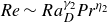 $\textit{Re}\sim Ra_{D}^{\gamma _2 }\textit{Pr}^{\eta _2}$ with respect to Rayleigh–Darcy number $Ra_D$ and Prandtl number $\textit{Pr}$. We derive $(\gamma _1,\gamma _2,\eta _1,\eta _2)=(2,1,0,-1)$ for the steady regime and $(1/3,4/9,0,-2/3)$ for the turbulent regime. All theoretical scaling exponents in these two regimes are validated by DNS results. Furthermore, we find that the influence of the Darcy number $Da$ becomes almost negligible when it is sufficiently small. Unified models for $\textit{Pr}=1$ are proposed to integrate the three regimes and are applicable across a broad range of $\phi$ and $Ra_D$, which are satisfactorily verified by DNS results. The unified models provide a predictive framework for heat transport and flow intensity in porous-medium thermal convection, thereby offering practical values for thermal engineering applications.


