To save content items to your account,
please confirm that you agree to abide by our usage policies.
If this is the first time you use this feature, you will be asked to authorise Cambridge Core to connect with your account.
Find out more about saving content to .
To save content items to your Kindle, first ensure no-reply@cambridge.org
is added to your Approved Personal Document E-mail List under your Personal Document Settings
on the Manage Your Content and Devices page of your Amazon account. Then enter the ‘name’ part
of your Kindle email address below.
Find out more about saving to your Kindle.
Note you can select to save to either the @free.kindle.com or @kindle.com variations.
‘@free.kindle.com’ emails are free but can only be saved to your device when it is connected to wi-fi.
‘@kindle.com’ emails can be delivered even when you are not connected to wi-fi, but note that service fees apply.
Since their publication in the 1950s and 1980s respectively, the Commentaries on the Geneva Conventions of 1949 and their Additional Protocols of 1977 have become a major reference for the application and interpretation of those treaties. The International Committee of the Red Cross, together with a team of renowned experts, is currently updating these Commentaries in order to document developments and provide up-to-date interpretations of the treaty texts. This article provides an introduction to the updated Commentary on Geneva Convention IV (GC IV), published online in 2025. It describes the methodology behind the updated Commentaries before explaining the historical background of bringing civilian protection into the framework of the Geneva Conventions. It then discusses how the structure of GC IV impacts its application and explains GC IV’s personal, geographic and temporal scope of application. The article summarizes key substantive protections provided in the Convention for civilians and their property during armed conflicts, including in situations of occupation, and points to where these are addressed in the updated Commentary.
To evaluate food marketing techniques used in Canadian recreation and sport facilities and assess the healthfulness of foods and beverages marketed by the techniques.
Design:
Cross-sectional content analysis of photographed food marketing instances coded for marketing techniques according to Health Canada’s Monitoring Protocol, developed for monitoring food marketing techniques across settings, supplemented with new inductively identified codes and sport-related marketing techniques. Healthfulness was classified as ‘of concern’ or ‘not of concern’ according to cut-offs of sodium, sugar and saturated fat established by Health Canada.
Setting:
Recreation and sport facilities in Canada
Participants:
134 facilities with 2576 food marketing instances
Results:
91·4 % of food marketing instances included at least one general marketing technique. Branded infrastructure, displays and furniture was the most prevalent (87·9 %) and appeared with another technique half of the time. Sport-related marketing appeared in 12·2 % of marketing instances, with most referring to sponsors. Most (86·5 %) marketing instances were ‘of concern’. Food marketing instances with sport-related marketing (97·6 %) were significantly more likely to be ‘of concern’ than without sport-related marketing (84·6 %) (χ2 = 20·54, P < 0·001). Three new indicators – appeals to taste, appeals to emotion, and cross-channel references – captured persuasive elements not addressed by the current monitoring protocol.
Conclusions:
This study highlights the presence of food branding and the use of sport-related marketing to promote unhealthy products/brands in recreation and sports facilities. Monitoring protocols may underestimate exposure to persuasive food marketing by overlooking subtle, symbolic and cross-channel techniques. Future research can be improved by including subtle techniques and reinforced messages across marketing channels.
The Covid-19 pandemic introduced new challenges for the long-term care (LTC) sector and changed how staff provided care to residents and families. For example, in Canada, LTC staff were required to implement social contact restrictions, while also supporting ‘virtual’ resident and family communication, with video conference visits becoming a primary strategy for this. The objective of this study was to explore Canadian LTC staff members’ experiences supporting virtual communication between residents and family members during the first year of the Covid-19 pandemic. A total of eight LTC staff with experience supporting or coordinating videoconference visits during this time were interviewed about their experiences. Interview data were analyzed using reflexive thematic analysis. Results revealed an overarching theme of holding it together – working with the imperfect to support resident and family communication – which encompassed four key subthemes: accepting distanced communication as a new normal, tolerating the discomfort of new roles, needing to rely on each other in difficult circumstances, and disconnect between policy and on-the-ground experience. The social contact policies that were introduced during the Covid-19 pandemic had never been tested over such a long duration of time. This study provides insight into the challenges of adapting some of these policies within LTC and may be valuable to ongoing planning for future outbreaks, epidemics, and pandemics, especially when considered alongside resident and family experiences.
The economic valuation of recreational ecosystem services is challenging due to difficulties in obtaining geo-tagged information of users. The objective of this study is to validate crowdsourced and user-generated content in order to predict visitation patterns to 16 national parks in Spain. The results may serve to encourage its utilization in the study of recreational demand in other countries, particularly developing countries, where on-site visitor information may be limited or expensive to gather. The present article employs a negative binomial regression model to evaluate the validity of two sources of data: Flickr and mobile phones. The accuracy of predictions exhibited variation across the 16 parks, indicating that site-specific characteristics, such as the seasonality of visitation patterns, may be of significance. The utilization of mobile phone data for modelling visitors yielded enhanced predictive capacity, as shown by the goodness of fit of the estimated models.
This article revisits Rayford Logan’s thesis in The Negro in American Life and Thought: The Nadir, 1877‒1901 to chart how African Americans experienced joy during a racial low point—“the Nadir” of race relations. Using Logan’s claims as a conceptual framework, the article examines W. E. B. Du Bois’s position on amusement and everyday Black people’s joyful acts during the post-Reconstruction period to understand “a paradox of pleasure”—feeling jovial during dark times. With the Nadir as a case study, this essay argues that historians may develop Black joy as a historical analytic by asking research questions about Black affect, employing the tools of historical imagination, and concentrating on the small delights of daily life. This essay seeks to inspire curiosity about how exploring Black life from the angle of elation, not sorrow, can produce complex histories of Black subjectivity and feeling. It proposes Black joy as an inchoate analytic in hopes of it becoming a formal mode of historical inquiry.
Water recreation is valuable to people, and its value can be affected by changes in water quality. This paper presents the results of a revealed preference survey to elicit coastal New England, USA, residents’ values for water recreation and water quality. We combined the survey responses with a comprehensive data set of coastal attributes, including in-water and remotely sensed water quality metrics. Using a travel cost model framework, we found water clarity and the bacterial conditions of coastal waters to be practical water quality inputs to economic analysis, available at appropriate scales, and meaningful to people and their behavior. Changes in clarity and bacterial conditions affected trip values, with a $4.5 change for a meter in clarity in Secchi depth and $0.08 for a one-unit bacteria change in colony-forming units per 100 ml. We demonstrate the large potential value of improving water quality through welfare analysis scenarios for Narragansett Bay, Rhode Island, and Cape Cod, Massachusetts, USA. The paper discusses lessons for improving the policy relevance and applicability of water quality valuation studies through improved water quality data collection, combined with the application of scalable analysis tools for valuation.
Limited studies have evaluated the impact of recreation on successful ageing (SA) for individuals with spinal cord injury (SCI) in a longitudinal manner. Most existing SA models emphasise biomedical-based dimensions of physical functioning, which has been criticised as unrealistic and limited, especially for people with disabilities. Various researchers and organisations have proposed that SA needs to be reassessed using more self-perceived, self-reported measurements. Understanding long-term life satisfaction predictors for individuals ageing with SCI is still limited, particularly when including longitudinal recreation participation data. This study, based on Rowe and Kahn's SA model and utilising self-reported measurements, observes the long-term changes in self-reported health status, recreation participation time and social integration levels, and evaluates the long-term impacts of these predictors on life satisfaction among individuals with SCI. The sample comprises individuals with SCI (N = 11,450) who are at least 45 years old at the time of injury or have lived with their injury for over 15 years. Results indicate that when ageing with SCI, life satisfaction increases over time, but their recreation time, social interactions and self-perceived health status decline. Moreover, regular participation in recreational activities, engagement in and maintenance of certain levels of social relationships, and high self-evaluation of health can positively impact life satisfaction during ageing. The study explores the feasibility of using self-perceived measurements to replace biomedical-based variables in Rowe and Kahn's SA model and examines their impacts on life satisfaction among people ageing with disabilities. In the future development of SA models, researchers can incorporate more self-reported, self-evaluated assessment variables to better capture the ageing experience, especially for people with disabilities.
Chapter 6 scrutinizes how the corporate structures set up by Texaco shaped social dynamics and daily life in the oil fields. Texaco’s facilities constituted fenced-off and almost independent spatial enclaves in the rainforest that ensured an unobstructed resource extraction based on imported labor and a “masculine” work ethic. The discriminatory hierarchies established within the oil industry shaped the experiences of the Ecuadorean and international oilmen. The workers’ position within the hierarchy of power also predisposed their relationship with nature: While the executive level was able to keep as much physical and emotional distance as possible, most oilmen were exposed to the hardships brought on by working in a tropical environment. While state institutions showed little presence in the region, national policies and military forces protected the oil companies’ interests, subdued protests by oilmen and the public, and contributed to solidify the new social order. This chapter explores for the first time the oilmen’s experiences from their own perspective, offering insights into the social dimension of the metamorphosis of the Amazon.
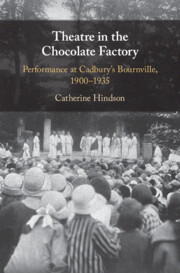
Cadbury’s represents the heyday of British industrialism and remains a familiar global brand. Guided by Quaker Capitalism, employees at Cadbury’s Bournville factory took part in recreational and educational activities. In the first decades of the twentieth century sports, leisure, and entertainment were part of day-to-day Cadbury’s life. Creativity flourished. Amidst this culture of Work and Play, an astonishing amount of factory theatre was staged involving tens of thousands of Cadbury’s employees. Home-grown Bournville casts and audiences were supplemented by performers, civic leaders, playwrights, academics, town planners, and celebrities, interweaving Birmingham’s famous Quaker industrialists with the city’s theatre culture, visual artists, wider, national entertainment cultures, and ground-breaking approaches to mental and physical health and education. Theatre in the Chocolate Factory uncovers stories of Bournville’s theatre and the employees who made it, exploring industrial performance and positioning theatre and creativity at the heart of Cadbury’s operation.
In Chapter 2, we move inside the Bournville factory. As Cadbury’s staff numbers grew over the first three decades of the twentieth century, several indoor performance spaces were created across the estate to accommodate the increasing number of entertainments created and staged in-house. These spaces varied enormously, from purpose-built parts of major factory expansions and developments, to found spaces that were temporarily re-appropriated for performance. Framed by a range of performance case studies, the chapter identifies the complexity of Cadbury’s indoor performance and explores the entwined recreational, promotional, and business functions theatrical activity served at the firm’s Bournville headquarters.
From 1908 to 1914, each summer party included a large-scale outdoor play, and these productions are considered in Chapter 4. Performed by casts of between 80 and 150 employees, between 1911 and 1914 these plays were written and produced by local theatrical personality John Drinkwater (1882–1937). Alongside other parties, charity occasions, and wartime entertainments that took place in the grounds, these performances demanded huge investments of time and money. What is clear is that they also offered a return, and these two chapters explores how outdoor theatrical events worked for and at Bournville and the ways in which they told stories about Cadbury’s and the Cadbury’s factory to in-house and external audiences.
This study aimed to better understand the extent to which older adult centres are a focal point for recreation and social activities for their members. Travel diaries completed by 261 members of 12 older adult centres across Ontario provided comprehensive and real-time (24-hour) data over two consecutive weeks concerning time away from home, trip purposes, and modes of travel. The data showed that nearly one-third of their trips included a stop at their older adult centre. Three-quarters also went to other community venues over the study period, possibly to access amenities (e.g., pools) not available at their centre. Notwithstanding, their local older adult centre was still a focal point in out-of-home travel, particularly for potentially more vulnerable older adults, including those who were non-drivers, had less education, and felt lonelier. The diaries also substantiated the importance of time spent socializing with peers and staff at the centre, apart from formal program participation.
Providing a new way of thinking about industrialism and its history through the lens of one of Britain's most recognisable heritage brands, Catherine Hindson explores the creativity that was at the heart of Cadbury's operation in the early twentieth century. Guided by Quaker Capitalism, employees at Bournville took part in recreational and educational activities, enabling imagination to flourish. Amidst this pattern of work and play arose the vibrant phenomenon that was factory theatre, with performances and productions involving tens of thousands of employees as performers and spectators. Home-grown Bournville casts and audiences were supplemented by performers, civic leaders, playwrights, academics, town planners, and celebrities, interweaving industrialists with the city's theatrical and visual arts as well as national entertainment cultures. This interdisciplinary study uncovers the stories of Bournville's theatre and the employees who made it, considering ground-breaking approaches to mental and physical health and education.
During the late colonial period’s nationalism and politics Africans made Western dress conventions their own. In recreation and leisure activities their dress performance developed new local appeals, dressing for freedom in the immediate pre-independence period and after. Sports clubs, especially football, the cinema, and women’s clubs promoting housekeeping and tailoring, provided spaces for social mixing as did the mining and municipal beerhalls that generated revenue for welfare activities. Popular culture, including traditional dance performances and ballroom dance competitions placed the dress of performers in focus. With independence in view (1964) politicians and their followers explored ways of expressing themselves through dress in the new nation.
A director who has facilitated Shakespeare programmes in prisons for fifteen years in conversation with a former prisoner who served eighteen years and who participated in four of those programmes. The authors explore the ways in which performative Shakespeare programmes fill a niche otherwise unoccupied in the prison system – a recreational programme that offers opportunities for collaboration, growth and the development of empathic and communication skills that are not constrained by a deficit-based and outcome-oriented pedagogy. The programme offers models of camaraderie and support that are not ‘in opposition to’ other groups, and promotes collaborative over individual achievement. The development of intrinsic motivation is a key component in functioning as a free citizen, but is actively discouraged by the correctional system. Prison Shakespeare programmes develop these skills in addition to offering a practical critique to the model of ‘toughness’ promoted by the prisoners’ own cultural milieu. The chapter speaks to the value of recreation for its own sake, and how it can be a vital component in both education and rehabilitation precisely because it does not set out to do either.
This article explores the All-Day Neighborhood Schools (ADNS) program, operated as a partnership between the New York City Board of Education and local philanthropists from 1936 to 1971. Designed to expand the resources available to children and parents, the program included after-school activities, additional teachers, professional development, social workers, and parent engagement at fourteen public elementary schools across the city. Through a study of two program sites, I examine how this public-private partnership functioned, and trace changes in the motivations of its leadership, from a focus on recreation and democracy during World War II, to juvenile delinquency prevention, to compensatory education. I argue that ADNS's ability to transform public schooling in New York City was limited by its separation from the rest of the school system, which came about through its dependance on outside philanthropy and its consistent formulation as a supplemental program rather than as a fundamental part of children's education.
Chapter 8 identifies the rationale and components of an integrated, locally based program for increasing the number, size, and cumulative benefits of natural environments in developed municipalities. Elements include (1) getting stakeholders to accept natural landforms and habitats as appropriate elements in a developed coastal landscape; (2) identifying environmental indicators and target reference conditions for new restoration sites using characteristics of nearby natural enclaves; (3) establishing demonstration sites to evaluate the positive and negative effects of return to a more dynamic system; (4) developing guidelines and protocols for restoring and managing landforms and habitats; and (5) developing education programs to establish an appreciation for naturally functioning landscape components. Suggestions are also made for managing litter and wrack, grading landforms, controlling vehicles on the beach, managing access paths across dunes, reducing structures on beaches and dunes, using vegetation for landscaping private lots, establishing programs for monitoring and adaptive management, and developing compatible legislation.
This chapter covers the recreational activities of servicewomen. The military authorities were sensitive to the off-duty pursuits of servicewomen and on occasion intervened in order to protect their ‘feminine virtue’. The chapter also deals with their romances with servicemen, incidences of sexual harassment, and lesbianism in the women’s forces. This latter issue was the subject of an ATS memorandum entitled ‘A Special Problem’.
Since their publication in the 1950s and 1980s respectively, the Commentaries on the Geneva Conventions of 1949 and their Additional Protocols of 1977 have become a major reference for the application and interpretation of those treaties. The International Committee of the Red Cross, together with a team of renowned experts, is currently updating these Commentaries in order to document developments and provide up-to-date interpretations of the treaty texts. This article highlights key points of interest covered in the updated Commentary on the Third Geneva Convention. It explains the fundamentals of the Convention: the historical background, the personal scope of application of the Convention and the fundamental protections that apply to all prisoners of war (PoWs). It then looks at the timing under which certain obligations are triggered, those prior to holding PoWs, those triggered by the taking of PoWs and during their captivity, and those at the end of a PoW's captivity. Finally, the article summarizes key substantive protections provided in the Third Convention.