To save content items to your account,
please confirm that you agree to abide by our usage policies.
If this is the first time you use this feature, you will be asked to authorise Cambridge Core to connect with your account.
Find out more about saving content to .
To save content items to your Kindle, first ensure no-reply@cambridge.org
is added to your Approved Personal Document E-mail List under your Personal Document Settings
on the Manage Your Content and Devices page of your Amazon account. Then enter the ‘name’ part
of your Kindle email address below.
Find out more about saving to your Kindle.
Note you can select to save to either the @free.kindle.com or @kindle.com variations.
‘@free.kindle.com’ emails are free but can only be saved to your device when it is connected to wi-fi.
‘@kindle.com’ emails can be delivered even when you are not connected to wi-fi, but note that service fees apply.
This paper examines clothing depicted in the portraits painted on the walls of the tombs of elites at various settlements in Campania and Lucania in southwest Italy in the fourth century BC, as it provides important information on sartorial appearances and self-perception, especially in view of the dearth of textiles and lack of textual sources. It investigates the interconnected relationship between dress behaviour, ethnic identity and social status among independent Italic groups in the region in this century, a time of political and cultural tensions triggered by Rome’s aggressive expansion of its territorial control. The images, as well as the material culture from grave assemblages, indicate that people expressed who they thought they were through clothing and dress accessories and that this happened on a local basis rather than on a large scale or ‘national’ level. It was predominantly women who were expressing group belonging through specific garments and styles, headdresses, colours and patterns. These images painted for perpetuity offer us a precious window on dress behaviour and they suggest that women were the primary bearers of small-scale community identities in funerary representation and in life in this period of political and social change.
The article aims to shed new light on the voices of bereaved benefactors: slaves, freedmen and freedwomen, who are often marginalized in literary and monumental sources, by exploring a series of unpublished funerary inscriptions from Rome, currently in storage at the Museo Nazionale Romano. Editions of the text, translations and commentaries have been produced by young scholars from the British School at Rome (former participants of the BSR Postgraduate Course in Epigraphy). Their entries, edited by Abigail Graham (Institute for Classical Studies, University of London, British School at Rome) and Silvia Orlandi (La Sapienza, President of the Association Internationale d’ Epigraphie Grecque et Latine), are an exciting and unique opportunity to view inscriptions through a different lens: from scholars with diverse backgrounds and interests (history, archaeology, epigraphy, as well as linguistics), including postgraduates and academics. Careful consideration of text, appearance and context presents an array of voices and audiences as well as poignant messages that transcend time and space through a common experience: grief. By incorporating interdisciplinary scholars in the editorial process, we aim to provide and promote uniquely accessible epigraphic discussions that reflect the broader impact and significance of epitaphs as texts, images and emotive experiences.
In the summer of 1924, a young Neapolitan scholar, Mario di Martino Fusco, claimed to have discovered the long-lost 107 books of Livy’s Ab Urbe Condita, sparking an international media frenzy. Announced prematurely by his supposed ally, Francesco Ribezzo, the claim captivated the scholarly world until it was definitively debunked. Drawing on a wide range of contemporary newspaper reports and scholarly reactions, this article reconstructs the unfolding of the Livy delusion: from Martino’s initial assertion, through journalistic hysteria and academic opportunism, to the final official inquiry revealing a misreading of a fourteenth-century reference. The episode not only ruined Martino’s career but also exposed the vulnerabilities of scholarly ambition, press sensationalism and nationalist rivalries in Fascist Italy. It remains one of the most extraordinary cases of literary delusion in classical scholarship, illustrating both the enduring allure of lost texts and the dangers of credulity and pride.
The Antikythera shipwreck provides a rare chronological anchor in the history of Greek sculpture. The cargo, a massive haul of more than four-dozen bronze and marble statues, in addition to amphorae and portable luxury goods, was lost at sea c. 70–50 BCE, possibly later, along the north-east coast of the island of Antikythera. Previous research on the sculptural assemblage from the wreck has focused on the style and iconographic heritage of individual statues. This article examines the statuary as a gathered whole to isolate trends in material, size, and subject matter. The results suggest a main setting where some, maybe all, of the statues might have originally been displayed: the gymnasion. The statues were probably obtained through plunder or extortion, not normal commercial activity. The study concludes by considering where the statues might have been set up once they reached their presumed destination in Italy. It is shown that the statues were most appropriate for display in a lavish public building in Rome.
Crete’s economy under Roman rule is associated primarily with production and distribution of wine, an interpretation resulting from textual and archaeological data. Several scholars have commented on the potential of oleoculture within the economic structure of Roman Crete, including reference to olive oil as a good for export, but there has been minimal follow up that considers the specific evidence available and its ability to shed light on these practices. This paper critically considers the evidence for oleoculture on Crete during the Roman period and its prospective role in the economic life of the island, including a focus on evidence for olive cultivation and the extent to which this points to surplus production. While there are indications of olive oil production across different parts of Crete, oleoculture may have focused primarily on supporting regional economic needs across the island. Some degree of export likely did occur, perhaps on a small scale and intermittently, but evidence is lacking to develop any interpretation beyond that. Such analysis is important not only for consideration of the Roman economy of Crete but also for addressing questions and concerns around the standard contents of transport amphoras, which remain one of the most important archaeological proxies for studying economic networks and the distribution of different products. Analysis of trade routes and distribution often rely on direct correlations between amphora types and their contents, and this must always be critically assessed.
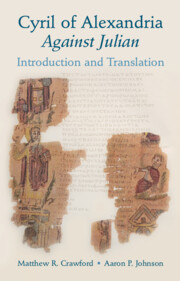
In 362/363 the Roman emperor Julian composed a treatise titled Against the Galileans in which he set forth his reasons for abandoning Christianity and returning to devotion to the traditional Greco-Roman deities. Sixty years later Cyril, bishop of Alexandria, composed a response. His resulting treatise Against Julian would dwarf the size of Julian's original work and in fact serves as our primary source for the fragments of it that have survived. Julian's treatise was the most sophisticated critique of Christianity to have been composed in antiquity and Cyril's rebuttal was equally learned. The Christian bishop not only responded directly to Julian's own words but drew upon a wide range of ancient literature, including poetry, history, philosophy, and religious works to undermine the emperor's critiques of the Christian Bible and bolster the intellectual legitimacy of Christian belief and practice. This is the first full translation of the work into English.
The Corpus of Latin Texts on Papyrus (CLTP) is a comprehensive, up-to-date, and unique reference tool in six volumes, gathering nearly 1,500 Latin texts on papyrus. Editions are provided with both a palaeographic and a critical apparatus, English translations, and detailed introductions. The texts in CLTP cover a wide chronological range and many different types and genres. They include both literary and documentary texts, dating from the first century BC to the Middle Ages. They provide new knowledge about the circulation of Latin, offering unique insights into textual transmission and indeed into Latin literature itself, but also into topics such as ancient education and multilingualism, economics, society, culture, and multiculturalism in the ancient Mediterranean world. The result is a lasting and crucial reference work for all those interested in the history of Latin and of the Roman world.
Origen of Alexandria stands at the headwaters of the entire history of Gospel reading. In this study of the earliest extant Gospel commentaries, Samuel Johnson explores questions, often associated with modern Gospel criticism, that were already formative of the first moments of the Christian interpretative tradition. Origen's approach to the Gospels in fact arose from straightforward historical and literary critical judgments: the Gospel narratives interweave things that happened with things that did not. Origen discerned that the Gospels depict events in Jesus's life not merely as matters of historical fact, but also figuratively. He did not just interpret the Gospels allegorically. Johnson demonstrates that Origen believed the Gospel writers themselves were figurative readers of the life of Jesus. Origen thus found no contradiction between discerning the truth of the Christian Gospels and facing the critical challenges of their literary form and formation. Johnson's study shows how they constitute a single unified vision.
This chapter examines attitudes to ancient relief sculpture through a comparison with painting. Focusing on the art of Rome, and especially on the representation of relief sculpture in Roman mural painting of the first centuries BCE and CE, the chapter looks to how ancient painting and relief fed off and reverberated around each other, to the ways in which they both overlapped and, ultimately, sought to distinguish themselves. Drawing on modern media theory, the chapter proposes that Roman relief and painting remediated one another through a double, oscillating logic of immediacy and hypermediacy – through the iterative alternation from communicative transparency to opacity and back. Thinking through relief and painting as reciprocally related media reveals the consistent blurring of boundaries between apparent opposites: two and three dimensions, real and pictorial space, haptic and optic, form and color, and illusion and fiction. The chapter further argues that the representation of relief sculpture within Roman murals permitted painters to explore the boundaries of their capabilities by offering both a material limit to pictorialization and providing ways in which the pictorial could seek to outflank the material.
While a three-dimensional statue may be photographed from any angle, some views are more pervasive than others, and a published photograph of an Attic grave relief not in a frontal view can hardly be found at all. Relief sculpture seems to ask for a frontal view, while sculpture in the round presents itself to the viewer wherever s/he stands. Since the late nineteenth century, however, there have also been attempts to limit the range of “possible” views onto freestanding sculpture by defining for each statue a principal view, or Hauptansicht. Such attempts thereby turn sculpture into relief. The conceptualization of sculpture as relief can be traced back both to sculptor Adolf Hildebrand’s Das Problem der Form in der bildenden Kunst (1893) and to the rise of photography in the academic study of sculpture. The practice of subjecting sculpture to a particular view, however, stretches even further back, at least to neoclassicism. Indeed, the privileging of one view is a compositional strategy in ancient sculpture itself. Yet in contrast to the photographic experience of a statue strictly limited to its “correct” view, the “bad” views, or nonprincipal views, still played a crucial role in the ancient aesthetic experience of sculpture.
This chapter addresses the relief features in Athenian vase painting – that is, the painted or gilded added clay affixed to the smooth bodies of vases. I argue that the primary purpose of relief features is the creation of a dynamic visual experience, either by facilitating light effects like reflections or by intensifying the presence of a represented figure. I begin with the origins of added-clay relief for the representation of hair in black-figure vase painting and show how it enhances the experience of reflectivity. Then, I consider relief mask kantharoi. Here, relief afforded the artist the opportunity to translate a two-dimensional pictorial image of the face of Dionysos or a satyr into a partially three-dimensional form. The effect of this was to intensify the sense of the visual presence of the god or satyr for the viewer. Finally, I review the interpretation of added-clay relief in vase painting as a means of creating a sense of pictorial space. Cohen, Hildebrand, and Riegl emphasize the relationship between relief and space, but I believe that in vase painting, relief serves primarily to make one more attuned to material surfaces and their qualities, not less.
This introduction opens the volume by considering the inherent multiplicity of the idea of relief, which even in the limited purview of the visual arts crosses boundaries of material, form, technique, genre, scale, and style. As a technical term referring to art, moreover, relief is not an ancient idea but a modern one, which first emerged from specific discourses surrounding Italian Renaissance art. The introduction briefly surveys the significance of the historiography of relief in discussions of ancient art before turning to three case studies of ancient vessels decorated in relief – an Archaic Greek pithos from Mykonos, the Derveni krater, and the Townley Vase – which concretely articulate the complexity and variety of ancient relief practices. It then concludes by introducing and offering a synopsis of the ten chapters that follow.