Refine search
Actions for selected content:
6974 results in Algorithmics, Complexity, Computer Algebra, Computational Geometry
On Regularity Lemmas and their Algorithmic Applications
-
- Journal:
- Combinatorics, Probability and Computing / Volume 26 / Issue 4 / July 2017
- Published online by Cambridge University Press:
- 28 March 2017, pp. 481-505
-
- Article
- Export citation
Uniform s-Cross-Intersecting Families
-
- Journal:
- Combinatorics, Probability and Computing / Volume 26 / Issue 4 / July 2017
- Published online by Cambridge University Press:
- 28 March 2017, pp. 517-524
-
- Article
- Export citation
-
In this paper we study a question related to the classical Erdős–Ko–Rado theorem, which states that any family of k-element subsets of the set [n] = {1,. . .,n} in which any two sets intersect has cardinality at most $\binom{n-1}{k-1}$ .
We say that two non-empty families ${\mathcal A}, {\mathcal B}\subset \binom{[n]}{k}$ are s-cross-intersecting if, for any A ∈ ${\mathcal A}$ , B ∈ ${\mathcal B}$ , we have |A ∩ B| ≥ s. In this paper we determine the maximum of | ${\mathcal A}$ |+| ${\mathcal B}$ | for all n. This generalizes a result of Hilton and Milner, who determined the maximum of | ${\mathcal A}$ |+| ${\mathcal B}$ | for non-empty 1-cross-intersecting families.


Minimum Codegree Threshold for C 6 3-Factors in 3-Uniform Hypergraphs
-
- Journal:
- Combinatorics, Probability and Computing / Volume 26 / Issue 4 / July 2017
- Published online by Cambridge University Press:
- 22 March 2017, pp. 536-559
-
- Article
- Export citation
Groups, Languages and Automata
-
- Published online:
- 16 March 2017
- Print publication:
- 23 February 2017
Preface
-
- Book:
- Finite Elements
- Published online:
- 14 December 2017
- Print publication:
- 16 March 2017, pp vii-viii
-
- Chapter
- Export citation
Contents
-
- Book:
- Finite Elements
- Published online:
- 14 December 2017
- Print publication:
- 16 March 2017, pp v-vi
-
- Chapter
- Export citation
Surprise Probabilities in Markov Chains
- Part of
-
- Journal:
- Combinatorics, Probability and Computing / Volume 26 / Issue 4 / July 2017
- Published online by Cambridge University Press:
- 16 March 2017, pp. 603-627
-
- Article
- Export citation
-
In a Markov chain started at a state x, the hitting time τ(y) is the first time that the chain reaches another state y. We study the probability $\mathbb{P}_x(\tau(y) = t)$ that the first visit to y occurs precisely at a given time t. Informally speaking, the event that a new state is visited at a large time t may be considered a ‘surprise’. We prove the following three bounds.
-
• In any Markov chain with n states, $\mathbb{P}_x(\tau(y) = t) \le {n}/{t}$ .
 -
• In a reversible chain with n states, $\mathbb{P}_x(\tau(y) = t) \le {\sqrt{2n}}/{t}$ for $t \ge 4n + 4$ .
 -
• For random walk on a simple graph with n ≥ 2 vertices, $\mathbb{P}_x(\tau(y) = t) \le 4e \log(n)/t$ .
To prove the bound for random walk on graphs, we establish the following estimate conjectured by Aldous, Ding and Oveis-Gharan (private communication): for random walk on an n-vertex graph, for every initial vertex x,
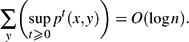 $$\sum_y \biggl( \sup_{t \ge 0} p^t(x, y) \biggr) = O(\log n). $$
 -

1 - Introduction to Sobolev Spaces
-
- Book:
- Finite Elements
- Published online:
- 14 December 2017
- Print publication:
- 16 March 2017, pp 1-14
-
- Chapter
- Export citation
6 - Parabolic problems
-
- Book:
- Finite Elements
- Published online:
- 14 December 2017
- Print publication:
- 16 March 2017, pp 87-118
-
- Chapter
- Export citation
Index
-
- Book:
- Finite Elements
- Published online:
- 14 December 2017
- Print publication:
- 16 March 2017, pp 207-208
-
- Chapter
- Export citation
Bibliography
-
- Book:
- Finite Elements
- Published online:
- 14 December 2017
- Print publication:
- 16 March 2017, pp 201-206
-
- Chapter
- Export citation
Frontmatter
-
- Book:
- Finite Elements
- Published online:
- 14 December 2017
- Print publication:
- 16 March 2017, pp i-iv
-
- Chapter
- Export citation
5 - Biharmonic equation
-
- Book:
- Finite Elements
- Published online:
- 14 December 2017
- Print publication:
- 16 March 2017, pp 59-86
-
- Chapter
- Export citation
7 - Systems in solid mechanics
-
- Book:
- Finite Elements
- Published online:
- 14 December 2017
- Print publication:
- 16 March 2017, pp 119-130
-
- Chapter
- Export citation
2 - Elliptic scalar problems
-
- Book:
- Finite Elements
- Published online:
- 14 December 2017
- Print publication:
- 16 March 2017, pp 15-26
-
- Chapter
- Export citation
4 - Interpolation and discretization error
-
- Book:
- Finite Elements
- Published online:
- 14 December 2017
- Print publication:
- 16 March 2017, pp 47-58
-
- Chapter
- Export citation
9 - Implementation of the finite element method
-
- Book:
- Finite Elements
- Published online:
- 14 December 2017
- Print publication:
- 16 March 2017, pp 171-200
-
- Chapter
- Export citation
3 - Finite element spaces
-
- Book:
- Finite Elements
- Published online:
- 14 December 2017
- Print publication:
- 16 March 2017, pp 27-46
-
- Chapter
- Export citation
8 - Systems in fluid mechanics
-
- Book:
- Finite Elements
- Published online:
- 14 December 2017
- Print publication:
- 16 March 2017, pp 131-170
-
- Chapter
- Export citation
A Stability Result for Families with Fixed Diameter
- Part of
-
- Journal:
- Combinatorics, Probability and Computing / Volume 26 / Issue 4 / July 2017
- Published online by Cambridge University Press:
- 06 March 2017, pp. 506-516
-
- Article
- Export citation
-
Let $\mathcal F$ ⊂ 2[n] be a family of subsets. The diameter of $\mathcal F$ is the maximum of the size of symmetric differences among pairs of members of $\mathcal F$ . In 1966 Kleitman determined the maximum of | $\mathcal F$ | for fixed diameter. However, this important classical result lacked a characterization of the families meeting the bound. This is remedied in the present paper, where a best possible stability result is established as well.
In Section 4 we introduce a ‘parity trick’ that provides an easy way of deducing the odd case from the even case in both Kleitman's original theorem and its stability version.

