Refine search
Actions for selected content:
6974 results in Algorithmics, Complexity, Computer Algebra, Computational Geometry
7 - Monotone cellular automata
-
-
- Book:
- Surveys in Combinatorics 2017
- Published online:
- 21 July 2017
- Print publication:
- 30 June 2017, pp 312-371
-
- Chapter
- Export citation
9 - Some applications of relative entropy in additive combinatorics
-
-
- Book:
- Surveys in Combinatorics 2017
- Published online:
- 21 July 2017
- Print publication:
- 30 June 2017, pp 409-442
-
- Chapter
- Export citation
Fractional Clique Decompositions of Dense Partite Graphs
- Part of
-
- Journal:
- Combinatorics, Probability and Computing / Volume 26 / Issue 6 / November 2017
- Published online by Cambridge University Press:
- 19 June 2017, pp. 911-943
-
- Article
- Export citation
Corners Over Quasirandom Groups
- Part of
-
- Journal:
- Combinatorics, Probability and Computing / Volume 26 / Issue 6 / November 2017
- Published online by Cambridge University Press:
- 06 June 2017, pp. 944-951
-
- Article
- Export citation
-
Let G be a finite D-quasirandom group and A ⊂ G k a δ-dense subset. Then the density of the set of side lengths g of corners
converges to 1 as D → ∞. $$\{(a_{1},\dotsc,a_{k}),(ga_{1},a_{2},\dotsc,a_{k}),\dotsc,(ga_{1},\dotsc,ga_{k})\} \subset A$$
On the Maximum Number of Spanning Copies of an Orientation in a Tournament
- Part of
-
- Journal:
- Combinatorics, Probability and Computing / Volume 26 / Issue 5 / September 2017
- Published online by Cambridge University Press:
- 06 June 2017, pp. 775-796
-
- Article
- Export citation
Convex Polygons in Geometric Triangulations†
- Part of
-
- Journal:
- Combinatorics, Probability and Computing / Volume 26 / Issue 5 / September 2017
- Published online by Cambridge University Press:
- 30 May 2017, pp. 641-659
-
- Article
- Export citation
Critical Window for Connectivity in the Configuration Model
- Part of
-
- Journal:
- Combinatorics, Probability and Computing / Volume 26 / Issue 5 / September 2017
- Published online by Cambridge University Press:
- 29 May 2017, pp. 660-680
-
- Article
- Export citation
Frank Ramsey
-
- Journal:
- Combinatorics, Probability and Computing / Volume 12 / Issue 5-6 / November 2003
- Published online by Cambridge University Press:
- 25 May 2017, pp. 469-475
-
- Article
-
- You have access
- Export citation
Special Issue on Ramsey Theory
-
- Journal:
- Combinatorics, Probability and Computing / Volume 12 / Issue 5-6 / November 2003
- Published online by Cambridge University Press:
- 25 May 2017, p. 467
-
- Article
- Export citation
The Proofs of Two Directed Paths Conjectures of Bollobás and Leader
- Part of
-
- Journal:
- Combinatorics, Probability and Computing / Volume 26 / Issue 5 / September 2017
- Published online by Cambridge University Press:
- 22 May 2017, pp. 762-774
-
- Article
- Export citation
Mixing in High-Dimensional Expanders
-
- Journal:
- Combinatorics, Probability and Computing / Volume 26 / Issue 5 / September 2017
- Published online by Cambridge University Press:
- 17 May 2017, pp. 746-761
-
- Article
- Export citation
Bridge-Addability, Edge-Expansion and Connectivity
- Part of
-
- Journal:
- Combinatorics, Probability and Computing / Volume 26 / Issue 5 / September 2017
- Published online by Cambridge University Press:
- 11 May 2017, pp. 697-719
-
- Article
- Export citation
Comparing Graphs of Different Sizes
- Part of
-
- Journal:
- Combinatorics, Probability and Computing / Volume 26 / Issue 5 / September 2017
- Published online by Cambridge University Press:
- 02 May 2017, pp. 681-696
-
- Article
- Export citation
Sets in Almost General Position
- Part of
-
- Journal:
- Combinatorics, Probability and Computing / Volume 26 / Issue 5 / September 2017
- Published online by Cambridge University Press:
- 18 April 2017, pp. 720-745
-
- Article
- Export citation
CPC volume 24 issue 1 Cover and Front matter
-
- Journal:
- Combinatorics, Probability and Computing / Volume 24 / Issue 1 / January 2015
- Published online by Cambridge University Press:
- 08 April 2017, pp. f1-f2
-
- Article
-
- You have access
- Export citation
CPC volume 24 issue 1 Cover and Back matter
-
- Journal:
- Combinatorics, Probability and Computing / Volume 24 / Issue 1 / January 2015
- Published online by Cambridge University Press:
- 08 April 2017, pp. b1-b3
-
- Article
-
- You have access
- Export citation
Stability and Turán Numbers of a Class of Hypergraphs via Lagrangians
- Part of
-
- Journal:
- Combinatorics, Probability and Computing / Volume 26 / Issue 3 / May 2017
- Published online by Cambridge University Press:
- 29 March 2017, pp. 367-405
-
- Article
- Export citation
-
Given a family of r-uniform hypergraphs ${\cal F}$ (or r-graphs for brevity), the Turán number ex(n, ${\cal F})$ of ${\cal F}$ is the maximum number of edges in an r-graph on n vertices that does not contain any member of ${\cal F}$ . A pair {u,v} is covered in a hypergraph G if some edge of G contains {u, v}. Given an r-graph F and a positive integer p ⩾ n(F), where n(F) denotes the number of vertices in F, let HFp denote the r-graph obtained as follows. Label the vertices of F as v 1,. . .,vn (F). Add new vertices vn(F)+1 ,. . .,vp . For each pair of vertices vi, vj not covered in F, add a set Bi,j of r − 2 new vertices and the edge {vi, vj } ∪ Bi,j , where the Bi,j are pairwise disjoint over all such pairs {i, j}. We call HFp the expanded p-clique with an embedded F. For a relatively large family of F, we show that for all sufficiently large n, ex(n,HFp ) = |Tr (n, p − 1)|, where Tr (n, p − 1) is the balanced complete (p − 1)-partite r-graph on n vertices. We also establish structural stability of near-extremal graphs. Our results generalize or strengthen several earlier results and provide a class of hypergraphs for which the Turán number is exactly determined (for large n).

An Inequality for Functions on the Hamming Cube
- Part of
-
- Journal:
- Combinatorics, Probability and Computing / Volume 26 / Issue 3 / May 2017
- Published online by Cambridge University Press:
- 29 March 2017, pp. 468-480
-
- Article
- Export citation
Erdős–Ko–Rado for Random Hypergraphs: Asymptotics and Stability
- Part of
-
- Journal:
- Combinatorics, Probability and Computing / Volume 26 / Issue 3 / May 2017
- Published online by Cambridge University Press:
- 29 March 2017, pp. 406-422
-
- Article
- Export citation
-
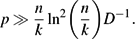
We investigate the asymptotic version of the Erdős–Ko–Rado theorem for the random k-uniform hypergraph $\mathcal{H}$ k (n, p). For 2⩽k(n) ⩽ n/2, let $N=\binom{n}k$ and $D=\binom{n-k}k$ . We show that with probability tending to 1 as n → ∞, the largest intersecting subhypergraph of $\mathcal{H}$ has size for any
 $$(1+o(1))p\ffrac kn N$$ This lower bound on p is asymptotically best possible for k = Θ(n). For this range of k and p, we are able to show stability as well.
 $$p\gg \ffrac nk\ln^2\biggl(\ffrac nk\biggr)D^{-1}.$$
 A different behaviour occurs when k = o(n). In this case, the lower bound on p is almost optimal. Further, for the small interval D −1 ≪ p ⩽ (n/k)1−ϵ D −1, the largest intersecting subhypergraph of
$\mathcal{H}$ k (n, p) has size Θ(ln(pD)ND −1), provided that  $k \gg \sqrt{n \ln n}$ .
Together with previous work of Balogh, Bohman and Mubayi, these results settle the asymptotic size of the largest intersecting family in
$\mathcal{H}$ k , for essentially all values of p and k.


Simply Generated Non-Crossing Partitions
-
- Journal:
- Combinatorics, Probability and Computing / Volume 26 / Issue 4 / July 2017
- Published online by Cambridge University Press:
- 28 March 2017, pp. 560-592
-
- Article
- Export citation
