Refine search
Actions for selected content:
7008 results in Algorithmics, Complexity, Computer Algebra, Computational Geometry
Large Deviations and Ratio Limit Theorems for Pattern-Avoiding Permutations
-
- Journal:
- Combinatorics, Probability and Computing / Volume 23 / Issue 2 / March 2014
- Published online by Cambridge University Press:
- 13 December 2013, pp. 161-200
-
- Article
- Export citation
-
For a fixed permutation τ, let $\mathcal{S}_N(\tau)$ be the set of permutations on N elements that avoid the pattern τ. Madras and Liu (2010) conjectured that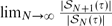 $\lim_{N\rightarrow\infty}\frac{|\mathcal{S}_{N+1}(\tau)|}{ |\mathcal{S}_N(\tau)|}$ exists; if it does, it must equal the Stanley–Wilf limit. We prove the conjecture for every permutation τ of length 5 or less, as well as for some longer cases (including 704 of the 720 permutations of length 6). We also consider permutations drawn at random from $\mathcal{S}_N(\tau)$, and we investigate properties of their graphs (viewing permutations as functions on {1,. . .,N}) scaled down to the unit square [0,1]2. We prove exact large deviation results for these graphs when τ has length 3; it follows, for example, that it is exponentially unlikely for a random 312-avoiding permutation to have points above the diagonal strip |y−x| < ε, but not unlikely to have points below the strip. For general τ, we show that some neighbourhood of the upper left corner of [0,1]2 is exponentially unlikely to contain a point of the graph if and only if τ starts with its largest element. For patterns such as τ=4231 we establish that this neighbourhood can be extended along the sides of [0,1]2 to come arbitrarily close to the corner points (0,0) and (1,1), as simulations had suggested.

Effective Mathematics of the Uncountable
-
- Published online:
- 05 December 2013
- Print publication:
- 31 October 2013
CPC volume 23 issue 1 Cover and Back matter
-
- Journal:
- Combinatorics, Probability and Computing / Volume 23 / Issue 1 / January 2014
- Published online by Cambridge University Press:
- 03 December 2013, pp. b1-b2
-
- Article
-
- You have access
- Export citation
Almost Every Tree With m Edges Decomposes K2m,2m
-
- Journal:
- Combinatorics, Probability and Computing / Volume 23 / Issue 1 / January 2014
- Published online by Cambridge University Press:
- 03 December 2013, pp. 50-65
-
- Article
- Export citation
CPC volume 23 issue 1 Cover and Front matter
-
- Journal:
- Combinatorics, Probability and Computing / Volume 23 / Issue 1 / January 2014
- Published online by Cambridge University Press:
- 03 December 2013, pp. f1-f2
-
- Article
-
- You have access
- Export citation
Conflict-Free Colouring of Graphs
-
- Journal:
- Combinatorics, Probability and Computing / Volume 23 / Issue 3 / May 2014
- Published online by Cambridge University Press:
- 29 November 2013, pp. 434-448
-
- Article
- Export citation
Linear Index Coding via Semidefinite Programming†
-
- Journal:
- Combinatorics, Probability and Computing / Volume 23 / Issue 2 / March 2014
- Published online by Cambridge University Press:
- 29 November 2013, pp. 223-247
-
- Article
- Export citation
Site Percolation on the d-Dimensional Hamming Torus
-
- Journal:
- Combinatorics, Probability and Computing / Volume 23 / Issue 2 / March 2014
- Published online by Cambridge University Press:
- 29 November 2013, pp. 290-315
-
- Article
- Export citation
-
The d-dimensional Hamming torus is the graph whose vertices are all of the integer points inside an a1n × a2n × ⋅⋅⋅ × adn box in $\mathbb{R}^d$ (for constants a1, . . ., ad > 0), and whose edges connect all vertices within Hamming distance one. We study the size of the largest connected component of the subgraph generated by independently removing each vertex of the Hamming torus with probability 1 − p. We show that if p = λ/n, then there exists λc > 0, which is the positive root of a degree d polynomial whose coefficients depend on a1, . . ., ad, such that for λ < λc the largest component has O(log n) vertices (w.h.p. as n → ∞), and for λ > λc the largest component has $(1-q) \lambda \bigl(\prod_i a_i \bigr) n^{d-1} + o (n^{d-1})$ vertices and the second largest component has O(log n) vertices w.h.p. An implicit formula for q < 1 is also given. The value of λc that we find is distinct from the critical value for the emergence of a giant component in bond percolation on the Hamming torus.

Greedy Random Walk
-
- Journal:
- Combinatorics, Probability and Computing / Volume 23 / Issue 2 / March 2014
- Published online by Cambridge University Press:
- 20 November 2013, pp. 269-289
-
- Article
- Export citation
-
We study a discrete time self-interacting random process on graphs, which we call greedy random walk. The walker is located initially at some vertex. As time evolves, each vertex maintains the set of adjacent edges touching it that have not yet been crossed by the walker. At each step, the walker, being at some vertex, picks an adjacent edge among the edges that have not traversed thus far according to some (deterministic or randomized) rule. If all the adjacent edges have already been traversed, then an adjacent edge is chosen uniformly at random. After picking an edge the walker jumps along it to the neighbouring vertex. We show that the expected edge cover time of the greedy random walk is linear in the number of edges for certain natural families of graphs. Examples of such graphs include the complete graph, even degree expanders of logarithmic girth, and the hypercube graph. We also show that GRW is transient in $\mathbb{Z}^d$ for all d ≥ 3.

The Distance-t Chromatic Index of Graphs
-
- Journal:
- Combinatorics, Probability and Computing / Volume 23 / Issue 1 / January 2014
- Published online by Cambridge University Press:
- 14 November 2013, pp. 90-101
-
- Article
- Export citation
Finding Hidden Cliques in Linear Time with High Probability
-
- Journal:
- Combinatorics, Probability and Computing / Volume 23 / Issue 1 / January 2014
- Published online by Cambridge University Press:
- 14 November 2013, pp. 29-49
-
- Article
- Export citation
-
We are given a graph G with n vertices, where a random subset of k vertices has been made into a clique, and the remaining edges are chosen independently with probability $\frac12$. This random graph model is denoted $G(n,\frac12,k)$. The hidden clique problem is to design an algorithm that finds the k-clique in polynomial time with high probability. An algorithm due to Alon, Krivelevich and Sudakov [3] uses spectral techniques to find the hidden clique with high probability when $k = c \sqrt{n}$ for a sufficiently large constant c > 0. Recently, an algorithm that solves the same problem was proposed by Feige and Ron [12]. It has the advantages of being simpler and more intuitive, and of an improved running time of O(n2). However, the analysis in [12] gives a success probability of only 2/3. In this paper we present a new algorithm for finding hidden cliques that both runs in time O(n2) (that is, linear in the size of the input) and has a failure probability that tends to 0 as n tends to ∞. We develop this algorithm in the more general setting where the clique is replaced by a dense random graph.


Mixing Times and Moving Targets
-
- Journal:
- Combinatorics, Probability and Computing / Volume 23 / Issue 3 / May 2014
- Published online by Cambridge University Press:
- 14 November 2013, pp. 460-476
-
- Article
- Export citation
Component Games on Regular Graphs
-
- Journal:
- Combinatorics, Probability and Computing / Volume 23 / Issue 1 / January 2014
- Published online by Cambridge University Press:
- 04 November 2013, pp. 75-89
-
- Article
- Export citation
Short Proofs of Some Extremal Results
-
- Journal:
- Combinatorics, Probability and Computing / Volume 23 / Issue 1 / January 2014
- Published online by Cambridge University Press:
- 04 November 2013, pp. 8-28
-
- Article
- Export citation
Local computability and uncountable structures
-
-
- Book:
- Effective Mathematics of the Uncountable
- Published online:
- 05 December 2013
- Print publication:
- 31 October 2013, pp 81-123
-
- Chapter
- Export citation
Frontmatter
-
- Book:
- Effective Mathematics of the Uncountable
- Published online:
- 05 December 2013
- Print publication:
- 31 October 2013, pp i-iv
-
- Chapter
- Export citation
Effective model theory: approach via σ-definability
-
-
- Book:
- Effective Mathematics of the Uncountable
- Published online:
- 05 December 2013
- Print publication:
- 31 October 2013, pp 164-197
-
- Chapter
- Export citation
Contents
-
- Book:
- Effective Mathematics of the Uncountable
- Published online:
- 05 December 2013
- Print publication:
- 31 October 2013, pp v-vi
-
- Chapter
- Export citation
Reverse mathematics, countable and uncountable: a computational approach
-
-
- Book:
- Effective Mathematics of the Uncountable
- Published online:
- 05 December 2013
- Print publication:
- 31 October 2013, pp 150-163
-
- Chapter
- Export citation
Borel structures: a brief survey
-
-
- Book:
- Effective Mathematics of the Uncountable
- Published online:
- 05 December 2013
- Print publication:
- 31 October 2013, pp 124-134
-
- Chapter
- Export citation
