Refine search
Actions for selected content:
212700 results in Engineering

Hydraulic fractures of the dipole type subject to fluid withdrawal through a conduit
-
- Journal:
- Journal of Fluid Mechanics / Volume 1007 / 25 March 2025
- Published online by Cambridge University Press:
- 17 March 2025, A44
-
- Article
- Export citation
-
We study the dynamics of fracture deflation following hydraulic fracturing of an infinite elastic solid, with fluid removal from a narrow conduit at the centre. This process involves coupled lubricating flow and elastic deformation, now subject to appropriate descriptions of fluid removal through the conduit towards the ambient, driven by elastic stresses and extraction/suction. When the influence of material toughness is negligible, the dynamics is found to be governed by two dimensionless parameters that describe the relative influence of elasticity-driven backflow ( $\Pi _c$) and ambient-pressure-driven backflow ( $\Pi _e$), respectively. We also found that the fracture’s thickness eventually approaches zero at the centre, while the fracture evolves into a self-similar shape of the dipole type that conserves the dipole moment $M$. The fracture’s front continues to elongate according to $x_f \propto t^{1/9}$, while the total fluid volume within the fracture decreases according to $V \propto t^{-1/9}$. The model and solutions might find use in practical problems to estimate the rate of backflow and effective permeability of a fractured reservoir once pressure is released.


Aerodynamic deformation and breakup of wall-attached droplets in axisymmetric stagnation airflow
-
- Journal:
- Journal of Fluid Mechanics / Volume 1007 / 25 March 2025
- Published online by Cambridge University Press:
- 17 March 2025, A48
-
- Article
- Export citation

Numerical study of the supersonic impinging jet oscillation and tone generation mechanism
-
- Journal:
- Journal of Fluid Mechanics / Volume 1007 / 25 March 2025
- Published online by Cambridge University Press:
- 17 March 2025, A58
-
- Article
- Export citation

The dynamics of a thick fluid layer with a tilted rotation vector
-
- Journal:
- Journal of Fluid Mechanics / Volume 1007 / 25 March 2025
- Published online by Cambridge University Press:
- 17 March 2025, A61
-
- Article
- Export citation

Features of double-frequency triad interactions in the nonlinear response to a moving load on a floating ice sheet
-
- Journal:
- Journal of Fluid Mechanics / Volume 1007 / 25 March 2025
- Published online by Cambridge University Press:
- 17 March 2025, A50
-
- Article
- Export citation
Predictive monitoring of asset populations in a rotating plant under operational uncertainty: a transfer learning approach
-
- Journal:
- Data-Centric Engineering / Volume 6 / 2025
- Published online by Cambridge University Press:
- 17 March 2025, e21
-
- Article
-
- You have access
- Open access
- HTML
- Export citation

Dynamics of floating droplets under the action of an inclined temperature gradient
-
- Journal:
- Journal of Fluid Mechanics / Volume 1007 / 25 March 2025
- Published online by Cambridge University Press:
- 17 March 2025, A51
-
- Article
- Export citation

Axisymmetric evolution of thin films in spin coating
-
- Journal:
- Journal of Fluid Mechanics / Volume 1007 / 25 March 2025
- Published online by Cambridge University Press:
- 17 March 2025, A56
-
- Article
- Export citation

Three-dimensional coherent structures in a curved pipe flow
-
- Journal:
- Journal of Fluid Mechanics / Volume 1007 / 25 March 2025
- Published online by Cambridge University Press:
- 17 March 2025, A34
-
- Article
-
- You have access
- Open access
- HTML
- Export citation

Gravity-driven film flow over isolated topography in a circular pipe
-
- Journal:
- Journal of Fluid Mechanics / Volume 1007 / 25 March 2025
- Published online by Cambridge University Press:
- 17 March 2025, A57
-
- Article
-
- You have access
- Open access
- HTML
- Export citation

Mass transport by ciliary point torques in flow
-
- Journal:
- Journal of Fluid Mechanics / Volume 1007 / 25 March 2025
- Published online by Cambridge University Press:
- 14 March 2025, A14
-
- Article
-
- You have access
- Open access
- HTML
- Export citation

Morphological evolutions and transverse dynamics of strong transverse wave structure in detonations near critical propagation state
-
- Journal:
- Journal of Fluid Mechanics / Volume 1007 / 25 March 2025
- Published online by Cambridge University Press:
- 14 March 2025, A12
-
- Article
- Export citation
-
Two-dimensional gaseous detonations near critical propagation state were studied numerically in a channel with stoichiometric H $_2$/air and H $_2$/O $_2$ mixtures. Detonation waves exhibit a mode-locking effect (MLE) in a single-headed mode regime. Increasing the channel width alters the strength and propagation period of the single transverse wave. This leads to MLE failure and the occurrence of the single-dual-headed critical mode, featuring the emergence of a new transverse wave. For a stoichiometric H $_2$/air mixture, generation of the new transverse wave is due to interactions between the detonation front and the local explosion wave originating from interactions between the transverse wave and unreacted gas pocket downstream. Whereas, for a stoichiometric H $_2$/O $_2$ mixture, a transverse wave interacting with the wall produces Mach reflection bifurcation, causing MLE failure and generation of the new transverse wave. Our results show that all transverse waves manifest as strong transverse wave (STW) structures, with most belonging to the second kind, and an acoustic coupling exists between the typical second kind of STW structure and the acoustic wave in the induction zone behind the Chapman–Jouguet detonation front. A high-pressure region close to the STW structure plays a crucial role in exploring the transverse dynamics of this structure. Shock polars with rational assumptions are adopted to predict flow states in this region. The roles of pivotal factors in influencing the flow states and wave structure are clarified, and characteristic pressure values derived adequately represent the STW structure’s transverse dynamic behaviours. Lastly, the relationship between the kinematics and kinds of STW structures is unveiled.


Spectral characteristics of the heat release rate in confined turbulent flames
-
- Journal:
- Journal of Fluid Mechanics / Volume 1007 / 25 March 2025
- Published online by Cambridge University Press:
- 14 March 2025, A29
-
- Article
-
- You have access
- Open access
- HTML
- Export citation
-
The broad-band direct combustion noise is an important problem for industrial and domestic burners. The power spectral density (PSD) of this noise is related to the local spectral density of fluctuating heat release rate (HRR) ( $\psi _{\dot {q}}$), which is challenging to measure but is readily available from large eddy simulations (LES) results. The behaviour of $\psi _{\dot {q}}$ for a wide range of thermochemical and turbulence conditions is investigated. Three burners are studied, namely a dual-swirl burner, a bluff-body burner and a jet in cross-flow burner, operating at atmospheric conditions with $\textrm {CH}_4$–air and $\textrm {H}_2$–air mixtures. In contrast to the classical $f^{-5/2}$ scaling, the far-field sound pressure level and volume-integrated HRR ( $\psi _{\dot {Q}}$) spectra reveal a universal $f^{-5}$ scaling for high frequencies. This differing spectral decay rate for $\psi _{\dot {Q}}$ compared to the classical scaling is due to multi-regime combustion, related to either partial premixing or the local turbulence intensity. The dependence of $\psi _{\dot {q}}$ on the chosen spatial locations, flame configuration and its relation to velocity spectra are studied. A simple model for $\psi _{\dot {q}}$ involving the velocity spectra is found that compares well with LES results. The characteristic frequency involved in this model is related to the time scale of the coherent structures of the flow.


Evaporation-driven coalescence of two droplets undergoing freezing
-
- Journal:
- Journal of Fluid Mechanics / Volume 1006 / 10 March 2025
- Published online by Cambridge University Press:
- 14 March 2025, A21
-
- Article
-
- You have access
- Open access
- HTML
- Export citation

Principles of hydrodynamic particle manipulation in internal Stokes flow
-
- Journal:
- Journal of Fluid Mechanics / Volume 1007 / 25 March 2025
- Published online by Cambridge University Press:
- 14 March 2025, A33
-
- Article
-
- You have access
- Open access
- HTML
- Export citation
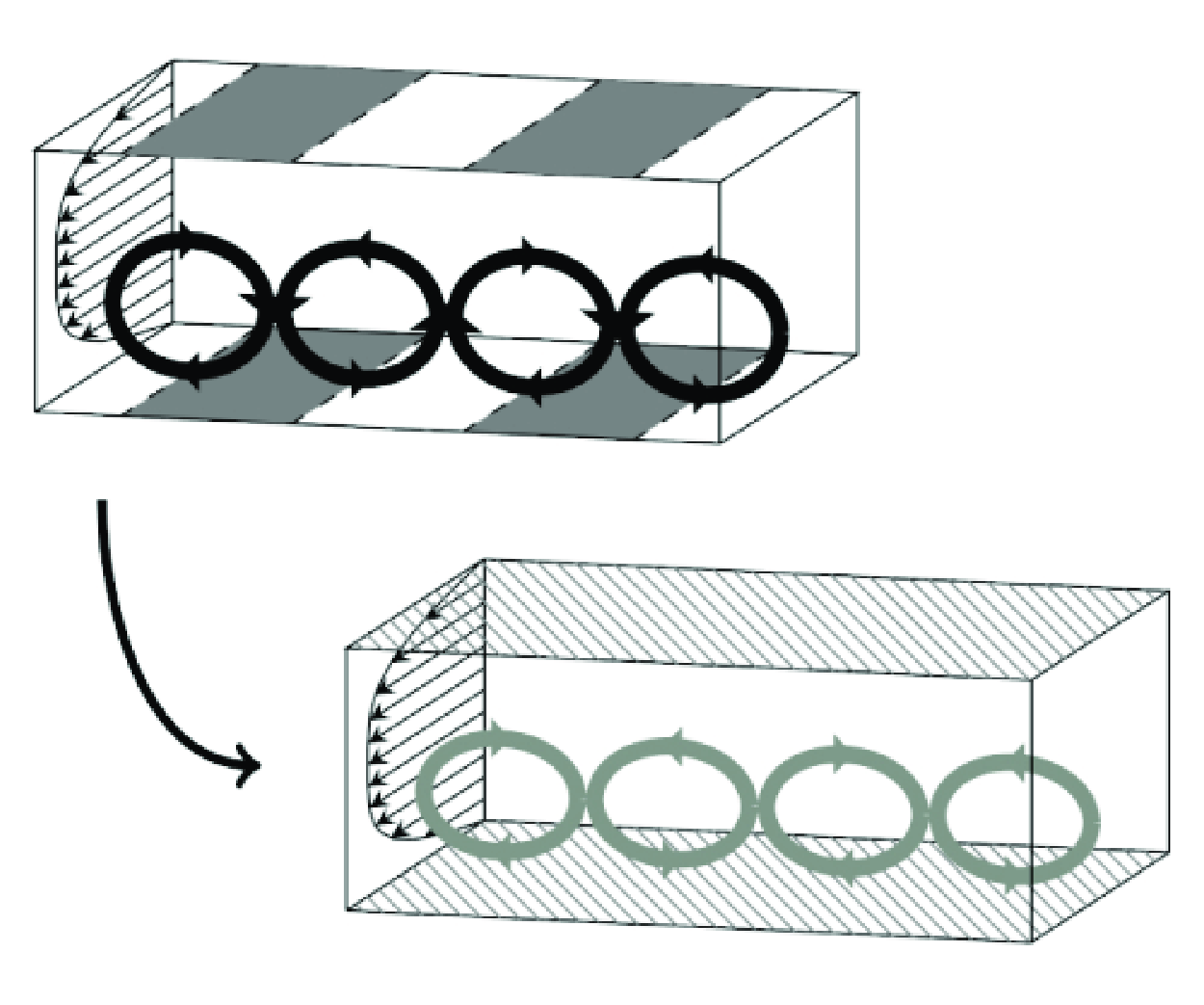
Temporal decay of secondary motions in turbulent channel flows
-
- Journal:
- Journal of Fluid Mechanics / Volume 1007 / 25 March 2025
- Published online by Cambridge University Press:
- 14 March 2025, A19
-
- Article
-
- You have access
- Open access
- HTML
- Export citation
-
We perform direct numerical simulations of turbulent channel flows. Secondary motions are produced by applying a streamwise-homogeneous, spanwise-heterogeneous roughness pattern of spanwise period $\Lambda _s$ to the walls of the channel; their time evolution is observed. Notice that, owing to the geometry, the secondary motions are streamwise-invariant at any instant of time, so that no spatial development is seen. Once the secondary motions reach a statistically steady state, the roughness pattern is suddenly removed, so that the secondary motions decay. The time needed for the secondary motions to vanish is then measured; in doing so, we distinguish between the streamwise-momentum pathways and the cross-sectional circulatory motions that compose the secondary motions. Larger values of $\Lambda _s$ are generally associated with a longer time scale for the decay of the momentum pathways, although this might not hold true for $\Lambda _s/h\gt 4$ (where $h$ is the channel half-height). The value of such a time scale for the circulatory motions, instead, saturates for $\Lambda _s/h \geqslant 2$; this may be related to the observed spatial confinement of said circulatory motions. For specific values of $\Lambda _s$ ( $2 \leqslant \Lambda _s/h \leqslant 4$), the volume-averaged energy associated with the momentum pathways undergoes an unexpected transient growth with respect to its value at the beginning of the decay. This might indicate that structures of such a specific size are able to self-sustain as postulated by Townsend (The Structure of Turbulent Shear Flow, 2nd edition, 1976, ch. 7.19); the evidence we gather in this respect is however inconclusive. Finally, the present data suggest that most of the energy of the momentum pathways is produced by the circulatory motions transporting the mean (spanwise-averaged) velocity.


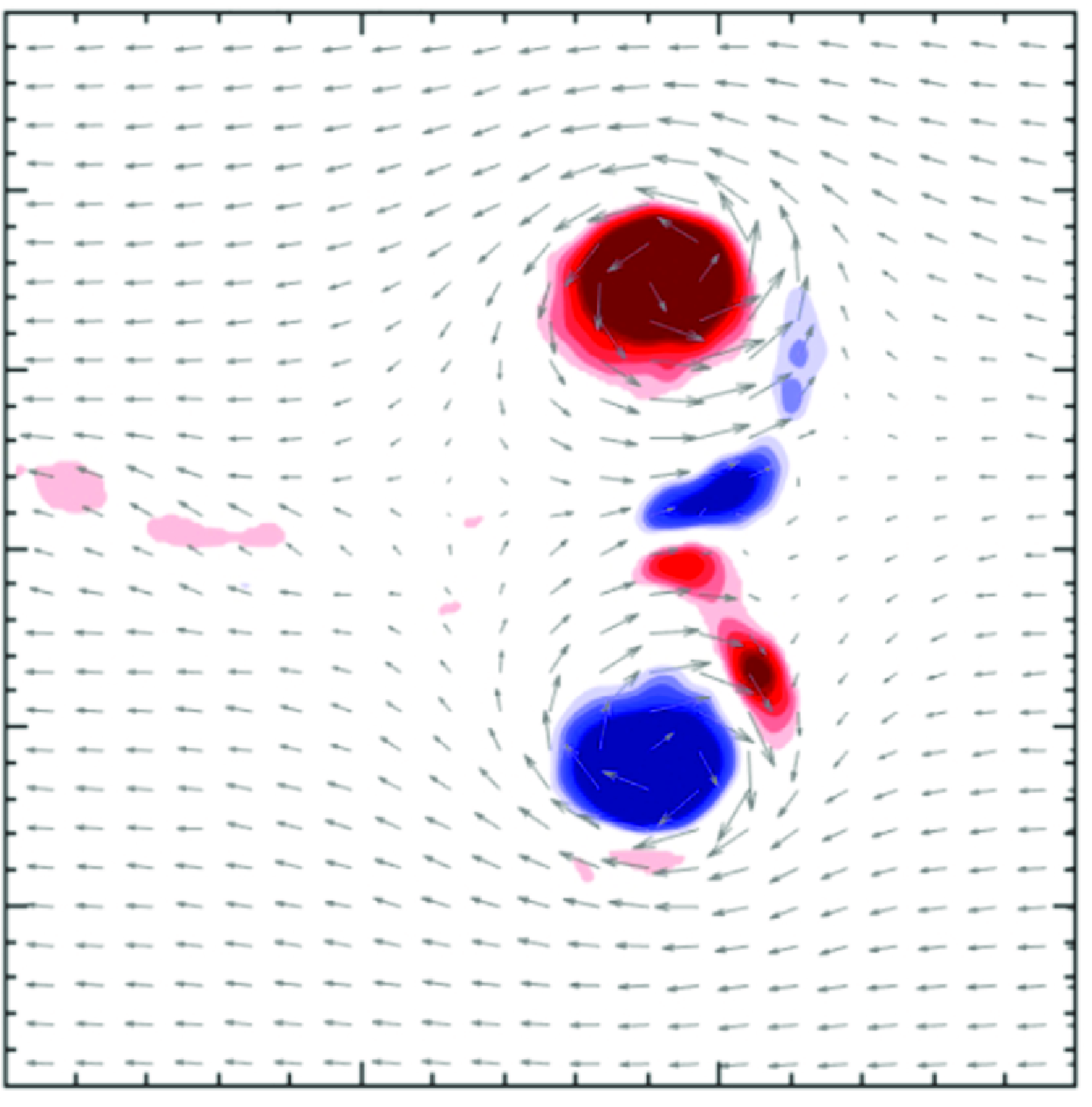
Swirl momentum control in vortex rings generated experimentally
-
- Journal:
- Journal of Fluid Mechanics / Volume 1007 / 25 March 2025
- Published online by Cambridge University Press:
- 14 March 2025, A20
-
- Article
-
- You have access
- Open access
- HTML
- Export citation
-
Particle image velocimetry is used to study the control of swirl momentum, delivered through an orifice formed by a physically rotating tube of finite length, relevant to the evolution of vortex rings produced at a Reynolds number ${Re}\approx 1000$ based on the average discharge velocity, for swirl numbers ${S} \in [0, 1]$. Experiments without discharge, reinforced with complimentary numerical predictions, reveal the presence of an intriguing secondary flow pattern in the rotating tube, preventing attainment of a solid-body-like swirl distribution. Nevertheless, it is found that fully established rings produced in this way, following discharge once conditions in the tube have reached a steady state, exhibit similar characteristics to rings formed by an otherwise solid-body rotating initial condition as explored computationally by Ortega-Chavez et al. (2023, J. Fluid Mech. 967, A16). Namely, opposite-signed vorticity forms due to vortex tilting, which subsequently interacts with the ring, promoting vorticity cancellation and vortex ring breakdown. A key feature of the experimental work is that partially established vortex rings, produced before a steady-state rotating tube condition is reached, show unique characteristics. Their creation, a short time after the onset of tube rotation: (i) facilitates more efficient delivery of swirl momentum to the vortex core area; (ii) maintains a low level of swirl in the ring bubble’s central region which would otherwise promote the formation of opposite-signed vorticity and vortex breakdown.


Natural oscillations of sessile drops with a central bubble on a solid wall
-
- Journal:
- Journal of Fluid Mechanics / Volume 1007 / 25 March 2025
- Published online by Cambridge University Press:
- 14 March 2025, A18
-
- Article
- Export citation
-
We investigate the natural oscillations of sessile drops with a central trapped bubble on a plane using linear potential flow theory, considering both free and pinned contact lines. The system is governed by the contact angle $\alpha$ and the ratio $\tau$ of inner to outer contact line radii. For bubble-containing (BC) hemispherical drops with free contact lines (referred to as free BC semi-drops), the modes mirror half of those in concentric spherical BC drops due to plane symmetry. These modes are labelled ‘plus’ (with greater inner surface deformation) and ‘minus’ (with greater outer surface deformation). As $\tau \to 0$, minus modes converge to those of bubble-free drops. Results show that varying $\alpha$ from $90^\circ$ or pinning the contact line in free BC semi-drops alters the topology of spectral lines, turning original crossings of spectral lines between minus and plus modes into avoided crossings. This shift causes minus and plus modes to form spectral trends with avoided crossings, maintaining their original spectral shapes. In an avoided crossing, two coupled modes cannot be classified as plus or minus due to their comparable inner and outer surface deformations, resulting in mode beating when both are excited, as confirmed by our direct numerical simulations. This study on the impact of inner bubbles on the spectrum may help in predicting bubble size in opaque sessile drops.


Inhomogeneity-induced wavenumber diffusion
-
- Journal:
- Journal of Fluid Mechanics / Volume 1007 / 25 March 2025
- Published online by Cambridge University Press:
- 14 March 2025, A15
-
- Article
-
- You have access
- Open access
- HTML
- Export citation

Reynolds number effects on turbulent flow in curved channels
-
- Journal:
- Journal of Fluid Mechanics / Volume 1007 / 25 March 2025
- Published online by Cambridge University Press:
- 14 March 2025, A28
-
- Article
-
- You have access
- Open access
- HTML
- Export citation
-
We investigate fully developed turbulent flow in curved channels to explore the interaction between turbulence and curvature-driven coherent structures. By focusing on two cases of mild and strong curvature, we examine systematically the effects of the Reynolds number through a campaign of direct numerical simulations, spanning flow regimes from laminar up to the moderately high Reynolds number – based on bulk velocity and channel height – of $87\,000$. Our analysis highlights the influence of curvature on the friction coefficient, showing that flow transition is anticipated by concave curvature and delayed by convex curvature. In the case of mild curvature, a frictional drag reduction compared with plane channel flow is found in the transitional regime. Spectral analysis reveals that the near-wall turbulence regeneration cycle is maintained in mildly curved channels, while it is absent or severely inhibited on the convex wall of strongly curved channels. Streamwise large-scale structures resembling Dean vortices are found to be weakly dependent on the Reynolds number and strongly affected by curvature: increasing curvature shifts these vortices towards the outer wall and reduces their size and coherence, limiting their contribution to streamwise velocity fluctuations and momentum transport. In the case of strong curvature, spanwise large-scale structures are also detected. These structures are associated with large pressure fluctuations and the suppression of turbulent stresses near the convex wall, where a region with negative turbulence production is observed and characterised via quadrant analysis.

