Refine search
Actions for selected content:
212775 results in Engineering
4 - Spectral Description of Turbulence
-
- Book:
- Fundamentals of Turbulent Flows
- Published online:
- 09 January 2025
- Print publication:
- 12 December 2024, pp 109-139
-
- Chapter
- Export citation
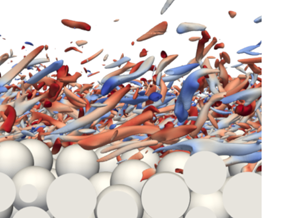
Turbulent flow over random sphere packs – an investigation by pore-resolved direct numerical simulation
-
- Journal:
- Journal of Fluid Mechanics / Volume 1001 / 25 December 2024
- Published online by Cambridge University Press:
- 12 December 2024, A29
-
- Article
-
- You have access
- Open access
- HTML
- Export citation
-
Pore-resolved direct numerical simulations have been performed to investigate the turbulent open-channel flow over a rough and permeable sediment bed, represented by a mono-disperse random sphere pack. After a careful validation, eleven cases were simulated to systemically sample a parameter space spanned by a friction Reynolds number $Re_\tau \in [150, 500]$ and a permeability Reynolds number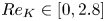 $Re_K \in [0, 2.8]$. By varying the ratio of flow depth to sphere diameter within a range of $h/D \in \{ 3,5,10,\infty \}$, the influence of both Reynolds numbers on the flow field and the turbulence structure could be investigated independently. The simulation results are analysed within a time–space double-averaging framework, whereas flow visualizations provide insight into instantaneous fields. Based on the drag distribution, we propose a consistent interface description, which can be used to define both near-interface and outer-flow coordinates. In these near-interface coordinates, the profiles of the mean velocity and the total shear stress collapse. Furthermore, the proposed interface definition yields outer-layer coordinates, in which the flow and turbulence statistics over a rough and permeable bed reveal similarity to a smooth-wall flow at a similar $Re_\tau$. Within the parameter space, $Re_\tau$ has a strong influence on the wake region of the velocity profile. In contrast, $Re_K$ changes the wall-blocking effect and the shear intensity, which is reflected by the turbulence structure and vortex orientation in the near-interface region. As streamwise velocity streaks disappear and the vortex inclination increases with higher $Re_K$, differences between near-interface and outer-layer turbulence structure are reduced.


12 - Overview of Synchronization Approaches
-
- Book:
- Mixed-Signal CMOS for Wireline Communication
- Published online:
- 05 December 2024
- Print publication:
- 12 December 2024, pp 295-307
-
- Chapter
- Export citation
8 - Modeling and Prediction of Turbulent Flows
-
- Book:
- Fundamentals of Turbulent Flows
- Published online:
- 09 January 2025
- Print publication:
- 12 December 2024, pp 226-253
-
- Chapter
- Export citation
13 - Oscillators
-
- Book:
- Mixed-Signal CMOS for Wireline Communication
- Published online:
- 05 December 2024
- Print publication:
- 12 December 2024, pp 308-332
-
- Chapter
- Export citation
Index
-
- Book:
- Fundamentals of Turbulent Flows
- Published online:
- 09 January 2025
- Print publication:
- 12 December 2024, pp 271-280
-
- Chapter
- Export citation
Frontmatter
-
- Book:
- Mixed-Signal CMOS for Wireline Communication
- Published online:
- 05 December 2024
- Print publication:
- 12 December 2024, pp i-iv
-
- Chapter
- Export citation
Notation and Acronyms
-
- Book:
- Mixed-Signal CMOS for Wireline Communication
- Published online:
- 05 December 2024
- Print publication:
- 12 December 2024, pp xiii-xiv
-
- Chapter
- Export citation
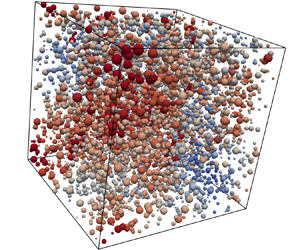
Hindered settling of a log-normally distributed Stokesian suspension
-
- Journal:
- Journal of Fluid Mechanics / Volume 1001 / 25 December 2024
- Published online by Cambridge University Press:
- 12 December 2024, A30
-
- Article
-
- You have access
- Open access
- HTML
- Export citation
-
Settling velocity statistics for dilute, non-Brownian homogeneous suspensions of polydisperse spheres having a log-normal size distribution are generated from Stokesian dynamics simulations, as a function of the total volume fraction $\phi$ and normalised width $\alpha$ of the particle size distribution. Several hundred instantaneous configurations are averaged to obtain reliable statistics. The paper reports data for the average and fluctuating settling velocity of each particle class in a suspension that is widely polydisperse – previous work was limited to only two or three classes, and the average settling velocity of each particle class was in most cases not reported – and provides an assessment of the accuracy of the analytical models proposed by Batchelor, Richardson & Zaki, Davis & Gecol and Masliyah–Lockett–Bassoon in predicting the simulation data. A limited comparison with dynamic simulations in which the particle microstructure is allowed to evolve in time is also included.


2 - Electrical Channels
-
- Book:
- Mixed-Signal CMOS for Wireline Communication
- Published online:
- 05 December 2024
- Print publication:
- 12 December 2024, pp 40-72
-
- Chapter
- Export citation
1 - Overview of Turbulent Flows
-
- Book:
- Fundamentals of Turbulent Flows
- Published online:
- 09 January 2025
- Print publication:
- 12 December 2024, pp 1-38
-
- Chapter
- Export citation
3 - Decision Circuits
-
- Book:
- Mixed-Signal CMOS for Wireline Communication
- Published online:
- 05 December 2024
- Print publication:
- 12 December 2024, pp 73-95
-
- Chapter
- Export citation
5 - Electrical-Link Transmitter Circuits
-
- Book:
- Mixed-Signal CMOS for Wireline Communication
- Published online:
- 05 December 2024
- Print publication:
- 12 December 2024, pp 119-147
-
- Chapter
- Export citation
4 - Equalization
-
- Book:
- Mixed-Signal CMOS for Wireline Communication
- Published online:
- 05 December 2024
- Print publication:
- 12 December 2024, pp 96-118
-
- Chapter
- Export citation
8 - Optical-Link Transmitter Circuits
-
- Book:
- Mixed-Signal CMOS for Wireline Communication
- Published online:
- 05 December 2024
- Print publication:
- 12 December 2024, pp 203-223
-
- Chapter
- Export citation
Preface
-
- Book:
- Fundamentals of Turbulent Flows
- Published online:
- 09 January 2025
- Print publication:
- 12 December 2024, pp xi-xii
-
- Chapter
- Export citation
7 - Turbulence Near a Wall
-
- Book:
- Fundamentals of Turbulent Flows
- Published online:
- 09 January 2025
- Print publication:
- 12 December 2024, pp 200-225
-
- Chapter
- Export citation
1 - Introduction to Wireline Communication
-
- Book:
- Mixed-Signal CMOS for Wireline Communication
- Published online:
- 05 December 2024
- Print publication:
- 12 December 2024, pp 1-39
-
- Chapter
-
- You have access
- Export citation
6 - Free-Shear Flows
-
- Book:
- Fundamentals of Turbulent Flows
- Published online:
- 09 January 2025
- Print publication:
- 12 December 2024, pp 172-199
-
- Chapter
- Export citation
9 - Optical Receivers
-
- Book:
- Mixed-Signal CMOS for Wireline Communication
- Published online:
- 05 December 2024
- Print publication:
- 12 December 2024, pp 224-267
-
- Chapter
- Export citation
