To save content items to your account,
please confirm that you agree to abide by our usage policies.
If this is the first time you use this feature, you will be asked to authorise Cambridge Core to connect with your account.
Find out more about saving content to .
To save content items to your Kindle, first ensure no-reply@cambridge.org
is added to your Approved Personal Document E-mail List under your Personal Document Settings
on the Manage Your Content and Devices page of your Amazon account. Then enter the ‘name’ part
of your Kindle email address below.
Find out more about saving to your Kindle.
Note you can select to save to either the @free.kindle.com or @kindle.com variations.
‘@free.kindle.com’ emails are free but can only be saved to your device when it is connected to wi-fi.
‘@kindle.com’ emails can be delivered even when you are not connected to wi-fi, but note that service fees apply.
We present a practical verification method for safety analysis of the autonomous driving system (ADS). The main idea is to build a surrogate model that quantitatively depicts the behavior of an ADS in the specified traffic scenario. The safety properties proved in the resulting surrogate model apply to the original ADS with a probabilistic guarantee. Given the complexity of a traffic scenario in autonomous driving, our approach further partitions the parameter space of a traffic scenario for the ADS into safe sub-spaces with varying levels of guarantees and unsafe sub-spaces with confirmed counter-examples. Innovatively, the partitioning is based on a branching algorithm that features explainable AI methods. We demonstrate the utility of the proposed approach by evaluating safety properties on the state-of-the-art ADS Interfuser, with a variety of simulated traffic scenarios, and we show that our approach and existing ADS testing work complement each other. We certify five safe scenarios from the verification results and find out three sneaky behavior discrepancies in Interfuser which can hardly be detected by safety testing approaches.
Transfer learning has been highlighted as a promising framework to increase the accuracy of the data-driven model in the case of data sparsity, specifically by leveraging pretrained knowledge to the training of the target model. The objective of this study is to evaluate whether the number of requisite training samples can be reduced with the use of various transfer learning models for predicting, for example, the chemical source terms of the data-driven reduced-order modeling (ROM) that represents the homogeneous ignition of a hydrogen/air mixture. Principal component analysis is applied to reduce the dimensionality of the hydrogen/air mixture in composition space. Artificial neural networks (ANNs) are used to regress the reaction rates of principal components, and subsequently, a system of ordinary differential equations is solved. As the number of training samples decreases in the target task, the ROM fails to predict the ignition evolution of a hydrogen/air mixture. Three transfer learning strategies are then applied to the training of the ANN model with a sparse dataset. The performance of the ROM with a sparse dataset is remarkably enhanced if the training of the ANN model is restricted by a regularization term that controls the degree of knowledge transfer from source to target tasks. To this end, a novel transfer learning method is introduced, Parameter control via Partial Initialization and Regularization (PaPIR), whereby the amount of knowledge transferred is systemically adjusted in terms of the initialization and regularization schemes of the ANN model in the target task.
Fully revised and updated, this second edition is a comprehensive introduction to molecular communication including the theory, applications, and latest developments. Written with accessibility in mind, it requires little background knowledge, and carefully introduces the relevant aspects of biology and information theory, as well as practical systems. Capturing the significant changes and developments in the past decade, this edition includes seven new chapters covering: the architecture of molecular communication; modelling of biological molecular communication; mobile molecular communication; macroscale systems; design of components and bio-nanomachine formations. The authors present the biological foundations followed by analyses of biological systems in terms of communication theory, and go on to discuss the practical aspects of designing molecular communication systems such as drug delivery, lab-on-a-chip, and tissue engineering. Including case studies and experimental techniques, this remains a definitive guide to molecular communication for graduate students and researchers in electrical engineering, computer science, and molecular biology.
For the engineer or scientist using spectroscopic laser diagnostics to investigate gas-phase media or plasmas, this book is an excellent resource for gaining a deeper understanding of the physics of radiative transitions. While a background in quantum mechanics is beneficial, the book presents a comprehensive review of the relevant aspects, extensively covering atomic and molecular structure alongside radiative transitions. The author employs effective Hamiltonians and Hund's case (a) basis wavefunctions to develop the energy level structure of diatomic molecules. These techniques also form the basis for treating radiative transitions in diatomic molecules. Recent advancements in quantum chemistry, enabling readers to calculate absolute single-photon and Raman transition strengths, are also presented. Illustrated with detailed example calculations of molecular structure and transition rates, this self-contained reference for spectroscopic data analysis will appeal to professionals in mechanical, aerospace, and chemical engineering, and in applied physics and chemistry.
We derive the governing equations for the mean and turbulent kinetic energy and discuss simplifications of the equations for several canonical flows, including channel flow and homogeneous isotropic turbulence. A classical expression for the dissipation rate in isotropic turbulence is provided. In addition, the governing equations for turbulent enstrophy and scalar variance are derived with parallels to the derivation of the turbulent kinetic energy equation. A model for turbulent kinetic energy evolution and dissipation in isotropic turbulence is introduced. Finally, we derive the governing equations for the Reynolds stress tensor components and discuss the roles of the terms in the Reynolds stress budgets in homogeneous shear and channel flows. A crucial link between pressure-strain correlations and the redistribution of turbulent kinetic energy between various velocity components is established. Quantifying how energy is transferred between the mean flow and turbulent fluctuations is crucial to understanding the generation and transport of turbulence and its accompanying Reynolds stresses, and thus properties that phenomenological turbulence models should conform to.
Building on the governing equations and spectral tools introduced in earlier chapters, we analyze the energy cascade, which describes the transfer of turbulent kinetic energy from large to small eddies. This includes an estimate of the energy dissipation rate, as well as the characteristic length and time scales of the smallest-scale motions. Nonlinearity in the Navier-Stokes equations is responsible for triadic interactions between wavenumber triangles that drive energy transfer between scales. Empirical observations suggest that the net transfer of energy occurs from large to small scales. In systems where the large scales are sufficiently separated from the small scales, an inertial subrange emerges in an intermediate range of scales where the dynamics are scale invariant. Kolmogorov’s similarity hypotheses and the ensuing expressions for the inertial-subrange energy spectrum and viscous scales are introduced. The Kolmogorov spectrum for the inertial subrange, which corresponds to a -5/3 power law, is a celebrated result in turbulence theory. We further discuss key characteristic turbulence scales including the Taylor microscale and Batchelor scale.
We discuss properties of numerical methods that are essential for high-fidelity (LES, DNS) simulations of turbulent flows. In choosing a numerical method, one must be cognizant of the broadband nature of the solution spectra and the resolution of turbulent structures. These requirements are substantially different than those in the RANS approach, where the solutions are smooth and agnostic to turbulent structures. We focus on spatial discretization of the governing equations in canonical flows where Fourier analysis is helpful in revealing the effect of discretization on the solution spectra. In high-fidelity numerical simulations of turbulent flows, it is necessary that conservation properties inherent in the governing equations, such as kinetic energy conservation in the inviscid limit, are also satisfied discretely. An important benefit of adhering to conservation principles is the prevention of nonlinear numerical instabilities that may manifest after long-time integration of the governing equations. We end by discussing the appropriate choice of domain size, grid resolution, and boundary conditions in the context of canonical flows with uniform Cartesian mesh spacing.
This paper presents a systematic design approach for developing a semiflexible multiple-input–multiple-output antenna system operating in the millimeter wave frequency spectrum, specifically designed for body-worn applications in biotechnologies. The designed antenna features dual flower-shaped antenna radiators placed in a spatial diversity configuration. Strategic modifications have been implemented by integrating dual crescent-shaped slots in the ground layer to attain the targeted frequency band of 25.7–30.6 GHz. Later, the upper edge of the ground plane is truncated in order to achieve circularly polarized radiation characteristics at 29.4 GHz with 3 dB ARBW of 0.6 GHz (29.1–29.7 GHz). The realization of circular polarization in the antenna geometry is validated through the analysis of characteristic mode theory. A maximum gain of 5.6 dBi is attained along with a port isolation of >30 dB. The proposed antenna undergoes analysis to assess its performance in the bending conditions and specific absorption rate, besides validation of diversity metrics encompassing envelope correlation coefficient, diversity gain, channel capacity loss, total active reflection coefficient, and mean effective gain has also been conducted. Finally, the proposed antenna structure is fabricated, and its performance is validated and subsequently compared with that of its simulated counterpart.
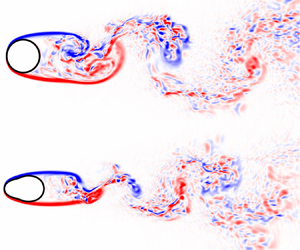
In this work, the shape of a bluff body is optimized to mitigate velocity fluctuations of turbulent wake flows based on large-eddy simulations (LES). The Reynolds-averaged Navier–Stokes method fails to capture velocity fluctuations, while direct numerical simulations are computationally prohibitive. This necessitates using the LES method for shape optimization given its scale-resolving capability and relatively affordable computational cost. However, using LES for optimization faces challenges in sensitivity estimation as the chaotic nature of turbulent flows can lead to the blowup of the conventional adjoint-based gradient. Here, we propose using the regularized ensemble Kalman method for the LES-based optimization. The method is a statistical optimization approach that uses the sample covariance between geometric parameters and LES predictions to estimate the model gradient, circumventing the blowup issue of the adjoint method for chaotic systems. Moreover, the method allows for the imposition of smoothness constraints with one additional regularization step. The ensemble-based gradient is first evaluated for the Lorenz system, demonstrating its accuracy in the gradient calculation of the chaotic problem. Further, with the proposed method, the cylinder is optimized to be an asymmetric oval, which significantly reduces turbulent kinetic energy and meander amplitudes in the wake flows. The spectral analysis methods are used to characterize the flow field around the optimized shape, identifying large-scale flow structures responsible for the reduction in velocity fluctuations. Furthermore, it is found that the velocity difference in the shear layer is decreased with the shape change, which alleviates the Kelvin–Helmholtz instability and the wake meandering.
This chapter presents optical receivers that intentionally limit the bandwidth so as to achieve higher gain and better sensitivity. This has the consequence of introducing that ISI that must be removed by a suitable equalizer. Important aspects of the noise analysis of these receivers are clarified. Various approaches to equalization in these reduced bandwidth receivers are presented by way of recently published examples.
In this paper the performance of an internal strut-based thrust vector control (TVC) system has been studied at different expansion conditions of propulsion nozzle. The TVC system uses a cylindrical strut inserted through the diverging wall of a supersonic nozzle. This TVC system can be construed as an alternative to secondary injection TVC method. The nozzle had an expansion ratio of 1.545 and nozzle pressure ratio (NPR) of 6.61 for optimum expansion. Numerical simulations were performed at over-expansion (NPR = 3.94) and under-expansion (NPR = 7.89) conditions for four strut locations (xs) and five strut heights (hs). The strut location from the nozzle throat corresponded to 33%, 50%, 66.7% and 80% of the diverging length (Ld) of the nozzle. The schlieren images of the nozzle exhaust and nozzle internal wall pressure distribution from experiments were compared with the results from numerical simulation and the agreement was quite good. Computational results show that introduction of the strut caused a maximum total pressure loss of 1.5% at its maximum height. The calculations also show that $ \pm $4${}^{\circ}$ thrust deflection angle could be achieved using combinations of strut location and strut height over a range of nozzle operational conditions. Thrust vectoring performance of strut insertion TVC was evaluated using a parameter called vectoring performance index (VPI) defined as thrust deflection angle per unit percentage of pressure loss. The maximum VPI was observed when xs=0.5Ld at ${\bar{h_s}} = 0.429$ in both over-expansion and under-expansion conditions. The study reveals that an internal strut based TVC has a good future potential to be developed as an alternate TVC system obviating the requirement of carrying a fluid tank for a system like secondary injection TVC.
Beginning with a discussion of receiver metrics, this chapter discusses electrical-link receiver implementation by first considering input termination and ESD capacitance mitigation. The receiver front-end has two main jobs. The first is to amplify the signal to levels that can be captured by a decision circuit and the second is to remove enough ISI such that low BER detection is possible. With the types of receive-side equalization already described at the system level in Chapter 4, this chapter focuses on their transistor-level implementation. Both CML and inverter-based circuits are presented.
This chapter presents advanced topics that draw on the fundamentals of previous chapters. Section 11.1 presents how implementing PAM4 signalling impacts equalization and circuit design. A brief overview of DAC/ADC-based links, also known as DSP-based links, is presented in Section 11.2. A consequence of PAM4 signalling is a smaller vertical eye opening. A digital equalization technique known as “maximum likelihood sequence estimation” is discussed in Section 11.4.